

In This Article
- Why QM Tracking Cannot Live in Spreadsheets Anymore
- What Is Presumption of Compliance?
- Why Power BI for Compliance Tracking
- Template 1: Qualified Mortgage Checklist Dashboard
- Template 2: DTI and Pricing Risk Monitor
- Template 3: Pipeline Stage Compliance Tracker
- Template 4: Audit-Ready Evidence Report
- Implementation Steps
- Frequently Asked Questions
A loan that fails a Qualified Mortgage delivery edit cannot be sold. For a lender tracking presumption-of-compliance status in spreadsheets, that failure surfaces at the worst possible moment: after the loan has already funded, when the only options left are a buyback request or a scramble for an investor who will still take the paper. Fannie Mae's loan delivery edits enforce QM eligibility, points-and-fees limits, APR-to-APOR spreads, and Uniform Closing Dataset accuracy, and those edits are adjusted each year to track the thresholds the CFPB publishes. Going into 2026, every one of those parameters is a moving target.
Microsoft Power BI changes the timing. By pulling loan origination data into live dashboards, your compliance team can flag a QM threshold problem while the loan is still in the pipeline, not after it closes. Power BI ships inside Microsoft 365 Business Premium and E5, so for most banks, credit unions, and mortgage companies the tool is already paid for. The question is whether anyone has pointed it at the compliance pipeline yet.
This guide walks through four Power BI dashboard templates built for presumption-of-compliance tracking, with practical setup steps your team can stand up this quarter. The dashboards make the calculations faster, but the deeper win is governance: every QM determination becomes visible, sourced, and auditable, which is exactly what an examiner asks to see.
Why QM Tracking Cannot Live in Spreadsheets Anymore
The mechanics of presumption of compliance have not gotten simpler. The general QM definition is now price-based rather than a single debt-to-income cutoff, the points-and-fees tiers adjust annually, and the safe harbor boundary turns on a precise APR-to-APOR spread. A workbook that one analyst maintains by hand cannot keep pace with that, especially once monthly volume climbs past a few dozen loans.
When the spread that decides your legal protection is measured in fractions of a percentage point, manual tracking stops being a productivity problem and becomes a risk problem. The rest of this guide is about closing that gap with a tool you very likely already own.
What Is Presumption of Compliance?
Presumption of compliance protects mortgage lenders from ability-to-repay (ATR) lawsuits when a loan meets Qualified Mortgage (QM) standards. There are two levels of protection, and the line between them is a pricing line.
The criteria that drive a general QM determination changed materially when the CFPB replaced the old 43 percent debt-to-income cap and Appendix Q with a price-based standard. Debt-to-income is still part of the underwriting picture, but the general QM category now hinges on the loan's pricing relative to APOR rather than a single hard DTI number:
- Pricing (APR-to-APOR spread): The general QM standard is price-based. For most larger first-lien loans the APR may not exceed APOR by more than roughly 2.25 percentage points to qualify as a general QM, with tighter tiers for smaller loan amounts.
- Points and fees: Must fall below the threshold for the loan amount, generally 3 percent for larger loans, with higher allowances on smaller balances. These dollar tiers are adjusted each year.
- Debt-to-income and income consideration: The creditor must still consider and verify the borrower's income, assets, debts, and DTI, even though there is no longer a fixed 43 percent general-QM ceiling.
- Loan term: Cannot exceed 30 years.
- No risky features: No negative amortization, interest-only payments, or balloon features on standard QMs.
Every loan your company originates should be assessed against these criteria before closing. Power BI makes that assessment visible, automated, and auditable. (For the broader Microsoft 365 reporting picture, see our companion guide to real-time Power BI dashboards for lenders, and our walkthrough of visualizing combined tax and mortgage payment trends for the data-modeling pattern these dashboards share.)
Why Power BI for Compliance Tracking
Spreadsheets break down when you are originating 50 or more loans per month. Formulas get overwritten. Versions conflict. Nobody fully trusts the numbers during crunch time. Power BI solves these problems, and it does so inside the Microsoft 365 tenant your IT partner already manages.
What Power BI Brings to Compliance
- Live data connections. Pull loan data directly from your loan origination system, Excel exports, or SQL databases. No manual copy-paste between systems.
- Automated calculations. APR-to-APOR spreads, points-and-fees percentages, and DTI ratios compute in real time as loan data updates.
- Visual risk identification. Color-coded dashboards surface loans approaching or exceeding QM thresholds before they close.
- Scheduled refreshes. Set dashboards to update hourly or daily. Compliance teams see current data without running manual reports.
- Role-based access. Underwriters see their pipeline. Compliance officers see the full picture. Branch managers see their branch. Same data, filtered by role through Power BI row-level security.
Power BI is already included in Microsoft 365 Business Premium and E5 licenses. The tool is available. Whether your compliance team is actually using it for QM oversight is a different question, and the gap is usually a setup gap, not a licensing one.

Template 1: Qualified Mortgage Checklist Dashboard
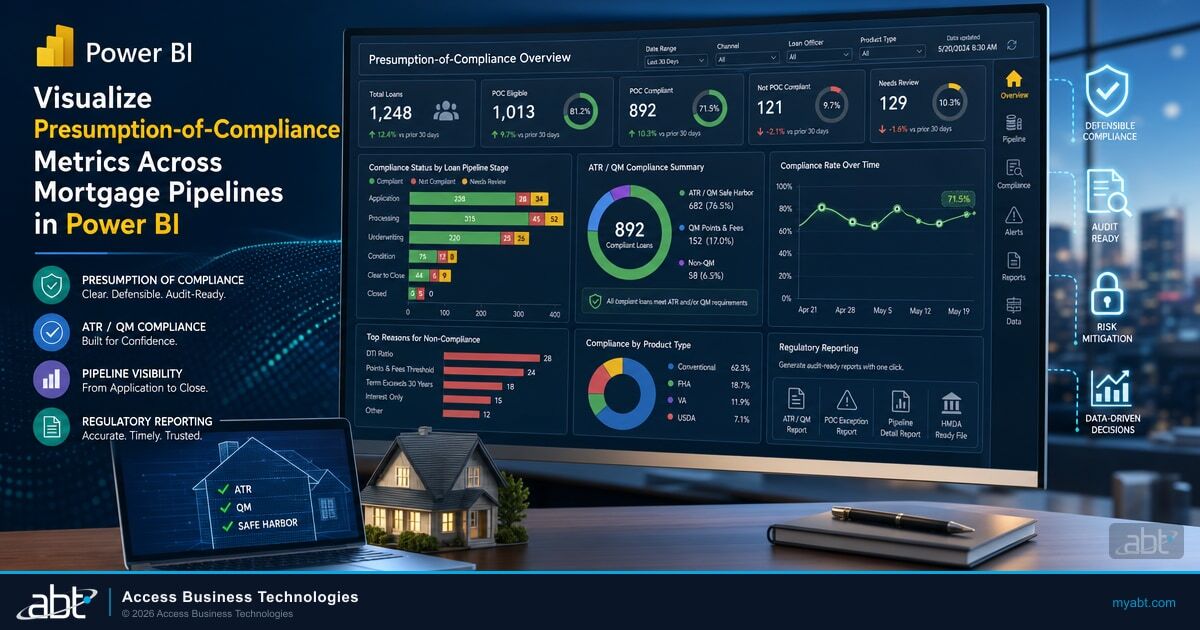
This dashboard provides a real-time snapshot of every loan's QM status across your pipeline.
Dashboard Components
| Visual | What it shows |
|---|---|
| Donut chart | The share of loans categorized as safe harbor, rebuttable presumption, and non-QM. Gives leadership a one-glance risk view. |
| Bar graph | Points and fees against the threshold for each loan-amount tier. Loans approaching the cap highlight in yellow; those exceeding it appear in red. |
| Scatter plot | APR-to-APOR spread mapped against loan amount. Cluster analysis reveals pricing patterns that may warrant underwriting review. |
| Data grid | Each loan with pass or fail icons for every QM criterion. Drill into any loan to see the data driving the assessment. |
| Trend line | QM compliance rate over time. A declining trend signals process issues before they become systemic. |
Together these five visuals turn a static spreadsheet review into a living view of QM exposure. The donut and trend line give leadership the summary; the scatter plot, bar graph, and data grid give underwriters the loan-level detail behind it.
Why This Matters for Financial Institutions
The donut chart is the slide your CEO and board actually look at. When 96 percent of the pipeline sits in safe harbor and 3 percent is rebuttable presumption, leadership can see the institution's ATR exposure in one number rather than waiting for a quarterly compliance memo.
Template 2: DTI and Pricing Risk Monitor
This dashboard focuses on the two factors that cause the most QM failures: pricing relative to APOR, and loans whose debt-to-income profile pushes them toward higher-priced or non-QM treatment.
Dashboard Components
- DTI distribution histogram: Shows where your pipeline clusters. Loans with elevated DTI need extra scrutiny, because pricing and DTI together determine whether a loan stays a comfortable safe-harbor QM or drifts into rebuttable-presumption or non-QM territory.
- Pricing heat map: Visualizes APR-to-APOR spread across loan types, terms, and branches. Identifies which products or branches produce higher-priced loans that receive only rebuttable presumption.
- Alert panel: Flags loans where the pricing spread approaches the 1.5-point higher-priced threshold or the general-QM pricing cap. Gives underwriters time to restructure before closing.
- Branch comparison: Side-by-side DTI and pricing distributions by branch. Reveals whether specific offices consistently produce riskier loan profiles.
The pricing spread that decides your safe-harbor protection is measured in fractions of a point. A dashboard sees that line; a spreadsheet maintained by hand during a busy month often does not.
Template 3: Pipeline Stage Compliance Tracker
This dashboard tracks compliance health across origination, underwriting, and closing stages.
Dashboard Components
- Funnel visualization: Shows how many loans pass QM checks at each pipeline stage. A narrowing funnel reveals where compliance issues concentrate.
- SLA tracker: Monitors time from application to QM assessment completion. Delays in compliance review can bottleneck the pipeline.
- Condition clearance grid: Tracks open QM-related conditions by loan. Items like missing income verification or unresolved DTI calculations appear with age indicators.
- Stage-over-stage comparison: Compares this month's stage-level compliance to the previous month. Trends reveal whether process improvements are working.
This view pairs naturally with the operational metrics in our guide to how point-of-sale interfaces speed up mortgage pre-qualification, because compliance velocity and origination velocity are usually constrained by the same data bottlenecks.
Template 4: Audit-Ready Evidence Report
This report template generates examiner-ready documentation for individual loans or portfolio segments. It is the governance layer that turns dashboards from an internal convenience into audit evidence.
Report Components
- Loan-level QM summary: A one-page view showing every QM criterion with pass or fail status, supporting data, and source documentation references.
- Portfolio compliance snapshot: Aggregate statistics showing QM compliance rates by product type, branch, loan officer, and time period.
- Exception log: Documents every loan that required QM remediation, the issue found, the corrective action taken, and the resulting QM status.
- Export capability: PDF and Excel exports formatted for examiner review, including data sources, calculation methodology, and the timestamp of report generation.

The same evidence discipline shows up across regulatory areas. Our guide to AI governance auditing for financial institutions walks the Microsoft Purview and Sentinel side of the audit story, and the five Microsoft 365 controls examiners ask about piece covers the tenant configuration that backs it up.
Implementation Steps
None of these steps require a new platform. Each one is a configuration task inside the Microsoft 365 tenant your institution already runs, which is why most QM dashboard rollouts move from idea to live workspace in weeks rather than months.
Watch the data path, not just the numbers
Because ABT manages your Microsoft 365 tenant, a Power BI compliance workspace should be governed like any other system that touches borrower data: row-level security, Microsoft Entra ID Conditional Access on the workspace, and Microsoft Purview sensitivity labels on the underlying datasets. A dashboard that exposes full pipelines to every viewer is its own compliance finding, and state data-security rules can reach it too, as our look at California's information security requirements for mortgage companies spells out.
Stop finding QM failures after the loan funds
Spreadsheet-based QM tracking cannot keep pace with annual threshold changes and growing pipeline volumes. ABT helps banks, credit unions, and mortgage companies stand up governed Power BI compliance dashboards inside the Microsoft 365 tenant they already run.
Frequently Asked Questions
Presumption-of-compliance metrics are loan attributes that determine whether a mortgage qualifies for safe harbor or rebuttable presumption protection under federal ATR/QM rules. Key metrics include the APR-to-APOR pricing spread, total points and fees relative to loan amount, loan term, amortization type, income and asset verification, and the debt-to-income ratio that the creditor must still consider under the price-based general QM standard.
Yes. Power BI connects directly to loan origination systems through ODBC, API, or file-based imports. With automated data refreshes, dashboards display current QM compliance status for every loan in your pipeline. Visual alerts flag loans approaching or exceeding thresholds before they reach closing, giving compliance teams time to address issues.
Under the CFPB Revised General QM Rule, the general QM category is price-based rather than tied to a fixed 43 percent debt-to-income cap. A loan generally qualifies as a general QM when it meets the product and underwriting requirements, its points and fees stay under the applicable tier, and its APR does not exceed the average prime offer rate by more than the threshold for its loan amount. A first-lien loan is a safe-harbor QM when that APR-to-APOR spread is under 1.5 percentage points; at 1.5 points or more it is a higher-priced, rebuttable-presumption QM. The points-and-fees and loan-amount tiers are adjusted each year, and the 2026 figures are in effect.
Power BI dashboards produce examiner-ready documentation including loan-level QM summaries, portfolio compliance snapshots, exception logs, and trend analysis. Reports can be exported as PDF or Excel files with calculation methodology and timestamps. Having dashboard evidence readily available reduces audit preparation time and demonstrates proactive compliance monitoring.
Power BI is included in Microsoft 365 Business Premium and E5, so most banks, credit unions, and mortgage companies already have the tool through their existing subscription. ABT manages your Microsoft 365 tenant, which means the same governance you apply to email and documents, including Microsoft Entra ID Conditional Access and Microsoft Purview sensitivity labels, can extend to your Power BI compliance workspace. Building QM dashboards is usually a setup project, not a new license purchase.