

In This Article
- The 9.9 flaw Microsoft fixed before you woke up
- What the Microsoft Entra provisioning service actually does
- Inside CVE-2026-57100
- "Nothing to patch" is not "nothing to do"
- What banks, credit unions, and mortgage companies must verify now
- The examiner angle: identity governance is already in scope
- How ABT hardens and watches your identity plane
- Frequently Asked Questions
On July 2, 2026, Microsoft disclosed a vulnerability scored as high as 9.9 in the engine that creates, changes, and deletes user accounts across the applications connected to your tenant. By the time most IT teams read about it, it was already fixed. Not by a patch you deployed. By Microsoft, on its own cloud, before anyone at your institution had to lift a finger.
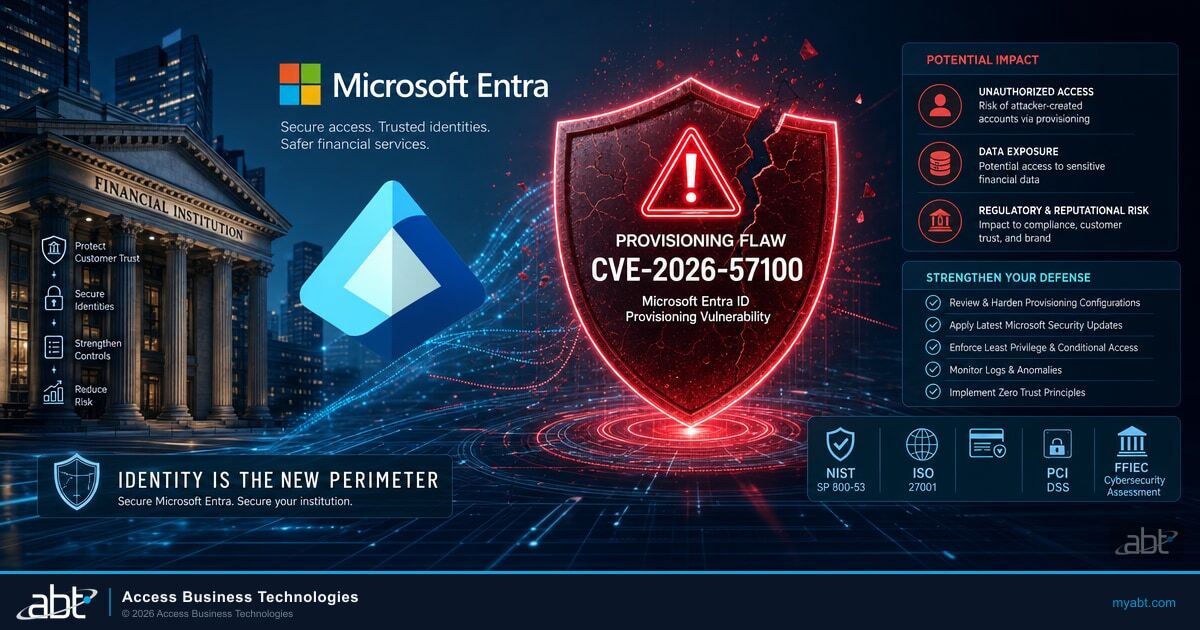
The flaw is CVE-2026-57100, an elevation-of-privilege bug in the Microsoft Entra provisioning service. Microsoft rates it 9.9 Critical. Some third-party vulnerability scoring puts it a notch lower at 8.8 High. It was not exploited in the wild, and it needs no action from you to remediate. That combination, a near-maximum severity score attached to a vulnerability you cannot patch because there is nothing on your side to patch, is exactly why it deserves a closer look than the average Patch Tuesday line item.
For a bank, credit union, or mortgage company, the real lesson is not in this specific bug. It is in where the bug lived. The provisioning service is the automation plane that mints, modifies, and removes identities across the applications connected to your tenant. A privilege-escalation flaw there is a keys-to-the-identity-kingdom scenario. Microsoft caught this one for you. The next flaw, or a stolen provisioning credential, or a quiet misconfiguration, may not be. This article walks through what the service does, what CVE-2026-57100 actually was, and the identity controls your examiners already expect you to have in place.
The 9.9 flaw Microsoft fixed before you woke up
CVE-2026-57100 landed inside a busy month. July 2026 was one of Microsoft's largest update cycles on record, and several of the flaws it addressed were being actively exploited. This one was not. It arrived, was scored, and was quietly closed on Microsoft's infrastructure, which is why so few teams noticed it at all.
A 9.9 with nothing to install is an unusual thing to hand a security team. Most critical-rated vulnerabilities come with a knowledge base article, a patch ring, and a deadline. This one came with none of that, because the vulnerable code runs in a service Microsoft operates, not in software that lives on your servers. The fix shipped where the service lives.
If you want the wider context on that update cycle and which of July's flaws actually carried federal remediation deadlines, our July 2026 Patch Tuesday triage for financial institutions sorts the month by exploitation status rather than raw severity score. CVE-2026-57100 is the opposite kind of item: high score, zero exploitation, zero action to remediate. It is worth understanding precisely because it breaks the usual pattern, and because of the part of Microsoft 365 it touched.
What the Microsoft Entra provisioning service actually does
Most people who run Microsoft 365 have never opened the provisioning blade in Microsoft Entra ID. It works quietly in the background, which is exactly why a flaw there is easy to underestimate. Before you can judge the risk, you need to understand what this service is trusted to do on your behalf.
What Is the Microsoft Entra Provisioning Service?
The Microsoft Entra provisioning service is the automation layer that creates, updates, disables, and deletes user identities across the applications connected to your tenant. It handles inbound provisioning, where a human resources system drives who exists in your directory, and outbound provisioning, where Entra pushes those identities into software as a service and on-premises apps. It speaks SCIM 2.0 to modern apps and reaches older systems through an on-premises provisioning agent.
To do that work, the service holds power that few other components have. Per Microsoft Learn, it stores the credentials it needs to connect to each target application's user-management interface. It caches the user identifier for every account it has touched, so it can find and update the right record next time. And it writes every read and write it performs into the Entra provisioning logs. In plain terms, this one service knows how to log into your other apps, knows which account belongs to which person, and keeps the ledger of everything it changed.
That is the identity control plane. When someone is hired, the provisioning service can open their accounts across a dozen systems in minutes. When someone is terminated, it can shut those accounts just as fast. The value of that automation is exactly what makes it dangerous if an attacker gets a foothold in it. A component that can create accounts and grant access at scale can also create accounts and grant access to the wrong person at scale.

Inside CVE-2026-57100
The public CVE record describes the flaw in one sentence: a server-side request forgery in the Microsoft Entra provisioning service, known internally as SyncFabric, that allows an authorized attacker to elevate privileges over a network. Server-side request forgery, cataloged as CWE-918, is a class of bug where an attacker convinces a server to make requests it should not, using the server's own trust and position to reach places the attacker cannot reach directly.
The published attack profile is a low-privileged remote attacker who needs no user interaction and faces low attack complexity. In other words, someone with a modest foothold and network access, no phishing of a victim required. Where the two ratings part ways is on how far the damage reaches, and that difference is why you see two different scores for the same CVE.
| Assessment | CVSS score | Severity | Scope | Basis |
|---|---|---|---|---|
| Microsoft (MSRC) | 9.9 | Critical | Changed | Vendor assessment; impact crosses a security boundary |
| Third-party scoring | 8.8 | High | Unchanged | Same CVSS 3.1 base, scored with an Unchanged scope |
Microsoft scores the flaw with a Changed scope, meaning the impact reaches beyond the vulnerable component into other parts of the system. That single decision pushes the number from 8.8 to 9.9. Third-party scoring that treats the scope as Unchanged lands at 8.8. Both are High or Critical. Both describe a serious identity vulnerability. When you brief a board or an examiner, the honest answer is to present both numbers and explain that the gap is a scoping judgment, not a factual dispute about how bad the bug is.
Now the part that keeps this out of emergency territory: CVE-2026-57100 was not reported as exploited in the wild at disclosure. That is a meaningful distinction, because July 2026 also carried several zero-days that were actively exploited, such as an Active Directory Federation Services elevation-of-privilege flaw and a Microsoft SharePoint Server elevation-of-privilege flaw, both added to the CISA Known Exploited Vulnerabilities catalog. Those are different, lower-scored CVEs with their own remediation deadlines. CVE-2026-57100 sits in a separate bucket: high score, no known exploitation, already fixed.
It helps to contrast this with a flaw that does reach into a tenant. When Microsoft disclosed the Storm-2949 no-malware identity attack, the story was an actual intrusion campaign abusing identity misconfigurations, not a vendor-side fix that closed the door with no reported exploitation. CVE-2026-57100 is the calmer cousin. The point of studying it is not fear. It is to notice how much trust sits in the provisioning plane, and to ask whether you would even see it if that trust were abused.
"Nothing to patch" is not "nothing to do"
It is tempting to file a fixed-server-side CVE under "not my problem" and move on. That reflex is understandable and, for this specific bug, technically correct. There is genuinely nothing to install. But the reflex misses the reason the flaw mattered enough to warrant a near-maximum score in the first place.
The Risk You Are Carrying
Your identity-provisioning plane is a single point of catastrophic failure. It can create and remove access across the applications it is configured to provision, it holds the credentials to those connected apps, and its logs are the primary record of what it changed. If an attacker ever controlled it, they could grant themselves access and push changes across the apps that service provisions, operating inside the very system that keeps the record of what happened. You cannot audit what you are not watching, and most institutions are not watching this at all.
Microsoft closed one door here. But the provisioning service will keep doing high-privilege work every day, driven by credentials, connections, and configurations that live on your side of the shared-responsibility line. Microsoft patched the code. It cannot patch a provisioning credential you left over-scoped, an admin account with no phishing-resistant sign-in, or a log stream nobody is reading.
A provisioning credential is phished, or a future flaw in the identity plane is not caught server-side, or a connection is quietly misconfigured to over-provision accounts across your apps.
An attacker who reached the provisioning service could create accounts and escalate privileges across the apps that service provisions, while operating inside the system that generates the provisioning records in the first place. That is exactly why those logs have to live somewhere the provisioning plane cannot reach. There is no vendor patch to wait for. Your best defense is the hardening and monitoring you put in place before it happens.
This is the same shape as other "fixed for you" cloud disclosures. The vendor absorbs the immediate hit, and the durable takeaway is a governance question about the surrounding controls you own. The score tells you how much would be at stake if the surrounding controls fail. On the identity-provisioning plane, that number is high.
Key Takeaway
Nothing to patch, everything to govern. CVE-2026-57100 required no customer action to remediate, but it is a standing reminder that the Microsoft Entra provisioning service is one of the highest-value targets in your tenant. Harden it and watch it now, while it is calm, so you are not doing it under an incident.
What banks, credit unions, and mortgage companies must verify now
Here is the productive way to spend the attention this CVE earned. Instead of hunting for a patch that does not exist, verify that the controls around your identity-provisioning plane are actually in place. None of this remediates CVE-2026-57100 itself, which Microsoft has already fixed. It hardens the plane the flaw lived in, so the next credential, misconfiguration, or unpatched flaw is something you can see and contain. Every item below maps to a Microsoft capability you already run or can enable across Microsoft Entra, Microsoft 365, and Microsoft Azure, and every one is something an examiner or an incident responder could ask you to demonstrate.
Each app-provisioning connection uses the narrowest scope that still works. No connection runs with directory-wide write it does not need.
Application Administrator, Cloud Application Administrator, Hybrid Identity Administrator, and Global Administrator are eligible-only through Microsoft Entra Privileged Identity Management, activated just in time with approval and time limits.
Every account that can touch provisioning sits behind phishing-resistant multifactor authentication and Conditional Access policies that block legacy authentication.
Entra provisioning logs and audit logs stream into Microsoft Sentinel running in your Azure environment, with retention that meets your regulator's recordkeeping window, not the shorter default.
Microsoft Defender XDR and Microsoft Entra ID Protection are tuned to alert on unusual provisioning activity, new high-privilege role assignments, and risky sign-ins on admin accounts.
Recurring Microsoft Entra access reviews confirm that accounts created by provisioning still belong, and that disabled or terminated users were actually deprovisioned.
Microsoft Purview Audit is on, with the retention and crucial-events coverage you would need to reconstruct who changed what if the provisioning plane were ever abused.
Someone is watching for provisioning "quarantine" status and rising error rates, which are early signals of a broken or tampered connection, not just an IT nuisance.
A few of these deserve extra weight for regulated institutions. Phishing-resistant sign-in on privileged accounts is the control the industry and regulators point to most for stopping identity-based intrusions, and it is the one examiners increasingly expect: our guide to phishing-resistant MFA for financial institutions covers which methods qualify and how to roll them out privileged accounts first. If your institution still leans on directory-sourced phone numbers or email for password reset, the Microsoft Entra self-service password reset registered-methods change is a related hardening deadline worth closing at the same time.

The last two items, log streaming and continuous detection, are where most institutions have the biggest gap. Provisioning changes that are never sent to a monitored system might as well be invisible. If you want the fuller picture on wiring Entra and Microsoft 365 telemetry into a watched pipeline, our guide to continuous security monitoring for financial institutions covers what to collect and how long to keep it.
The examiner angle: identity governance is already in scope
No single CVE puts identity governance on your examiner's radar, because it was already there. Federal financial regulators have required access controls and strong authentication for years. The specific authority depends on what kind of institution you are, and it is worth being precise, because the wrong citation in a board memo is its own kind of finding.
Independent, non-bank mortgage lenders and brokers fall under the Federal Trade Commission's jurisdiction, which means the FTC Safeguards Rule at 16 CFR Part 314 governs their information security program. Banks are supervised under the Gramm-Leach-Bliley Act through the interagency Information Security Standards, which each banking regulator issues separately. For national banks and federal savings associations, for example, that is 12 CFR Part 30 Appendix B from the OCC, with parallel standards from the FDIC and the Federal Reserve. Federal credit unions answer to the National Credit Union Administration under 12 CFR Part 748 Appendix A. And the FFIEC Information Security guidance applies to banks and credit unions, though not to independent mortgage companies. Different rulebooks, same destination: control access, authenticate strongly, and be able to prove both.
Implement and periodically review access controls, including technical and, as appropriate, physical controls to authenticate and permit access only to authorized users, and to limit authorized users' access only to customer information that they need to perform their duties and functions.
Read that requirement against the provisioning plane and the connection is direct. The provisioning service is how access gets granted and reviewed at scale, so the controls around it are the controls the rule is asking about. When an examiner asks how you authenticate privileged users, limit their access, and review it over time, a well-governed provisioning plane is a large part of the answer. The parallel requirements in the banking and credit union standards land in the same place. Identity governance is examiner territory regardless of any single vulnerability, and this CVE is a good prompt to confirm you can demonstrate it.
How ABT hardens and watches your identity plane
Everything on the verify-now list uses capability you already have across Microsoft Entra, Microsoft 365, and Microsoft Azure, though some pieces, such as Microsoft Sentinel and Privileged Identity Management, depend on the right licensing. The catch is that the capability only helps if it is configured correctly, kept from drifting, and actually watched by someone. That configure-and-watch work is what ABT does for financial institutions every day, and it is the core of the Guardian MxDR managed operating model.
The model is straightforward. ABT manages your Microsoft 365 and Microsoft Entra tenant as your Tier-1 Cloud Solution Provider, so identity hardening is not a one-time project you are left to maintain alone. Guardian configures the controls around the provisioning plane, privileged access through Microsoft Entra Privileged Identity Management, Conditional Access, and phishing-resistant sign-in, then monitors them against a defined baseline so a quiet change does not go unnoticed for months. Detection runs on Microsoft Defender XDR and Microsoft Sentinel, which we run in your Azure environment, and ABT's team watches the alerts and responds.
Microsoft's own documentation is blunt about the stakes: the provisioning service stores the credentials it uses to reach each connected application, and its logs record every read and write it performs. Across the more than 750 financial institutions ABT manages as the largest Tier-1 Microsoft Cloud Solution Provider primarily dedicated to financial services, the identity-provisioning plane is one of the least-watched high-privilege surfaces we see, until an examiner or an incident forces the question.
The last piece is response. A hardened, monitored tenant still needs a plan for the moment an alert is real, and that plan is what turns a detection into a contained incident instead of a breach report. If you want to see what examiner-ready response looks like against the Microsoft 365 stack, our Microsoft 365 incident response playbook for financial institutions lays out the detect, contain, and document steps we build with clients. CVE-2026-57100 got handled for you. The standing job is making sure the next identity event, whatever form it takes, gets handled too.
See what your identity plane looks like from the outside
ABT manages the Microsoft 365 and Microsoft Entra tenants of more than 750 financial institutions. A security grade shows you exactly where your provisioning, privileged access, and monitoring stand today, and what an examiner would flag first.
Frequently Asked Questions
CVE-2026-57100 is an elevation-of-privilege vulnerability in the Microsoft Entra provisioning service, the component known internally as SyncFabric. It is caused by a server-side request forgery, cataloged as CWE-918, that could let a low-privileged remote attacker elevate privileges with no user interaction. Microsoft rates it 9.9 Critical and some third-party vulnerability scoring rates it 8.8 High. It was published on July 2, 2026, and Microsoft fixed it entirely on its own cloud infrastructure.
No. Microsoft mitigated CVE-2026-57100 entirely on its own cloud infrastructure, so there is no knowledge base article and no customer patch to apply for this specific vulnerability. The productive action is proactive, not reactive: harden and monitor the Microsoft Entra provisioning plane and the privileged accounts around it, so a future flaw, a stolen credential, or a misconfiguration does not become an incident.
No. CVE-2026-57100 was not reported as exploited in the wild at disclosure. The July 2026 Microsoft updates did include several actively exploited zero-days, such as an Active Directory Federation Services elevation-of-privilege flaw and a Microsoft SharePoint Server elevation-of-privilege flaw that were added to the CISA Known Exploited Vulnerabilities catalog, but those are different, lower-scored vulnerabilities. CVE-2026-57100 itself has no known exploitation.
The Microsoft Entra provisioning service is the automation layer that creates, updates, disables, and removes user identities across the applications connected to your tenant. It supports inbound provisioning driven by a human resources system and outbound provisioning into software as a service and on-premises apps, using SCIM 2.0 and an on-premises provisioning agent. It stores the credentials needed to connect to each target application and records every operation in the Entra provisioning logs, which makes it one of the highest-privilege components in a Microsoft 365 tenant.
The governing authority depends on the institution type. Independent, non-bank mortgage lenders and brokers fall under the FTC Safeguards Rule at 16 CFR Part 314. Banks are supervised under Gramm-Leach-Bliley through the interagency Information Security Standards issued by their banking regulators, such as 12 CFR Part 30 Appendix B from the OCC for national banks. Federal credit unions are covered by NCUA 12 CFR Part 748 Appendix A. FFIEC Information Security guidance applies to banks and credit unions. All of these require access controls and strong authentication, which puts the identity-provisioning plane squarely in scope.
ABT delivers identity security as a managed service through the Guardian MxDR operating model. As your Tier-1 Microsoft Cloud Solution Provider, ABT manages your Microsoft 365 and Microsoft Entra tenant, configures the controls around the provisioning plane and privileged access, ships provisioning and audit logs to Microsoft Sentinel running in your Azure environment, tunes Microsoft Defender XDR for identity anomalies, and monitors and responds around the clock. You can start with a security grade to see where your tenant stands, or talk to an ABT expert about managed hardening and monitoring.