

In This Article
- The Escrow Pressure Reshaping Mortgage Affordability
- Why Financial Institutions Need Visualization, Not Just Statements
- The Regulatory Anchor: 2024 CFPB Servicing Rule and FFIEC Expectations
- Building the Combined Payment Trends Dashboard
- Mortgage BI and MortgageExchange: ABT's Purpose-Built Mortgage Data Stack
- Turning Data Into Better Borrower and Member Conversations
- How ABT Builds These for Banks, Credit Unions, and Mortgage Companies
- Frequently Asked Questions
Median monthly escrow costs jumped from $334 to $419 between 2019 and 2024, a 25% increase that pushed property taxes and insurance from background line items to the dominant variable in many borrowers' housing budgets. By early 2026, Cotality reported that escrow alone made up more than 40% of the total monthly mortgage payment in many US markets. And in a 2025 Lereta escrow awareness survey, 55% of homeowners said they had been surprised by a payment increase in the previous two years.
For financial institutions that originate, hold, or service mortgages, those numbers are not just borrower hardship. They are servicing-complaint volume, member satisfaction risk, and a quiet test of whether the systems your bank, credit union, or mortgage company uses can explain a changing payment in plain terms. The borrowers who feel ambushed by an escrow adjustment are the same ones who file CFPB complaints, churn to a competitor at refinance, and tell their family that your institution does not know what it is doing.
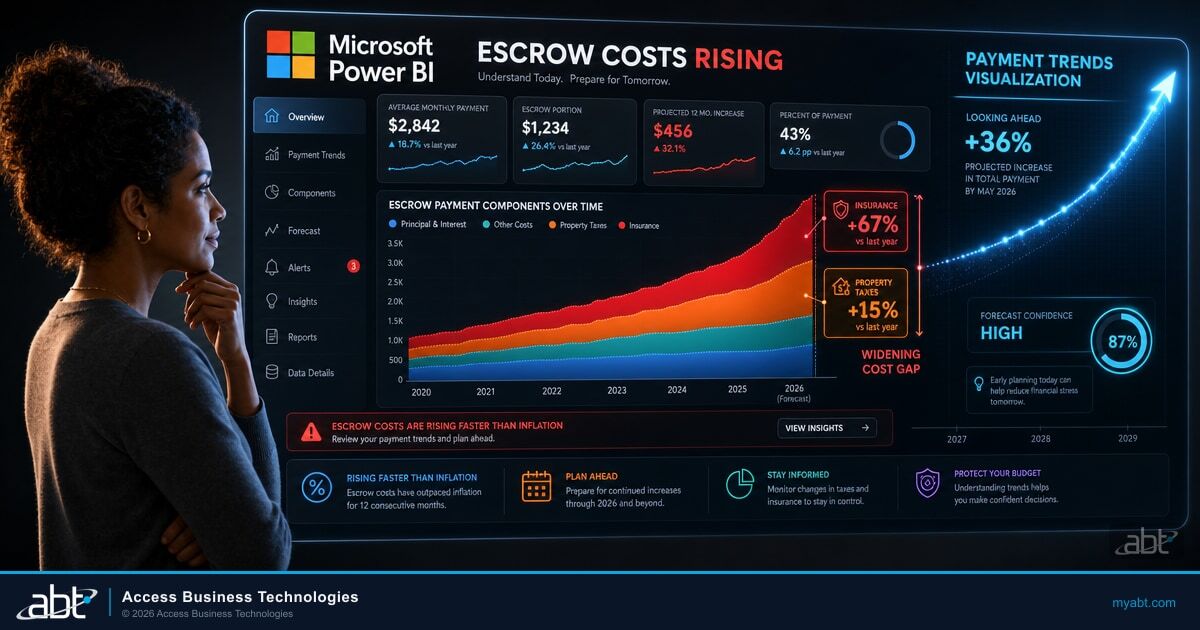
Visualizing combined tax and mortgage payment trends is how forward-looking lenders close that gap. When borrowers can see how principal, interest, taxes, and insurance interact across a 30-year horizon, the conversation shifts from "Why did my payment go up?" to "Here is what my year-five payment will look like under three scenarios." This guide shows how banks, credit unions, and mortgage companies can build those visualizations using Mortgage BI, ABT's purpose-built business intelligence layer for mortgage portfolios, fed by MortgageExchange, the data lake that unifies servicer feeds, escrow data, and tax disbursements into a single queryable layer.
The Escrow Pressure Reshaping Mortgage Affordability
A fixed-rate mortgage was never a fixed monthly payment, but for most of the past two decades the gap between the headline rate and the all-in cost was small enough to ignore. That assumption is now obsolete for borrowers and for the institutions that serve them.
Cotality's January 2026 property market analysis found that escrow now exceeds 40% of total monthly mortgage cost in many US markets, with several states (Nebraska, Kansas, Wyoming) seeing escrow components rise more than 50% since 2019. The National Association of Realtors confirmed the longer arc in its 2025 Escrow Effect study: combined property taxes plus homeowners insurance climbed from $334 to $419 a month between 2019 and 2024 nationally, with insurance alone up 41% and property taxes up roughly 20% over the same five years.
Insurance is the loudest signal. According to Bankrate's 2025 study of 30,000+ ZIP codes, average annual homeowners insurance premiums reached $3,548 in 2025, a roughly 70% jump from 2021 levels. Cotality projects another 8% national increase in 2026 as carriers continue to price in catastrophe exposure. A borrower who closed in 2023 is now seeing a second or third escrow analysis cycle, and many will be blindsided.
Why This Matters for Financial Institutions
Banks and credit unions originated roughly 47% of US home loans in 2024 (banks at 30.1%, credit unions at 16.6%, per the National Community Reinvestment Coalition's analysis of HMDA data). Most of those institutions also retain or sub-service some portion of those loans. Every escrow surprise that lands in a borrower's mailbox is a servicing-call queue item, a CFPB complaint risk, and a member-satisfaction problem for the institution that lent the money.
Why Financial Institutions Need Visualization, Not Just Statements
The CFPB-required initial escrow statement and annual escrow account statement (Reg X § 1024.17) tell a borrower the numbers. They do not tell a story. A standard amortization schedule shows principal and interest declining over time and treats taxes and insurance as static line items. That model worked when reassessments moved 2 to 3% a year. It does not work when insurance carriers raise premiums 20 to 50% in a single adjustment and a single county tax reassessment can add hundreds of dollars to a monthly payment.
The Lereta 2025 Escrow Awareness Survey found that nearly half of homeowners said a 10% increase in their monthly mortgage payment would be a hardship. Forty-five percent still believed, incorrectly, that a fixed-rate mortgage payment cannot change. Sixty-eight percent said they had experienced a payment increase in the past two years.
An interactive chart that separates principal, interest, taxes, and insurance into stacked layers across a 30-year horizon gives a borrower or member something a periodic statement cannot: an immediate visual of where their money goes and how it shifts. They can see that their note rate stays flat while their escrow climbs. They can see the crossover point where escrow exceeds principal repayment in some states. And they can see how their year-10 payment looks under conservative, moderate, and aggressive escrow growth assumptions.
The borrower who feels informed at year zero is the same borrower who calls before filing a CFPB complaint at year five.
This is not about prettier reports. It is about preventing the financial shock that drives servicing complaints, refinance churn, and the slow erosion of trust in your institution. For credit unions, that trust is the franchise. For community and regional banks, it is the wedge against larger, more impersonal competitors. For mortgage companies, it is the difference between a one-loan customer and a referral pipeline.
The Regulatory Anchor: 2024 CFPB Servicing Rule and FFIEC Expectations
Visualization is not a regulatory mandate. The plain-language obligation is. The CFPB's 2024 mortgage servicing proposal, "Streamlining Mortgage Servicing for Borrowers Experiencing Payment Difficulties" (Regulation X), would expand early intervention requirements and reshape loss mitigation timelines; it remains a proposed rule and has not been finalized. The duty that is already in force, independent of that proposal, is Reg X § 1024.38, which requires servicers to maintain "reasonable policies and procedures" that produce accurate and timely information for borrowers. Reg Z § 1026.41 requires monthly periodic statements that break out the escrow portion of each payment.
The compliance tie-in
FFIEC IT Examination Handbook expectations apply to any system used to produce borrower-facing data. Examiners look for risk assessment, audit trails, access controls, and independent review of reporting tools. A Mortgage BI dashboard that influences how a borrower understands their loan is a system in scope, not a side project. Build it inside your governed Microsoft 365 tenant, with role-based access through Microsoft Entra ID and dataset lineage tracked in Microsoft Purview, and the same tooling that helps borrowers will hold up under examination.
The point: the same dashboard that helps a member understand their year-five payment also produces an audit trail your IT examiner can follow. That is the FI-specific reason to build this inside the Microsoft 365 tenant your CSP partner already manages for you, with Mortgage BI as the borrower-facing layer.
Building the Combined Payment Trends Dashboard
Gather the right data sources
Start with loan terms from your origination platform: amount, rate, term, closing date, and current escrow balance. Layer in property-specific data: assessed value, current effective tax rate, current insurance premium. For projections, pull historical tax rate changes from county assessor APIs and state-level insurance trend data from departments of insurance. This is the step where most institutions stall, because the data sits in five different systems that do not talk to each other. MortgageExchange solves the plumbing problem by unifying loan-origination feeds, core banking servicing data, escrow disbursements, and county-level tax data into a single queryable layer that Mortgage BI reads from. Many credit unions add household-level data from their core banking system or member CRM to support household-wide financial wellness conversations, not just loan-by-loan projections. Our companion piece on visualizing presumption-of-compliance metrics in Power BI covers the same data plumbing pattern applied to compliance reporting.
Structure an amortization model with adjustable assumptions
Build an amortization table that includes a row per payment period and columns for principal, interest, projected property tax, projected insurance premium, total monthly payment, and remaining balance. Apply annual growth assumptions to the tax and insurance columns. The single most important design choice is making those growth rates adjustable. A 2% annual property tax increase produces a very different 30-year picture than a 6% increase. Your dashboard should let a loan officer or member service rep toggle scenarios in front of a borrower.
Choose chart types that communicate, not impress
A stacked area chart works best for showing how total payment composition changes over time. Principal and interest form the base. Taxes and insurance stack on top. A separate line tracks total monthly payment. Add a reference line showing the original payment at closing. As the gap between the reference line and the actual total widens, the escrow impact becomes visually obvious without a single number.
Add scenario controls the borrower can see
Mortgage BI's scenario controls let a loan officer or member service rep adjust annual property tax growth, insurance growth, and loan term in front of the customer. When a borrower drags the tax slider from 3% to 6%, they see their year-20 payment jump by hundreds of dollars. That single interaction communicates more than any disclosure document. It also documents that the conversation happened, since the dashboard's audit log captures the parameter values used and writes them back to the servicing record through MortgageExchange.
Mortgage BI and MortgageExchange: ABT's Purpose-Built Mortgage Data Stack
Generic Power BI works, until it doesn't. The moment a community bank or credit union tries to combine loan-origination data from Encompass with servicing data from Symitar with escrow disbursement records from a tax service provider with county-level reassessment data, the off-the-shelf BI tool becomes a part-time job for someone who already has a full-time job. The hand-off between data engineering and dashboard design swallows most internal Power BI projects before they reach a borrower.
Mortgage BI is ABT's purpose-built business intelligence layer for mortgage portfolios. It is not a rebranded Power BI dashboard. It is a productized analytics stack with pre-built data models for loan composition, delinquency trends, escrow exposure, combined tax and payment projections, secondary market performance, and HMDA reporting, all calibrated to the way community banks, credit unions, and independent mortgage banks actually run a mortgage book. Loan officers and member service reps open it to a borrower-conversation view that already shows the combined tax-plus-payment trend for the loan in front of them. Risk officers open it to a portfolio view that flags loans with rising escrow exposure before the borrower calls. The dashboards are configured once, deployed across the institution, and refreshed automatically as the underlying data updates.
MortgageExchange is the data lake that feeds Mortgage BI. It is the interface layer that connects loan origination systems (Encompass, Byte, MeridianLink, Calyx PointCentral), core banking platforms (Symitar, Episys, Jack Henry, FIS, Fiserv DNA), tax and escrow service providers, and county-level data sources into a single queryable layer. Every borrower record carries its full picture in one place: current note rate, current escrow balance, historical tax bills, historical insurance premiums, and the projected forward curve. Mortgage BI reads from MortgageExchange. The institution reads from Mortgage BI. The data plumbing problem that kills most internal Power BI rollouts is solved by the time the loan officer opens the dashboard.
M365 Guardian is the security and governance layer. Mortgage BI dashboards sit inside the Microsoft 365 tenant ABT manages for you under Tier-1 Cloud Solution Provider delegated admin. Microsoft Entra ID Conditional Access controls who can open the dashboard and from where. Microsoft Purview Information Protection labels the underlying datasets. Microsoft Purview Audit logs every parameter change and every borrower view. M365 Guardian is the operating model that ties those Microsoft controls into the broker-dealer-grade, examiner-ready posture that an FFIEC IT examiner expects to see on any system that produces borrower-facing data. The institution gets a borrower-conversation dashboard. The examiner gets the audit trail. Both come out of the same governed M365 footprint.
The reason ABT's Mortgage BI deploys in weeks instead of quarters is that MortgageExchange has been moving data between mortgage origination systems and core banking platforms for more than two decades, against every major LOS and every major core. That interface footprint is the moat. A community bank or credit union does not need to stand up a parallel analytics team. ABT manages the Microsoft 365 tenant where Mortgage BI runs, hosts the MortgageExchange data layer, and applies the M365 Guardian operating model that keeps both inside FFIEC IT examination expectations from day one.
See Mortgage BI configured against your own loan and servicing data
ABT configures Mortgage BI on top of MortgageExchange against your origination system, your core banking platform, and your tax and escrow feeds. The borrower-conversation dashboard is live in weeks. The audit trail your FFIEC examiner expects is live the same day. Inside the Microsoft 365 tenant we already manage for institutions like yours.
Turning Data Into Better Borrower and Member Conversations
The visualization is the tool. The conversation is where the value lands. Here is how forward-looking financial institutions actually use Mortgage BI across the loan lifecycle.
The three conversations that matter
At application. Show the borrower their projected total payment over five, ten, and 30 years under conservative, moderate, and aggressive escrow growth scenarios. Set expectations at the moment of decision, not after the first escrow analysis surprise.
At closing. Walk through the dashboard one more time. Confirm the borrower or member understands their payment will change. Document the conversation in your servicing system. This is also the moment to align with your data-driven learning dashboards so the borrower has a self-service way to revisit the projections later.
At annual escrow review. Pull up the dashboard with actual versus projected data. Show where their escrow landed compared with the estimate. If the county reassessed, walk through the impact. This turns a reactive complaint call into a proactive, advice-led check-in. Credit unions especially can layer this into broader member financial wellness conversations.
Lenders that have adopted this approach report fewer servicing complaints, stronger borrower retention at refinance, and more referrals from satisfied members. The pattern is consistent: borrowers who feel informed at year zero do not blame their bank, credit union, or mortgage company at year five.
How ABT Builds These for Banks, Credit Unions, and Mortgage Companies
Access Business Technologies has built Microsoft-native technology infrastructure for financial institutions for more than 27 years. We are a Tier 1 Microsoft Cloud Solution Provider with direct Microsoft support access, and we serve more than 750 banks, credit unions, and mortgage companies across the United States. Our Mortgage BI and MortgageExchange teams configure the dashboard against your origination system, your core banking platform, and your servicing data, then train your loan officers and member service teams to use it in real customer conversations.
Because we work across the full FI vertical, MortgageExchange has been built and battle-tested against data from Encompass, Byte, MeridianLink, Calyx PointCentral, Symitar, Episys, Jack Henry, FIS, Fiserv DNA, and custom platforms. We know the data structures, the integration constraints, and the dashboard layouts that loan officers and member service reps actually use in front of a customer. Just as importantly, we know how to wire those dashboards into Microsoft Entra ID Conditional Access, Microsoft Purview Audit, and the rest of the Microsoft 365 governance surface that an FFIEC examiner expects to see. M365 Guardian is the operating model that brings those Microsoft controls together into a single examination-ready posture. For institutions still mapping their broader compliance posture, our guide to building a compliant IT framework for community banks and credit unions covers the surrounding control set.
Give your borrowers and members a clear view of their total cost of ownership
ABT configures Mortgage BI on top of MortgageExchange inside the Microsoft 365 tenant we already manage for financial institutions like yours. Built for FFIEC examination through M365 Guardian, not just internal review.
Frequently Asked Questions
Property taxes climbed roughly 20% and homeowners insurance climbed 41% between 2019 and 2024, per the National Association of Realtors 2025 Escrow Effect study, and Bankrate reports insurance is up close to 70% since 2021. Banks, credit unions, and mortgage companies need visualizations that separate variable escrow components from fixed principal and interest so borrowers can see how their total monthly cost will move over the life of the loan, not just at the next escrow analysis. ABT's Mortgage BI dashboard, fed by the MortgageExchange data layer, is built specifically for that combined view.
Standard Power BI is a general-purpose business intelligence tool. The institution has to design the data model, connect to each upstream system separately, build dashboards from scratch, and maintain them as systems and regulations change. Mortgage BI is ABT's purpose-built layer on top of that toolset, with pre-configured data models for combined tax and payment trends, delinquency exposure, escrow analysis, and HMDA reporting, plus a MortgageExchange-fed data layer that already understands the structure of Encompass, Byte, MeridianLink, Symitar, Episys, Jack Henry, FIS, Fiserv DNA, and Calyx PointCentral. The institution gets a borrower-conversation dashboard configured against its own data in weeks instead of standing up a parallel analytics team.
County assessor records provide current assessed values and tax rates per property. State departments of revenue publish historical tax rate changes by municipality. State insurance department filings and carrier rate filings provide premium trend data. Tax service providers and escrow administrators provide disbursement records. MortgageExchange ingests these sources alongside loan origination and core banking data into a governed data layer that Mortgage BI reads from, so loan officers in Florida see Florida-specific tax projections and members in Texas see Texas data without each branch building its own model.
Yes. MortgageExchange has been built and battle-tested against Encompass, Byte, MeridianLink, Calyx PointCentral, Symitar, Episys, Jack Henry, FIS, Fiserv DNA, and custom platforms over more than two decades of FI deployments. Once connected, the data layer pulls current loan data automatically and applies configured growth assumptions, then feeds Mortgage BI dashboards that loan officers and member service reps use during borrower and member consultations. Most institutions set up daily refreshes so the dashboard always reflects current pipeline and servicing data.
The 2025 Lereta Escrow Awareness Survey found that 55% of homeowners had been surprised by a payment increase in the past two years and 45% still believed a fixed-rate payment cannot change. Visual dashboards inside Mortgage BI that show year-over-year escrow growth projections at application, closing, and annual review set realistic expectations and reduce the payment shock that drives complaint calls and CFPB filings against the institution. The MortgageExchange data layer that feeds Mortgage BI also writes parameter values used in those conversations back to the servicing record, giving the institution a documented trail of the borrower-facing disclosures.
Examiners apply the FFIEC IT Examination Handbook risk management, audit, and information security expectations to any system used to produce borrower-facing data. M365 Guardian is ABT's operating model for the Microsoft 365 tenant where Mortgage BI runs. It ties Microsoft Entra ID Conditional Access, Microsoft Purview Information Protection, and Microsoft Purview Audit into a single examination-ready posture, with access controls, dataset lineage, and audit trails that examiners look for during an IT review. The borrower-facing dashboard and the examiner-facing audit trail come out of the same governed footprint.