

In This Article
- What MISMO Certification Means in 2026
- Why Your Systems Only Talk When They Share a Standard
- The 2026 to 2027 Standards Deadline Clock
- Real-Time Data Exchange and the Cost Per Loan
- MISMO Alignment and Regulatory Compliance
- What to Demand From a MISMO-Aligned Integration Partner
- How Microsoft 365 Wraps MISMO-Compliant Systems
- Frequently Asked Questions
The Mortgage Bankers Association reported that the average cost to originate a residential mortgage hit $11,109 in the third quarter of 2025, roughly $3,300 above the long-run average of $7,799 the industry has carried since 2008. A meaningful share of that excess is avoidable. It sits inside reformatting data between systems that should already agree, handling exceptions on rejected agency deliveries, and reconciling fields by hand that ought to flow cleanly from application through closing to the secondary market.
That reconciliation work is what happens when the systems running a lending operation do not speak the same language. MISMO, the Mortgage Industry Standards Maintenance Organization, defines that shared language. When a loan origination system, a closing platform, a servicing core, and a secondary-marketing tool all conform to the same MISMO version, data moves between them without a translation layer. When they do not, someone on staff becomes the translation layer, and the cost shows up on every loan.
For credit unions, banks, and mortgage companies, 2026 raised the stakes. MISMO shipped a new reference model, the agencies set a hard deadline for redesigned appraisals, and state regulators began standardizing how they examine mortgage data. This article explains what MISMO certification actually means now, what changed in the last twelve months, and what to demand from the partners that build and operate the integrations carrying your data.
What MISMO Certification Means in 2026
MISMO is a subsidiary of the Mortgage Bankers Association. It develops and maintains the data standards that govern how information moves between mortgage technology systems. Fannie Mae, Freddie Mac, Ginnie Mae, the FHA, and the CFPB all reference MISMO standards in their guidance and operational specifications, which is why the standard reaches every institution that originates or services a residential loan, whether that is a national mortgage company, a community bank, or a credit union running depositary servicing in-house.
Certification comes in two forms that buyers see most often:
- Certified MISMO Standards Professional (CMSP). An individual certification for professionals who demonstrate advanced knowledge of MISMO standards and how to implement them.
- System and product certifications. Firm-level evaluations that test a specific platform against MISMO compliance criteria, including the Remote Online Notarization, eClosing System, and eVault System certifications listed on mismo.org. Wolters Kluwer earned MISMO certification for its eOriginal eVault and ClosingCenter platforms on November 12, 2025, after independent third-party evaluation, one recent example of the vendor certifications buyers can verify directly.
When a technology partner holds MISMO certification, it has been vetted for the ability to implement data standards correctly. That matters because a poorly implemented standard is worse than no standard at all. It creates a false sense of compatibility, and the resulting failures are expensive to find because they look like data-quality problems when they are actually architecture problems.
What Changed in MISMO This Year
MISMO published Reference Model Version 3.6.2 on October 30, 2025. It is a minor release with additive changes only and is fully backward compatible with Version 3.6.1, so institutions already aligned to the 3.6.x family do not need to rebuild anything to adopt it. Version 3.6.1, which reached Candidate Recommendation status on May 27, 2025, added support for reverse-mortgage origination and was MISMO's first backward-compatible release. The 3.6 family also introduced a Unique ID Matrix that shortens the time and cost of implementing future updates. The takeaway for a buyer is simple: 3.6.x is the working baseline, and the version question is now a conversation about minor releases, not a forced migration every cycle.
Why Your Systems Only Talk When They Share a Standard
A lending operation runs on a stack of systems. The loan origination system handles application and underwriting. A core banking platform manages servicing for the credit unions and banks that service in-house. A pricing engine pulls investor rates. Compliance tools check regulatory requirements. A document system stores and retrieves files. Secondary-marketing tools deliver loans to the agencies. Every handoff between two of those systems is a potential failure point.
When two systems share a data format, the handoff is automatic. When they do not, a person translates the data from one shape into another, and that manual translation is where most of the cost-per-loan creep lives, especially in operations that grew through acquisition or bolted on best-of-breed point solutions over the years. The fix is not a new system. The fix is an integration layer that carries MISMO data end to end, with no middleware quietly reshaping fields in the middle.
This is exactly the problem ABT built MortgageExchange to solve. MortgageExchange is ABT's custom interface product, the layer that connects loan origination systems such as Calyx, Encompass, MortgageFlex, and Mortgage Cadence to core platforms such as Corelation Keystone, Symitar, and Fiserv DNA, and on to servicing and the secondary market. Because the interface carries MISMO-formatted data rather than translating it through a generic middleware bus, the data that leaves origination is the data that arrives at closing and at delivery. Credit unions including Lafayette Federal and Credit Union West have used it to retire the manual reconciliation step entirely.
What the MISMO standards stack actually covers:
- ULDD (Uniform Loan Delivery Dataset) Phase 5. The data format required for delivering loans to Fannie Mae and Freddie Mac. Phase 5 became mandatory on July 28, 2025, with fatal-edit enforcement on the submission, so a malformed delivery file is now rejected rather than quietly accepted and corrected later.
- UCD (Uniform Closing Dataset) v2.0. Standardizes Closing Disclosure data for agency delivery. The transition to v2.0 began on September 29, 2025, with production environments now accepting compliant files and the mandate expected in late 2026 or beyond.
- SMART Doc. Specifications for secure, tamper-evident electronic documents, including eNotes that satisfy ESIGN Act and UETA requirements.
- RON (Remote Online Notarization). Standards for remote notarization that support fully digital eClose workflows.
- MISMO Reference Model 3.6.2. The current backward-compatible release covering loan-application data, property information, borrower details, and transaction records. Version 3.6.x is the baseline most origination, closing, and servicing platforms target.
- Mortgage Compliance Dataset (MCD). A joint MISMO and Conference of State Bank Supervisors effort that reached Version 2.0 public comment in November 2025. It standardizes the compliance-examination data state regulators use, so multiple jurisdictions can run risk-based, technology-driven exams against the same baseline.
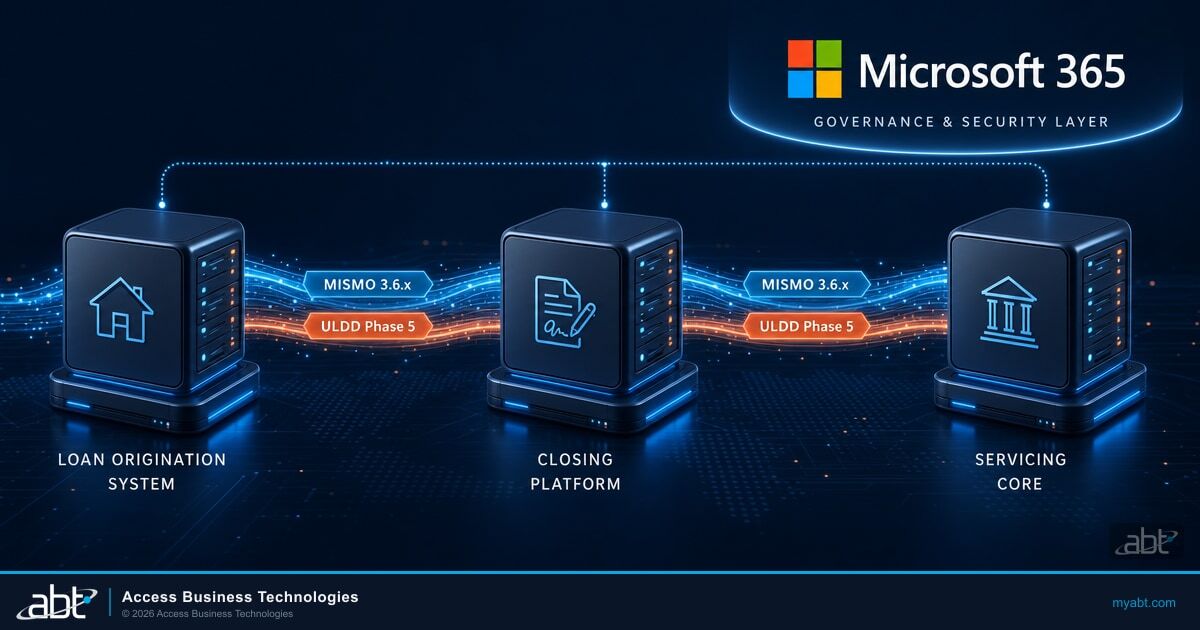
When the origination system, closing platform, secondary-marketing tools, and servicing core all speak MISMO 3.6.x, data moves between them without manual intervention. That is the whole point of the standard, and it is the difference between an integration that lowers cost per loan and one that merely promises to.

The 2026 to 2027 Standards Deadline Clock
The version question would be academic if the standards stack sat still. It does not. The agencies and MISMO have a sequence of dates on the calendar, and the one that forces a decision is the redesigned appraisal mandate. Lenders already aligned to MISMO 3.6.x are positioned for it. Lenders running older versions face a forced migration on a deadline.
Read the clock from the bottom up. The November 2, 2026 appraisal mandate is the immovable date, and because it aligns with MISMO v3.6, an institution that is already on the 3.6.x baseline has very little work to do. An institution still running older versions has to migrate appraisal workflows, retest integrations, and revalidate delivery files on a fixed deadline while loans keep closing. The cheapest version of that project is the one started before the deadline forces it.
Real-Time Data Exchange and the Cost Per Loan
Overnight batch processing was the standard for years. The origination system sent a file to the core at midnight. If something failed, nobody knew until the next morning, and by then the loan had moved.
MISMO-compliant integrations support real-time data exchange instead. Loan-status updates, condition clearances, and closing data move between systems immediately rather than waiting for an end-of-day window. The business effects are concrete:
- Faster lock-to-close timelines. When an underwriting condition clears in the origination system, the closing team sees it instantly instead of waiting for a batch sync.
- Fewer errors from stale data. Real-time sync eliminates the window where two systems show different information for the same loan.
- Better borrower communication. Loan officers give accurate status updates because the data they see is current.
- Reduced exception handling. Most mismatches between systems trigger a manual review. Real-time sync prevents most of those mismatches from occurring at all.
- Faster agency delivery. ULDD Phase 5 fatal edits caught at origination, instead of at delivery, save the round-trip rework that delays settlement.
Real-time data exchange is not a nice-to-have once cost per loan sits north of $11,000. The savings show up in three places: fewer rejected agency deliveries, fewer hours spent reconciling field-level mismatches between the origination system and the core, and lower borrower abandonment when loan officers can answer status questions on the spot.
Credit unions, banks, and mortgage companies that run MISMO-compliant integrations report measurable improvements in processing time and error rates against peers still running custom field mapping or middleware translation layers. The exact savings depend on loan volume and the quality of the existing integration, but the mechanism is the same on every file: a rejected agency delivery is a full round-trip (re-export, re-validate, re-submit) on a loan that has already closed, and a hand-reconciled field is staff time that scales with volume instead of revenue. Both line items disappear when the data carries through clean. Patelco Credit Union's experience breaking its mortgage-data bottleneck is a representative example of what changes when the translation step disappears.
Wondering whether your integrations actually carry MISMO data end to end, or whether they translate it through middleware that introduces errors? ABT can map your real data flow against MISMO 3.6.x and ULDD Phase 5 and show you exactly where it breaks.
MISMO Alignment and Regulatory Compliance
Regulators reference MISMO standards in their guidance and in many of the data formats they require. Fannie Mae and Freddie Mac require ULDD Phase 5 and UCD v2.0 conformance for loan delivery. State regulators are aligning examination procedures with the MISMO Mortgage Compliance Dataset through the joint Conference of State Bank Supervisors initiative. The CFPB references MISMO data definitions in its industry guidance, although HMDA filing itself uses the CFPB's own pipe-delimited LAR format rather than MISMO XML directly, a nuance worth getting right before an examiner does.
For banks, credit unions, and mortgage companies, MISMO alignment simplifies compliance in four ways:
| Compliance area | What MISMO alignment delivers | Anchor reference |
|---|---|---|
| Consistent data definitions | Every system uses the same field names and formats, so regulatory reports pull clean data without manual mapping. HMDA filing still uses pipe-delimited LAR, but institutions can collect the fields in MISMO 3.6.x and translate only at submission. | CFPB HMDA Filing Instructions Guide |
| Audit-ready records | MISMO-formatted data creates a standardized trail an examiner can follow across systems. The MCD v2.0 from MISMO and CSBS extends this to state-level mortgage exams. | MISMO Mortgage Compliance Dataset (MCD) v2.0, public comment November 2025 |
| Reduced rework on delivery | Loans formatted to ULDD Phase 5 and UCD v2.0 at origination do not need reformatting before delivery. Phase 5 fatal edits caught early prevent late-stage agency rejections. | Fannie Mae ULDD Phase 5, mandatory July 28, 2025 |
| Examination consistency across states | The CSBS and MISMO MCD lets state regulators run risk-based, technology-driven examinations against a consistent baseline rather than each state defining its own format. | MISMO and CSBS Mortgage Compliance Dataset |
Institutions licensed in multiple states feel this most. The MCD reaching Version 2.0 public comment in November 2025 signaled that state supervisors intend to examine against a shared baseline, which means an institution aligned to MISMO standards today is already aligned to the dataset state examiners will ask for next. That is the same logic that drives a compliant IT framework generally: standardize once, satisfy many examiners.
Remote Online Notarization status, 2026
More than 40 U.S. states have enacted permanent Remote Online Notarization laws as of 2026, but the federal SECURE Notarization Act, which would create a single national RON standard, has not passed. Banks, credit unions, and mortgage companies operating across state lines should treat RON as a state-by-state checklist rather than relying on federal preemption, and confirm that their eClose stack supports the MISMO RON and SMART Doc standards each state recognizes.

What to Demand From a MISMO-Aligned Integration Partner
Not every vendor claiming MISMO compliance has tested its implementation against the current reference model. The phrase appears on contracts long before it appears in production. Before you sign or renew, put the claim under pressure with specific questions, and expect specific answers.
Your managed IT partner sits inside this picture too. The infrastructure that hosts the loan origination system, the integrations that connect it to the core, and the Microsoft 365 environment that governs the people and documents around the data all have to be operated by a team that can read MISMO XML and recognize a ULDD edit failure in production. When the interface team and the team governing the tenant are the same team, the seam where most audit failures hide simply is not there. That is the standard ABT holds for its own interface work: 1st MidAmerica Credit Union's Mortgage Cadence and Fiserv DNA integration and Tower Federal Credit Union's systems unification were both built and are operated against the live MISMO baseline, not a contract checkbox.
How Microsoft 365 Wraps MISMO-Compliant Systems
MISMO standards govern the data inside the loan origination system, the closing platform, and the connections between them. Microsoft 365 governs the people, identities, devices, and documents that surround that data. Both layers have to be solid for an audit-ready lending operation, because MISMO-formatted data inside the systems is not audit-ready in practice if the controls around it are weak.
The Microsoft 365 components that support MISMO-compliant workflows:
- Microsoft Entra ID Conditional Access enforces multi-factor authentication on every loan officer, processor, and underwriter who touches MISMO-formatted data inside the origination system or the closing platform, and blocks sign-ins from risky locations and unmanaged devices.
- Microsoft Purview Audit and Information Protection retain audit-quality logs on every action against borrower data and apply sensitivity labels to closing documents so they cannot leave the organization without an explicit override. Purview retention supports the documentation requirements that attach to MISMO-formatted closing records.
- Microsoft Defender for Office 365 protects the email channel that lenders, title agents, warehouse lenders, and agency-delivery partners use to confirm closing data, with anti-phishing and Safe Links guarding the funding-day thread against business email compromise.
- Microsoft Intune manages the laptops and mobile devices loan officers use in the field, keeping encryption, screen-lock, and remote-wipe policies current on every endpoint that meets Conditional Access requirements.
- Microsoft 365 Copilot adds AI assistance inside the same governance boundary, so summarized loan files and document-review tasks respect the same retention, sensitivity, and audit controls that govern the underlying data.
Most lending operations buy loan-origination-system integration from one vendor and managed IT from another, which is precisely how the seam between MISMO data and the controls around it goes unexamined. ABT operates both layers as one relationship. The MortgageExchange interface keeps MISMO data clean between systems, and the managed Microsoft 365 tenant keeps that data governed, encrypted, and examiner-ready, read by the same team that recognizes a ULDD edit failure in production. Mortgage companies, banks, and credit unions running both correctly produce evidence packages that hold up to OCC, NCUA, FDIC, and state mortgage examinations without scrambling on examination week.
Access Business Technologies has supported credit unions, banks, and mortgage companies on Microsoft cloud platforms since 1999 and serves more than 750 financial institutions today. ABT manages the Microsoft 365 tenants that wrap MISMO-compliant origination, closing, and servicing platforms, using Microsoft Entra ID Conditional Access for identity, Microsoft Defender for Office 365 for email security on lender and borrower communications, Microsoft Purview for retention and audit on closing documents, and Microsoft Intune for device management on the loan-officer fleet. The MortgageExchange interface keeps the data inside those systems MISMO-aligned, and the Microsoft 365 layer keeps it governed, encrypted, and examiner-ready.
For a buyer comparing partners, all of this reduces to a short diagnostic. The question is not whether a vendor says the word MISMO on a contract. It is whether the data stays MISMO from origination through delivery, and whether the controls around that data are operated by people who would notice if it did not.
Decision Lens
If a vendor cannot answer "which MISMO version do you support" with a specific 3.6.x figure, the integration risk is higher than it looks. If a vendor supports MISMO but your Microsoft 365 environment is not configured for the surrounding controls, the audit risk is higher than it looks. Both layers need to be current, and they need to be operated by the same team that understands how they connect.
Map your real MISMO and Microsoft 365 footprint before the next examination
Most lending operations believe they are MISMO-aligned because a loan origination system vendor said so on the contract. The audit reality lives in the integrations that connect the origination system to the closing platform, the secondary market, the core, and the document of record. ABT builds and operates the MortgageExchange interface and manages the Microsoft 365 tenant for more than 750 financial institutions, and can show you exactly where your MISMO data flows cleanly and where it gets translated.
Frequently Asked Questions
MISMO certification validates that a professional or a system has demonstrated advanced knowledge and correct implementation of Mortgage Industry Standards Maintenance Organization data standards. It matters because MISMO standards govern how loan data moves between origination systems, closing platforms, compliance tools, and the secondary market. Partners that hold certification have been vetted for correct implementation, which reduces the risk of integration failures that show up as data errors and processing delays.
The Uniform Loan Delivery Dataset Phase 5 became mandatory on July 28, 2025 and standardizes the loan-level data submitted with each mortgage delivery to Fannie Mae and Freddie Mac, with fatal-edit enforcement that rejects malformed files. The Uniform Closing Dataset v2.0 transition began on September 29, 2025 and standardizes Closing Disclosure data for agency delivery, with the mandate expected in late 2026 or later. Loans that do not conform to these formats are rejected, requiring manual correction and resubmission that delays settlement and raises cost per loan.
MISMO Reference Model 3.6.2, published October 30, 2025, is a minor, fully backward-compatible additive release that builds on 3.6 and 3.6.1 with new data points, containers, and enumerations. Systems implementing the 3.6.x family exchange data without custom field mapping or manual translation, which cuts integration development time, removes format mismatches between systems, and supports real-time data exchange instead of overnight batch processing. Institutions already aligned to an earlier 3.6 release do not need to rebuild to adopt 3.6.2.
The Uniform Appraisal Dataset (UAD) 3.6 entered Broad Production on January 26, 2026 and becomes mandatory on November 2, 2026, when every new appraisal report on a loan sold to Fannie Mae or Freddie Mac must use UAD 3.6. Because UAD 3.6 aligns with MISMO v3.6, an institution already on the 3.6.x baseline has little work to do, while one running older versions faces a forced migration of appraisal workflows and integration retesting on a fixed deadline. Banks, credit unions, and mortgage companies that sell loans to the agencies should confirm their appraisal data path is mapped to UAD 3.6 well before the mandate.
A managed IT and integration partner maintains the infrastructure that MISMO-compliant systems depend on, including origination-system hosting, integration monitoring, security configuration, and compliance controls. When a MISMO version update requires changes, the partner coordinates testing and deployment across every connected platform. ABT's MortgageExchange interface carries MISMO data between the origination system, the core, and servicing, while the managed Microsoft 365 tenant keeps that data encrypted, access-controlled, and audit-logged using Microsoft Entra ID, Purview, and Defender for Office 365.
MISMO's SMART Doc standard specifies tamper-evident electronic documents, including eNotes that satisfy ESIGN Act and UETA requirements, while the Remote Online Notarization standards define how notarization sessions are conducted, recorded, and stored electronically. As of 2026, more than 40 U.S. states have permanent RON laws, although the federal SECURE Notarization Act has not passed. Together, SMART Doc and RON enable fully digital closings where borrowers sign remotely and the resulting electronic records are accepted by the agencies, title insurers, and warehouse lenders.