

In This Article
- Credit Union West: 75 Years Serving Arizona Members
- The Swivel-Chair Problem Between MortgageFlex and Symitar
- How MortgageExchange Closed the Gap
- What Credit Union West Gained
- Why This Pattern Repeats Across Credit Unions
- Integration Is a Security Control, Not Just Plumbing
- The Bottom Line for Credit Unions
- Frequently Asked Questions
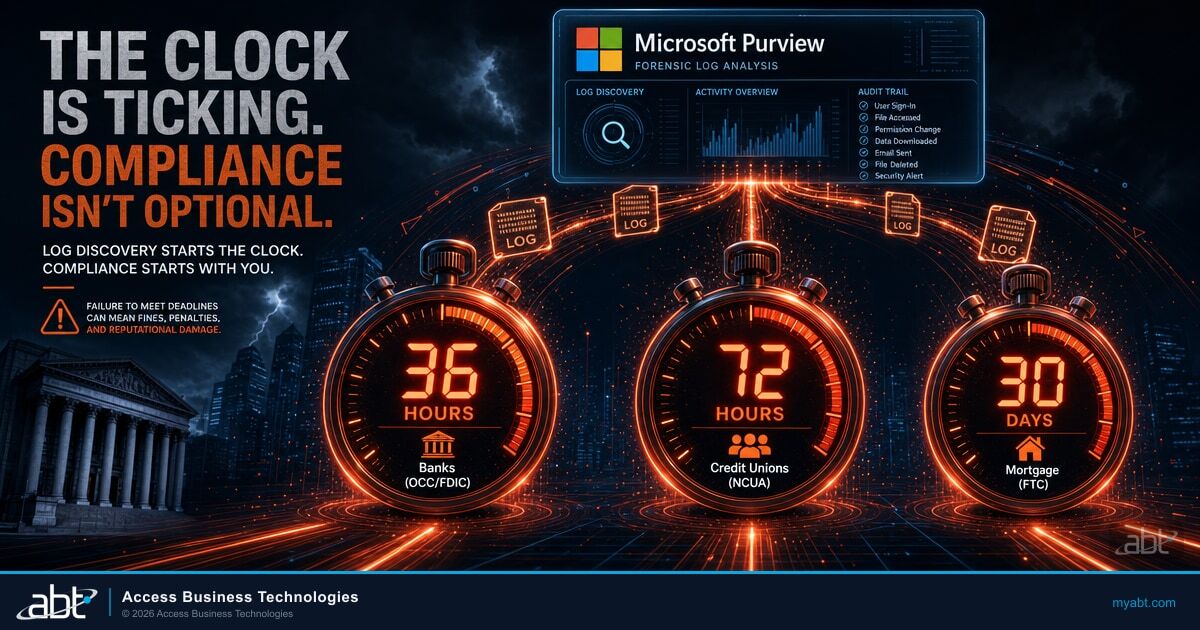
Since the NCUA's 72-hour cyber incident reporting rule took effect in September 2023, federally insured credit unions filed 892 cyber incidents with the agency through May 2024, with reporting peaking in February. By August 2024 that total had grown to 1,072 incidents, and nearly seven in ten of them involved a third-party vendor or service provider. Every one of those incidents traces back to the same structural weakness: the connections between systems. Loan data, member data, and operational data move through integration layers that nobody inside the credit union is actively monitoring, and that is where attackers and errors both find purchase.
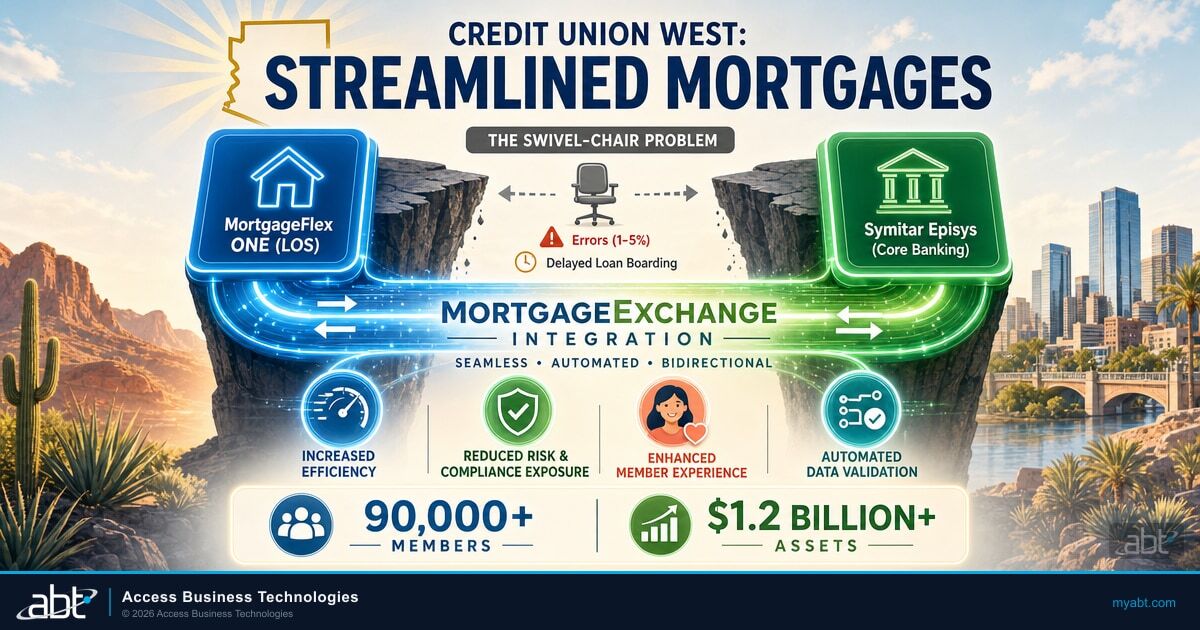
Credit Union West knew this challenge firsthand. Headquartered in Glendale, Arizona, the institution serves roughly 90,000 members and holds more than $1.2 billion in assets. Like many credit unions its size, Credit Union West ran two best-of-breed mortgage platforms that did not natively speak to each other: MortgageFlex ONE as its loan origination system and Jack Henry Symitar Episys as its core banking platform. Members got modern technology on either end. Staff got the swivel chair in the middle.
This case study walks through what changed for Credit Union West when the integration moved from staff keyboards to a managed pipeline, then explains why the same pattern keeps surfacing across credit unions, community banks, and mortgage companies running multi-vendor mortgage stacks.
Credit Union West: 75 Years Serving Arizona Members
Credit Union West traces its history back to 1951, when it was chartered to serve military personnel and their families stationed at Luke Air Force Base in Glendale, Arizona. Over the decades, the institution expanded its field of membership and geographic reach across the state, broadening its mission to serve Arizonans of every walk of life. Today, Credit Union West operates branches across the Phoenix metropolitan area and beyond, with its headquarters in Glendale and a member base that spans active-duty military, retirees, families, and small business owners.
The credit union offers a full suite of retail banking products: checking and savings accounts, auto loans, credit cards, business services, and home lending. Mortgage lending is a core service line and one where the back-office experience can make or break member satisfaction. A member who waited weeks for closing should not have to wait additional days to see their loan reflected in their online banking. Credit Union West's leadership recognized that maintaining service standards in mortgage required tackling a less visible problem: the gap between the loan origination system and the core platform.
On the lending side, Credit Union West runs MortgageFlex ONE, a long-established mortgage origination platform built for credit unions and community lenders. MortgageFlex ONE handles application intake, underwriting, processing, closing, and the entire retail mortgage workflow. On the core banking side, the credit union operates Jack Henry Symitar Episys for member account records, loan servicing, regulatory reporting, and the rest of its operational backbone.
Both platforms are capable systems on their own. The problem was the space between them.
The Swivel-Chair Problem Between MortgageFlex and Symitar
Before MortgageExchange, every new mortgage application or loan update at Credit Union West required duplicate manual data entry. Borrower information, interest rates, escrow calculations, payment schedules, insurance details. All of it keyed into MortgageFlex ONE during the loan process, then re-keyed into Symitar Episys after closing for servicing setup and member account updates.
This swivel-chair workflow created cascading problems that compounded with every closed loan:
- Error rates between 1 and 5 percent. Industry data consistently shows that manual data transcription produces errors at this rate. For a credit union closing dozens of mortgages per month, that translates to records with incorrect data flowing into servicing systems. A transposed interest rate. A wrong escrow amount. A misspelled borrower name that breaks identity matching downstream.
- Delayed loan boarding. Members who just closed expected to see the mortgage in their online banking account quickly. When post-closing data entry took hours or days, members called asking where their loan went. Those calls cost staff time and undermined the experience the lending team worked to build.
- Compliance exposure. NCUA examiners pull data from both the origination system and the core platform during examinations. When those records do not match, the credit union produces findings that trigger management response plans, board reporting, and follow-up examinations. Every one of those findings was preventable if the data matched from the start.
- Staff trapped in clerical work. Loan officers and operations staff hired for their expertise spent hours doing data entry that added zero value. Every hour spent retyping loan fields was an hour not spent on member consultations, pipeline management, or processing the next application.
The siloed systems also introduced timing delays. Data in one platform might not reflect in the other until someone manually updated it, hindering real-time visibility for everyone from loan officers checking pipeline status to compliance officers reconciling records at month-end. McKinsey research cited by industry analysts puts the operating-cost penalty for institutions still running legacy or poorly integrated platforms at roughly 10 times higher than peers on modern integrated platforms. Much of that cost hides in manual workarounds exactly like the one Credit Union West was living with.
Why This Matters for Financial Institutions
The NCUA's annual cybersecurity report calls out third-party risk and the agency's limited authority over vendors as ongoing concerns. Integration layers between an LOS and a core sit in exactly that gap. Even when a credit union's own systems are hardened, the data flowing between them through manual processes is invisible to most security monitoring and audit tooling. Fixing the integration fixes a control point, not just an operational headache.

How MortgageExchange Closed the Gap
Credit Union West partnered with Access Business Technologies to deploy MortgageExchange, ABT's cloud-managed integration platform that connects loan origination systems to core banking platforms. MortgageExchange sits between MortgageFlex ONE and Symitar Episys, automatically routing validated loan data between the two systems without manual intervention.
MortgageExchange is not a point-to-point connector built for one pair of systems. It is an integration platform that supports 40+ mortgage technology systems, including every major LOS and core banking platform used by credit unions, community banks, and mortgage companies. ABT built MortgageExchange specifically for the financial services industry, where data accuracy and regulatory compliance are not optional.
What changed for Credit Union West:
- Automatic post-closing data transfer. When a loan closes in MortgageFlex ONE, MortgageExchange receives the complete loan record, validates every field against business rules, and posts the clean data directly into Symitar Episys. No staff member touches the data during the transfer.
- Bi-directional synchronization. Changes in the core that affect the LOS flow back automatically. Both systems stay in lockstep without manual reconciliation, so staff can trust either system as the source of truth at any point in the loan lifecycle.
- Rules-based validation. Before any data crosses from origination to core, MortgageExchange checks every field. Required fields present? Values within expected ranges? Data types correct? If something does not match, the system flags it for human review instead of silently pushing bad data through. Errors get caught before they propagate, not weeks later during reconciliation.
- Cloud-hosted on Microsoft Azure. Data encrypted in transit and at rest. No on-premise servers for the credit union to maintain. MortgageExchange runs in ABT's hosted Azure environment alongside the security monitoring, compliance controls, and incident response that ABT provides across the full IT stack.
- Fully managed by ABT. When MortgageFlex releases an update or Jack Henry changes the Symitar API, ABT handles the compatibility work. Credit Union West's IT team stays focused on member-facing technology instead of chasing integration issues between vendors who do not talk to each other directly.
MortgageExchange runs on Microsoft Azure inside ABT's hosted cloud environment. As a Tier-1 Microsoft Cloud Solution Provider serving more than 750 financial institutions, ABT manages the Microsoft 365 tenant for credit unions like Credit Union West while hosting their Azure integration environment with the same Microsoft Entra ID conditional access, Microsoft Defender for Cloud monitoring, and Microsoft Purview audit logging applied across the rest of the stack. The integration pipeline inherits the identity, security, and compliance controls credit unions are already documenting for NCUA examiners, so it does not become a separate, weakly governed surface.
What Credit Union West Gained
Manual re-entry disappeared. The hours staff spent retyping loan data between MortgageFlex ONE and Symitar Episys went to zero. Loan officers who had been spending afternoons on clerical data entry were suddenly available for the work they were hired to do: helping members and growing the lending pipeline.
Data accuracy jumped to near-perfect. With MortgageExchange handling the transfer and validation, the transcription errors that used to trigger reconciliation cycles dropped to near zero. Loan records matched across both systems from the moment of closing. Quality assurance shifted from catching typos to reviewing exception cases flagged by the rules engine.
Loan boarding accelerated from days to minutes. New mortgages appeared in Symitar Episys within minutes of closing in MortgageFlex ONE. Members saw their accounts update almost immediately. Welcome letters, payment schedules, and online account access happened on time because the data arrived without waiting for a human to finish typing it.
Audit readiness became the default state. Consistent data across both systems meant Credit Union West could hand NCUA examiners a clean set of records without spending days reconciling discrepancies. Every data movement through MortgageExchange is logged, timestamped, and traceable. That audit trail is something manual processes can never provide.
The integration scaled with volume. Because MortgageExchange runs in the cloud, Credit Union West can originate more mortgages without adding IT infrastructure or back-office headcount. Growth does not mean more re-keying. It means more loans flowing through the same automated pipeline.

The integration gap between your LOS and core is not a minor inconvenience. It is a structural drag on speed, accuracy, and compliance that grows worse with every loan you close.
Why This Pattern Repeats Across Credit Unions
Credit Union West's situation is not unusual. The credit union industry is hitting what analysts call a 2026 inflection point: legacy cores, bolt-on digital layers, and fragmented point solutions cannot support real-time operations, AI-driven analytics, or the member experiences that younger members demand.
The numbers tell the story. Credit union core systems are 20 to 40 years old on average. The NCUA approved 157 credit union mergers in 2025, down slightly from 162 in 2024, and every merger creates a new integration challenge. Jack Henry Symitar is one of the most widely deployed credit union core platforms in the United States, with hundreds of institutions running Episys as their member system of record. MortgageFlex serves a similar share of the credit union and community-bank mortgage market. Every one of those institutions faces the same question Credit Union West answered.
How do you connect your loan origination system to your core banking platform without turning your staff into the middleware?
The institutions that solve it early gain a structural advantage. Faster loan processing, cleaner data, lower compliance risk, and a technology foundation that absorbs growth without breaking. The ones that do not solve it keep paying the hidden tax of manual integration on every loan they close. See how Patelco Credit Union eliminated the same bottleneck between Empower LOS and Fiserv Spectrum, or read about AllSouth FCU's MortgageExchange deployment between Mortgage Cadence LFC and Fiserv DNA for another perspective on the same pattern.
Integration Is a Security Control, Not Just Plumbing
Most credit unions treat integration as an operations problem. It is also a security problem and a compliance problem, and the NCUA's enforcement record over the past two years makes that explicit.
When loan data moves between systems through human keyboards, the credit union has no visibility into what was typed, when, or by whom. Examiners cannot reconstruct the data lineage. Incident responders cannot trace where a discrepancy entered the record. Compliance officers cannot prove that a borrower's information matched across origination and servicing at the moment of disclosure delivery.
A managed integration platform changes that. Every field that crosses MortgageExchange is logged with a timestamp, an authenticated source, a validation outcome, and a destination receipt. When the NCUA examiner asks for the audit trail of a specific loan, the credit union produces it in minutes instead of spending days reconstructing what happened from staff memory and spreadsheets.
This is the productivity gain that funds the security investment. Loan officers spend their time on members. The data pipeline produces clean records and a complete audit trail without anyone having to think about it. Compliance gets stronger because the controls are automated, not because the staff is working harder. Governance falls into place naturally because the system records what happened.
The Bottom Line for Credit Unions
Credit Union West eliminated the manual data bottleneck between MortgageFlex ONE and Jack Henry Symitar Episys by deploying MortgageExchange. The result: faster loan boarding, cleaner data, stronger audit readiness, and staff freed from hours of redundant work every week.
For credit unions wrestling with the same disconnected systems, the lesson is straightforward. The integration gap between your LOS and core is not a minor inconvenience. It is a structural drag on speed, accuracy, and compliance that grows worse with every loan you close.
See where a managed integration pipeline fits in your stack
ABT's integration specialists map your current LOS-to-core data flow, identify where manual re-entry is costing you accuracy and audit time, and show you what a MortgageExchange deployment would look like for your specific systems.
Frequently Asked Questions
MortgageExchange is ABT's cloud-managed integration platform that connects loan origination systems to core banking platforms. Credit Union West deployed MortgageExchange to bridge MortgageFlex ONE, its loan origination system, with Jack Henry Symitar Episys, its core banking system. The platform automatically validates, transforms, and routes loan data between systems using mortgage-specific business rules, eliminating the manual re-entry that previously consumed hours of staff time after every closing.
MortgageFlex ONE and Jack Henry Symitar Episys were not natively connected at Credit Union West. Every new mortgage required staff to enter loan data into MortgageFlex during origination and then re-key the same data into Symitar Episys for servicing and core records. The swivel-chair workflow created compliance risk, slowed loan boarding, introduced transcription errors at industry-standard rates of 1 to 5 percent, and trapped loan officers in clerical work that added zero member value.
Manual re-entry produces error rates between 1 and 5 percent, creating data discrepancies between origination and servicing records. NCUA examiners compare data across both systems during examinations. Mismatched loan amounts, incorrect escrow figures, or missing fields trigger findings that require management response plans and board reporting. Automated integration through MortgageExchange eliminates these discrepancies at the source and produces a logged, timestamped audit trail that manual processes cannot replicate.
MortgageExchange runs on Microsoft Azure with encryption in transit using TLS 1.2 or higher (TLS 1.3 supported) and encryption at rest for all stored data. Both endpoints authenticate before data flows. Service accounts use dedicated credentials monitored separately from user accounts. MortgageExchange operates within ABT's managed IT environment, so integration security shares the same monitoring, alerting, and incident response framework as the rest of the infrastructure, including Microsoft Entra ID conditional access, Microsoft Defender for Cloud, and Microsoft Purview audit logging.
MortgageExchange supports 40+ mortgage technology systems including MortgageFlex ONE, Mortgage Cadence Loan Fulfillment Center, Empower, Encompass, Byte, LoanSoft, Fiserv DNA, Fiserv Spectrum, Fiserv Premier, Corelation KeyStone, Jack Henry Symitar Episys, FICS MortgageServicer, and dozens of additional loan origination, core banking, and servicing platforms. ABT maintains the connectors as vendors release updates, so the credit union never falls behind on compatibility.
Yes. MortgageExchange supports financial institutions of every size, from community banks closing fewer than 50 mortgages per month to multi-billion-dollar credit unions handling thousands of loans annually. The platform scales with volume, the pricing structure aligns with institution size, and ABT supports more than 750 financial institutions as a Tier-1 Microsoft Cloud Solution Provider. Smaller institutions often see the largest relative gains because manual integration consumes a larger share of their staff time.
Continue Reading: Related Guides
- Breaking the Mortgage Data Bottleneck: Patelco Credit Union's Integration Success
- AllSouth FCU Streamlined Mortgages With MortgageExchange Integration
- 1st MidAmerica Credit Union: Mortgage Cadence + Fiserv DNA Integration
- How Tower FCU Unified Its Mortgage Systems with MortgageExchange