
In This Article
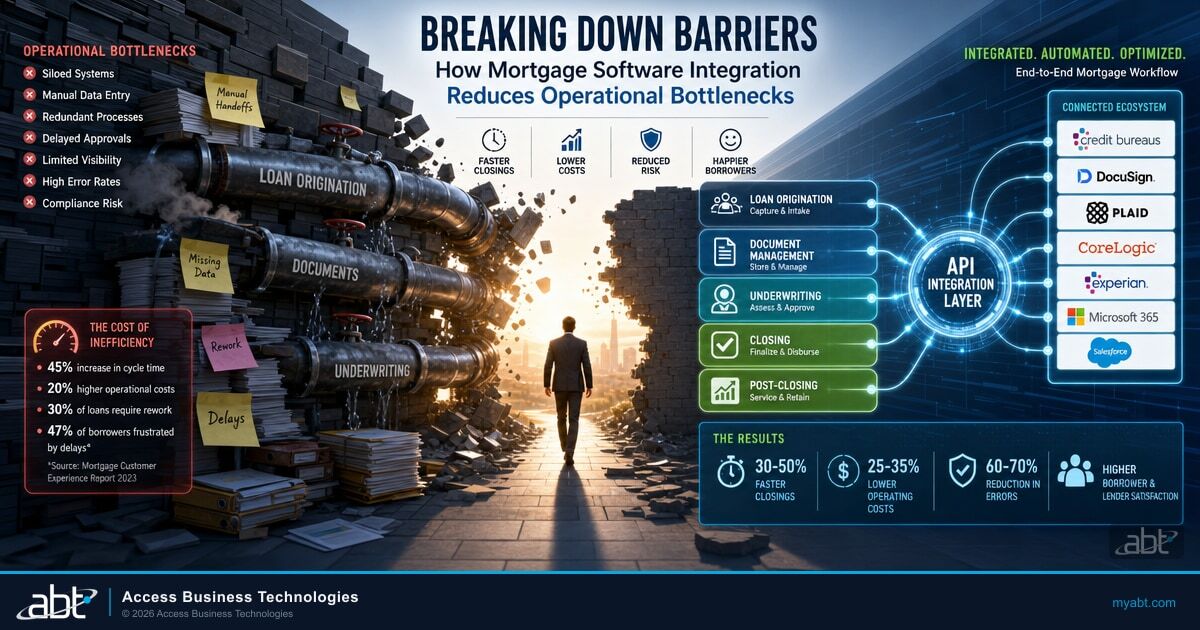
Most mortgage lenders pour a meaningful share of operating budget into technology. Yet much of that investment sits in disconnected systems that create bottlenecks instead of eliminating them. Your loan origination system does not talk to your customer relationship manager. Your document platform does not sync with your compliance engine. Your team fills the gaps with manual work.
The result shows up in the cost to originate. Independent mortgage banks reported total loan production expenses of $11,109 per loan in the third quarter of 2025, according to the Mortgage Bankers Association. A significant portion of that cost comes from the friction between systems that should be connected but are not.
Mortgage software integration fixes these bottlenecks by connecting your platforms into a single workflow. This guide walks through where the biggest bottlenecks hide, the five ways integration eliminates them, and how to evaluate a platform before you commit. For lenders running on Encompass and Calyx, the payoff is measured in faster files and lower per-loan cost.
Where Mortgage Operational Bottlenecks Hide
The Handoff Problem
Every time data moves from one system to another through a person, you have created a bottleneck. The loan officer enters application data in the loan origination system. The processor re-enters borrower details in the document management system. The closer re-keys fee information into the disclosure engine.
Each handoff adds time, introduces error risk, and creates a queue where work stacks up waiting for someone to manually push it forward. Multiply that across a full pipeline and the lost capacity is substantial.
Why This Matters for Financial Institutions
Banks, credit unions, and mortgage companies operate under thin per-loan margins and strict examiner scrutiny. A manual handoff is not just slow. It is an unlogged, unauditable step where a borrower's nonpublic information passes through an email, a spreadsheet, or a copy-and-paste action that no compliance system ever sees.
The Compliance Delay
The CFPB, the Gramm-Leach-Bliley Act, the FTC Safeguards Rule, and state regulators all require specific data at specific times. When your compliance checks run in a separate system from your loan origination system, someone has to export data, run the check, and import the results. That manual round-trip adds hours to every loan file.
AI and automation are now widely cited as the primary levers lenders use to reduce per-loan cost and shorten compliance cycle times. The lenders who keep these checks manual fall behind on both speed and accuracy. Connected compliance is also the foundation for capturing the fair-lending data examiners expect, a theme we cover in our guide on CFPB-proof loan application interfaces.
The Communication Gap
Borrowers call their loan officer for status updates. The loan officer checks one system, then another, then asks the processor. The processor checks their queue. By the time the borrower gets an answer, twenty minutes have passed and three people were interrupted.
Disconnected communication tools cost your team capacity every single day. Self-service borrower interfaces close that gap, which is exactly the pattern that lets lenders move pre-qualification from weeks to minutes.

Five Ways Software Integration Removes Bottlenecks
Automated Data Flow Between Systems
Integration connects your loan origination system, CRM, document platform, and compliance engine so data flows automatically. When a borrower submits an application through your portal, the information populates your loan origination system, triggers a credit pull, and notifies your processor. No re-keying. No waiting.
MortgageExchange handles this automated data flow for credit unions and mortgage lenders, connecting Encompass, Calyx, and other loan origination platforms to core banking systems and CRMs through a single integration layer. One connection replaces dozens of manual handoff points. Lenders using integrated platforms report up to a 70% reduction in manual tasks between borrower and creditor systems.
Real-Time Document Management
Integrated document platforms accept borrower uploads and route them to the right place in the loan file automatically. A W-2 goes to income verification. A bank statement routes to asset documentation. An appraisal report lands in the collateral section.
AI-powered document automation handles this classification in seconds. Manual sorting takes processors fifteen to thirty minutes per file, time that compounds across every loan in the pipeline.
Faster Underwriting Decisions
When your automated underwriting system connects directly to your loan origination system, underwriting decisions happen in minutes instead of hours. Fannie Mae's Desktop Underwriter and Freddie Mac's Loan Product Advisor both offer API-based connections that pull loan data directly from your system, no manual export required. The same API surface is what makes deeper Encompass API integrations possible.
Lenders who maximize these connections report stronger pull-through, adding measurable revenue to annual production. Real-time visibility into pipeline performance is also where a tool like Mortgage BI on Power BI dashboards turns integration data into decisions.
Automated Compliance Monitoring
Integration lets compliance engines monitor your loan data continuously instead of checking it at specific milestones. TRID timelines, fee tolerance calculations, and disclosure accuracy all validate in real time.
When a regulation changes, the compliance engine updates once. Every loan in your pipeline benefits immediately. No manual file-by-file review required.
Borrower Self-Service
Connected systems let borrowers track their own loan status, upload documents, and sign disclosures without calling their loan officer. A large share of borrowers already engage in mortgage activities through mobile devices, and integration is what makes that self-service possible.
Fewer status calls mean more time for your team to focus on the complex files that genuinely need human attention. That borrower-to-secondary-market data path is the backbone of the broader fintech lending ecosystem.
Every manual handoff in your mortgage operation is a bottleneck waiting to slow down your next loan. Integration does not just speed up the file. It makes every step auditable.
How to Choose a Mortgage Integration Platform
Not all mortgage technology platforms integrate the same way. The table below separates real integration from marketing claims. Each criterion is a question to ask any vendor before you sign.
| Capability | What real integration looks like |
|---|---|
| Connection method | Native API connections through published endpoints, not file-based exports |
| Data direction | Bi-directional data flow. Read-only connections create new bottlenecks |
| Error handling | Failed syncs are logged and your team is alerted, never silently dropped |
| Security validation | SOC 2 Type II certification or equivalent independent attestation, with every integration point secured at the API gateway |
| Mortgage fluency | Native understanding of MISMO data standards, ULAD formatting, and GSE submission requirements |
Providers serving more than 750 financial institutions build with these requirements from the start. MortgageExchange was designed to meet every one of these criteria, with native API connections to every major loan origination system, CRM, and servicing platform in the market. If MISMO certification is on your checklist, our guide to what to demand from MISMO-certified partners spells out the questions that matter.
Integration Implementation Checklist
Use this checklist when planning a mortgage software integration project. Work the steps in order. Skipping the audit step is the most common reason integration projects stall.

Ready to connect your mortgage systems?
Two ways to remove the handoffs slowing down your next loan.
Map Your Bottlenecks
Walk through where your loan origination system, CRM, document, and compliance tools hand off work today and where MortgageExchange can close the gaps.
Map Your Integration GapsTalk Through Your Stack
Get a working session on connecting Encompass, Calyx, and your core systems for faster processing and lower origination cost.
Talk to an ABT mortgage integration specialistFrequently Asked Questions
The most common mortgage processing bottlenecks are manual data re-entry between disconnected systems, document routing and classification delays, compliance check round-trips between separate platforms, and fragmented borrower communication across email, phone, and portal channels. These bottlenecks add days to loan timelines and increase origination costs.
Lenders using integrated platforms report meaningfully faster loan closures than disconnected operations. Specific improvements include cutting document verification from a multi-day manual process to hours, reducing manual task volume by up to 70%, and accelerating underwriting decisions from hours to minutes through direct connections between the automated underwriting system and the loan origination system.
Mortgage integration platforms should hold SOC 2 Type II certification, support encryption in transit and at rest, and comply with GLBA data protection requirements. Additional standards include FTC Safeguards Rule technical controls, multi-factor authentication for system access, and audit logging for all data transfers between connected platforms.
Most modern integration platforms connect to legacy loan origination systems through middleware layers and API adapters. ICE Mortgage Technology has shifted Encompass integrations toward cloud-based REST APIs through Encompass Developer Connect, moving away from legacy SDK-style integrations over the past several years. Middleware tools bridge the gap for platforms that still lack native API support.