

In This Article
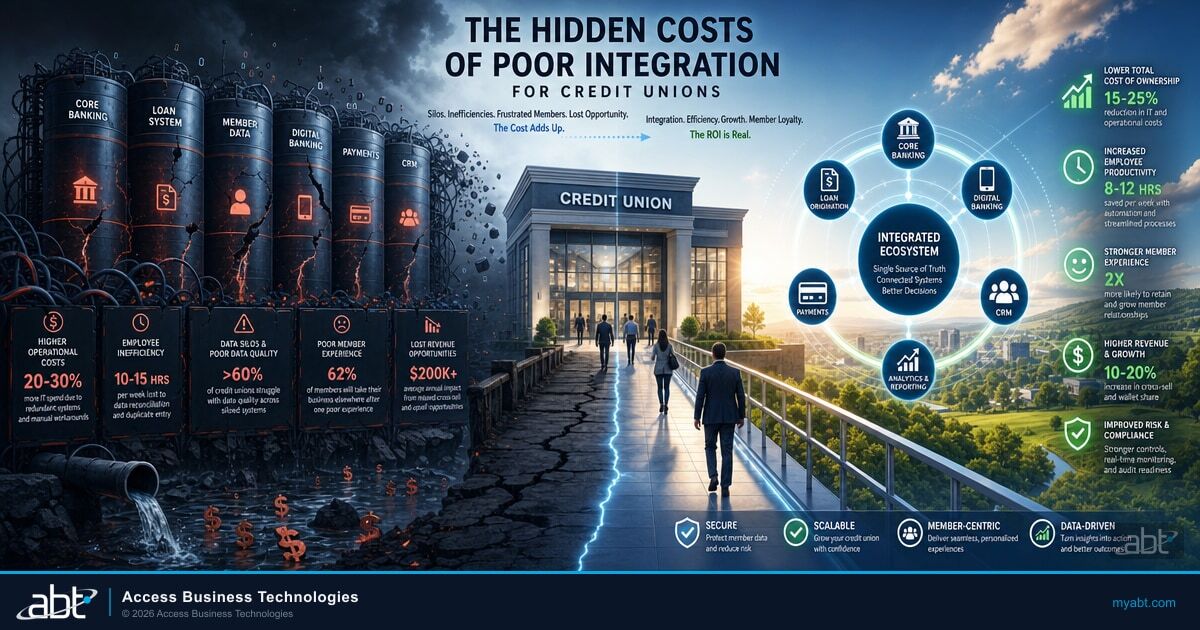
More than half of financial institution leaders now say data silos are a significant barrier to innovation and competitiveness. For credit unions, the problem runs deeper than most leaders realize, because the gaps between systems are paid for quietly, in staff hours and in risk, long before they ever show up on a budget line.
When your loan origination system, core banking platform, and compliance tools do not share data automatically, the gaps get filled by people. People copy numbers between screens. People re-enter borrower information. People catch errors, sometimes, during post-close reviews. Every manual handoff costs money, creates risk, and slows down member service.
This article maps the hidden costs of poor integration and shows what a connected technology stack looks like in practice, from the first online application all the way through loan boarding and examiner-ready reporting.
Compliance Risk From Disconnected Systems
NCUA examiners evaluate how credit unions manage data integrity across systems. When loan data moves between platforms through manual processes, audit trails break. And broken audit trails draw examiner attention. This is the same expectation we unpack in our guide to credit union board IT reporting for NCUA and FFIEC examiners: the board, and the regulator, want to see one consistent version of the truth.
Manual data transfers create gaps where errors slip through undetected. A borrower's income figure typed incorrectly during re-entry might not surface until a quality control review weeks later. By then, the loan may have closed, creating a compliance exception that requires remediation.
The FFIEC IT Examination Handbook requires credit unions to demonstrate that data transfers between systems are accurate, timely, and auditable. Manual processes rarely meet all three criteria at once.
Why This Matters for Credit Unions
An examiner does not just ask whether your numbers are right today. They ask whether you can prove how a number moved from the application, through underwriting, to the core, and into your regulatory reporting. Disconnected systems force you to reconstruct that story by hand, under deadline, every exam cycle.
Common compliance gaps from poor integration:
- Missing or incomplete audit trails between the loan origination system and core systems
- Inconsistent borrower data across platforms that triggers HMDA reporting errors
- Delayed regulatory filings because staff must manually reconcile data before submission
- Inability to produce complete transaction records during examinations
Each of these is a place where a connected stack quietly removes risk. When the same borrower record carries through every system, there is no second copy to drift out of sync. That is also why integration sits at the center of what a managed IT services provider for credit unions should actually deliver, not just uptime, but data that examiners can trust.
Data Accuracy Problems That Compound Over Time
Duplicate data entry is not just inefficient. It is a compounding error source.
Every time a staff member re-enters information from one system into another, there is a chance of introducing a mistake. Over hundreds of loans per month, those small errors accumulate into patterns that distort reporting, trigger false exceptions, and waste staff time on corrections. Data-quality practitioners consistently find that manual keying is one of the most common sources of defects in any records process, and a mortgage loan file is one of the most field-heavy records a credit union handles.
On a single loan file with two hundred or more data fields, even a low per-field error rate translates to multiple mistakes per loan. Some are caught during processing. Others survive to closing, where they become the kind of audit exception we describe in the hidden risks in financial services automation.
Integrated systems eliminate this category of error entirely. When data flows automatically from the loan origination system to the core banking platform, the borrower's name, Social Security number, income, and property address are entered once and propagated everywhere. That is the same single-entry principle behind modern loan origination systems that redefine financial services efficiency.
Every manual handoff between systems is a place where a number can change without anyone deciding to change it. Integration is how you take that decision back.
Member Service Suffers When Systems Are Slow
Members notice when your systems do not keep up. A borrower calls to check loan status. Your member services team opens the core platform, sees outdated information, and has to call the lending department to get a current answer. That phone call takes five minutes. Multiply that across every status inquiry, and you have a service bottleneck that frustrates both staff and members.
Real-time data synchronization between systems means every department sees the same current information. The member services team can answer status questions instantly. The lending team does not get pulled away from processing to field internal inquiries. Strong integration also makes it easier for those teams to break down the operational bottlenecks that slow lending down in the first place.
Member experience is a competitive differentiator. NCUA system performance data show credit union first-mortgage lending continued to grow through 2024, and in a market where borrowers have options, the institutions that close cleanly and communicate clearly win the next transaction. Borrowers who encounter delays or inconsistencies during the loan process are less likely to return.
The Real Financial Cost of Integration Gaps
Poor integration costs more than most credit unions estimate, because the expenses hide in places that standard reporting does not capture.
| Cost type | Where it hides | What it looks like |
|---|---|---|
| Direct cost | Payroll and rework | Staff hours spent on manual data entry, reconciliation, and correcting loans with data discrepancies |
| Compliance cost | Exam remediation | Time and outside help to close audit exceptions that resulted from data gaps between systems |
| Cycle-time cost | Cost per loan | Longer loan cycle times that raise the fully loaded cost of originating each loan |
| Revenue cost | Member relationships | Attrition from poor service, plus missed cross-sell because member data is fragmented across silos |
| Opportunity cost | IT roadmap | IT staff time spent maintaining custom workarounds instead of strategic projects |
Industry research makes the trend hard to ignore. Banking-technology advisory research published on GonzoBanker found that digital investment among financial institutions rose from roughly $220,000 per $1 billion in assets in 2021 to about $425,000 in 2022, and nearly doubled again to about $780,000 per $1 billion in assets in 2023. A large share of that spending went toward integration, because leaders recognized that disconnected systems were costing more than the integration investment itself.
The takeaway
The question is rarely whether you can afford to integrate. It is whether you can keep affording not to. The manual hours, the rework, and the exam remediation are already on your books. Integration moves that spend from firefighting to infrastructure.
What Seamless Integration Looks Like
A fully integrated credit union technology stack moves data automatically at every stage of the lending process.
Application stage: Borrower data entered in the online application flows directly into the loan origination system without re-entry. Credit pulls, income verification, and property data populate automatically through API connections.
Processing stage: Documents uploaded by the borrower are indexed and attached to the loan file. Compliance checks run automatically against NCUA and FFIEC requirements. Conditions are generated and communicated to the borrower through the portal.
Closing stage: Loan data transfers from the loan origination system to the core banking platform automatically upon closing. The new loan appears in the member's account without manual boarding.
Post-close stage: Quality control reviews pull data from both systems for comparison. Reporting to regulators draws from a single source of truth.

This is not theoretical. Credit unions working with integration-focused IT partners achieve this level of connectivity today. The key is having a technology partner that understands both the loan origination system ecosystem, including platforms like Encompass and Calyx, and the core banking platform. We walk through that connected, audit-ready setup in our guide to staying audit-ready with Encompass and Calyx.
The platform underneath matters too. ABT manages each institution's Microsoft 365 tenant and hosts the connected lending applications in its Azure environment, so identity, document storage, and the integrations between systems all sit inside one governed Microsoft cloud rather than scattered across disconnected vendors. That shared foundation is what makes the data flow above dependable instead of fragile, and it is the same backbone we describe in our overview of the fintech lending ecosystem, from borrower apps to secondary market integration.

ABT has worked with credit unions like Chevron Federal Credit Union, Patelco, and Bay Federal Credit Union to build integrations that close data gaps and reduce manual processing. As a Tier-1 Microsoft Cloud Solution Provider serving 750+ financial institutions, ABT brings both the technical depth and the regulatory understanding that credit union integrations require.
Stop paying the hidden tax of disconnected systems
If your credit union is spending staff hours on manual data entry between systems, those hours are costing you more than you think. ABT can assess your current integration gaps and build connections that eliminate manual handoffs, on a governed Microsoft cloud.
Frequently Asked Questions
Data silos create incomplete audit trails that NCUA examiners flag during IT examinations. When loan data exists in disconnected systems without automated reconciliation, the credit union cannot demonstrate data integrity across the lending lifecycle. Examiners look for consistent borrower information, complete transaction records, and documented data flows between all systems that handle member financial data.
Manual data entry is one of the most common sources of error in any records process, and a mortgage loan file carries two hundred or more data fields. Even a low per-field error rate translates to multiple mistakes per loan. Each error requires staff time to identify, research, and correct. Errors that survive to closing create compliance exceptions that require remediation and may trigger additional examination scrutiny.
A fully integrated loan origination to core system moves borrower data automatically from application through closing and loan boarding. Data entered once during the application flows through underwriting, compliance checks, and closing without manual re-entry. Documents upload directly to the loan file. The closed loan boards to the core platform automatically, and both systems share a single source of truth for reporting and quality control.
Credit unions with fewer than 500 employees typically lack the specialized IT staff needed to manage loan origination integrations, core banking API connections, and compliance monitoring simultaneously. A managed service provider with credit union experience handles the technical complexity while the credit union's team focuses on lending and member service. The deciding factor is whether your IT team has deep experience with both your loan origination vendor and your core banking platform.
Microsoft 365 provides the identity, document storage, and collaboration layer, while Azure hosts the lending applications and the integrations that connect them. ABT manages the credit union's Microsoft 365 tenant and hosts the connected applications in its Azure environment, so authentication, data, and system-to-system connections all sit inside one governed Microsoft cloud. That shared foundation makes data flows between the loan origination system and the core platform more reliable and easier to audit than integrations stitched across disconnected vendors.