

In This Article
- What an API Gateway Does in a Financial Institution
- Why Financial Institutions Face Unique API Security Challenges
- Five Business Benefits of API Gateways
- Microsoft Azure API Management as the Canonical Gateway
- Open Banking and Core Banking API Migration
- Evaluating Your API Gateway: What to Check Now
- Building API Architecture for AI-Era Demand
- How ABT Hosts Azure and Layers M365 Guardian Over the Gateway
- Frequently Asked Questions
Gartner projected that more than 30% of the increase in API demand through 2026 would come from AI agents and large language models. For banks, credit unions, and mortgage companies, that means your API infrastructure is no longer just managing system integrations. It is fielding automated queries from borrower-facing AI tools, fintech partner platforms, and intelligent workflow systems that did not exist two years ago.
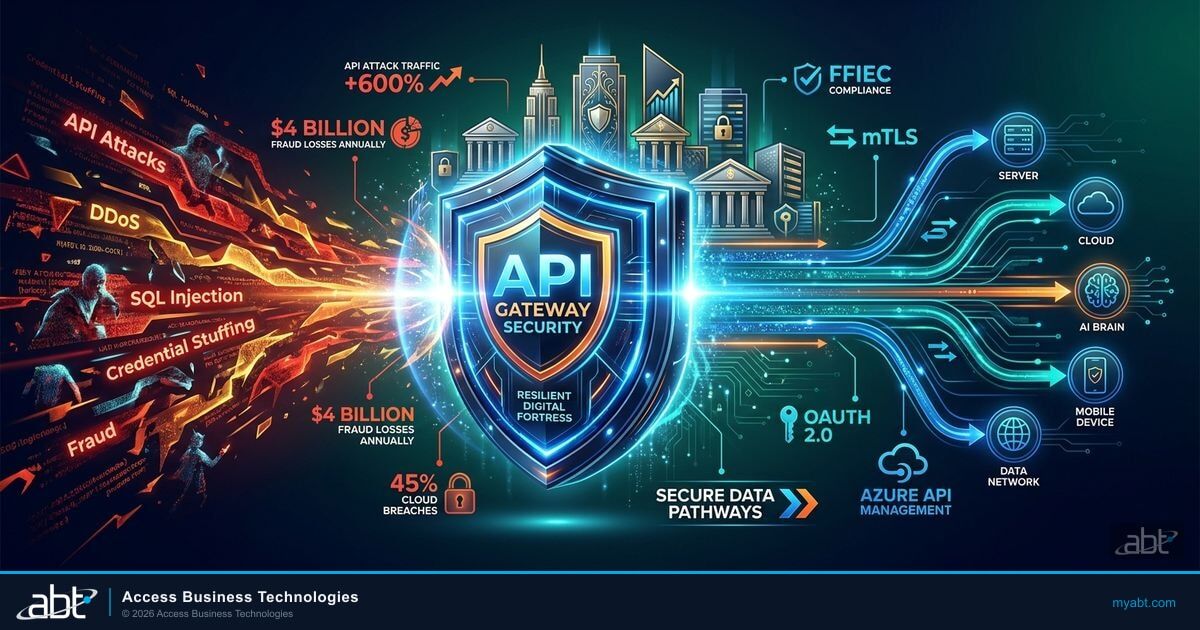
Financial institutions collectively face over $4 billion in API-related fraud losses annually, and API attack traffic has grown by more than 600% in recent years. Meanwhile, only 21% of organizations report strong API attack detection capabilities. In a sector where a single exposed endpoint can put account numbers, Social Security numbers, and transaction histories at risk, those gaps represent direct regulatory and operational exposure.
API gateways sit at the center of this problem. They control who gets in, what data flows where, and how your systems communicate under pressure. Here is how API gateway architecture works in financial services, why it matters more than ever in 2026, and what to look for when evaluating your current setup. Access Business Technologies hosts Microsoft Azure environments for more than 750 financial institutions and runs Azure API Management as the canonical gateway layer over those subscriptions, with M365 Guardian providing the SOC operating model over the top.
What an API Gateway Does in a Financial Institution
An API (Application Programming Interface) is a set of rules that lets different software systems exchange data. Your core banking system talks to credit bureaus through APIs. Your compliance tools pull transaction data for BSA/AML reporting through APIs. Your Microsoft 365 environment exchanges identity and access information with your core through APIs. Your loan origination system connects to income verification services through APIs.
An API gateway is the single entry point that manages all of these connections. Think of it as a security checkpoint and traffic controller combined. Every API request, whether it comes from a mobile banking app, a fintech partner, a Microsoft Power Automate workflow, or an internal compliance tool, passes through the gateway. The gateway verifies credentials, checks permissions, routes the request to the correct backend system, and monitors the entire exchange.
Without a gateway, each integration manages its own authentication, rate limiting, and error handling. A mid-size community bank connecting its core to six or eight third-party services ends up with six or eight separate security configurations, six or eight credential sets to manage, and six or eight potential attack surfaces. A gateway consolidates all of that into one managed layer.
Why This Matters for Financial Institutions
The FFIEC's 2021 Authentication Guidance expanded its scope to explicitly cover system-to-system communications via APIs, not just human user authentication. Examiners now expect banks and credit unions to demonstrate that API connections are secured with the same rigor as user-facing access controls. An undocumented or weakly authenticated API endpoint is a finding waiting to happen.
Why Financial Institutions Face Unique API Security Challenges
Financial institution data is among the most sensitive information any organization handles. A single customer record can contain account numbers, Social Security numbers, transaction history, employment data, and loan details. When APIs transmit this data between systems, every connection point becomes a potential breach vector.
The API security challenges specific to banks, credit unions, and mortgage companies include:
- Regulatory data requirements. GLBA, FFIEC guidance, NCUA regulations, and OCC standards mandate specific protections for customer data in transit and at rest. An API transmitting unencrypted account data between systems does not just create a security risk. It creates a regulatory violation. Under GLBA Safeguards, financial institutions are required to implement encryption for data transmitted over external networks.
- Third-party integration volume. Community banks and credit unions typically connect their core to credit bureaus, online banking platforms, payment processors, fintech partners, compliance monitoring tools, and data aggregators. Each connection expands the attack surface. Many of those integrations were built years apart, using different authentication approaches, and have never been centrally audited.
- Legacy system persistence. Core banking systems from Fiserv, Jack Henry, and FIS have historically relied on point-to-point integration patterns that predate modern API security standards. As these vendors migrate to API-first architectures, institutions running older integration layers face the same migration challenge that mortgage companies experienced with the Encompass SDK sunset: forced modernization under time pressure.
- Third-party vendor risk. APIs do not just expose your systems. They expose your systems through your vendors. The 2025 Marquis Software ransomware breach demonstrated this directly: attackers compromised a marketing and compliance vendor to reach the data of more than 80 banks and credit unions, affecting nearly 824,000 consumers. The entry point was a vendor API connection, not the institutions' own systems.
The Marquis breach illustrates what is at stake when vendor API connections go unmonitored. The gateway had privileged access to customer data across dozens of institutions. None of them controlled the security posture of that connection. A centralized API gateway approach lets you enforce authentication standards and monitor traffic for your side of every third-party connection, even when you cannot control the vendor's infrastructure.
Five Business Benefits of API Gateways
Security drives the gateway conversation, but the operational benefits determine the return on investment.
1. Faster transaction processing through automated data flow. When your gateway manages clean, reliable connections between systems, data moves without manual intervention. Account opening workflows trigger identity verification, compliance screening, and core system updates automatically. Loan applications route through credit pulls, income verification, and document collection without staff intervention at each step. Financial institutions that implement centralized API gateway management typically see measurable reductions in manual data handling and transaction processing time.
2. Reduced development time for new integrations. Adding a fintech partner or a new compliance tool is dramatically simpler when the gateway handles authentication, data formatting, and error handling. Industry analysis indicates that a well-managed API strategy can reduce integration development cycles by as much as 70% to 75% for new vendor connections. For institutions frequently onboarding new tools, that time savings compounds quickly.
3. Real-time visibility into system performance. Because all API traffic flows through the gateway, it becomes the natural monitoring point for your entire technology stack. Response times, error rates, traffic patterns, and usage trends are visible from a single dashboard. When a third-party service starts degrading, your gateway shows it before customers notice it.
4. Scalability without infrastructure overhaul. Rate limiting at the gateway level prevents any single service from overwhelming your systems while ensuring critical operations like real-time payments maintain priority. When transaction volume spikes, the gateway absorbs the load management rather than requiring changes to individual backend integrations.
5. Compliance documentation. The gateway logs every API transaction, creating a complete audit trail of data exchanges between systems. When FFIEC examiners ask how customer data moved through your technology stack, the gateway produces the answer without requiring manual documentation. That same log supports incident response, breach notification timelines under NCUA's 72-hour reporting requirement, and data lineage tracing for BSA/AML purposes.
Microsoft Azure API Management (APIM) is the gateway layer ABT deploys across the Azure subscriptions it hosts for financial institutions. APIM provides centralized credential management, OAuth 2.0 token validation with Microsoft Entra ID as the issuer, mutual TLS termination, rate limiting and throttling, payload transformation, and an integrated web application firewall through Azure Front Door. Because the APIM instance runs inside the financial institution's Azure subscription, it inherits the organization's Microsoft Entra ID identity controls, Conditional Access policies, and Microsoft Purview data governance rules. The same authentication framework that governs employee access to Microsoft 365 governs system-to-system API traffic. Institutions running M365 Guardian already have the Entra ID and Conditional Access baseline in place for secure API gateway deployment, and Guardian's SOC layers Microsoft Sentinel SIEM and Microsoft Defender for Cloud monitoring over the gateway so every API call is correlated against the broader threat picture.

Is Your API Infrastructure Ready for an FFIEC Examination?
ABT helps banks, credit unions, and mortgage companies audit their API security posture against FFIEC authentication guidance and GLBA Safeguards requirements. Start with a readiness assessment.
Microsoft Azure API Management as the Canonical Gateway
Microsoft Azure API Management is the canonical API gateway for financial institutions already standardized on Microsoft 365 and Azure. APIM was purpose-built as a managed Platform-as-a-Service that fronts back-end APIs hosted anywhere, whether the back end runs in the same Azure subscription, in another cloud, on a Fiserv or Jack Henry core, or behind a fintech partner endpoint. The gateway capabilities map directly to the FFIEC and GLBA control areas that examiners grade.
Four APIM capability areas matter most in the financial-services context. First, OAuth 2.0 and OpenID Connect authentication with Microsoft Entra ID as the token issuer. Every inbound API request is validated against Entra ID before the gateway forwards it to the back end, which means the same identity provider that governs employee sign-in to Outlook, Teams, and SharePoint also governs system-to-system API traffic. Second, rate limiting and quota policies expressed in declarative XML policy at the gateway, with per-subscription, per-user, and per-IP limits configurable down to the individual API operation. Third, an integrated Azure Web Application Firewall through Azure Front Door or Application Gateway, which inspects every request against the OWASP Core Rule Set and a managed FFIEC-aware ruleset that blocks API-specific attack patterns including credential stuffing, broken-object-level authorization, and JSON injection. Fourth, end-to-end observability into Azure Monitor and Microsoft Sentinel, which feeds the SOC the data it needs to correlate API anomalies against identity, endpoint, and email signals from the rest of the Microsoft security stack.
Because APIM is a Microsoft-managed PaaS, the financial institution does not patch or operate the gateway VMs. The institution defines policies, publishes APIs, and reviews telemetry. Microsoft runs the underlying infrastructure inside SOC 2 Type II and ISO 27001-certified Azure regions, which gives the institution a clean line in its vendor oversight documentation under amended Regulation S-P and the GLBA Safeguards Rule.
If your institution is working through a cloud migration, the API gateway layer belongs in the architecture from day one. The same applies if you are evaluating BSA/AML compliance tooling connected to Microsoft 365: every integration you add to your M365 environment is an API connection that needs governance.
Open Banking and Core Banking API Migration Are Forcing Change
Two converging forces are pushing financial institutions to modernize their API infrastructure whether they planned to or not.
The first is the CFPB's Section 1033 open banking rulemaking. Finalized in October 2024 and currently subject to active reconsideration, the rule requires financial institutions to expose consumer data through standardized, secure APIs on customer request. Even with enforcement stayed while the CFPB reconsiders the regulation, the largest institutions (those with $250 billion or more in assets) faced an April 2026 compliance window under the original rule. Regardless of how the regulatory process resolves, the technical infrastructure investment required for Section 1033 compliance is real and institutions are building it.
The second force is core banking modernization. Fiserv, Jack Henry, and FIS are all migrating their platform estates toward API-first architectures. Fiserv's CoreAdvance platform consolidates Premier, Precision, and Cleartouch; Jack Henry's cloud-native deposit core is targeting H1 2026 for the $500 million to $5 billion institution market; FIS's Affinity Edge is positioned at upper mid-market. IDC projects that 40% of global banks will pursue sidecar API approaches by 2026 as a way to modernize without full core cutover.
Point-to-Point Integration
- Each vendor manages its own authentication separately
- No centralized visibility across API traffic
- Each new integration requires custom security configuration
- No audit trail linking data movement to specific API calls
- Single vendor failure requires individual troubleshooting per integration
- FFIEC exam prep requires gathering logs from multiple disconnected systems
Centralized API Gateway
- Authentication enforced uniformly across all integrations
- Real-time monitoring dashboard covers every API connection
- New integrations inherit security policies automatically
- Complete, centralized audit trail for regulatory examination
- Rate limiting and failover managed at gateway layer
- Single configuration point for GLBA Safeguards compliance
Institutions treating the core migration as a checkbox exercise, porting each legacy integration to its API equivalent without rethinking the overall architecture, will miss the most important benefit of the transition. This is the right moment to implement centralized gateway management because you are migrating integrations anyway. Doing it once, with a gateway architecture in place from the start, is dramatically less work than retrofitting security controls onto 15 or 20 individual connections after the fact.
Evaluating Your API Gateway: What to Check Now
Whether you are implementing a gateway for the first time or auditing an existing setup, these areas determine whether your API infrastructure is protecting your operation or creating hidden risk. The FFIEC's Authentication Guidance identifies API security as a direct examination focus, so treating this as a compliance readiness exercise is appropriate.
At minimum, enforce API key validation and certificate-based authentication (mTLS) for all financial data connections. Token-based authentication (OAuth 2.0, JWT) should protect any internet-facing APIs. If any production integration still accepts basic username and password authentication, that is your first remediation target.
Only 27% of organizations have fully mapped their API endpoints. Financial institutions often have undocumented APIs running in production, especially older integrations that were never formally decommissioned. A complete inventory is the prerequisite for every other security control. You cannot protect what you have not found.
Your gateway should limit how many requests any single client can make within a time window. This prevents both malicious attacks, including credential stuffing and DDoS, and accidental overload from a misbehaving vendor integration. Without rate limiting, a single failing third-party connection can degrade performance across your entire platform during peak transaction periods.
All API traffic should use TLS 1.2 or higher. Payload-level encryption (AES-256) adds protection for sensitive data fields, including account numbers and Social Security numbers, ensuring that even a compromised connection does not expose readable data. GLBA Safeguards explicitly require encryption for customer data transmitted over external networks.
Your gateway should produce immediate alerts for authentication failures, unusual traffic patterns, error rate spikes, and latency increases. The NCUA's 72-hour breach notification requirement means that reactive monitoring is not an option. You need to know about a problem before regulators or customers tell you about it.
Third-party vendors with API access to your systems represent the same risk as privileged internal users. Review which vendors have active API credentials, confirm that access is scoped to the minimum required data, and implement a rotation schedule for vendor API keys. The Marquis Software breach started with a vendor, not with the institution's own infrastructure.
The Conditional Access policies your institution uses for Microsoft Entra ID should extend to API traffic wherever possible. When API authentication flows through your Azure subscription, you can enforce MFA, location restrictions, and device compliance on system-to-system connections, not just on human users. That is a meaningful security layer that most institutions have not yet activated.

Building API Architecture for AI-Era Demand
AI agents are the newest category of API consumer, and they behave differently from both human users and traditional system integrations. An AI agent making decisions on behalf of a loan officer or compliance team can execute hundreds of API calls in seconds. It can aggregate data across systems that were never meant to share information directly. And if it is compromised or misconfigured, it can exfiltrate data at machine speed.
Your gateway needs to distinguish between legitimate AI agents acting on behalf of authorized staff, partner AI tools accessing your data through approved integrations, and malicious bots probing for misconfigured endpoints or expired credentials. Traditional authentication checks are necessary but not sufficient for this. You also need behavioral analysis: an AI agent that suddenly starts querying customer records outside its normal scope pattern is a signal worth investigating, even if the authentication credentials are valid.
Financial-grade API (FAPI) 2.0 standards, originally built for open banking, are increasingly relevant for any institution running AI agents with API access to financial data. The core requirement is sender-constrained tokens that cannot be replayed if intercepted.
Financial-grade API (FAPI) 2.0 standards require sender-constrained tokens, mutual TLS, and short-lived access credentials. These measures prevent token theft and replay attacks that become significantly more dangerous as AI tools grow more capable. FAPI 2.0 is not just for open banking compliance. It is the right architecture for any system where AI agents have API access to account data, transaction histories, or customer records.
Your API architecture should also support modular integration, where adding a new AI-powered compliance tool or replacing an existing vendor does not require rebuilding your core infrastructure. Gateway-managed connections handle the authentication and routing complexity so your backend systems do not need to change when you onboard a new tool. This is the same principle that makes integration costs manageable for credit unions adding fintech capabilities without replacing their core.
As you evaluate AI tools for your institution, pay particular attention to how they authenticate to your systems and what data they can access. An AI agent with an overly broad API scope is a much more valuable target than a narrowly scoped one. Zero-trust access principles apply to AI agents the same way they apply to human users: minimum required permissions, enforced at the gateway layer, with full logging of every request.
How ABT Hosts Azure and Layers M365 Guardian Over the Gateway
Access Business Technologies is a Tier-1 Microsoft Cloud Solution Provider that manages Microsoft 365 tenants and hosts Microsoft Azure environments for more than 750 financial institutions. The distinction matters. Microsoft owns the M365 infrastructure and ABT manages the customer tenant via delegated admin under Granular Delegated Administrative Privileges (GDAP). Azure subscriptions, by contrast, are customer-controlled cloud infrastructure that ABT operates as the partner of record. When a community bank or credit union runs Azure API Management, the APIM instance, the back-end services it fronts, the Web Application Firewall in front of it, and the Microsoft Sentinel workspace collecting its telemetry all sit inside that customer's Azure subscription, and ABT operates the subscription as the partner.
M365 Guardian is ABT's operating model layered over the Microsoft security stack inside that subscription. For an API gateway deployment, Guardian provides three things on top of the Microsoft baseline. First, Conditional Access policies in Microsoft Entra ID tuned to financial-services risk patterns rather than vendor defaults, so the same identity controls that gate employee sign-in also gate the OAuth 2.0 tokens APIM accepts. Second, a Microsoft Sentinel SIEM deployment with analytic rules that correlate API gateway telemetry against sign-in risk, endpoint posture, email-channel signals, and Microsoft Defender for Cloud findings, so an unusual API traffic pattern lands on the SOC desk with the rest of the threat picture already attached. Third, a 24-by-7 security operations center that triages those alerts, escalates the ones that need human eyes, and produces the evidence record the institution's CCO hands to FFIEC and NCUA examiners on demand. Guardian closes the gap between "we have Azure API Management deployed" and "we know what every API call did, when, and whether anything looked wrong."
Key Takeaway
An API gateway protects what you have integrated; Microsoft Azure API Management plus Microsoft Entra ID plus M365 Guardian protects what you have integrated, gives the institution a single place to enforce authentication and monitoring, and lands the resulting evidence in the same SOC that watches the rest of the Microsoft stack. For a Tier-1 CSP hosting the institution's Azure subscription, the gateway is not a separate product. It is the integration backbone of a Microsoft-managed security posture that satisfies FFIEC examination expectations without bolting another vendor onto the stack.
Ready to Build a Secure API Foundation?
ABT helps banks, credit unions, and mortgage companies design Microsoft Azure API Management gateway architecture that satisfies FFIEC examination requirements, supports Section 1033 data access obligations, and scales for AI-driven integration demand. Our team hosts Azure environments for more than 750 financial institutions and layers M365 Guardian's SOC operating model over every deployment.
Frequently Asked Questions
An API is a connection between two specific systems, such as your core banking platform and a credit bureau. An API gateway is the centralized management layer that handles all of your API connections from one point. The gateway manages authentication, routing, rate limiting, monitoring, and logging for every integration, rather than requiring each connection to manage those functions independently. For financial institutions, the gateway is also the primary compliance control point for FFIEC authentication requirements and GLBA data protection obligations.
The FFIEC's 2021 Authentication Guidance explicitly covers system-to-system API communications, not just human user access. A centralized gateway enforces encryption for all data in transit, manages access credentials to ensure only authorized systems receive customer data, and creates complete audit logs documenting every data exchange. During examinations, institutions can produce a comprehensive record of how customer data moved between systems without manual reconstruction. Centralized logging also supports breach notification timelines, including the NCUA's 72-hour reporting requirement for credit unions.
The CFPB finalized its Section 1033 personal financial data rights rule in October 2024, requiring covered financial institutions to expose consumer transaction data, account balances, and product terms through secure, standardized APIs on customer request. The largest institutions faced an April 2026 compliance window under the original rule, though enforcement is currently stayed while the CFPB undertakes new rulemaking. Regardless of the regulatory timeline, Section 1033 compliance requires building API infrastructure that can securely authorize third-party data access on behalf of account holders, which is the same foundation needed for core banking API modernization generally.
Yes. A Tier-1 Microsoft Cloud Solution Provider that hosts the institution's Azure subscription handles the APIM technical implementation, policy configuration, and ongoing management so the institution does not need to build internal API infrastructure expertise. The key is choosing a partner who understands both the technology and the specific integration requirements for financial institutions, including core banking vendor APIs, fintech partner connections, and regulatory reporting systems. ABT deploys Microsoft Azure API Management inside the Azure subscriptions it hosts for banks and credit unions, which means the gateway inherits existing Microsoft Entra ID identity controls rather than requiring a separate security configuration from scratch. M365 Guardian's SOC then monitors the gateway traffic alongside the rest of the Microsoft stack.
Start with OAuth 2.0 for token-based authentication and mutual TLS (mTLS) for certificate-based verification on all financial data connections. Implement AES-256 payload encryption for sensitive customer data fields including account numbers and Social Security numbers. Enforce TLS 1.2 or higher on all API traffic. As AI-driven API demand increases, evaluate Financial-grade API (FAPI) 2.0 standards, which add sender-constrained tokens and pushed authorization requests to prevent token theft and replay attacks. FAPI 2.0 originated in open banking but applies to any environment where AI agents or automated systems have programmatic access to financial data.
ABT manages Microsoft 365 tenants and hosts Microsoft Azure environments. The distinction matters for vendor oversight documentation. Microsoft owns the Microsoft 365 infrastructure, and ABT manages each customer tenant under Granular Delegated Administrative Privileges as Microsoft's Tier-1 Cloud Solution Provider. Microsoft Azure subscriptions are customer-controlled cloud infrastructure, and ABT operates each subscription as the partner of record. When ABT deploys Azure API Management for a financial institution, the APIM instance, the back-end services it fronts, the Azure Web Application Firewall, and the Microsoft Sentinel workspace collecting telemetry all sit inside the customer's Azure subscription. M365 Guardian is the SOC operating model ABT layers over the resulting Microsoft stack.