

In This Article
- Why Cloud Migration Matters for Banks and Credit Unions Right Now
- Understanding Banking Workflows Before You Migrate
- The Interface Challenges That Derail Cloud Migration
- Practical Solutions for Banking Cloud Integration
- What Cloud Migration Actually Costs (and Saves)
- Five Mistakes That Turn Cloud Migration into a Money Pit
- Why Microsoft Azure Fits Banking Operations
- Frequently Asked Questions
The FFIEC's updated Cloud Computing guidance issued in June 2024 made the regulatory expectation clear: financial institutions moving workloads to the cloud must demonstrate the same risk management rigor they apply to on-premises infrastructure. Meanwhile, OCC guidance and FDIC examination procedures now include specific cloud governance questions. If your community bank or credit union is still running core workloads through on-premises servers, you are building technical debt that compounds with every new regulatory mandate.
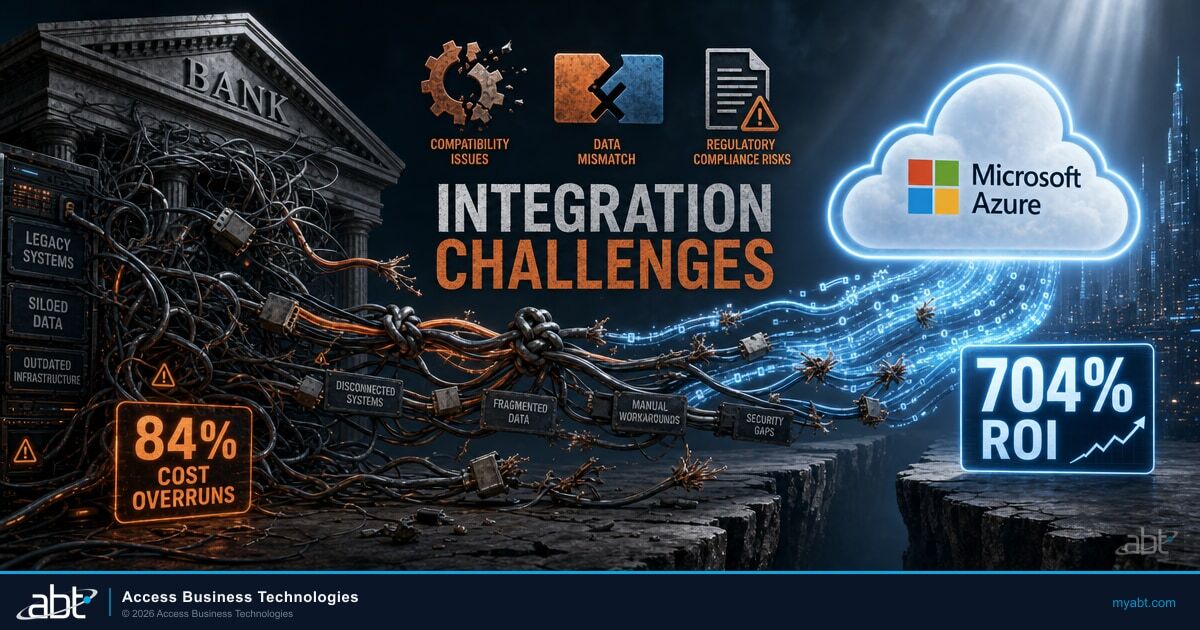
The spending numbers confirm the direction. Nearly 78% of financial firms report increasing IT and cybersecurity spending over the past 12 months. Worldwide public cloud spending is forecast to reach $723 billion in 2025, up 21.5% from 2024. Companies migrating to Azure report a 704% three-year return on investment. Yet while 65% to 80% of financial institutions have a cloud strategy in place, far fewer have actually migrated their core systems. That gap between intention and execution is where banking cloud migration projects fail.
This guide breaks down the real challenges of moving banking operations to the cloud, the integration problems nobody warns you about, and the practical steps that separate a smooth migration from a six-figure headache.
Why Cloud Migration Matters for Banks and Credit Unions Right Now
Banking runs on uptime. Customers expect instant access to account balances, real-time payments, and mobile deposit capture 24 hours a day. On-premises infrastructure was built for a different era, one where transaction volume was predictable and regulatory changes happened annually, not quarterly.
Three forces are pushing financial institutions toward cloud adoption faster than any vendor pitch:
Regulatory velocity is accelerating. The FFIEC issued updated cloud computing guidance in 2024. The OCC's bank information technology examination handbook now includes dedicated cloud governance sections. NCUA examiners ask credit unions specifically about cloud vendor management and data residency. The Federal Reserve's 2025 cybersecurity report to Congress emphasized cloud resilience as a priority. On-premises systems need manual updates for each regulatory change. Cloud-native platforms pull those updates through APIs and managed services.
Hybrid and remote work is permanent. Loan officers, tellers trained for universal banking, and back-office staff work from branch locations, home offices, and satellite sites. VPN connections to on-premises servers create latency that slows document retrieval and kills productivity. Cloud platforms deliver the same performance regardless of location.
AI requires cloud infrastructure. Automated fraud detection, document classification, and predictive risk scoring all depend on scalable compute resources that on-premises hardware cannot provide cost-effectively. 85% of Fortune 500 companies run on Azure. The compute demands of AI workloads are accelerating cloud adoption across financial services.
Understanding Banking Workflows Before You Migrate
Migrating to the cloud without mapping your workflows first is like remodeling a building without blueprints. You will tear out walls you needed and miss the pipes that matter.
A typical banking workflow runs through four operational pillars. Each has different cloud migration requirements:
Core Banking and Deposits: Account opening, transaction processing, general ledger, and real-time payment rails including FedNow. This pillar generates the most data and involves the most third-party integrations (payment processors, card networks, ACH operators). Cloud migration here means API connections, not file transfers. Core banking platforms from Fiserv, FIS, and Jack Henry each have different cloud compatibility profiles.
Lending and Underwriting: Loan origination, credit decisioning, collateral management, and automated underwriting. This is compute-intensive work. Cloud infrastructure lets you scale processing power during volume spikes without buying hardware that sits idle during slow months.
Compliance and BSA/AML: Suspicious Activity Report filing, Currency Transaction Reports, OFAC screening, and ongoing regulatory reporting. This pillar requires real-time data access across multiple systems. Cloud-based compliance platforms eliminate the batch processing delays that create gaps in transaction monitoring.
Customer-Facing Digital Services: Online banking, mobile apps, digital account opening, and self-service platforms. This is where user expectations grow without limit. Cloud infrastructure scales automatically to handle peak loads. On-premises infrastructure requires purchase orders, rack space, and IT staff to maintain.
Most migration failures happen because institutions treat these four pillars as one project. They are four separate migrations with different priorities, risk profiles, and timelines.
The Interface Challenges That Derail Cloud Migration
Here is what the cloud vendor brochures will not tell you: the hardest part of banking cloud migration is not moving data. It is keeping your systems talking to each other after you move them.
Legacy Core Integration
Your core banking platform was probably implemented 10 to 20 years ago. It expects specific database connections, file-based data exchanges, and network protocols that do not exist in cloud environments. Fiserv DNA, FIS Horizon, Jack Henry Symitar, and similar platforms each have different cloud compatibility profiles. Some offer cloud-hosted versions. Others require middleware that adds cost and complexity.
Data Format Mismatches
On-premises systems often store data in proprietary formats. Cloud platforms expect standardized APIs and JSON or XML data structures. The translation layer between these formats is where data gets corrupted, fields get dropped, and transaction records lose critical information.
Security and Compliance Gaps
Banking data falls under GLBA, the FFIEC IT Examination Handbook, OCC heightened standards, NCUA regulations, and state-specific requirements. Cloud environments handle security differently than on-premises networks. Conditional Access policies, identity management, encryption at rest and in transit, and audit logging all need configuration specific to banking compliance requirements.
Hybrid Environment Complexity
Most financial institutions cannot migrate everything at once. You end up with some systems in the cloud and others on-premises. That hybrid environment creates synchronization challenges, network routing complexity, and security blind spots where data moves between the two environments.
Performance and Latency
When a teller pulls up a customer account, they expect it in under two seconds. Route that request through a poorly configured cloud environment, and it takes 15 to 30 seconds. Do that across 50 employees processing hundreds of transactions per day, and you have lost a full-time employee's worth of productivity to waiting.
FFIEC Cloud Computing Guidance: What Examiners Will Ask
The FFIEC's 2024 cloud computing guidance requires financial institutions to evaluate cloud service providers with the same rigor as any critical third-party vendor. Examiners will ask for documented risk assessments, data classification policies, incident response procedures specific to cloud environments, and evidence that your institution maintains control over customer data regardless of where it physically resides. Institutions that cannot demonstrate these controls face MRAs (Matters Requiring Attention) or worse.
Practical Solutions for Banking Cloud Integration
Every challenge above has a proven solution. The difference between a successful migration and a failed one is execution order.
Start with an Integration Audit
Before touching any infrastructure, document every system-to-system connection in your current environment. Map data flows between your core banking platform, digital banking channels, card processing, compliance tools, and third-party services. Identify which connections use APIs (easy to migrate), file transfers (moderate), or direct database links (hardest).
Build Your Identity Layer First
Microsoft Entra ID provides the identity foundation that every other cloud service depends on. Configure Conditional Access policies, multi-factor authentication, and role-based access controls before migrating any workloads. This prevents the security gaps that regulators flag during exams.
Migrate in Waves, Not All at Once
Wave 1: Email, collaboration tools, and document storage (lowest risk, highest visibility). Wave 2: Business applications and reporting tools. Wave 3: Core banking connections and lending systems. Each wave gets its own testing cycle, rollback plan, and user training period.
Use Middleware for Legacy Connections
Azure Logic Apps and API Management bridge the gap between legacy core banking interfaces and cloud-native services. These tools handle protocol translation, data format conversion, and error handling without requiring changes to your legacy systems.
Implement Zero-Trust Security from Day One
Do not migrate first and secure later. Every cloud resource should require authentication, every data transfer should be encrypted, and every access attempt should be logged. Microsoft Defender for Cloud provides continuous security assessment and compliance monitoring across hybrid environments.
What Cloud Migration Actually Costs (and Saves)
Cloud vendors love to quote percentage savings. Here are the numbers that hold up under scrutiny:
Infrastructure maintenance: Financial institutions report up to 35% reduction in infrastructure maintenance costs after cloud migration. That includes hardware refresh cycles, data center power and cooling, and the IT staff dedicated to keeping physical servers running.
Time-to-market: Cloud-native financial services companies report a 58.4% reduction in time-to-market for new services. For banks and credit unions, that means faster deployment of new digital banking features, compliance updates, and customer-facing tools.
Total cost of ownership: Core banking system TCO drops by 26.8% on average after cloud migration. Companies migrating to Azure report a 704% three-year ROI. But these savings typically take 12 to 24 months to materialize. Budget for a temporary increase in IT costs during the migration period.
The hidden cost nobody mentions: 84% of financial services organizations without formal FinOps practices experience cost overruns exceeding 30% of initial estimates. Cloud spending without governance is cloud spending out of control. Set budget alerts, review monthly usage reports, and assign someone to own cloud cost management from the start.
Five Mistakes That Turn Cloud Migration into a Money Pit
1. Lifting and shifting without re-architecting. Moving a poorly designed on-premises application to the cloud gives you a poorly designed cloud application that costs more to run. Evaluate each workload for cloud optimization before migration.
2. Ignoring compliance during the transition period. GLBA, FFIEC examination procedures, and state regulations do not pause while you migrate. Your hybrid environment must meet every compliance requirement at every stage of the migration, not just at the endpoint.
3. Underestimating change management. Your operations staff have used the same systems for years. Dropping them into a new interface without proper training and a feedback loop creates resistance, workarounds, and errors that erode every efficiency gain the cloud was supposed to deliver.
4. Skipping the rollback plan. Every migration wave needs a documented rollback procedure. If Wave 2 breaks something, you need to revert to the pre-migration state within hours, not days. Test the rollback before you need it.
5. Choosing the wrong cloud partner. A cloud partner who has never worked with banking compliance requirements will learn on your dime. Look for partners with specific financial services experience, SOC 2 Type II certification, and a track record with GLBA, FFIEC, and OCC compliance.
Accenture Banking Cloud Survey, 2025"About 64% of financial institutions use hybrid cloud architectures. The institutions that succeed treat hybrid as a deliberate architecture, not a byproduct of an incomplete migration."
Why Microsoft Azure Fits Banking Operations
Microsoft Azure holds 21% of the global cloud market share and grew revenue 33% year over year. 85% of Fortune 500 companies use Azure. But market share alone does not tell the story. Azure's advantage for banks and credit unions is the Microsoft ecosystem that wraps around it.
Entra ID + Conditional Access provides the identity and access management layer that regulators expect. Configure policies that restrict access by device compliance, location, risk level, and user role.
Microsoft 365 + SharePoint handles the document management and collaboration that banking workflows depend on. Loan files, compliance documents, and board reports live in a single platform with version control, audit trails, and granular permissions.
Intune + Defender secures the endpoints (laptops, tablets, phones) that employees use across branches and remote locations. Device compliance policies enforce encryption, OS updates, and app restrictions without IT staff physically touching each device.
Power Automate + Logic Apps builds the workflow automation that connects legacy core systems to cloud-native services. Automate document routing, notification workflows, and data validation without writing custom code.
Access Business Technologies (ABT) manages this entire stack for 750+ financial institutions as a Tier-1 Microsoft Cloud Solution Provider. ABT does not sell licenses and walk away. ABT configures, hardens, integrates, monitors, and maintains the cloud environment that banks and credit unions depend on.
"Cloud migration is not a technology project. It is an operations project with technology components. The institutions that get it right start with workflows, not servers."
Serving 750+ financial institutions since 1999
Get a Migration Roadmap Built for Banking
ABT's technical assessment maps your current infrastructure, identifies integration risks, and delivers a phased migration plan built around your compliance requirements.
Frequently Asked Questions
A phased cloud migration for a community bank or credit union typically takes 6 to 18 months depending on system complexity, the number of third-party integrations, and organizational size. The first wave covering email and collaboration tools can complete in 4 to 6 weeks, while core banking system migration requires 3 to 6 months of planning, testing, and staged rollout.
Banking data in the cloud must comply with GLBA data protection requirements, the FFIEC IT Examination Handbook including the 2024 cloud computing guidance, OCC heightened standards for large banks, and NCUA regulations for credit unions. Cloud environments also need SOC 2 Type II certified hosting, encryption at rest and in transit, audit logging, and access controls that satisfy examiner expectations during IT examinations.
Financial institutions report infrastructure maintenance cost reductions of up to 35% and total cost of ownership reductions averaging 26.8% after cloud migration. Organizations migrating to Azure report a 704% three-year ROI. These savings come from eliminating hardware refresh cycles, reducing data center expenses, and shifting to pay-as-you-go pricing. Most institutions see full cost benefits within 12 to 24 months.
Yes, and most do. About 64% of financial institutions use hybrid cloud architectures that combine on-premises and cloud resources. Hybrid environments work well when properly configured with secure network connections, synchronized identity management, and clear data governance policies that define which workloads run where. The FFIEC's 2024 guidance addresses hybrid architectures specifically.
Look for a partner with SOC 2 Type II certification, specific experience with financial services compliance including GLBA, FFIEC, and federal banking agency examination procedures, and deep Microsoft ecosystem expertise if you run a Microsoft-based stack. The partner should handle licensing, configuration, security hardening, and ongoing monitoring as a single relationship rather than separate vendors for each function.