

In this article:
- Why Financial Institutions Need Specialized Managed IT
- M365 Guardian: The Managed-IT Operating Model for FIs
- Core Capabilities to Evaluate
- Red Flags That Should End the Conversation
- Microsoft 365 Managed Services for Regulated Environments
- Cloud Managed Services and Virtual Desktops
- IT Compliance for Financial Services
- How to Choose the Right Provider
- Frequently Asked Questions
Most managed IT providers sell the same pitch: "We'll handle your technology so you can focus on your business." That's fine for a retail chain. It falls apart the moment a regulator walks through your door.
Financial institutions don't just need IT support. They need managed IT services for financial institutions that understand compliance frameworks, data classification rules, and what happens when an examiner asks for your incident response documentation. The gap between a generic MSP and a provider built for regulated environments isn't a feature difference. It's a risk difference.
This guide covers what to evaluate, what to avoid, and how Access Business Technologies, a Tier-1 Microsoft Cloud Solution Provider that manages Microsoft 365 tenants for more than 750 financial institutions, packages the right managed-IT services into a named operating model called M365 Guardian.
Why Financial Institutions Need Specialized Managed IT Services
Credit unions face NCUA examiners. Mortgage lenders deal with CFPB audits and investor reviews. Community banks answer to OCC and FDIC oversight. Every one of these institutions operates under a regulatory framework that treats IT failures as compliance violations, not just operational problems.
Generic managed IT providers aren't built for this. They'll patch your servers and reset passwords, but they won't know what a Conditional Access policy gap means during an FFIEC cybersecurity assessment. They won't understand why a misconfigured DLP rule puts borrower data at risk or why your Microsoft 365 tenant needs hardening beyond the defaults.
The result? Organizations end up managing two problems: their actual technology and the gap between what their provider delivers and what their regulator expects.
Not All Managed IT Is Built for Banking
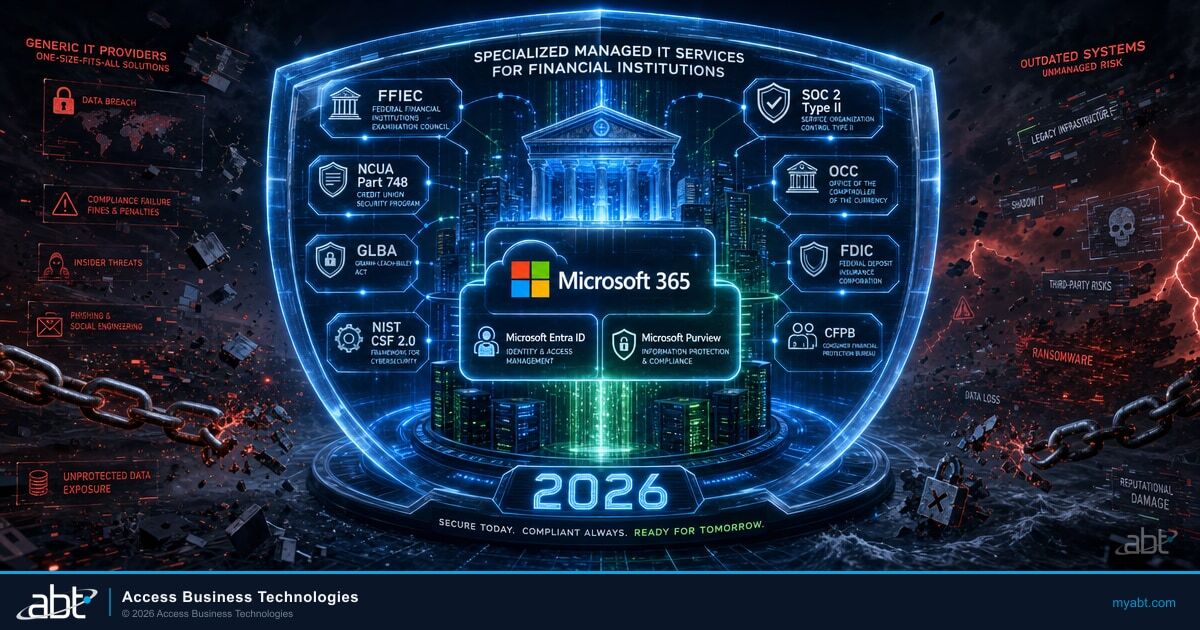
Generic MSPs don't understand FFIEC, NCUA, or GLBA. ABT has spent 25+ years building IT infrastructure specifically for financial services.
M365 Guardian: The Managed-IT Operating Model for Financial Institutions
For most financial institutions, the right answer to "what should managed IT services look like?" is a Microsoft-baseline platform run by a partner that specializes in your regulatory vertical. The platform is what Microsoft provides through Microsoft 365 and Azure. The specialized operating model is what ABT delivers on top of it. That layered model has a name: M365 Guardian.
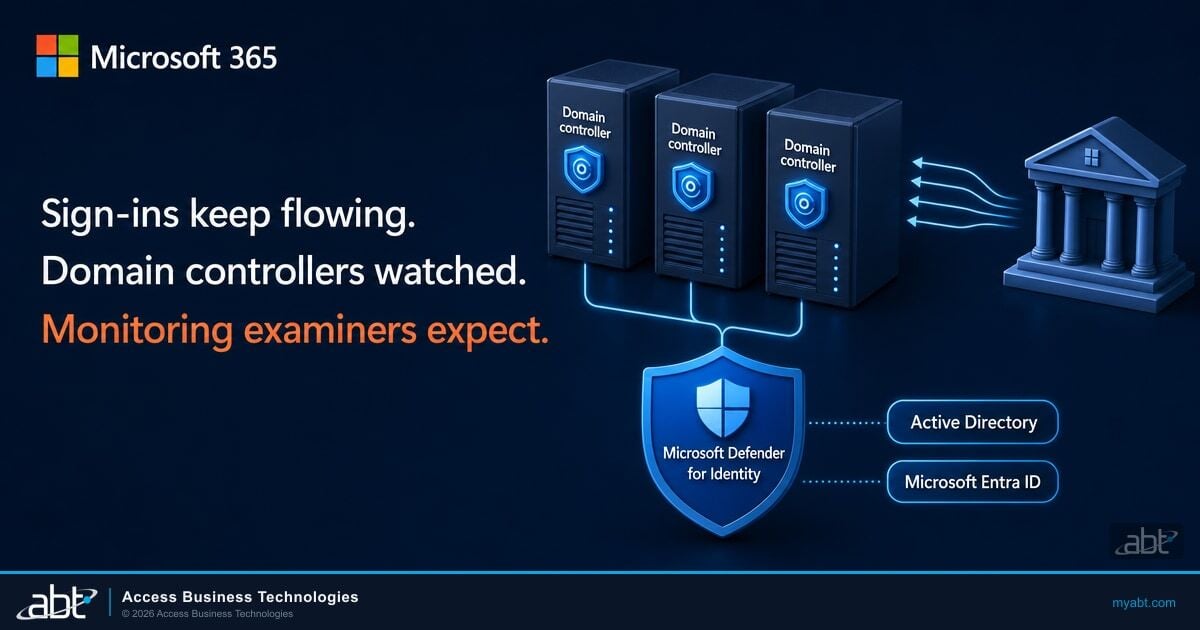
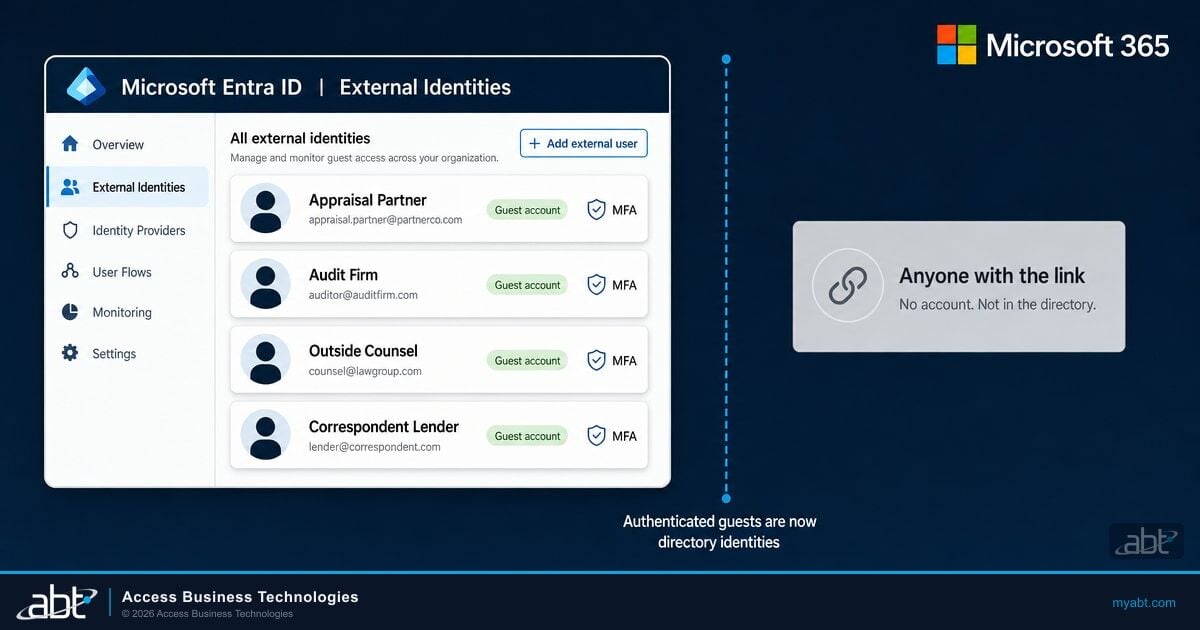
Microsoft owns the platform. Microsoft Entra ID supplies identity (multi-factor authentication, Conditional Access, sign-in risk, Privileged Identity Management). Microsoft Intune enrolls and posture-checks every device that touches institution data. Microsoft Defender for Office 365 and Microsoft Defender for Endpoint handle the active threat side. Microsoft Purview holds up the books-and-records side with Audit, DLP, retention, and Communication Compliance. Microsoft Sentinel aggregates everything into a SIEM that satisfies FFIEC, NCUA, and SEC incident-detection expectations. Microsoft 365 Lighthouse is the multi-tenant control plane that lets a partner apply consistent settings across every tenant in the institution's footprint.
That stack is available to any Microsoft customer. What's not available off the shelf is the operating model that turns the stack into ready-to-hand examiner evidence. That's the Guardian layer.
M365 Guardian is ABT's named managed-IT-for-FIs operating model on top of the Microsoft 365 platform. It includes a 24/7 security operations center watching the Defender and Sentinel signals every minute of the day; Microsoft Entra ID Conditional Access policies tuned to community-bank, credit-union, and mortgage-lender risk profiles; Microsoft Purview DLP and retention policies aligned to FFIEC IT Examination Handbook, NCUA Part 748, and GLBA Safeguards Rule expectations; Microsoft Sentinel analytic rules calibrated to FI attack patterns rather than vendor SMB defaults; Microsoft Intune compliance baselines that cover branch laptops, loan-officer mobile devices, and remote-work scenarios. ABT manages the Microsoft 365 tenant under delegated admin. The institution keeps its licenses, its data, and its regulatory relationships. ABT operates the controls and produces the examiner evidence.
The point of naming the operating model is to draw a clean line between the platform decision (Microsoft 365) and the partner decision (which CSP). The platform decision is largely settled inside most financial institutions. The partner decision is where the institution either gets managed IT that maps to its regulator, or gets generic SMB advice dressed up as financial-services expertise.
Core Capabilities Every Managed IT Provider Should Offer
When evaluating managed IT services for financial institutions in 2026, these aren't differentiators. They're the floor.
Identity and Access Management
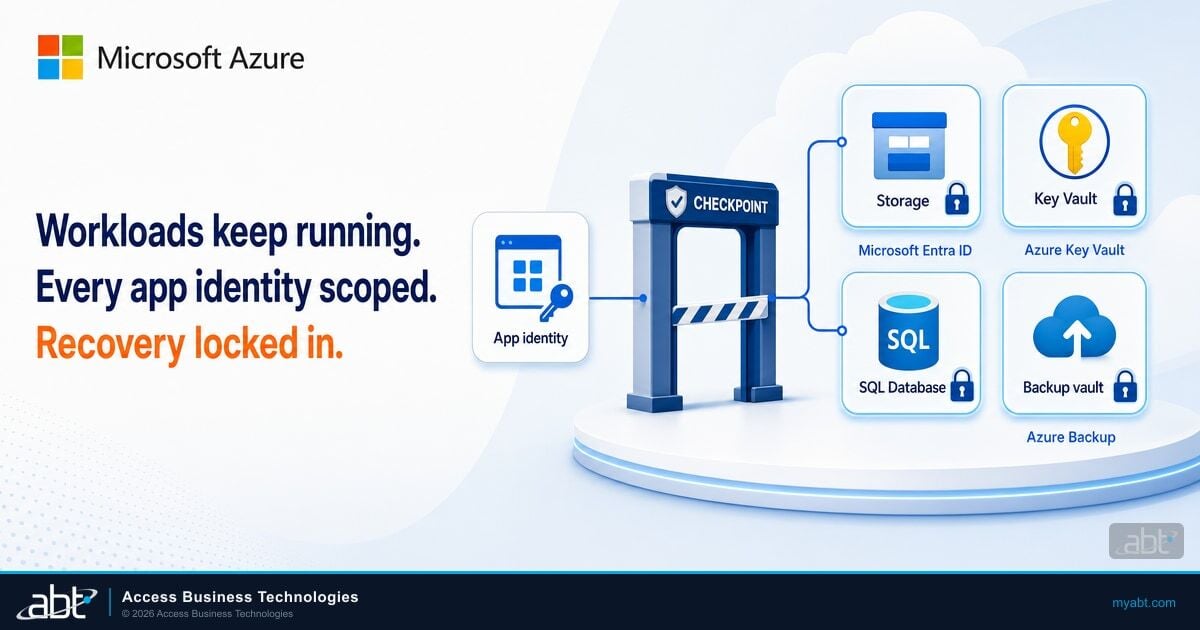
Multi-factor authentication across every account. No exceptions for service accounts, no "temporary" bypasses that become permanent. Conditional Access policies that enforce device compliance, location restrictions, and risk-based sign-in challenges. If your provider can't explain their Entra ID configuration in detail, they aren't managing identity. They're hoping nobody tests it.
Endpoint Protection and Continuous Monitoring
Every device that touches your environment needs managed security services covering detection, response, and remediation. That includes the laptops, the phones, and the virtual desktops. Continuous monitoring means someone's watching the alerts at 2 a.m. on a Saturday, not just reviewing logs on Monday morning.
Managed Security Services Built for Compliance
Security and compliance aren't the same thing, but in financial services, they're inseparable. Your managed IT provider should deliver security controls that map directly to your regulatory framework. SOC 2 Type II, NIST 800-53, NIST CSF 2.0 (the FFIEC's post-CAT successor reference since August 2025), NCUA Part 748. If they can't tell you which controls address which requirements, you're building compliance evidence from scratch during your next exam.
Red Flags That Should End the Conversation
We've seen organizations waste years with providers that couldn't keep up. The warning signs are consistent:
- Security is an add-on tier. If you have to pay extra for MFA enforcement or endpoint protection, that provider doesn't understand regulated environments. Security is the baseline, not the premium package.
- No compliance experience. Ask them to name three regulatory frameworks they've supported. If the answer is vague, move on.
- Reactive support model. "Call us when something breaks" doesn't work when a ransomware attack freezes your loan origination system or locks your core banking platform during business hours.
- One-size-fits-all infrastructure. A credit union with 150 employees and a mortgage company with 500 loan officers need fundamentally different architectures. If the provider has one template, neither institution gets what it needs.
- No Microsoft 365 depth. M365 is the primary platform for most financial institutions. If the provider treats it as "just email," they'll miss the security, compliance, and governance capabilities that actually matter.
Microsoft 365 Managed Services for Regulated Environments
Default Microsoft 365 configurations weren't designed for financial institutions. They're designed for everyone, which means they're optimized for no one in particular. Your provider should include Microsoft 365 managed services that go well beyond the initial setup.
That means licensing optimization that matches actual usage patterns instead of over-provisioning E5 licenses across the entire org. It means tenant hardening that configures data loss prevention policies, sensitivity labels, and retention rules specific to your regulatory requirements. And it means continuous monitoring for configuration drift, because the secure tenant you built in January won't stay secure by June if nobody's watching.
The pattern other financial institutions use for this work is documented in detail in the Lighthouse deployment guide for broker-dealers, which walks through how a Tier-1 CSP applies a consistent baseline across multiple tenants and produces cross-tenant audit evidence on demand. The same approach applies to credit unions with multiple charters, community banks with multiple subsidiaries, and mortgage companies operating under multiple state licenses.
ABT manages Microsoft 365 environments for over 750 financial institutions. That's not a feature list. It's pattern recognition across thousands of tenants that tells us where the real risks hide. Buyers comparing CSPs in this space often start with why CIOs are choosing ABT for Microsoft 365 licensing.
Cloud Managed Services and Virtual Desktops
Remote and hybrid work aren't temporary accommodations anymore. They're how financial institutions operate. Cloud managed services need to account for this reality without creating new security gaps.
Secure virtual desktops keep sensitive data off local devices entirely. A loan officer working from home processes applications on a virtual desktop where the data never leaves the secure environment. When that session ends, there's nothing on the personal device to steal, lose, or subpoena.
But virtual desktops are only as strong as the infrastructure behind them. Your cloud managed services provider should handle the compute, storage, networking, patching, and monitoring. If they hand you a virtual desktop and walk away, you've just moved the management burden from one platform to another.
IT Compliance for Financial Services
IT compliance for financial services isn't a project. It's a continuous operation. Your managed IT provider should understand that compliance evidence is generated daily through logging, monitoring, access reviews, and policy enforcement. When the examiner arrives, the documentation should already exist.
Every vertical has its own framework:
- Credit unions: NCUA Part 748, NIST CSF 2.0 (the FFIEC's post-CAT reference), annual IT examinations
- Mortgage lenders: CFPB oversight, TRID disclosure requirements, investor security questionnaires
- Community banks: OCC and FDIC examinations, GLBA safeguards, BSA/AML technology requirements
- All regulated institutions: SOC 2, NIST 800-53, incident response documentation
A managed IT provider that serves financial institutions should be producing audit-ready documentation as a byproduct of their normal operations, not scrambling to create it when your exam is scheduled. For institutions still working through licensing fundamentals first, see why credit unions can't afford cheap Microsoft 365 licenses as a starting point.
How to Choose the Right Managed IT Provider
Before signing a managed services agreement, ask these questions. The answers will tell you whether the provider understands your environment or is just saying what you want to hear.
- Which regulatory frameworks have you supported in the last 12 months? Can you provide references?
- How do you handle Microsoft 365 tenant hardening and configuration monitoring?
- What's your incident response process, and what's the average time to containment?
- How do you support compliance evidence generation between audit cycles?
- Can your infrastructure scale with seasonal volume changes without downtime?
- Do you provide managed security services in-house, or do you subcontract to a third party?
The right managed IT provider doesn't just keep the lights on. They reduce regulatory risk, strengthen your security posture with specific controls, and produce the documentation your examiners expect before you ask for it. For financial institutions, the cleanest available answer is a Microsoft-baseline platform run under a named operating model like M365 Guardian, delivered by a Tier-1 CSP that specializes in the regulatory verticals you live under.
Key Takeaway
Managed IT for financial institutions is not a generic MSP product. It is a Microsoft-baseline platform plus an operating model tuned to FFIEC, NCUA, OCC, FDIC, CFPB, and SEC examination expectations. ABT delivers that combination as M365 Guardian, applies it across more than 750 financial institutions as a Tier-1 Cloud Solution Provider, and produces the examiner evidence the institution's CIO and chief compliance officer need before exams open.
Your IT Provider Should Specialize in Financial Services
ABT doesn't just manage IT for financial institutions, we secure it against the specific threats and regulatory requirements targeting your industry. A 30-minute conversation maps your current Microsoft 365 footprint, surfaces the gaps your next examiner is most likely to find, and outlines what an M365 Guardian deployment would cover.
Frequently Asked Questions
Financial institutions should evaluate managed IT services based on regulatory compliance experience, Microsoft 365 depth, security operations maturity, and cloud infrastructure capabilities. The provider should demonstrate SOC 2 attestation, dedicated compliance support, and direct experience with frameworks like FFIEC, NCUA, and NIST relevant to the institution's specific regulatory vertical.
M365 Guardian is ABT's named operating model for managed IT services delivered to financial institutions. The platform layer is Microsoft 365, which includes Microsoft Entra ID for identity, Microsoft Intune for device management, Microsoft Defender for threat protection, Microsoft Purview for compliance and records, and Microsoft Sentinel for SIEM. The Guardian operating model layers a 24/7 security operations center, FFIEC- and NCUA-tuned Conditional Access and DLP policies, Sentinel analytic rules calibrated to financial-services attack patterns, and audit-ready evidence production on top of that Microsoft baseline. Guardian is delivered through ABT's Tier-1 Cloud Solution Provider relationship with Microsoft.
Credit unions operate under NCUA examination requirements with emphasis on member data protection and core system security. Mortgage lenders face CFPB oversight focused on disclosure compliance and borrower data handling. Both need security-first IT management, but the compliance frameworks and operational workflows differ significantly. ABT tunes its M365 Guardian operating model to the specific framework, not a generic SMB baseline.
Default Microsoft 365 configurations lack the security controls financial regulators expect. Managed services provide tenant hardening, data loss prevention policies, sensitivity labeling, Conditional Access enforcement, and continuous monitoring for configuration drift. Without active management, security settings degrade over time, exposing the organization to data loss, unauthorized access, and regulatory findings during examinations.
Managed IT services cover the full technology stack including infrastructure, cloud platforms, endpoint management, and user support. Managed security services focus specifically on threat detection, incident response, vulnerability management, and security monitoring. Financial institutions typically need both capabilities from a single provider, delivered as one operating model rather than two separate contracts.
Pricing varies based on user count, compliance requirements, and service scope. Financial institutions typically pay more than general businesses because regulated environments require deeper security controls, compliance documentation, and specialized expertise. Request a scoped proposal rather than comparing generic per-user pricing across providers.