

In This Article
- Why Healthcare Nonprofits Are on the Target List Right Now
- The October 2025 Microsoft Policy Change Most Healthcare Nonprofits Missed
- The Math That Changes the Conversation
- The July 1, 2026 Pricing Deadline
- The OCR Pattern Behind Every 2026 Settlement
- The Three-Step Playbook for Mission-Driven Healthcare
- How M365 Guardian Fits Healthcare Nonprofits
- Frequently Asked Questions
A federally qualified health center in the Mountain West runs on 28 staff, serves 11,000 patients a year, and has a part-time IT contractor as its entire technology function. None of that should matter to a ransomware crew running a credential-harvesting playbook. None of it DOES matter, which is exactly the problem.
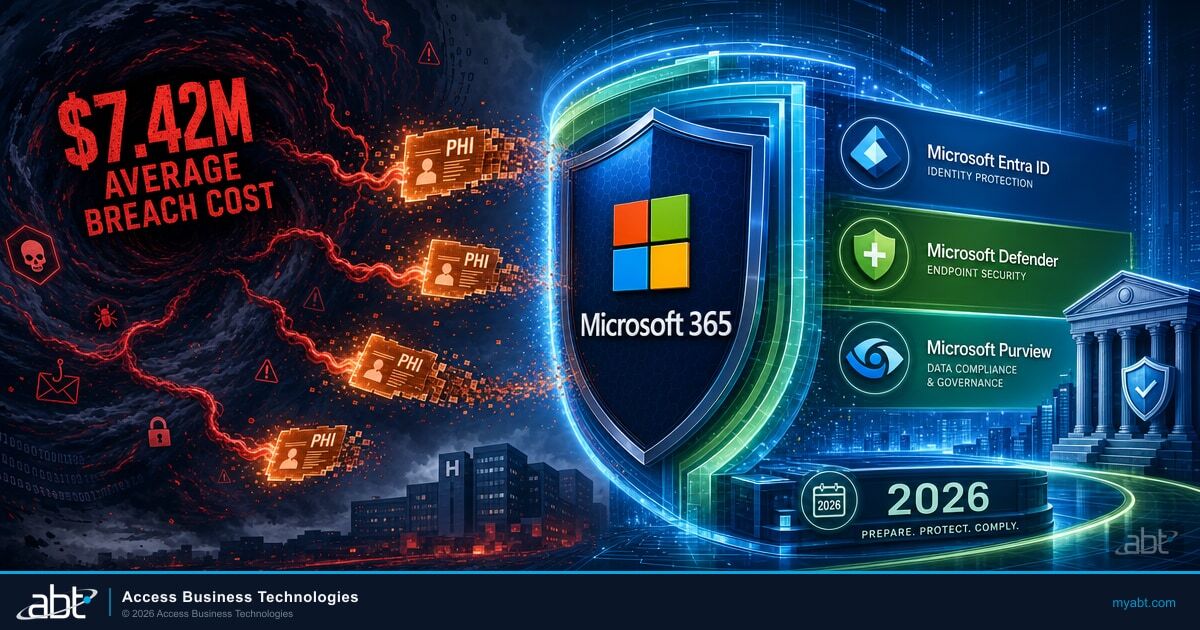
Healthcare nonprofits are caught between two forces that did not align until late 2025. The threat landscape that produced a $7.42 million average breach cost in 2025 (the IBM number for the 14th year running) does not differentiate between a 1,400-bed hospital system and a free clinic with three exam rooms. And Microsoft made a policy change in October 2025 that quietly opened nonprofit pricing to a much wider set of mission-driven healthcare organizations than the prior framework allowed. The same security operating model that hardens a billion-dollar bank is now within reach of a community clinic with a 50-seat tenant, at pricing that puts enterprise-grade controls inside a nonprofit operating budget.
This guide covers what changed in October 2025, the July 1, 2026 pricing deadline, the OCR enforcement pattern, and the three-step path to a HIPAA-defensible Microsoft 365 tenant.
Why Healthcare Nonprofits Are on the Target List Right Now
The mental model that says "we are too small to be a target" was wrong in 2018, and it is more wrong in 2026. Ransomware crews and credential brokers pick targets by attack surface and ability to pay, not by mission statement. Healthcare nonprofits sit in a particular sweet spot for attackers because of three structural conditions.
Protected health information remains the highest-value record on illicit markets because it bundles financial identifiers, insurance numbers, and clinical history that does not expire when a credit card does. A patient record from a free clinic sells for the same price as one from an academic medical center. Most healthcare nonprofits also run with a part-time IT contractor or one staff member who wears the IT hat alongside another role. That model is fine for keeping printers online. It is not built to detect a session-token replay attack at 2 a.m. on a Sunday or document a HIPAA-compliant risk analysis. And HHS Office for Civil Rights does not lower the bar for nonprofits. Every covered entity that handles electronic protected health information sits under the same HIPAA Security Rule that produced $1.7 million in settlements in a single April 2026 announcement.
Why This Matters for Mission-Driven Healthcare
A free clinic that loses 9,000 patient records to ransomware faces the same OCR investigation framework as a hospital system that loses 9 million. The corrective action plan, the two-year monitoring window, and the public press release land on the smaller organization with proportionally larger consequences. Brand damage at a 28-staff clinic that serves a defined geographic community is not a recoverable loss.
The October 2025 Microsoft Policy Change Most Healthcare Nonprofits Missed
In October 2025, Microsoft updated its nonprofit eligibility framework to be content-neutral. The previous attestation requirement, which excluded some healthcare organizations from nonprofit pricing based on the specific mission they served, was removed. The categorical exclusion of certain healthcare organization types was also rebuilt around a clearer, broader list of eligible categories.
The current Microsoft Learn eligibility page, last updated May 6, 2026, names the U.S. healthcare nonprofit categories that qualify: Independent Critical Access Hospitals and Rural Emergency Hospitals (those not in a multi-hospital health system), HRSA-designated Federally Qualified Health Centers and HRSA-certified FQHC Look-Alikes, CMS-certified nonprofit Rural Health Clinics, Skilled Nursing Facilities, and Long-Term Care facilities. Beyond that list, any 501(c)(3) healthcare nonprofit that meets Microsoft's general nonprofit criteria and completes the standard attestation is eligible.
The practical result for a 501(c)(3) healthcare organization is straightforward. Verification runs through nonprofit.microsoft.com, which uses Goodstack as the third-party validator. Microsoft's own documentation says the review typically completes in up to three business days. Once your organization is verified, a Microsoft Cloud Solution Provider like ABT can provision nonprofit-priced Microsoft 365 licenses through the CSP channel, and the licensing is yours from that point forward.
The categorical groups that were sitting on the eligibility fence before October 2025 include behavioral health and community mental health nonprofits, faith-based health ministries operating as 501(c)(3) charitable healthcare providers, pregnancy resource centers, addiction recovery clinics, sliding-scale community health centers without FQHC designation, and a long list of specialty clinic nonprofits. All of them now sit on the eligible side under the content-neutral framework.
A Tier 1 Microsoft Cloud Solution Provider provisions licensing, configures Microsoft Entra ID Conditional Access policies, deploys Microsoft Defender for Office 365 and Microsoft Defender for Endpoint, sets up Microsoft Purview audit log retention and Information Protection labels, and enrolls clinical devices in Microsoft Intune. The same configuration discipline applied to 750-plus regulated financial institutions sizes down cleanly to a 30-staff community clinic with a 50-seat tenant. The CSP relationship is the access layer that makes that discipline operationally cost-effective for a mission-driven healthcare nonprofit.
The Math That Changes the Conversation
The economics of nonprofit Microsoft 365 reshape what is affordable. Three numbers carry most of the weight. Microsoft 365 Business Basic is free as a granted offer for eligible nonprofits up to 300 seats, covering Exchange Online, OneDrive, SharePoint, and Teams. Microsoft 365 Business Premium runs $5.50 per user per month for eligible nonprofits on annual commitment, a 75 percent discount from the $22 commercial rate. Business Premium brings the security tooling: Microsoft Entra ID Plan 1 with Conditional Access, Microsoft Intune device management, Microsoft Defender for Business endpoint protection, Microsoft Purview Information Protection at the basic tier, and Microsoft 365 Copilot Chat. Eligible nonprofits also receive a $2,000 annual Azure consumption credit covering most clinic-scale workloads like backup, secondary storage, or a small archive tenant for compliance retention.
| License | Commercial Rate | Nonprofit Rate | Annual Cost for 30 Staff | What It Covers |
|---|---|---|---|---|
| Microsoft 365 Business Basic | $6.00/user/mo | Free (up to 300 seats) | $0 | Email, OneDrive, SharePoint, Teams |
| Microsoft 365 Business Premium | $22.00/user/mo | $5.50/user/mo | $1,980 | Above plus Entra ID Conditional Access, Intune, Defender for Business, Purview Information Protection |
| Microsoft Azure Consumption Credit | Pay-as-you-go | $2,000/year granted | Net credit, not cost | Backup, archive storage, secondary workloads |
For a 30-staff clinic on Business Premium, the licensing math is roughly $1,980 per year, against $7,920 per year at commercial pricing. The nonprofit discount alone covers most of the budget headroom needed to add a real managed-security partnership on top.

At $5.50 per user per month, the licensing component of a HIPAA-defensible Microsoft 365 tenant for a 30-staff healthcare nonprofit fits inside what most clinics already spend on coffee for the break room.
The July 1, 2026 Pricing Deadline
Microsoft has confirmed a nonprofit price adjustment effective July 1, 2026. Organizations that complete verification and provision before that date hold current rates through their first renewal cycle. The exact magnitude of the adjustment varies by SKU and region, but Microsoft has telegraphed that the deepest current discount tiers will compress. Verification at nonprofit.microsoft.com typically completes in up to three business days, and CSP provisioning runs within one business day after, so the full path from start to active licensing usually fits inside a two-week window.
The July 1, 2026 Cutoff in Plain English
If your organization verifies eligibility and provisions Microsoft 365 nonprofit licensing before July 1, 2026, you hold the current rates through your first renewal. If verification slips past July 1, you provision at the new rates with no path back. For most healthcare nonprofits running the math today, the right move is to start the verification process this month.
The OCR Pattern Behind Every 2026 Settlement
On April 23, 2026, the HHS Office for Civil Rights announced four ransomware-investigation settlements totaling more than $1.7 million: BayCare Health System ($800,000, insufficient access policies and logging review), Assured Imaging ($375,000, 245,000 records exposed via PYSA ransomware), Axia Women's Health ($320,000, nearly 38,000 records), and Star Group operating as SG Health Plan ($245,000, 9,316 individuals affected). Every corrective action plan cited the same root cause: failure to "conduct an accurate and thorough risk analysis to identify risks and vulnerabilities to electronic protected health information."
The lesson for nonprofit healthcare is that OCR is not asking smaller organizations to prove they spent more than they could afford. OCR is asking every covered entity to document what it has, where the gaps are, and how it tracks progress. A risk analysis written by a part-time IT contractor and kept current as the environment changes is defensible. A risk analysis completed once in 2019 and never updated is the document OCR keeps citing as the underlying violation.
What OCR Wants From a Mission-Driven Nonprofit
The same documentation a 200-bed hospital is expected to produce: a current risk analysis covering the whole electronic protected health information environment, a risk management plan that maps each finding to a corrective action, and evidence that the plan is being executed. Scale the depth to your size; do not skip the rhythm.
The Three-Step Playbook for Mission-Driven Healthcare
The path from where most healthcare nonprofits sit today to a HIPAA-defensible Microsoft 365 tenant runs through three discrete steps. None of them requires a 12-month transformation program. All of them are within reach of a clinic with a small IT footprint and a part-time technical partner.
Verify Eligibility and Lock Pricing Before July 1
Start at nonprofit.microsoft.com and submit the organization for Goodstack verification. The documents required are the IRS determination letter, the organization's legal name and address as filed with the IRS, and a primary contact email at the organization's verified domain. Up to three business days later, the eligibility decision lands. Once eligible, a Tier 1 Microsoft Cloud Solution Provider provisions nonprofit licensing through the CSP channel: Business Basic free seats first, then Business Premium for staff who handle protected health information, then any specialty SKUs.
Apply the Same Configuration Discipline a Bank Tenant Gets
The license is the floor, not the ceiling. The configuration discipline that turns Business Premium into a HIPAA-defensible tenant runs short: Microsoft Entra ID Conditional Access policies blocking sign-ins from outside the United States and requiring multi-factor authentication on every account, Microsoft Defender for Office 365 enforcing safe-link rewriting and safe attachments, Microsoft Purview Information Protection labels for documents containing protected health information, Microsoft Purview Audit with at least 12-month log retention, and Microsoft Intune device enrollment for every laptop and mobile device that touches the tenant. This is the same configuration discipline 750-plus regulated financial institutions apply to their tenants. The mechanics do not change at the small-clinic scale. What changes is the operational overhead, which is exactly where the Tier 1 CSP relationship earns its keep.
Document the Risk Analysis OCR Asks For
A HIPAA risk analysis is a living artifact that maps the protected health information environment, names the threats and vulnerabilities, scores the likelihood and impact, and ties every finding to a planned mitigation. The Microsoft 365 tenant produces most of the evidence once the configuration discipline is in place. The work is wiring that evidence into a quarterly review rhythm. The expectation is not perfection. The expectation is rhythm. An auditor who reads four versions of the risk analysis across two years sees a defensible program. An auditor who reads one document dated 2022 with no updates sees the underlying violation OCR has been citing in every 2026 settlement.

How M365 Guardian Fits Healthcare Nonprofits
The Microsoft 365 tenant is the platform. The configuration discipline that makes it HIPAA-ready is the work. M365 Guardian is the operating model that wraps around the work and turns it into a continuous service.
The four phases of M365 Guardian map cleanly to the OCR-defensible posture a healthcare nonprofit needs. Hardening establishes the baseline. Monitoring runs continuous checks against 160-plus Microsoft Secure Score controls and drift detection against the baseline. Insights produces the documented evidence OCR expects to see, the audit log trail with 12-month retention, and the quarterly risk analysis review. Response handles automated session revocation that kills refresh tokens on any risky sign-in, the kind of containment that moves the 279-day mean detection-to-containment number in the right direction.
For a healthcare nonprofit, the value is that the same operating model 750-plus regulated financial institutions use to survive examinations sizes down to a small clinic at a price point that fits inside the nonprofit operating envelope. For deeper context, see Why a Tier 1 Microsoft Cloud Solution Provider Matters for Healthcare, the architecture story behind the discipline. For the regulatory timeline, see HIPAA Security Rule 2026: Six Changes That Will Hit Your IT Operations. For ambient clinical documentation on top of a hardened tenant, see Microsoft Dragon Copilot for Small Physician Practices.
Is Your Nonprofit Ready for Microsoft's Policy Change?
Mission-driven healthcare organizations run lean, and Microsoft's October policy shift changes what your grant-funded budget actually covers. A security assessment shows where your Microsoft 365 tenant is hardened and where the nonprofit discount still leaves gaps to close.
Frequently Asked Questions
Yes, assuming your organization has 501(c)(3) status (or country-equivalent nonprofit legal status) and completes the standard Goodstack verification. The October 2025 update made eligibility content-neutral, which means the specific mission your organization serves no longer disqualifies it from nonprofit pricing. Behavioral health, community mental health, addiction recovery, and other 501(c)(3) healthcare nonprofits are eligible under the current framework. Microsoft's published eligibility list specifically names FQHCs, FQHC Look-Alikes, Critical Access Hospitals, Rural Emergency Hospitals, Rural Health Clinics, Skilled Nursing Facilities, and Long-Term Care facilities, and the general 501(c)(3) framework covers most other mission-driven healthcare categories.
TechSoup is one third-party path through which some Microsoft nonprofit offers can be accessed, primarily for donated software. The direct path through nonprofit.microsoft.com (validated by Goodstack) is the cleanest route for cloud licensing including Microsoft 365 Business Basic, Business Premium, and Azure consumption credit. For a healthcare nonprofit that wants ABT or another Tier 1 Microsoft Cloud Solution Provider to manage the tenant, the CSP-channel path is the right route, because it gives the partner delegated administrative access to configure and monitor the environment. Most healthcare nonprofits that work with a managed-security partner go through nonprofit.microsoft.com and then have their CSP provision the licensing.
No. The Microsoft Business Associate Agreement covers Microsoft's responsibilities for the underlying cloud services it operates, including Microsoft 365 and Azure services that handle protected health information. The BAA does not configure your tenant, enforce multi-factor authentication, set Conditional Access policies, retain audit logs, document your risk analysis, or train your staff. Those responsibilities sit with the covered entity (your nonprofit) and with any business associate (like a CSP partner) that handles protected health information on your behalf. The full Microsoft HIPAA HITECH offering documentation is at learn.microsoft.com under the compliance regulatory offering pages.
Provisioning after July 1, 2026 lands at the adjusted nonprofit rates, with no grandfather path back to current pricing. Organizations that verify before July 1 hold current rates through their first renewal cycle. The verification process typically completes in up to three business days, and CSP provisioning runs within one business day after verification, so the full path from start to active licensing usually fits inside a two-week window. For most healthcare nonprofits running the math today, the right move is to start the Goodstack verification process this month so any documentation requests can be resolved well before the July 1 cutoff.
Most cannot do it sustainably without help. Configuring Microsoft Entra ID Conditional Access, Defender for Office 365, Purview Audit retention, Information Protection labels, and Intune device enrollment is a discrete project that a competent contractor can complete. Keeping all of it current as Microsoft ships changes, as staff turnover happens, as new devices enroll, and as OCR enforcement guidance evolves is a continuous operational discipline. The realistic options are either to hire dedicated security staff (out of reach for most healthcare nonprofits at the 30-staff scale), or to engage a Tier 1 Microsoft Cloud Solution Provider that runs the Microsoft 365 security operating model as a managed service. The economics of nonprofit licensing make the managed-service path achievable inside most clinic operating budgets.
Yes, under the content-neutral October 2025 framework. Any U.S. 501(c)(3) organization (or country-equivalent for non-U.S. organizations) that meets the general nonprofit criteria and completes the standard attestation is eligible for nonprofit pricing. The previous framework had attestation language that some healthcare nonprofits could not sign in good faith depending on the specific mission. The October 2025 update reworked that language to be content-neutral, which means the mission a 501(c)(3) healthcare organization serves is no longer the gating question. The remaining gating questions are legal status, the standard non-discrimination attestation, and Goodstack verification.
Week one: submit the organization for Goodstack verification at nonprofit.microsoft.com using the IRS determination letter and the organization's verified contact information. Up to three business days later, eligibility lands. Week two: a CSP partner (such as ABT) provisions Microsoft 365 Business Basic for the free 300-seat allocation, plus Business Premium licenses for staff who handle protected health information. Configuration of Conditional Access, Defender, Purview Audit retention, and Intune device enrollment typically runs alongside provisioning. Week three onward: monitoring rhythm, drift detection, audit log retention, and the quarterly risk analysis review take over as the steady-state operating model. For a mission-driven healthcare nonprofit, this is the operational equivalent of standing up the security posture a small bank would have, on a budget that fits inside the nonprofit operating envelope.
Healthcare nonprofit ready to lock pricing before July 1?
ABT runs Goodstack verification, provisions nonprofit-priced Microsoft 365 through the Cloud Solution Provider channel, and configures the Microsoft Entra ID, Defender, Purview, and Intune controls that make your tenant HIPAA-defensible. The same operating discipline 750-plus financial institutions use, sized for a clinic with a 30-seat tenant.
See M365 Guardian for Healthcare