

In This Article
Microsoft Dragon Copilot (the rebranded clinical AI engine formerly known as Nuance DAX) launched on February 1, 2026 with something new for the SMB clinical market: a 100-cap offer built specifically for small and mid-sized physician practices. The catch is the distribution model. The Physician Practice offer is sold through the Microsoft Cloud Solution Provider (CSP) channel only. Most practice managers have not heard about it yet.
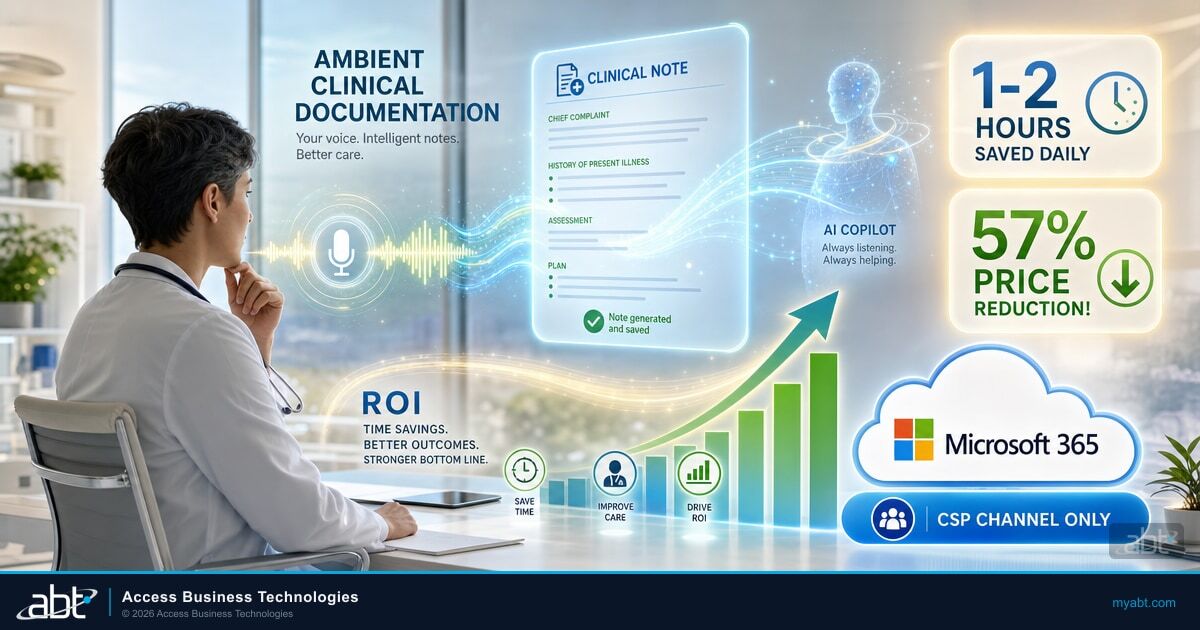
For a 5-physician specialty clinic, the math is hard to ignore. Independent research on ambient clinical documentation puts time savings at 1 to 2 hours per provider per day. At a $200/hour provider rate, that is $200 to $400 per provider per day in recovered chart time. Across a 5-physician practice, that is $1,000 to $2,000 in daily recovered capacity, against a license cost that now starts at $604.80 per provider per month.
This guide walks through what Dragon Copilot does, the two CSP-channel SKUs available to physician practices, the May 1, 2026 Microsoft price cut that reset the ROI conversation, the practice profiles where this works, and the HIPAA prerequisites every practice owner should confirm before turning a microphone on inside an exam room.
What Dragon Copilot Does
Dragon Copilot is ambient clinical documentation. A microphone in the exam room listens to the conversation between provider and patient. The AI engine generates a structured clinical note (history of present illness, exam findings, assessment and plan) that lands in the EHR ready for the provider to review, edit, and sign.
This is the same Nuance Dragon Ambient eXperience technology that hospital systems have been buying since 2020, repositioned and re-licensed under the Microsoft Copilot umbrella. The clinical model behind it is mature. Dragon Copilot adds the ambient layer (passive listening) plus the AI summarization layer (note generation) on top of the established Dragon Medical One speech recognition foundation.
The workflow is the part that sells itself. Provider walks into the exam room, taps a button on their phone or workstation, has a normal conversation with the patient, and walks out. The note is waiting for review by the time charting would normally start.
Why This Matters for Physician Practices
Charting is the single largest source of after-hours work for physicians in independent and small-group practice. Industry surveys consistently show 1 to 2 hours per day spent on documentation outside of patient-facing time. Ambient documentation does not replace the provider's clinical judgment. It replaces the typing.
The Two License Tiers Explained
For physician practices in the CSP channel, Dragon Copilot ships in two flavors. Both are built on the same underlying ambient engine. The difference is the billing model for the AI usage that happens after the base license is in place.
Dragon Copilot (Physician Flex): $604.80 per user per month. This is the base license plus pay-as-you-go ambient AI usage. The $604.80 covers the license itself and a metered allowance of ambient sessions. Providers who use the tool sporadically pay the base rate and a small overage if they exceed the metered tier. Flex is the right fit for practices that want to roll Dragon Copilot out gradually or run it alongside traditional dictation workflows. The SKU is CFQ7TTC11MM7 SKU 005.
Dragon Copilot (Physician Per User): $1,512 per user per month. This is unlimited ambient usage at a flat rate. Once a provider is licensed, they can use ambient documentation on every encounter without metered overage. Per User is the right fit for high-volume clinics where providers are seeing 25 or more patients per day and want ambient turned on for every visit. The SKU is CFQ7TTC11MM7 SKU 002.
There are two other Dragon Copilot SKUs worth knowing about, but they sit outside the standard physician practice motion. The Radiologist SKU (CFQ7TTC11MM7 SKU 002C) is built for imaging-heavy practices and is priced separately (pricing TBD as of May 2026). The Nurse Per User SKU exists, but it is sold direct from Microsoft only and is not available through CSP partners.
| License Tier | Monthly Cost | Usage Model | Best Fit |
|---|---|---|---|
| Physician Flex (SKU 005) | $604.80/user | Base + pay-as-you-go ambient | Selective rollout, mixed workflows, smaller patient volumes |
| Physician Per User (SKU 002) | $1,512/user | Unlimited ambient usage | High-volume clinics, every-visit ambient documentation |
| Radiologist (SKU 002C) | Pricing TBD | Built for imaging workflows | Imaging-heavy practices |
| Nurse Per User | Direct Microsoft only | Not available via CSP | N/A for CSP-channel practices |
The May 2026 Price Cut Changes the ROI Math
On May 1, 2026, Microsoft cut the Dragon Copilot Physician Per User tier from $3,528 per user per month to $1,512 per user per month. That is a 57 percent reduction. The Flex tier ($604.80) was unchanged.
The old Per User price effectively pushed small practices into Flex whether the volume math worked or not. At $1,512, a clinic seeing 30 patients per day per provider now produces under $2 of ambient cost per visit, which sits well below the marginal value of recovered provider time. For high-volume specialty practices, the price cut is what makes Per User the obvious tier choice. For lower-volume primary care, Flex remains the entry point.
At $1,512 per provider per month, unlimited ambient documentation costs less than half of what one hour of recovered provider time is worth per day.
ROI Math for a 5-Physician Specialty Clinic
Run the numbers for a 5-physician specialty practice. Assume each provider works a 5-day week and currently spends 1.5 hours per day on charting outside of patient-facing time. Assume an internal provider time value of $200 per hour (a conservative midpoint of the $150 to $300 per hour range typical for specialty physicians).
Recovered time per provider per month: 1.5 hours/day x 5 days x 4.3 weeks = 32.25 hours. At $200/hour, that is $6,450 per provider per month, or $32,250 across all 5 providers.
Compare that to the license cost. Flex tier: 5 providers x $604.80 = $3,024 per month. Per User tier: 5 providers x $1,512 = $7,560 per month.
The Flex tier produces roughly 10.7x return on license spend before counting any value from reduced provider burnout, faster A/R cycles, or improved patient experience. The Per User tier produces 4.3x return on license spend with no per-visit metering anxiety. For practices doing 25 or more encounters per provider per day, Per User wins on simplicity alone.
The Honest ROI Frame
Ambient documentation is a recovered-time investment, not a hard-dollar cost reduction. Practices that recover 1 to 2 hours per provider per day can use that time to see more patients (revenue), close charts faster (improved A/R), or send providers home on time (retention). The ROI is real, but it shows up in the practice's operating rhythm, not on a single line item.

Who Dragon Copilot Is Right For
Dragon Copilot pays back fastest in practices where charting volume is high and provider time is expensive. The clearest fits we have seen so far:
- High-volume specialty clinics (cardiology, orthopedics, dermatology, gastroenterology). Providers in these specialties often see 30 or more patients per day and the documentation burden scales linearly with volume. Per User tier is usually the right pick.
- Hospital-employed physicians in network-affiliated practices where the parent system has standardized on Microsoft Dragon technology already. The CSP channel still works for the affiliated practice's standalone licensing.
- High-volume primary care (PCPs who see 25 or more patients per day). The day is long enough that recovering 1 to 2 hours per day is the difference between charting at 8 PM and leaving the office at 6 PM.
- Practices with a documentation backlog. If providers are chronically running 2 or more days behind on note completion, ambient documentation breaks that cycle within the first month.
See the Dragon Copilot Math for Your Practice
Every practice has a different volume, provider rate, and EHR. ABT's healthcare specialists run the Flex versus Per User math for your specific encounter volume and walk you through the CSP onboarding workflow before any license commitment.
Talk to a Healthcare Specialist Microsoft Dragon Copilot Product Page
Who Dragon Copilot Is Not Right For
Just as important as the right-fit list is the not-right-fit list. Ambient documentation is a real cost, and there are practice profiles where the math does not work yet:
- Solo PCPs seeing fewer than 10 patients per day. The volume is too low to recover meaningful time. Traditional Dragon Medical One dictation (at a fraction of the price) is usually the better starting point.
- Behavioral health practices. Sessions are longer (45 to 60 minutes) and charting volume per hour of patient time is much lower. The cost-per-encounter math does not pencil out at current pricing.
- Dental hygiene practices. Clinical documentation requirements are structured and minimal. The ambient summarization layer adds little value over existing dental practice management software.
- Allied practitioner counselors (APCs) in lower-volume practice settings. Same volume problem as behavioral health.
None of this means Dragon Copilot will never fit these practice types. It means the current SKU pricing is calibrated for high-volume physician encounters. As Microsoft expands the SKU lineup (the nurse tier is one signal, the radiologist tier is another), the right-fit table will grow.
Microsoft BAA Coverage and HIPAA Prerequisites
Dragon Copilot is covered under Microsoft's standard Online Services Business Associate Agreement. This is the same BAA framework that already covers Microsoft 365, Azure, and the broader Microsoft cloud surface area for healthcare customers. There is no separate Dragon Copilot BAA to sign. If your practice has a Microsoft BAA on file (and any practice running Microsoft 365 should), Dragon Copilot is covered.
The BAA is necessary but not sufficient. HIPAA compliance for ambient clinical documentation requires the tenant configuration foundation to be in place: identity controls (Microsoft Entra ID with Conditional Access and MFA), data loss prevention (Microsoft Purview DLP policies tuned for protected health information), audit logging (Microsoft Purview Audit), and device management (Microsoft Intune for the workstations and mobile devices that capture audio). The proposed HIPAA Security Rule update moves most of these controls from "addressable" to mandatory, which is why getting the configuration right before the final rule publishes matters.
This is where ABT's Guardian operating model for healthcare does the work that a license-only reseller cannot. Guardian configures the Microsoft 365 tenant controls (Microsoft Entra ID, Microsoft Purview, Microsoft Intune, Microsoft Defender) so that ambient documentation operates inside a tenant that meets HIPAA technical safeguards. The license alone does not produce a HIPAA-ready deployment. The tenant configuration does. For context on what happens when those prerequisites get skipped, see our breakdown of the $7.42M average healthcare breach cost and the OCR enforcement pattern behind it.
Before You Turn On Dragon Copilot
Confirm three things: your Microsoft BAA is current, your Microsoft 365 tenant has Entra ID Conditional Access and MFA enforced for clinical staff, and your audit logging through Microsoft Purview Audit is active. If any of these are missing, the BAA does not cover you for compliance purposes regardless of what the license includes.
Why an Authorized CSP Matters
The Physician Practice 100-cap offer is CSP-channel only. That is a Microsoft policy decision, not a market accident. Microsoft routes SMB physician practices through authorized Microsoft Cloud Solution Provider partners because the deployment, BAA paperwork, granular delegated admin (GDAP) workflow, and ongoing operational support are not part of a self-serve Microsoft direct purchase.
Going direct to Microsoft for a 5-physician practice is structurally hard. Microsoft's direct sales motion is built for hospital systems and large enterprise health customers. The Tier-1 CSP direct-bill model (which ABT operates as one of the largest Tier-1 CSPs primarily dedicated to regulated industries) is what makes SMB physician practice deployment workable. A Tier-1 CSP handles the licensing transaction, owns the support escalation relationship, holds the GDAP permissions that let the partner help with tenant configuration without requiring full Global Administrator rights, and operates the ongoing managed services around the deployment.
For a physician practice, the difference between a license-only reseller and a Tier-1 CSP shows up in three places: the BAA workflow (who confirms it is on file and current), the tenant configuration (Microsoft Entra ID Conditional Access, Microsoft Purview DLP for PHI, Microsoft Intune for workstations and mobile devices), and the ongoing support relationship when something breaks during an active patient encounter.
Talk to a Healthcare Specialist About Dragon Copilot
ABT is a Tier-1 Microsoft Cloud Solution Provider and an authorized partner for the Dragon Copilot Physician Practice 100-cap offer. We walk physician practices through the Flex versus Per User decision, run the ROI math against your encounter volume, and configure the Microsoft 365 tenant controls required for HIPAA technical safeguards. The license alone is the platform; the Guardian operating model is the discipline that makes it HIPAA-ready.
Talk to a Healthcare Specialist See M365 Guardian for HealthcareFrequently Asked Questions
Microsoft Dragon Copilot is the rebranded ambient clinical documentation product previously known as Nuance Dragon Ambient eXperience (DAX). It uses the same underlying ambient AI engine that hospital systems have been deploying since 2020, repositioned and re-licensed under the Microsoft Copilot umbrella. A microphone listens to the patient-provider conversation, and the AI generates a structured clinical note ready for review and sign-off inside the EHR.
The Physician Flex tier is $604.80 per user per month and includes the base license plus pay-as-you-go ambient AI usage. The Physician Per User tier is $1,512 per user per month and includes unlimited ambient usage. Microsoft reduced the Per User tier by 57 percent on May 1, 2026 (from $3,528). Both SKUs are available through authorized Microsoft Cloud Solution Provider partners under the Physician Practice 100-cap offer launched February 1, 2026.
Dragon Copilot is covered under Microsoft's standard Online Services Business Associate Agreement, the same BAA framework that covers Microsoft 365 and the broader Microsoft cloud for healthcare customers. The BAA is necessary but not sufficient for HIPAA compliance. The tenant must also have Microsoft Entra ID Conditional Access and MFA enforced for clinical staff, Microsoft Purview DLP configured for protected health information, audit logging through Microsoft Purview Audit, and Microsoft Intune device management for the workstations and mobile devices that capture audio.
The Physician Practice 100-cap offer launched February 1, 2026 is sold through the Microsoft Cloud Solution Provider channel only. The Nurse Per User SKU is sold direct from Microsoft only and is not available through CSP. Hospital systems and enterprise health customers can buy direct, but the SMB physician practice offer requires a CSP partner.
Dragon Copilot pays back fastest in high-volume specialty clinics (cardiology, orthopedics, dermatology, gastroenterology), hospital-employed physicians, and high-volume primary care practices where providers see 25 or more patients per day. For a 5-physician specialty practice recovering 1.5 hours per provider per day at $200 per hour, the recovered-time value runs about $32,250 per month against a Flex-tier license cost of $3,024 per month. The math is less favorable for solo PCPs seeing fewer than 10 patients per day, behavioral health practices, dental hygiene practices, and lower-volume counselor practices.
The Flex tier ($604.80 per user per month) covers a base license plus pay-as-you-go metered ambient AI usage. Providers who use the tool sporadically pay the base rate and a small overage if they exceed the metered tier. The Per User tier ($1,512 per user per month) covers unlimited ambient usage at a flat rate. Flex is the right fit for selective rollouts, mixed workflows, and smaller patient volumes. Per User is the right fit for high-volume clinics where providers are using ambient documentation on every encounter and want flat-rate predictability.