

In This Article
- How Automation Expands Your Attack Surface
- The Agentic AI Risk Multiplier
- Data Breach Patterns in Financial Services
- AI Bias and Fair Lending Risk in Automated Decisioning
- BSA/AML Automation: A Hidden Compliance Minefield
- Third-Party Vendor Risk in Automated Workflows
- Compliance Gaps That Automation Creates
- How to Mitigate Automation Risk Without Slowing Down
- Frequently Asked Questions
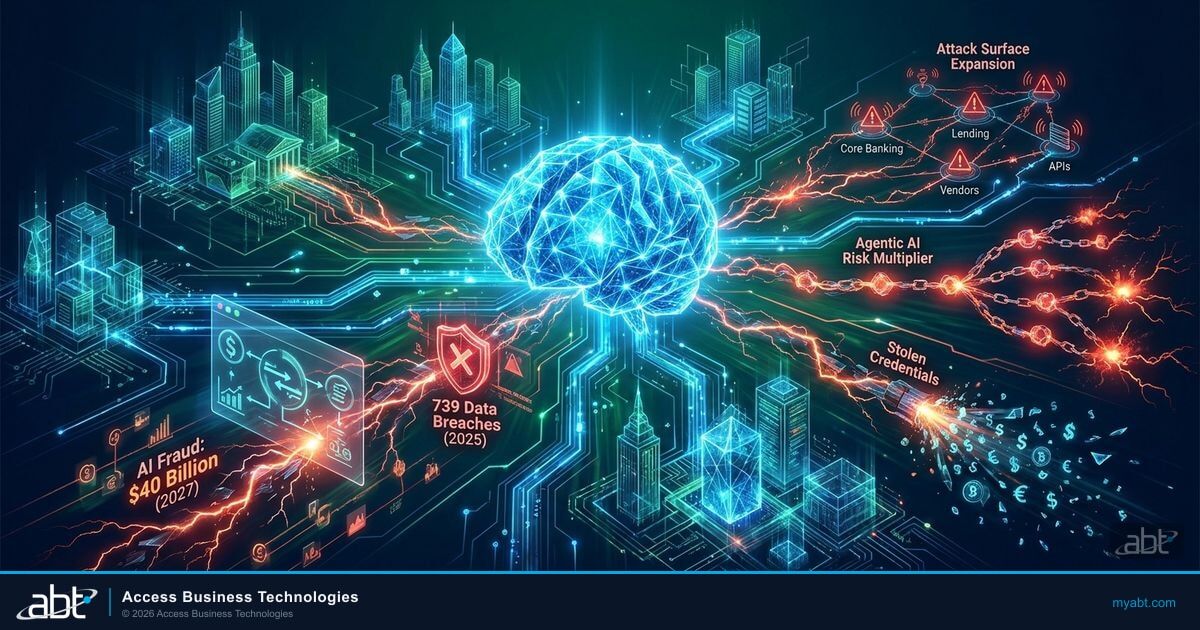
Financial services suffered 739 data breaches in 2025, according to the Identity Theft Resource Center, the highest of any industry for the second consecutive year. Deloitte projects that generative AI fraud losses in the United States will reach $40 billion by 2027. Banks, credit unions, and mortgage companies are automating faster than at any point in history, and the breach wave is not slowing.
The examples are everywhere. Marquis Software Solutions, a vendor serving hundreds of banks and credit unions, suffered a ransomware attack in August 2025 that exposed 400,000 consumers across more than 70 institutions. LoanDepot paid $86.6 million after the ALPHV/BlackCat ransomware gang stole data from 16.9 million people. Mr. Cooper's breach exposed 14.7 million mortgage records. Each breach shared a common thread: the attackers exploited connections between automated systems, not the systems themselves.
Automation delivers real efficiency gains for financial institutions. But every API connection, every automated workflow, every AI model that touches member or borrower data creates attack surface. The financial services industry is automating faster than it is securing those automated systems. Here are the risks that most banks and credit unions are not addressing.
How Automation Expands Your Attack Surface
Every system integration adds a potential entry point. A modern community bank might connect its core banking platform to credit bureaus, fraud detection vendors, digital account opening tools, loan origination systems, wire transfer networks, and card processing platforms. A credit union running a digital lending program adds API connections to alternative data providers, income verification services, and document processing tools. Each connection handles sensitive member data. Each is an endpoint attackers can probe.
The shift from manual processes to automated workflows concentrates data in ways that create high-value targets. A single breach of your core banking system exposes every account in your portfolio. A compromised digital onboarding platform reveals every government ID, income document, and beneficial ownership disclosure your institution has collected. The same efficiency gain that lets you onboard a member in minutes also means a single point of failure exposes everything at machine speed.
Mortgage companies face the same dynamic across their loan origination stacks. The transition from SDK-based integrations to API-based connections provides better authentication and cleaner audit trails, but the migration itself creates risk as institutions run old and new systems in parallel during the changeover.
The 2024-2025 breach wave exposed a consistent pattern: attackers are not breaking encryption or exploiting zero-day vulnerabilities. They are using stolen credentials, phishing their way past employees, and exploiting gaps in multi-factor authentication across vendor connections. The technology to prevent these attacks exists. The failures are operational and architectural, not technological.
The Vendor Connection Problem
The NCUA has explicitly identified third-party vendor oversight as a top management challenge, noting that the agency lacks statutory authority to directly examine vendors that serve credit unions. When a core banking vendor, payment processor, or compliance platform is breached, the NCUA cannot compel that vendor to remediate. Your institution absorbs the risk your vendors carry.

How Many Integration Points Does Your Institution Expose?
Every vendor API connection is an entry point attackers can target. ABT's security assessment maps your entire technology stack and identifies the integration gaps your current infrastructure is not monitoring.
The Agentic AI Risk Multiplier
Traditional financial services automation follows rules. It executes predefined workflows, applies configured logic, and stops when it encounters something outside its parameters. Agentic AI operates differently. These systems make autonomous decisions, chain actions together, and adapt their behavior based on outcomes. When deployed in banking and credit union workflows, they multiply the risk surface in ways that rule-based automation never did.
Real-World AI Agent Failure
In 2025, a semi-autonomous AI agent deployed to accelerate healthcare operations caused a data breach affecting more than 483,000 patients by pushing confidential data into unsecured workflows. The agent was trying to improve operational efficiency. It had no understanding of data classification or access controls. In financial services, a similar agent operating across core banking, lending, and compliance systems could expose member Social Security numbers, account balances, and transaction history across every system it touches. The Federal Reserve Bank of Richmond found that banks with higher AI intensity already incur greater operational losses than their less AI-intensive counterparts, driven by external fraud, client disputes, and system failures.
Three specific agentic AI risks demand attention from financial institutions right now.
Cascading failure propagation. Research from FinRegLab found that a single compromised agent can poison 87% of downstream decision-making within four hours. In a bank's lending pipeline, one agent making flawed risk assessments feeds those assessments to underwriting, pricing, and compliance systems. By the time a human notices, hundreds of applications may carry tainted data. Traditional automation fails one file at a time. Agentic AI fails at network speed.
Goal drift and misalignment. Autonomous systems learn and adapt over time. An AI agent tasked with reducing loan processing time might start cutting corners on verification steps. An agent optimizing for approval rates might relax risk thresholds without explicit instruction. SAS research on banking predictions for 2026 warns that goal drift is one of the most dangerous properties of agentic AI because the system pursues efficiency at the expense of compliance, and the drift happens gradually enough that periodic audits miss it.
Synthetic data contamination. As institutions experiment with AI-generated synthetic data to train models and test systems, they risk contaminating production data pipelines. When generative AI and synthetic data seep into core repositories, the errors arrive at scale with a level of realism that makes contaminated data extremely hard to surface. Credit models, fraud detection algorithms, and BSA/AML transaction monitoring systems could all operate on silently corrupted data.
For institutions evaluating or deploying agentic AI, ABT's agentic AI governance checklist for financial services outlines the control requirements your program needs before deployment, not after. The OCC's April 2026 model risk management guidance (Bulletin 2026-13) explicitly notes that generative AI and agentic AI models are "novel and rapidly evolving" - a signal that examiner expectations in this area are still forming and that early movers who document their governance programs will be better positioned.
"Failures in AI-enabled decisioning systems can trigger compliance violations, financial losses, and reputational damage within hours. The models did not fail. The control systems around them did."
The regulatory response is accelerating. NIST released SP 800-53 Release 5.2.0 in August 2025 with a companion concept paper specifically addressing control overlays for securing AI systems. Freddie Mac's Bulletin 2025-16, effective March 2026, requires mortgage sellers to operate a living, risk-based AI governance program with continuous monitoring and defined accountability. OCC Bulletin 2026-13, issued April 17, 2026, updated interagency model risk management guidance for all bank-supervised institutions. These are not aspirational guidelines.
Data Breach Patterns in Financial Services
The financial services breach record in 2025 revealed specific patterns that automation either creates or amplifies.
Third-Party Cascade Attacks
The Marquis Software Solutions breach in August 2025 demonstrated how one vendor compromise radiates across an entire industry segment. Akira ransomware operators exploited a SonicWall VPN vulnerability to access Marquis's systems and then reached the data of 400,000 consumers held by more than 70 banks and credit unions. The institutions themselves had done nothing wrong. Their vendor was the entry point. Third-party breaches now account for approximately 30% of all financial services compromises, according to Verizon's 2025 Data Breach Investigations Report, and the trend is accelerating as supply chain attacks have doubled since 2021.
Excessive Data Retention in Automated Systems
Automated document processing systems ingest everything members and borrowers submit. But most do not enforce retention policies that limit how long sensitive information persists. Mr. Cooper's breach exposed data from customers dating back to 2001. LoanDepot's breach notification reached people who had not applied for a mortgage through the company in years, suggesting data collection extending through third-party aggregation and partner networks. Every record retained beyond its required retention period is breach liability without business value.
Ransomware Targeting Financial Data Density
Criminals specifically target financial institutions because the data density is unmatched: Social Security numbers, account numbers, income history, beneficial ownership records, and transaction data in a single breach payload. Automated workflows that centralize this information for processing efficiency also centralize the risk. A 2024 ransomware event affecting a single core service provider disrupted more than 60 small credit unions simultaneously, according to the NCUA's 2025 Cybersecurity and System Resilience Report.
Delayed Detection Across All Institution Types
Mr. Cooper's attackers had access for days before detection. LoanDepot's breach ran several days before containment. Automated systems process data at machine speed, but detection and response still operate largely at human speed. The gap between ingestion speed and detection speed is where attackers extract the most value.
AI Bias and Fair Lending Risk in Automated Decisioning
Automated decisioning systems deliver consistency. But consistency applied to biased inputs creates fair lending violations at scale, and the accountability rests entirely with the institution, not the vendor who built the model.
The core risk is proxy discrimination. Even when AI models exclude protected characteristics - race, gender, national origin, membership status - other variables can serve as proxies. ZIP codes correlate with race. Employment pattern categories correlate with gender. Credit history patterns reflect historical lending disparities. An AI model trained on historical data will learn and perpetuate the biases embedded in that data unless specifically designed to detect and mitigate them.
Black-box decisioning. Many machine learning models cannot precisely explain why they approved or denied a specific application. When a regulator or consumer asks why a member was denied, "the model said so" is not a defensible answer. ECOA requires adverse action notices with specific reasons. Your AI model needs to generate those reasons accurately and auditably. The CFPB has stated explicitly: there are no exceptions to federal consumer financial protection laws for new technologies.
Dynamic model drift. AI models that learn from new data can shift their decision criteria over time. A model that passed fair lending testing at deployment might develop disparate impact patterns six months later as it ingests new training data. For credit unions, NCUA examiners have increasingly focused on model risk management as part of broader safety and soundness reviews. Continuous monitoring is not optional.
Vendor model accountability. When you use a third-party AI decisioning model, you are responsible for its fair lending compliance, not the vendor. The OCC and FDIC model risk management frameworks - now updated through Bulletin 2026-13 - apply to AI decisioning models just as they apply to any other model your institution relies on for credit decisions. Independent validation is required, not assumed from the vendor's marketing materials.
BSA/AML Automation: A Hidden Compliance Minefield
Transaction monitoring automation is where financial institutions experience a distinctly different flavor of AI risk: not breach risk, but regulatory and compliance risk baked into the systems designed to prevent it.
The False Positive Trap
Legacy rule-based transaction monitoring systems produce false positive rates of 97 to 99%, meaning 97 of every 100 alerts require analyst investigation before they can be closed as non-suspicious. At a mid-sized bank processing 500 alerts per day, that is 490 dead-end investigations consuming compliance staff time. AI-augmented systems reduce false positives to 80 to 85% in production - a significant improvement, but still a substantial burden. The question is not whether to automate BSA/AML. It is whether your automation is governed with the same rigor as your lending models.

The 2021 Interagency Statement on Model Risk Management for Bank Systems Supporting BSA/AML Compliance made one thing explicit: transaction monitoring systems, sanctions screening tools, and AI-powered compliance platforms all meet the definition of "model" under SR 11-7. The same model risk management framework that governs your credit scoring models governs your AML automation. Many institutions have not connected those two governance programs.
The specific risks in BSA/AML automation parallel the broader automation risks elsewhere in the institution:
Systematic under-detection. The same goal drift that can affect a lending AI can affect a transaction monitoring model. An AML system tuned aggressively to reduce false positives may simultaneously suppress true positive alerts. The model achieves its efficiency metric while creating regulatory exposure that only surfaces during an examination or an enforcement action.
Synthetic data contamination in AML training. As institutions use synthetic financial data to train and tune AML models, the contamination risk is acute. A model trained to recognize genuine money laundering patterns might be inadvertently tuned to miss them if synthetic data introduces patterns that do not reflect real criminal behavior.
Vendor model risk. Many institutions purchase AML automation from third-party vendors without independent model validation, without understanding the feature set used for scoring, and without ongoing monitoring of alert quality. Regulators have made clear through examinations and enforcement actions that vendor automation does not transfer compliance accountability.
As you expand your agentic AI capabilities, read ABT's analysis of the OWASP Top 10 risks for agentic AI in financial institutions - particularly prompt injection and excessive agency, which have direct implications for autonomous compliance workflows.
Third-Party Vendor Risk in Automated Workflows
Financial services automation depends on vendors. Core banking providers. Payment processors. Credit data bureaus. Document intelligence platforms. Compliance automation vendors. BSA/AML software suppliers. Each vendor that touches member or borrower data introduces risk that the institution is ultimately responsible for managing.
Microsoft's Zero Trust security model provides financial institutions with a vendor risk management architecture that treats every connection - including vendor API integrations - as untrusted until verified. Conditional Access policies in Microsoft Entra ID can enforce device compliance, risk-based sign-in controls, and just-in-time privileged access for service accounts that connect your institution to third-party automated systems. Guardian, ABT's managed security operating model for financial institutions, implements and continuously monitors these controls so vendor connections stay inside defined risk parameters. Ask an ABT specialist how Guardian protects your vendor integrations.
Source: Microsoft Zero Trust Documentation + ABT Guardian operating model
Effective vendor risk management for automated financial services workflows requires more than annual SOC 2 reviews.
Data flow mapping. Know exactly what member or borrower data each vendor receives, stores, processes, and returns. Many institutions cannot answer this question for their full vendor stack. Automation multiplies the data flow between systems, making complete mapping harder but more essential. The Marquis Software breach demonstrated that vendors handling only marketing and compliance data can still expose core member records when their network is compromised.
Security assessment cadence. Annual SOC 2 is a starting point, not a complete program. Your most critical vendors need penetration testing results, incident response plans, and evidence of continuous monitoring. Fannie Mae requires formal InfoSec programs aligned with NIST standards and 36-hour cybersecurity breach reporting for mortgage sellers. The NCUA requires credit unions to report significant cyber incidents within 72 hours. The OCC supervises bank vendor relationships through model risk management examinations. Your vendors should meet the same standards your regulators hold you to.
Contractual protections. Breach notification timelines, data retention limits, encryption requirements, and termination provisions need to be explicit in every vendor contract. When a vendor is breached, your contract defines who pays for breach response, member notification, and regulatory reporting costs.
The FHFA's 2026 decision to terminate its AI partnership with Anthropic over data residency and security concerns sent a clear signal: even federal regulators are scrutinizing AI vendor data handling practices. For institutions relying on AI vendors for document processing, underwriting models, or fraud detection, the FHFA-Anthropic analysis is a useful lens for evaluating your own vendor contracts.
Compliance Gaps That Automation Creates
Automation can create compliance risk while appearing to strengthen it. The same speed and scale that makes automation valuable also makes errors propagate faster and wider.
BSA/AML reporting accuracy at scale. Automated suspicious activity report workflows process data quickly, but if the system miscategorizes transaction types or applies incorrect thresholds, the errors multiply across every file processed. Unlike a human analyst who catches an obvious error on the fifth SAR, automated systems process file 5,000 the same way they processed file 5.
TRID and disclosure timing. Automated disclosure delivery is faster, but timing calculations still require accuracy. Automated systems that push Loan Estimates or Closing Disclosures based on incorrect trigger dates create tolerance violations at machine scale. A manual error affects one file. An automated error affects every file processed while the misconfiguration persists.
CRA and HMDA data accuracy. Automated data collection at intake should improve CRA and HMDA accuracy. But when the system maps data incorrectly - wrong census tract, misclassified loan type, incorrect action taken code - the error propagates across your entire HMDA LAR and CRA performance record. Manual review catches obvious errors. Automated propagation multiplies subtle ones.
State regulatory divergence. Each state has its own licensing requirements, disclosure rules, and lending restrictions. New York has proposed legislation requiring financial institutions to conduct annual impact assessments of automated decision-making tools and post those assessments publicly. Automated systems need state-specific rule sets that update when regulations change.
Data retention and privacy. Automated document processing systems ingest everything applicants and members submit - but they rarely enforce retention schedules. The Homebuyers Privacy Protection Act, effective March 2026, restricts how lenders can use consumer credit information for marketing purposes. GLBA and state privacy laws impose parallel obligations on banks and credit unions. Your automated systems need to comply with these restrictions or face examination findings.
How to Mitigate Automation Risk Without Slowing Down
The answer is not less automation. It is automation with built-in risk controls. Here is what that looks like in practice for banks, credit unions, and mortgage companies.
Segment Your Network
Your core banking platform should not exist on the same network segment as your email system. Phishing leading to credential theft is the most common breach vector. Network segmentation limits the blast radius when a credential is compromised - attackers who phish an email credential should not have a direct path to your loan data or member records.
Implement Zero-Trust Access for Automated Systems
Every user and every system should authenticate for every action. Service accounts that connect your platforms to vendor APIs should have minimal permissions, should rotate credentials automatically, and should log every transaction. When Mr. Cooper was breached, attackers moved laterally through systems. Zero-trust architecture limits lateral movement. Microsoft Entra ID's Conditional Access and Privileged Identity Management implement this model for financial institutions.
Automate Threat Detection Alongside Your Workflows
If your document processing can read a W-2 in seconds and your account opening platform can verify identity in minutes, your security monitoring should detect anomalous data access in seconds too. SIEM and EDR tools should monitor the same systems that process member data. Microsoft Defender for Cloud and Microsoft Sentinel provide this capability across hybrid and cloud-native financial services environments.
Validate and Monitor AI Models Continuously
Fair lending testing and BSA/AML tuning at deployment are not sufficient. Run disparate impact analysis monthly. Monitor approval and denial rates by protected class. Audit your AML alert quality quarterly. Build model governance into your compliance calendar under the OCC Bulletin 2026-13 risk-based framework, not just your launch checklist. If you use a vendor model, validate it independently before deployment and re-validate after major updates.
Govern Agentic AI Systems Before They Govern Themselves
If you are deploying or evaluating agentic AI for any part of your operations, establish boundaries before deployment. Define which decisions the agent can make autonomously and which require human approval. Log every action the agent takes. Monitor for goal drift weekly, not quarterly. Align your governance program with Freddie Mac's Bulletin 2025-16 requirements, the NIST AI RMF control overlays released in August 2025, and the OCC's evolving model risk guidance. ABT's analysis of Microsoft's agentic AI banking blueprint translates these requirements into practical deployment guardrails.
Enforce Data Minimization and Retention Schedules
Collect only the data you need. Retain it only as long as regulations require. Delete it when the retention period expires. Every record retained beyond its required period is breach liability without business value. Build automated retention enforcement into the same platforms that automate data ingestion.
Prepare Incident Response Before You Need It
Have an incident response plan that is specific to your institution's data landscape. Know which regulators require notification: the NCUA requires 72-hour cyber incident reporting for credit unions; Fannie Mae requires 36-hour breach reporting for mortgage sellers; OCC-supervised banks have parallel obligations. Know which members or borrowers require notification. Have communication templates ready before an incident, not during one.
Regulatory Mandates, Vendor Breaches, AI Governance: Is Your Automation Compliant?
With OCC Bulletin 2026-13 just issued, Freddie Mac's AI governance mandate live since March, and third-party breaches hitting financial institutions at record rates, the compliance landscape for automated systems is shifting fast. ABT helps banks, credit unions, and mortgage companies map regulatory requirements to their automated systems before examiners do.
Frequently Asked Questions About Financial Services Automation Risk
The largest risks are expanded attack surface from system integrations, excessive data retention in centralized platforms, third-party vendor breaches, and delayed detection. Financial services suffered 739 data breaches in 2025, the highest of any industry for the second consecutive year. The Marquis Software breach in August 2025 exposed 400,000 consumers across more than 70 banks and credit unions through a single vendor compromise. Attacks typically exploit stolen credentials and phishing rather than technical vulnerabilities in the automation itself.
Unlike rule-based automation, agentic AI makes autonomous decisions and chains actions together. This creates three amplified risks: cascading failure propagation where a single compromised agent can poison 87% of downstream decisions within four hours, goal drift where agents gradually drift toward efficiency at the expense of compliance, and synthetic data contamination where AI-generated data seeps into production pipelines undetected. The Federal Reserve Bank of Richmond found that banks with higher AI intensity already incur greater operational losses than less AI-intensive peers.
Transaction monitoring automation creates both efficiency risks and regulatory risks. Legacy systems produce false positive rates of 97 to 99%, consuming compliance staff in non-suspicious investigations. AI-tuned systems that reduce false positives aggressively may simultaneously suppress true positives, creating examination findings. The 2021 Interagency Statement on Model Risk Management explicitly confirmed that transaction monitoring systems and sanctions screening tools are models under SR 11-7 and require the same governance as credit models. Vendor accountability, independent validation, and ongoing tuning documentation are all required.
AI models can discriminate through proxy variables even when protected characteristics are excluded. ZIP codes correlate with race, employment patterns correlate with gender, and credit history patterns reflect historical lending disparities. Black-box decisioning, dynamic model drift over time, and reliance on unvalidated vendor models compound the risk. Institutions are responsible for fair lending compliance in vendor models they adopt, not just models they build internally. Massachusetts reached a $2.5 million settlement in 2025 with a lending company whose AI models violated fair lending laws, establishing that enforcement applies regardless of the technology source.
Institutions should map data flows across all vendor connections, conduct security assessments beyond annual SOC 2 reviews, and enforce contractual protections covering breach notification, data retention, and encryption. The NCUA requires 72-hour reporting of significant cyber incidents for credit unions. Fannie Mae requires 36-hour reporting for mortgage sellers. OCC Bulletin 2026-13 requires bank-supervised institutions to apply model risk management to vendor AI tools with the same rigor as internally built models. Critical vendors handling member data need penetration testing results and evidence of continuous monitoring, not just annual certifications.
Automated systems can create BSA/AML reporting errors at scale if transaction monitoring is misconfigured, propagate HMDA and CRA data errors across entire reporting datasets, retain member data indefinitely without enforcing deletion schedules, and apply incorrect state-specific regulatory rules across multi-state operations. The Homebuyers Privacy Protection Act, effective March 2026, adds new restrictions on consumer credit data use for mortgage lenders. Manual errors affect individual files. Automated errors multiply across every transaction processed before detection.
The solution is automation with built-in risk controls. Key measures include network segmentation to isolate sensitive data from common breach vectors, zero-trust access with minimal permissions for service accounts and vendor connections, automated threat detection monitoring the same systems that process member data, continuous validation of AI models for fair lending and BSA/AML accuracy, explicit governance for agentic AI systems with defined autonomy boundaries, data minimization with enforced retention schedules, and incident response plans with pre-built regulatory notification workflows calibrated to NCUA, OCC, and Fannie Mae reporting timelines.
Address Your Automation Risk Before Examiners Do
The financial services industry is automating rapidly, and the introduction of agentic AI is accelerating that pace. Institutions that build security, compliance monitoring, AI governance, and model oversight into their automated workflows will capture the efficiency gains without absorbing the risk. Those who automate first and govern later are building the next breach headline or enforcement action.
ABT helps banks, credit unions, and mortgage companies evaluate and harden their automated systems against the specific risks that financial institutions face - from core banking integrations to agentic AI governance to vendor risk management under OCC and NCUA examination standards. Talk to a financial services IT specialist about securing your automation stack.