

In this article:
- Why Credit Unions Need an AI Readiness Assessment
- The 25-Point Framework: Five Assessment Categories
- Category 1: AI Governance Readiness
- Category 2: Data Readiness
- Category 3: Infrastructure Readiness
- Category 4: Workforce Readiness
- Category 5: Compliance Readiness
- The ABT Microsoft 365 Copilot Path for Credit Unions
- Frequently Asked Questions
- Technical Reference
Fifty-nine percent of credit unions have deployed generative AI. Only 16% have a roadmap for it.
That gap showed up in Cornerstone Advisors' What's Going On in Banking 2026 report, based on a survey of 416 bank and credit union executives. It means the majority of financial institutions are running AI tools with no documented strategy for how those tools fit into their risk management, data governance, or compliance programs.
This isn't a theoretical problem. The NCUA's 2026 Supervisory Priorities explicitly added AI oversight to the examiner checklist. A May 2025 GAO report (GAO-25-107197) recommended the NCUA update its model risk management guidance specifically because credit unions are adopting AI without adequate oversight frameworks. And in December 2025, the NCUA published an updated AI Resource Hub directing credit unions to NIST, CISA, and Treasury resources for governing AI implementations.
Credit unions face a specific version of this challenge. Smaller IT teams. Shared branching complexity. Member data privacy obligations that predate AI by decades. The answer isn't to avoid AI. It's to evaluate readiness before deploying anything consequential. For most credit unions, the AI path starts with Microsoft 365 Copilot riding on top of the existing Microsoft 365 tenant, which means the tenant itself becomes the readiness question.
This 25-point framework gives you a structured way to measure where your credit union stands across five categories: governance, data, infrastructure, workforce, and compliance. Score each checkpoint 1 to 5, identify the gaps, and build a plan that matches your institution's risk appetite and resources. The article closes with the ABT Microsoft 365 Copilot path for credit unions, including SKU and pricing detail, and the M365 Guardian operating model that turns the framework score into a managed deployment.
Why Credit Unions Need an AI Readiness Assessment Before Deploying Anything
The numbers tell a consistent story across every major survey from the past six months. Eighty-eight percent of organizations now use AI in at least one business function, according to McKinsey's 2025 State of AI report. But fewer than 1% have fully operationalized responsible AI, per a joint study by the World Economic Forum and Accenture. This connects closely to Why CISOs Are Slow-Rolling Agentic AI (And Why That's Actually Smart).
Credit unions are no exception. Sixty-six percent plan to use AI for credit decisioning, according to the Filene Research Institute's survey of 110 participants across 78 credit unions. FORUM Credit Union in Indiana boosted loan processing volume by 70% with AI-powered document classification. Cobalt Credit Union in Nebraska achieved an 83% session containment rate with an AI voice assistant deployed in January 2026. Our guide to Colorado AI Act Countdown: 118 Days to Comply goes deeper on this.
These are real results. But they happened at institutions that evaluated their readiness first. The credit unions struggling with AI aren't the ones that said "no." They're the ones that said "yes" without asking whether their data, governance, and infrastructure could support what they were deploying.
Three specific factors make credit unions different from other financial institutions when it comes to AI readiness:
- Smaller IT teams. A credit union with $500 million in assets might have three to five IT staff. That team can't absorb AI governance as an extra responsibility on top of existing operations without a plan.
- Member data sensitivity. Credit unions hold decades of member financial data governed by NCUA rules, GLBA requirements, and state privacy laws. AI tools that touch this data need controls that match the existing regulatory framework.
- CUSO and vendor complexity. Many credit unions depend on shared service organizations and third-party cores. AI deployed by a CUSO affects your members, but your governance framework might not extend to vendor AI.
An AI readiness assessment doesn't slow you down. It tells you where to start, what to fix first, and which AI investments will actually work given your current capabilities.
The NCUA's January 2026 Supervisory Priorities letter (26-CU-01) added AI oversight to the examination program for the first time. Examiners will review AI use policies, vendor AI due diligence, and board-level AI governance. Credit unions that deploy AI without a readiness assessment will face questions they can't answer at their next exam. See also our breakdown of OWASP Top 10 for Agentic AI.
Score Your Tenant Before You Flip the Copilot Switch
Microsoft 365 Copilot inherits your tenant's existing security, governance, and identity posture. If those layers are weak, Copilot exposes the gaps, it does not fix them. Score your readiness across five categories before any AI tool reads member data.
The 25-Point AI Readiness Framework: Five Assessment Categories
This framework evaluates credit union AI readiness across five categories, each with five checkpoints. The categories map directly to what NCUA examiners, cyber insurance underwriters, and AI governance frameworks (NIST AI RMF, ISO 42001) evaluate.
Score each checkpoint 1 to 5:
- 1 = Not started. No documentation, no process, no awareness.
- 2 = Aware. The topic is on someone's radar, but no action has been taken.
- 3 = In progress. Partial implementation or documentation exists.
- 4 = Implemented. Controls are in place and documented.
- 5 = Mature. Controls are in place, tested, monitored, and continuously improved.
A perfect score is 125. Most credit unions we work with score between 35 and 65 on their first assessment. That's not a failing grade. It's a starting point.
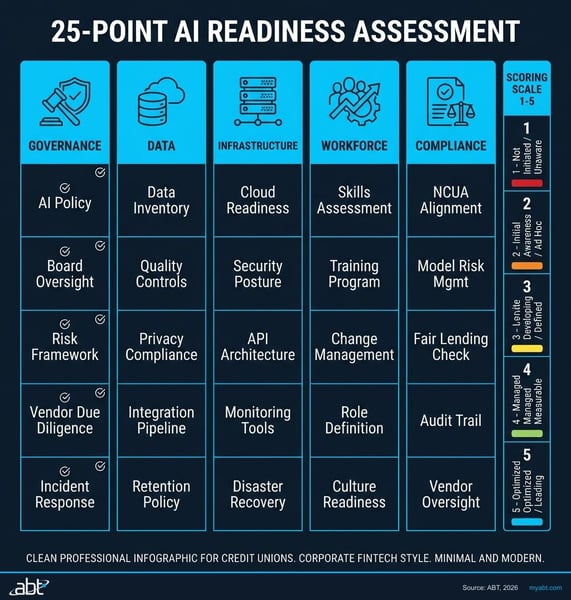
Five Assessment Categories at a Glance
- Governance (Points 1-5): Board policy, risk appetite, ethical guidelines, vendor due diligence, incident response
- Data (Points 6-10): Classification, accessibility, privacy controls, quality baselines, cross-system integration
- Infrastructure (Points 11-15): Microsoft 365 tenant health, identity management, compute capacity, API readiness, security monitoring
- Workforce (Points 16-20): AI literacy, change management, role-specific training, AI champions, employee communication
- Compliance (Points 21-25): NCUA alignment, fair lending audit, model risk management, vendor assessment, member consent
Category 1: AI Governance Readiness (Points 1-5)
Governance is where most credit unions score lowest. Cornerstone Advisors found that while agentic AI is now discussed at the executive or board level at more than half of financial institutions, the gap between discussion and documented policy remains wide. Pacific AI's 2025 Governance Survey reported that 75% of organizations have AI usage policies, but only 36% have adopted a formal governance framework.
For credit unions, governance readiness means answering five questions:
Point 1: Board-Level AI Policy
Does your board have a documented policy on AI use? Not a resolution saying "we support innovation." A written policy that defines what AI is in the context of your credit union, who approves new AI deployments, and what risk thresholds trigger board review. The NCUA's AI Compliance Plan, published September 2025, models this approach: inventory everything, classify risk, apply minimum practices for high-impact use.
Point 2: AI Risk Appetite Statement
Your credit union already has risk appetite statements for credit risk, interest rate risk, and liquidity risk. AI needs the same treatment. What types of AI decisions is your institution comfortable automating? Where do you require human review? A credit union that automates fraud screening but requires human approval for loan denials has defined its AI risk appetite, even if it hasn't written it down yet.
Point 3: Ethical Use Guidelines
AI used in lending, collections, or member communications creates fair lending exposure. Seventy-one percent of companies with AI strategies include ethical principles, according to the Thomson Reuters AI Corporate Data Initiative. But only 41% make those policies accessible to employees. Guidelines that exist in a binder nobody reads don't protect your institution.
Point 4: Vendor AI Due Diligence Process
Your core processor, digital banking platform, and fraud detection vendor probably already use AI. The NCUA explicitly links AI oversight to existing third-party guidance (Letters 07-CU-13 and 01-CU-20). Your vendor management process needs updated questions: What AI does this vendor use? What data does it consume? What decisions does it make? Can you audit it?
Point 5: AI Incident Response Plan
If an AI system makes a lending decision that violates fair lending rules, or if a member-facing chatbot provides incorrect financial guidance, what's your response plan? This extends your existing incident response framework. Document who gets notified, how you contain the AI system, and how you preserve evidence for potential examiner review.
Category 2: Data Readiness (Points 6-10)
AI is only as good as the data it consumes. Cornerstone Advisors' Ron Shevlin put it directly in the 2026 banking report: "There is no meaningful AI strategy without a credible, prioritized data strategy." Credit unions report high confidence in their data quality, but Shevlin questions whether that confidence is warranted, pointing to research showing community institutions are midway to acceptable data quality at best.
Point 6: Data Classification Maturity
Before any AI system touches member data, you need to know what data you have, where it lives, and how it's classified. Microsoft Purview sensitivity labels, if your credit union uses Microsoft 365, provide a starting framework. The question: can you show an examiner which data categories your AI tools access?
Point 7: Core Banking Data Accessibility
Most credit union AI use cases require data from your core banking system. How accessible is that data? Can you extract it through APIs, or does it require manual exports? Credit unions on legacy cores often discover that the data they need for AI exists but can't be accessed without batch processing delays that defeat the purpose of real-time AI.
Point 8: Member Data Privacy Controls
Twenty-six percent of organizations report that more than 30% of the data employees feed into public AI tools is private or sensitive, according to a Kiteworks survey. Only 17% have technical controls to block unauthorized AI access. For credit unions, member financial data flowing into a public AI tool is a regulatory incident waiting to happen. You need Data Loss Prevention policies that specifically address AI tools, which is exactly what Microsoft Purview Data Loss Prevention provides inside the Microsoft 365 tenant.
Point 9: Data Quality Baselines
AI trained on dirty data produces unreliable outputs. Do you measure data quality for the fields your AI will consume? Address accuracy, phone number completeness, loan classification consistency. Centris Federal Credit Union grew automated loan decisions from 43% to 63% in part because their data quality supported reliable AI decisioning.
Point 10: Cross-System Data Integration Readiness
AI that delivers value typically needs data from multiple systems: your core, digital banking, CRM, and fraud platform. Rate your ability to integrate data across these systems. Credit unions hitting a "2026 inflection point," as EAS Corp described it, are those where legacy cores, bolt-on digital layers, and fragmented point solutions can no longer support the data models AI requires.
"There is no meaningful AI strategy without a credible, prioritized data strategy."
Ron Shevlin, Chief Research Officer, Cornerstone Advisors, What's Going On in Banking 2026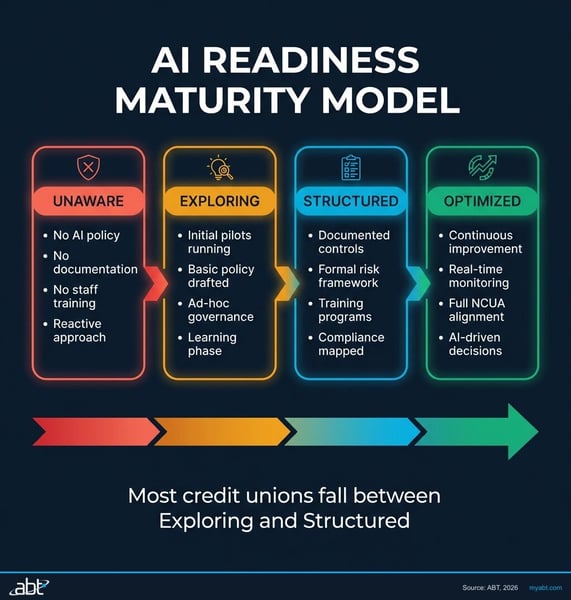
Category 3: Infrastructure Readiness (Points 11-15)
Infrastructure readiness determines whether AI tools can actually run in your environment. Eighty-three percent of financial institutions plan to increase technology spending in 2026, per the Celent/Zest AI report. But spending doesn't equal readiness. More than 80% of banks and credit unions continue to fall short on planned system deployments.
Point 11: Microsoft 365 Tenant Health Score
If your credit union runs Microsoft 365, your tenant health score is the baseline for AI readiness. Microsoft 365 Copilot inherits your existing security configuration. If your tenant has weak Conditional Access policies, misconfigured sharing settings, or gaps in data classification, Copilot will expose those gaps, not fix them. Check your Microsoft Secure Score and Compliance Score before evaluating any AI deployment.
Point 12: Entra ID Configuration
Identity management is the foundation of AI access control. Are your Microsoft Entra ID Conditional Access policies configured to control which users and devices can access AI tools? Do you have risk-based authentication policies? AI tools that authenticate through your identity provider inherit your access controls, for better or worse.
Point 13: Compute Capacity
Some AI workloads run entirely in the cloud. Others require local processing or hybrid configurations. Evaluate whether your current infrastructure can support the AI tools you're considering. Credit unions running older terminal-based core systems may face connectivity and performance constraints that limit real-time AI use cases.
Point 14: API Integration Capability
Modern AI tools connect through APIs. Rate your credit union's API maturity: do you have documented APIs for your core systems? Can you build integrations without vendor professional services? The credit unions achieving measurable AI results, like Lake Michigan Credit Union processing 60% more mortgage files with the same staff, have API-ready infrastructure.
Point 15: Security Monitoring Coverage for AI Workloads
When an AI system processes member data, your security monitoring needs to cover that activity. Can your SIEM or security monitoring tools detect anomalous AI behavior? Do your log management policies capture AI decisions for audit trails? This is where Microsoft Defender for Cloud Apps, Microsoft Purview Audit logs, and Microsoft Sentinel become essential for credit unions using Microsoft 365 based AI.
Category 4: Workforce Readiness (Points 16-20)
The CSI 2026 Banking Priorities report found that banks are nearly twice as likely as credit unions to recognize AI's potential for back-office efficiency (38% vs. 21%). That gap suggests credit union workforces need targeted preparation before AI tools are deployed. Technology readiness without workforce readiness produces expensive shelfware.
Point 16: AI Literacy Baseline
Survey your staff. Do they understand what AI is and isn't? Can they distinguish between rule-based automation and generative AI? Sixty-five percent of organizations with comprehensive AI governance are already training staff on AI tools, compared to just 27% with partial policies. The CSA/Google Cloud State of AI Security report from December 2025 confirmed that training directly correlates with governance maturity.
Point 17: Change Management Plan
AI changes workflows. Loan officers who reviewed every application will now review exceptions flagged by AI. Call center staff who answered routine questions will handle escalations the AI can't resolve. Without a documented change management plan, employees either resist the change or work around it, both of which undermine AI investments.
Point 18: Role-Specific Training Matrix
Your board needs AI governance training. Your IT team needs technical AI management skills. Your lending staff need training on AI-assisted decisioning. Your compliance team needs to understand AI audit requirements. One generic "AI awareness" session covers none of these needs. Build a training matrix that maps AI competencies to specific roles.
Point 19: AI Champion Identification
Every successful AI implementation at a credit union that we've observed has at least one internal champion who bridges the gap between technology and operations. Identify who that person is at your institution. It's often someone in operations or lending who sees the practical application, not necessarily someone in IT.
Point 20: Employee Communication Plan
Staff who learn about AI deployments through rumors rather than official communication will assume the worst. A documented communication plan addresses what AI will do, what it won't do, how it affects specific roles, and what training will be provided. This is particularly important at credit unions where the cooperative culture values transparency.
Category 5: Compliance Readiness (Points 21-25)
Compliance readiness is where AI governance meets regulatory reality. The NCUA's July 2025 board briefing on AI discussed a GAO report finding that lack of model risk management guidance may lead to inadequate oversight of credit unions' AI model use. The NCUA determined that focusing solely on model risk management isn't sufficient and that a broader approach covering all AI use cases is needed.
Point 21: NCUA AI Guidance Alignment
The NCUA's updated AI Resource Hub (December 2025) directs credit unions to specific frameworks: NIST AI resources, the COSO enterprise risk management framework applied to AI, CISA guidelines on deploying AI systems securely, and the Treasury's report on AI in financial services. Rate how well your credit union's AI practices align with these referenced frameworks. If you haven't read them, you're not aligned.
Point 22: Fair Lending AI Audit Capability
If AI touches lending decisions at your credit union, you need the ability to audit those decisions for fair lending compliance. Can you explain why an AI system approved one member's loan and denied another's? Centris Federal Credit Union found that AI-approved loans may have more reliable credit quality than traditional scoring models, but that finding came from rigorous monitoring. Without audit capability, you can't make that determination.
Point 23: Model Risk Management
The GAO recommended the NCUA update model risk management guidance. While formal rulemaking is pending, the direction is clear: credit unions using AI models for consequential decisions will need model validation, performance monitoring, and documented oversight. The banking equivalent, SR 11-7, provides a reference framework that NCUA examiners will likely draw from.
Point 24: Third-Party AI Vendor Assessment
The NCUA links AI oversight to existing third-party relationship guidance. Your vendor management program needs AI-specific questions: What AI does this vendor use? What data does it access? How are model outputs validated? Can you audit their AI? Can you terminate AI functionality independently of the core service? Forty-five percent of organizations cite deployment pressure as the biggest blocker to implementing AI governance, per the Kiteworks survey. Don't let vendor timelines drive your governance timeline.
Point 25: Member Notification and Consent Framework
When AI influences decisions that affect members, disclosure matters. Do members know that AI is involved in their loan decisions? Their fraud screening? Their customer service interactions? A documented consent and notification framework protects your credit union and maintains the member trust that defines the cooperative model. FinCEN's report on deepfake-driven fraud, referenced in the NCUA's AI Resource Hub, makes clear that member-facing AI transparency is becoming a regulatory expectation.
The ABT Microsoft 365 Copilot Path for Credit Unions
For most credit unions in the 50 to 500 employee range, the practical path from a 25-point readiness score to a working AI deployment runs through Microsoft 365 Copilot. The reason is simple. The credit union already pays for Microsoft 365 for email, Teams, SharePoint, and Office. Microsoft 365 Copilot is an add-on license that grants Copilot access inside those applications, which means the data Copilot reads is data the credit union already governs under existing Microsoft 365 controls. There is no second platform to harden, no new vendor relationship to renegotiate, no third tenant to monitor. The readiness work the framework above measures is the deployment work.
The Microsoft 365 Copilot SKU shape that fits community credit unions has shifted to a small and medium business orientation. Microsoft 365 Copilot Chat covers basic chat-only AI grounded in tenant data at $10 per user per month. Microsoft 365 Copilot Business, the SMB add-on that includes the full Copilot experience inside Word, Excel, Outlook, Teams, and PowerPoint, runs $21 per user per month standalone, with a limited-window promotional rate at $18 when bundled and a Business Premium plus Copilot Business bundle at $32 per user per month. Credit unions on Microsoft 365 Enterprise E3 or E5 add Copilot at the full enterprise tier at $30 per user per month. For a 100-employee credit union, that is a real monthly number, not an experiment, which is exactly why the readiness assessment matters before the licenses are bought.
Access Business Technologies is a Tier-1 Microsoft Cloud Solution Provider that manages Microsoft 365 tenants for more than 750 financial institutions. The firm has been doing this work for 25 years, since 1999. For credit unions specifically, ABT applies a managed operating model called M365 Guardian on top of the Microsoft 365 tenant. Microsoft 365 is the platform. Guardian is the configured, monitored, and continuously improved version of that platform tuned to NCUA examination expectations, member NPI handling, and the cooperative culture that defines credit unions.
The Guardian operating model layers four pieces on top of the Microsoft 365 tenant the credit union already owns. Microsoft Entra ID Conditional Access policies tuned to branch geography, registered employee behavior, and risk-based authentication so Copilot access inherits the same controls as the core banking session. Microsoft Purview sensitivity labels, Data Loss Prevention, and Audit Premium configured so member NPI is classified before Copilot indexes it, so high-impact AI prompts are logged for examiner review, and so retention rules align with the Bank Secrecy Act and state retention requirements. Microsoft Defender for Office 365, Defender for Endpoint, and Defender for Cloud Apps applied as the detection layer for AI-targeted phishing, anomalous Copilot prompts, and data exfiltration patterns. And Microsoft Sentinel sitting underneath as the SIEM that aggregates the signal into a single timeline a credit union's CCO can hand to an NCUA examiner. ABT manages the Microsoft 365 tenant and Microsoft hosts the underlying service, which means the credit union retains tenant ownership and the partner relationship runs under Granular Delegated Administrative Privileges, with least-privilege role grants tested annually.
Key Takeaway
The 25-point framework measures where your credit union stands. The ABT Microsoft 365 Copilot path is what you do with the score. For a 50 to 500 employee credit union running Microsoft 365, the Copilot add-on at $21 per user per month, layered with the M365 Guardian operating model for governance, security, and audit, turns the readiness gap into a managed deployment with the same examination evidence ABT produces for 750 other financial institutions.
This framework addresses AI readiness specifically. For broader cybersecurity assessments, see Credit Union Cybersecurity: Beyond the Basics. For NCUA exam preparation, see NCUA IT Exam Prep: What Examiners Look For. For agentic AI governance specifically, see Agentic AI Governance: CISO's Readiness Checklist and AI Governance Gap: 77% Use AI, 37% Govern It. For the Microsoft 365 Copilot pricing breakdown across SMB and enterprise tiers, see Microsoft 365 Copilot Pricing for Community Banks and Credit Unions.
Before Copilot, Before Agents, Get Your Foundation Right
Copilot does not know which documents are sensitive and which are not, your governance framework does. Make sure it is ready before AI starts reading your data.
Frequently Asked Questions
An AI readiness assessment evaluates a credit union's preparedness to deploy artificial intelligence across five categories: governance, data, infrastructure, workforce, and compliance. It identifies gaps in board-level AI policy, data quality, identity management, staff training, and regulatory alignment before AI tools are deployed, reducing the risk of failed implementations and examiner findings. For credit unions planning to add Microsoft 365 Copilot to an existing Microsoft 365 tenant, the assessment also surfaces the Conditional Access, Purview classification, and Defender configuration work that needs to happen before Copilot reads member data.
The NCUA has not issued formal AI-specific regulations as of early 2026, but its 2026 Supervisory Priorities include AI oversight, and examiners are asking about AI use, policies, and risk management. The NCUA's AI Resource Hub directs credit unions to NIST AI frameworks and existing third-party guidance for vendor AI oversight. Credit unions should treat current guidance as the examiner baseline.
Credit unions lead banks in some areas of AI adoption, with 59% having deployed generative AI compared to 49% of banks, per Cornerstone Advisors' 2026 report. However, CSI's 2026 Banking Priorities survey found banks are nearly twice as likely as credit unions to recognize AI's back-office efficiency potential. Fewer than 20% of credit unions describe their AI deployments as enterprise-ready.
The NCUA directs credit unions to the NIST AI Risk Management Framework as the primary governance reference. NIST AI RMF organizes AI risk management into four functions: Govern, Map, Measure, and Manage. ISO 42001, the first international certifiable AI management system standard, provides a more structured approach for larger institutions. Both frameworks complement existing FFIEC and NCUA cybersecurity requirements.
The three most common gaps are data quality, governance documentation, and workforce training. Cornerstone Advisors notes that community institutions are only midway to acceptable data quality, especially in sales and marketing data. Only 36% of organizations have formal AI governance frameworks despite 75% having written policies. And only 27% of organizations with partial AI policies are training staff on AI tools.
Microsoft 365 AI tools like Copilot inherit your existing tenant security configuration. Weak Conditional Access policies, misconfigured sharing settings, and missing data classification labels mean Copilot can access and surface data that should be restricted. Evaluating your Secure Score, Compliance Score, and Microsoft Entra ID configuration is a prerequisite for any Microsoft 365 based AI deployment at a credit union.
Community credit unions in the 50 to 500 employee range typically fit the small and medium business Copilot SKUs. Microsoft 365 Copilot Chat at $10 per user per month covers basic chat-only AI grounded in tenant data. Microsoft 365 Copilot Business at $21 per user per month adds the full Copilot experience inside Word, Excel, Outlook, Teams, and PowerPoint, with a limited-window promotional rate at $18 and a Business Premium plus Copilot Business bundle at $32 per user per month. Credit unions on Microsoft 365 Enterprise E3 or E5 add Copilot at the $30 per user per month enterprise tier. The right SKU depends on which Microsoft 365 plan the credit union already runs and whether the use case is chat-only or in-app productivity.
M365 Guardian is ABT's managed operating model layered on top of a credit union's Microsoft 365 tenant. The credit union retains tenant ownership and Microsoft hosts the underlying service. Guardian adds Microsoft Entra ID Conditional Access tuned to credit union branch geography and risk, Microsoft Purview sensitivity labels and Data Loss Prevention configured for member NPI before Copilot indexes any document, Microsoft Defender for Office 365, Endpoint, and Cloud Apps as the detection layer, and Microsoft Sentinel as the SIEM that produces examination-ready timelines. ABT manages the tenant under Granular Delegated Administrative Privileges with least-privilege roles. For a Copilot rollout, Guardian is what turns a license purchase into an examination-defensible deployment.
Technical Reference
Glossary
- NIST AI RMF (AI Risk Management Framework)
- Voluntary U.S. framework for managing AI risks, organized into four functions: Govern, Map, Measure, and Manage. Referenced by NCUA for credit union AI governance.
- ISO 42001
- International standard for an AI Management System (AIMS), published 2023. Provides certifiable requirements for AI governance, risk assessment, and continuous improvement.
- NCUA AI Resource Hub
- Centralized page at ncua.gov/ai with AI governance and risk management resources for federally insured credit unions. Updated December 2025. Links to NIST, CISA, COSO, Treasury, and FinCEN resources.
- Agentic AI
- AI systems that can act, decide, and learn autonomously. Unlike generative AI that produces content, agentic AI executes multi-step tasks with minimal human oversight. 17% of credit unions have deployed it per Cornerstone 2026.
- Conditional Access
- Microsoft Entra ID policy framework that controls authentication requirements based on user risk, device compliance, location, and application sensitivity. Critical for controlling AI tool access.
- Microsoft Purview
- Microsoft's data governance, compliance, and risk management platform. Includes sensitivity labels, DLP policies, and audit logs used to govern AI data access in Microsoft 365 environments.
- Microsoft 365 Copilot
- Microsoft's AI assistant grounded in tenant data, available across Word, Excel, Outlook, Teams, and PowerPoint. SMB tiers run from $10 per user per month (Chat) to $21 per user per month (Copilot Business); enterprise tier is $30 per user per month on top of Microsoft 365 E3 or E5.
- M365 Guardian
- ABT's managed operating model layered on top of the Microsoft 365 tenant. Combines configured Conditional Access, Purview, Defender, and Sentinel into a governance and monitoring layer tuned to NCUA, FFIEC, and member NPI requirements.
- CUSO (Credit Union Service Organization)
- Entity owned by one or more credit unions that provides services to credit unions. CUSOs deploying AI on behalf of credit unions create third-party AI governance obligations.
- SR 11-7
- Federal Reserve supervisory guidance on model risk management. While directed at banks, it provides a framework that NCUA examiners reference when evaluating credit union AI model oversight.
- GAO-25-107197
- May 2025 Government Accountability Office report titled "Artificial Intelligence: Use and Oversight in Financial Services." Recommended NCUA update model risk management guidance for credit unions using AI.