


Office 2021 stops getting security updates on October 13. Copilot was never coming to it.
Microsoft confirmed on September 15 that Office LTSC 2021, Project LTSC 2021 and Visio LTSC 2021 leave support on October 13, 2026. The date is the easy part. Two sentences in that same announcement matter more, because they describe things that stay true long after the deadline passes: Microsoft 365 Copilot does not run on on-premises Office at all, and the labeling client that regulated organizations used on perpetual Office has been retired.
- The apps keep opening on October 14. What stops is every future security fix
- Copilot is not a licence you can add to Office 2021 later. Microsoft says these versions are not eligible
- Sensitivity labeling inside the perpetual Office desktop apps has no supported client, which is a control worth checking before someone else does
What exactly ends on October 13, 2026?
Support ends. The software does not. That distinction is easy to get backwards, and getting it wrong in either direction costs money: panic buys what was not needed, complacency leaves an unpatched estate in place.
Microsoft's announcement is short and unambiguous. Support for Office Long Term Servicing Channel 2021, Project LTSC 2021 and Visio LTSC 2021 ends on October 13, 2026, and after that date these products no longer receive updates, security fixes or technical support.
"Support for Office Long Term Servicing Channel (LTSC) 2021, Project LTSC 2021, and Visio LTSC 2021 ends on October 13, 2026. After this date, these products no longer receive updates, security fixes, or technical support."
Microsoft Partner Center announcements, September 15, 2026Read that list again, because the second and third items get forgotten. Project and Visio are separate purchases with separate install bases, and organizations that tracked their Office estate carefully have often never inventoried the handful of Visio licences sitting on the desks of the people who draw the network diagrams and the process maps for the examiners.
The apps will still open on October 14
Nothing switches off. Word opens, the file saves, the spreadsheet calculates. What changes is that the next vulnerability found in any of these products is never fixed on your installation, and the next time something breaks there is no support case to open.
Microsoft states the consequence in its own lifecycle announcement: continuing to run the product past the date "may increase your organization's exposure to security risks and could impact compliance requirements." For a bank, a credit union or a mortgage company, that second clause is the operative one. An examiner does not need software to stop working in order to write a finding about it.
The line about regulated environments describes you
The announcement contains a line that reads like throat-clearing and is not. Microsoft writes that these products "have served organizations for many years, particularly in specialized or regulated environments."
That is the profile. Perpetual Office survives longest where a cloud move was deferred for a defensible reason: an examination cycle that was never a good time, an air-gapped branch, a core system integration that needed a specific Office build, a policy written before the institution had a cloud position. Those reasons were often correct when they were made. The date arrives anyway.
Which editions this covers
Microsoft's lifecycle records list Office LTSC 2021 in Standard and Standard for Mac editions, and Visio LTSC 2021 in Professional and Standard. All of them follow the Fixed Lifecycle Policy, which is the policy that produces a single published end date with no rolling extension behind it.
Consumer Office 2021 shares the same October 13, 2026 date. If your institution reimbursed a remote employee for an Office Home & Business 2021 licence at some point, that copy is on the same clock as the volume-licensed ones, and it is usually the copy nobody has a record of.
One product that sounds identical and is not
Windows 10 Enterprise LTSC 2021 is a different product with a different lifecycle. It shares the year and the channel name with Office LTSC 2021, which makes the two genuinely easy to confuse in a planning conversation, and we have seen the confusion run in both directions.
If your question is about the operating system rather than the Office apps, the relevant page is Windows 10 LTSC end of support. If you are running both, they are two separate decisions on two separate calendars.
Why can't Microsoft 365 Copilot run on Office 2021?
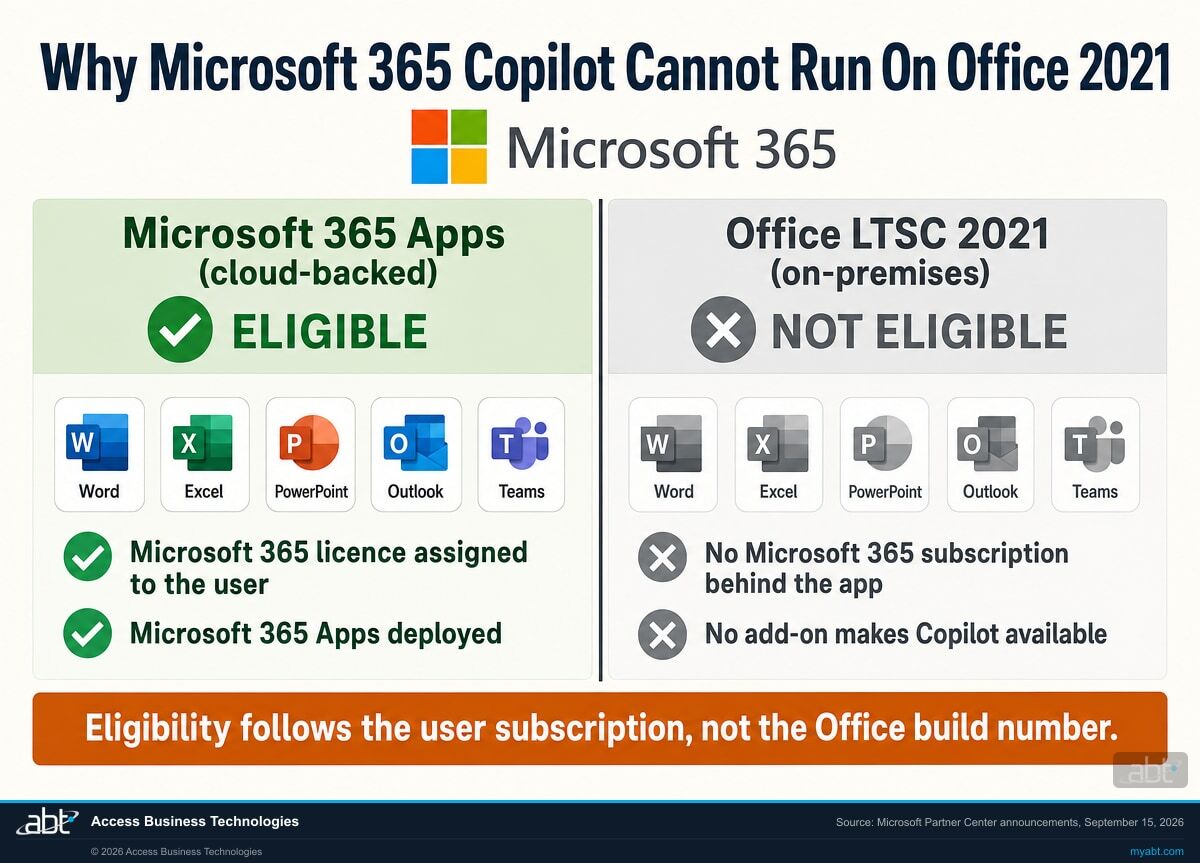
Because Microsoft draws the eligibility line around the Microsoft 365 subscription rather than around the Office version. Microsoft states that Copilot is supported only on the cloud-backed apps included in Microsoft 365 suites, and that on-premises versions of Office are not eligible.
This is the part of the announcement most coverage will skip, and it is the part that changes a budget conversation into a strategy conversation.
"Partners should note that Microsoft 365 Copilot is supported only on cloud-backed apps included in Microsoft 365 suites, and on-premises versions of Office aren't eligible."
Microsoft Partner Center announcements, September 15, 2026The word doing the work there is "eligible." This is not a statement that Copilot runs poorly on Office 2021, or that it needs a newer build, or that support is coming. It is a statement that the product is outside the boundary. There is no add-on that fixes it, because the thing that is missing is the subscription relationship itself.
Microsoft's own admin requirements say the same thing from the other direction. Copilot requires that users have a Microsoft 365 licence assigned to them, and that Microsoft 365 Apps are deployed. A perpetual install satisfies neither condition. Microsoft even rules out one nearby case explicitly: Copilot is not available when using device-based licensing for Microsoft 365 Apps for enterprise, which tells you the eligibility line is drawn around the user subscription rather than around the software version.
Why this reframes the deadline
An end-of-support date, on its own, is a cost to absorb. It buys nothing. It is the kind of line item that gets deferred one more cycle, which is exactly how an estate ends up on a 2021 product in late 2026.
The Copilot eligibility rule changes the arithmetic, because it means the organization is not choosing between paying now and paying later. It is choosing between a subscription that carries a productivity capability and a perpetual licence that structurally cannot. For as long as the estate stays perpetual, the loan officers, processors and analysts on those machines are outside that capability, and no amount of additional spending on the current licence changes it.
A question worth asking before the renewal meeting
If your institution has an AI strategy on paper, it is worth checking whether it assumes Copilot inside the Office apps, and if so, which desks that actually reaches. A perpetual install is not one of them.
Plenty of strategies survive that check. One that expects assistance in Word and Excel across the whole organization does not, and that is worth discovering in a planning session rather than in the meeting where someone asks why the pilot group is only half the department.
Find out how much of your estate is on the October 13 clock.
A free licensing assessment finds the Office, Project and Visio installs we can reach across your estate, reads them against your licensing records, identifies which ones leave support on October 13, 2026, and prices the supported paths side by side.
Book the assessmentWhat happened to sensitivity labels on perpetual Office?
The add-in that provided them is retired, and the built-in replacement does not support perpetual Office. Both halves of that sentence come from Microsoft, and together they describe a control that has nowhere left to run.
The September 15 announcement mentions it in a single clause, immediately after the Copilot sentence: "the Azure Information Protection (AIP) labeling client for perpetual Office has been retired."
Microsoft's own documentation for that client confirms the retirement and names the successor. The AIP unified labeling client is now replaced with the Microsoft Purview Information Protection client, and the Office add-in for labeling in Word, Excel, PowerPoint and Outlook is retired.
So far this reads like an ordinary product succession. The second half is where it stops being ordinary.
"To use sensitivity labels in Office apps, you must use a subscription edition of Office. Use the licensing link at the top of this page to identify eligible plans. Sensitivity labels aren't supported for standalone editions of Office, sometimes called 'Office Perpetual'."
Microsoft Purview documentation, Manage sensitivity labels in Office appsPut the two statements next to each other. The add-in that let perpetual Office apply sensitivity labels is retired. The built-in labeling that replaced it is not supported on perpetual Office. An institution running standalone Office therefore has no supported client-side path to sensitivity labeling in Word, Excel, PowerPoint or Outlook at all.
What this means for a documented classification control
A written information security program can name data classification as a control. The policy document can be current, approved and produced on request. The label taxonomy can exist in the Purview portal and look perfectly healthy there.
None of that means a person working in Word or Excel on a perpetual install can apply a label to the loan file in front of them. The policy exists, the taxonomy exists, and on that desktop there is no supported client to act on either. The gap is invisible from the portal, because the portal shows the labels you published rather than the endpoints that can consume them.
Be precise about the size of that gap, because overstating it is its own mistake. What Microsoft rules out is sensitivity labeling in the Office apps on a standalone edition. Other routes to a label are untouched: service-side automatic labeling in Microsoft Purview still evaluates content at rest, and a user signed in to Office on the web is working in a cloud-backed app rather than the perpetual one. What goes missing is the labeling your people do themselves, at the moment they create or handle the document.
That is usually the part of the control the policy actually describes. Be careful about the claim in the other direction too: Microsoft says this configuration is not supported, which is not the same as saying nothing will happen on any given machine. The point is narrower: an unsupported path is not one an institution can rely on, or expect Microsoft to stand behind if it changes. You can still observe and document what a given machine does today. The practical question is not whether the control is written down, but which routes to a label your environment actually supports today, and whether the people relying on it know which those are.
Worth checking early, whatever you decide about October
If your institution has ever told an examiner, an auditor, a carrier or a customer that it applies sensitivity labels to documents containing nonpublic personal information, it is worth confirming which endpoints can actually do that today.
The answer is a version inventory rather than a policy review, and it is a short piece of work. The uncomfortable version of this conversation is the one where the question comes from outside the institution first.
Which upgrade path is actually yours?
Microsoft published named recommendations rather than a general suggestion to modernize. They split on organization size first, and then on whether a cloud move is genuinely possible. The table below is Microsoft's own routing, not ours.
| If you are | Microsoft's recommended path | What to weigh before committing |
|---|---|---|
| An enterprise customer | Microsoft 365 E3 as the primary path, with Office 365 E3 or Microsoft 365 Apps for enterprise as fallback options | The three are not equivalent. Only the Microsoft 365 suites carry the bundled security and device management capabilities; the fallbacks are narrower, so check them against the controls your own program requires |
| A business with fewer than 300 users | Microsoft 365 Business Premium, Microsoft 365 Business Standard, or Microsoft 365 Apps for business | Business Premium is the only one of the three that carries the security stack. For most community institutions it is the honest comparison, not Business Standard |
| Running Project LTSC 2021 | Planner and Project Plan 3, layered on top of a Microsoft 365 suite | This is a separate line item that is routinely missed in the Office count, and it lands on a small number of named users |
| Running Visio LTSC 2021 | Visio Plan 2, layered on top of a Microsoft 365 suite | Same pattern. Usually a handful of seats, usually the people who produce diagrams for audits and examinations |
| Genuinely constrained from moving to cloud | Office LTSC 2024, Project LTSC 2024 and Visio LTSC 2024 | Supported, legitimate, and it carries forward both limitations described on this page. See the next section |
| Carrying more than 150 licences | Consider engaging Microsoft FastTrack for support with the move | Microsoft names this threshold itself in its lifecycle announcement. It is worth knowing the option exists before scoping the project |
The fallback options deserve a second look
Microsoft lists Office 365 E3 and Microsoft 365 Apps for enterprise as appropriate fallbacks "based on customer needs." For a financial institution, the needs that decide between them are usually the security and device management capabilities, which is precisely where the suites differ from the apps-only plans.
An organization that routes to an apps-only plan purely on price often rediscovers the difference during its next examination, and buys the capability again at that point.
What if regulation genuinely requires on-premises Office?
Then Office LTSC 2024 is a supported, legitimate answer, and Microsoft says so plainly. It is worth being equally plain about what that choice carries forward.
Microsoft does not treat the on-premises path as a failure state. Its announcement says that where regulatory, connectivity or technological constraints prevent the use of cloud solutions, customers might consider the latest supported on-premises alternatives, naming Office LTSC 2024, Project LTSC 2024 and Visio LTSC 2024. The lifecycle announcement repeats it: for organizations not yet ready to move to the cloud, the recommended path is the most recent supported on-premises version for commercial customers, Office LTSC 2024.
Microsoft's lifecycle records show Office LTSC 2024 becoming available in September 2024 and remaining in support into October 2029, under the same Fixed Lifecycle Policy, in Embedded, Professional Plus and Standard editions. That is a real runway.
What moving to the 2024 generation does not solve
Both of the limitations described earlier on this page are properties of perpetual licensing rather than of the 2021 vintage, so they travel with you.
- Microsoft 365 Copilot remains unavailable. Microsoft's eligibility statement is about on-premises versions of Office generally, not about the 2021 release. A 2024 perpetual install is still an on-premises version.
- Sensitivity labels remain unsupported. Microsoft's wording is "standalone editions of Office, sometimes called Office Perpetual." Office LTSC 2024 is a standalone edition.
- The same conversation returns. A Fixed Lifecycle Policy product has a published end date from the day it ships. Choosing the 2024 generation sets the next deadline rather than removing the category of deadline.
None of that makes the on-premises path wrong. An institution with a genuine air-gap requirement, a specific integration dependency, or a connectivity constraint at a branch is making a defensible engineering decision, and Microsoft supports it. The recommendation worth making is narrower: decide it deliberately, for the part of the estate that actually has the constraint, rather than applying it to the whole organization because that is what the last renewal did.
Mixed estates are normal and usually correct
The most common good answer we see is not all cloud or all perpetual. It is a subscription estate for the people whose work benefits from the security stack and the assistant, and a small, documented perpetual footprint for the specific machines with a specific constraint.
That shape is harder to describe in a budget line, and it is the one you can actually explain, because every exception has a stated reason attached to it. Documenting an exception does not make the exposure acceptable. It makes the decision reviewable, which is a different and smaller claim.
What should happen before October 13, in order?
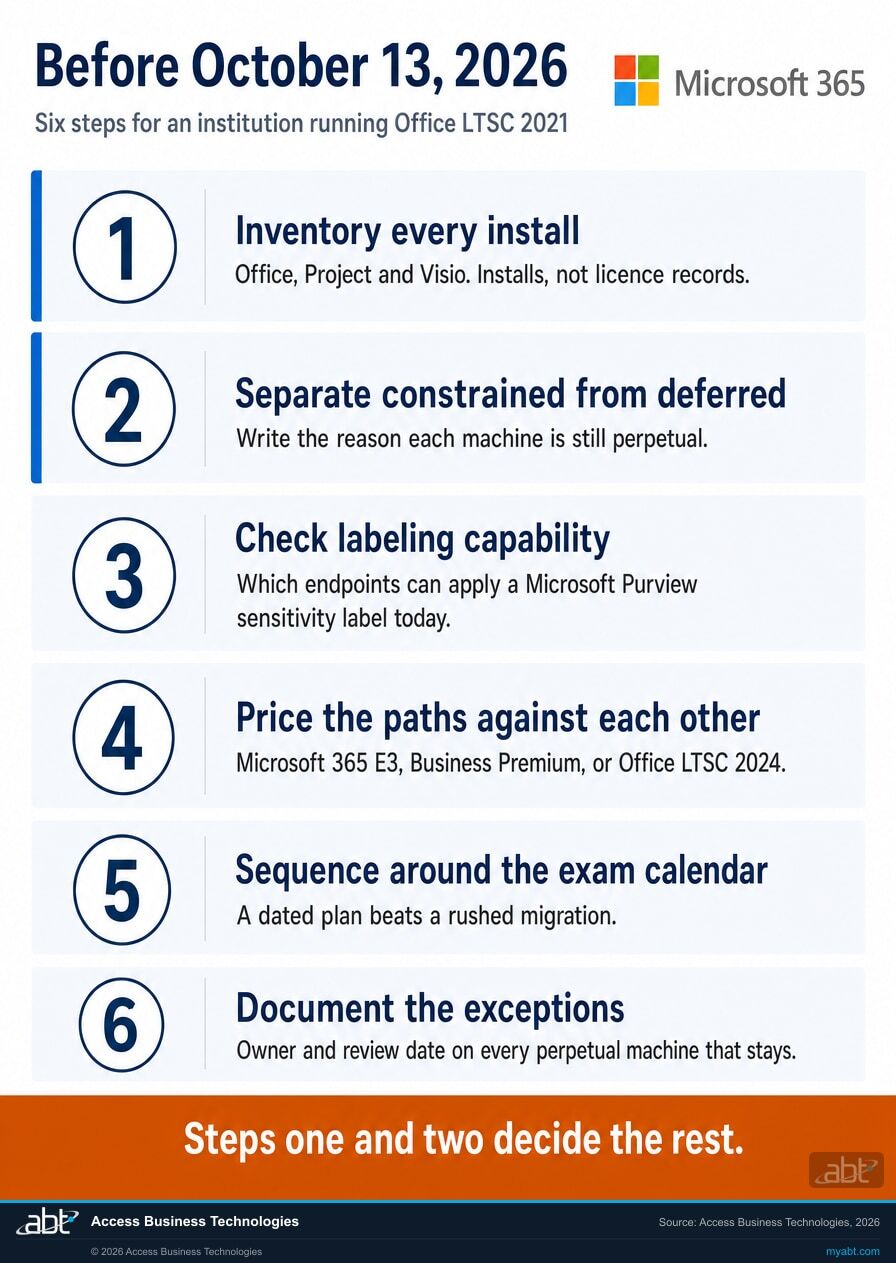
Six steps. The first two are discovery and cost nothing. The order matters, because each one narrows the decision the next one has to make.
Inventory the installs, and read them against the licence records
Licence records tell you what was bought. They do not reliably tell you what is running, and the gap between the two is where perpetual installs hide. Include home-use and reimbursed copies, machines that came in through an acquisition, and any device that has not been reimaged in five years.
Separate the constrained machines from the deferred ones
For each perpetual install, write down the reason it is perpetual. Some will have a constraint that still holds. Others will have a reason that was true in 2021 and is worth re-testing now, because connectivity, integrations and policy all move. That list is the whole decision, and writing it down is what makes the next step obvious.
Check which endpoints can apply a sensitivity label today
Do this even if you decide to stay perpetual, and do it before anyone is asked. If the institution has represented that it labels documents containing nonpublic personal information, the set of endpoints that can actually do so is a fact worth holding before an examiner, an auditor or a carrier asks for it.
Price the paths against each other rather than against today
The comparison that misleads is perpetual against subscription on licence cost alone, because it omits what the subscription carries. Compare Microsoft's named recommendation for your size against the capability the current estate cannot provide, including the assistant it is not eligible for.
Sequence the move around the examination calendar, not the deadline
October 13 is a hard date for support. What you do around it is a risk decision your institution owns, not a rule. If the move cannot complete before the date, the choice is between rushing a migration into an examination fortnight and running unsupported for a defined period against a dated plan, and the right answer depends on your examiners, your exposure and what those machines actually touch. Make it deliberately and write down the reasoning. A dated plan does not make unsupported software acceptable to an examiner, and nothing on this page should be read as saying it does. What it does is let you show the decision was made rather than missed.
Write down the exceptions and give each one an owner and a review date
Whatever stays perpetual should be a short, named list with a reason and a date attached to each entry, held where the board reporting can reach it. That register is how the risk gets managed rather than forgotten, and it is the artifact that makes next year's version of this conversation take an hour instead of a month. It records the exposure; it does not remove it.
A free licensing assessment, sized to the October 13 date
Find out what is on the clock, and what each supported path actually costs you.
Access Business Technologies is a Tier 1 Microsoft Cloud Solution Provider working with credit unions, banks and mortgage companies. We manage Microsoft 365 tenants and we host Azure environments, which means an Office estate spread across subscription and perpetual licensing is the kind of thing we untangle regularly.
- An install inventory across the machines and licensing records you can give us access to, covering Office, Project and Visio, so the October 13 exposure is a list of machines rather than an estimate.
- A constrained versus deferred split, with the stated reason for each perpetual install, so the genuine exceptions are separated from the habitual ones.
- A labeling capability read, naming which endpoints can apply a sensitivity label today and which cannot, mapped to what the institution has represented externally.
- Microsoft's recommended paths priced against each other for your seat count, including the Project and Visio lines that usually get missed.
- A sequencing plan that respects your examination calendar, plus the exception register that makes whatever stays perpetual documented and reviewable.
ABT also operates M365 Guardian, its managed security service for credit unions, banks, and mortgage companies.
Where the facts on this page come from
Every date, quotation and recommendation on this page was taken from Microsoft rather than from secondary coverage, and checked on the day this page was published.
- Microsoft Partner Center announcements, September 2026, item dated September 15, 2026. The end of support date, the three products, what stops after the date, the regulated environments wording, the Copilot eligibility statement, the retired labeling client, and every recommended upgrade path quoted on this page. Read the Microsoft announcement.
- Microsoft Lifecycle announcement, Office LTSC 2021 reaching end of support on October 13, 2026. The independent confirmation of the date, the security and compliance wording, the Office LTSC 2024 fallback, and the FastTrack threshold for organizations with more than 150 licences. Read the lifecycle announcement.
- Microsoft Purview documentation, Manage sensitivity labels in Office apps. The statement that sensitivity labels require a subscription edition of Office and are not supported for standalone editions. Read the Microsoft Purview documentation.
- Microsoft Learn, Azure Information Protection unified labeling client. The retirement of the Office labeling add-in and the succession to the Microsoft Purview Information Protection client. Read the Microsoft client status page.
- Microsoft Learn, app and network requirements for Microsoft Copilot admins. The Microsoft 365 licence prerequisite, the requirement that Microsoft 365 Apps be deployed, and the device-based licensing exclusion. Read the Copilot requirements.
- Microsoft Lifecycle product records. The editions and policy for Office LTSC 2021, Visio LTSC 2021, and Office LTSC 2024. Consumer Office 2021 guidance is published separately at End of support for Office 2021.
Microsoft changes product guidance. If you are planning around this date, confirm the current wording against the Microsoft sources above before relying on any statement, including the ones on this page.
Related reading
Microsoft Purview Sensitivity Labels for Financial Institutions
What labeling is supposed to do for nonpublic personal information, and what a working taxonomy looks like on endpoints that can actually apply one.
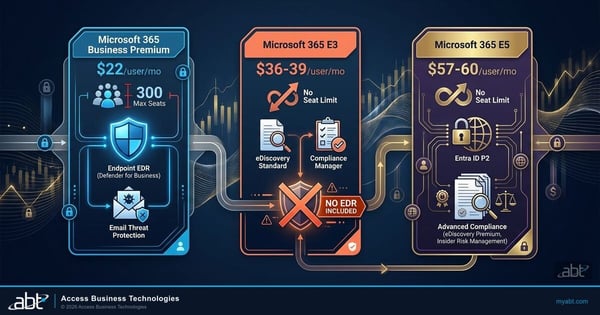
Microsoft 365 E3 vs. E5 vs. Business Premium
Once the perpetual estate is leaving, this is the next question. Where the suites genuinely differ, and which differences a financial institution feels.
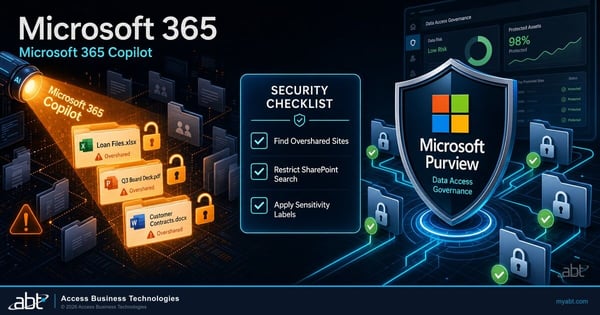
Microsoft 365 Copilot Oversharing: Fix Data Access Before Rollout
The work that has to happen between becoming eligible for Copilot and switching it on for the institution.
Two neighbouring deadlines: Publisher leaves Microsoft 365 on October 1, and three Microsoft support deadlines land in October.
What the estate on the other side of this decision can do
The capability described in this short is the one the Copilot eligibility rule puts out of reach for a perpetual install. Sixty seconds on what it looks like in practice.
Work that crosses Outlook, Word and Excel in one instruction. On an on-premises Office install, none of it is available.
Office LTSC 2021 end of support, answered from Microsoft's documentation
October 13, 2026. Microsoft states that support for Office Long Term Servicing Channel 2021, Project LTSC 2021 and Visio LTSC 2021 ends on that date, and that after it these products no longer receive updates, security fixes or technical support. Microsoft publishes the same date in its dedicated lifecycle announcement for the product.
No. The applications continue to open and run. What ends is Microsoft's provision of updates, security fixes and technical support, which means any vulnerability discovered after that date is never patched on your installation. Microsoft's lifecycle announcement notes that continuing to run the product may increase an organization's exposure to security risks and could impact compliance requirements.
No, and this is not a version limitation that a newer perpetual release would fix. Microsoft states that Microsoft 365 Copilot is supported only on cloud-backed apps included in Microsoft 365 suites, and that on-premises versions of Office are not eligible. Microsoft's Copilot requirements say the same from the other side: users must have a Microsoft 365 licence assigned to them and Microsoft 365 Apps must be deployed. A perpetual install meets neither condition, so there is no add-on that makes Copilot available on it.
Not in the Office apps on a standalone edition. Microsoft's Purview documentation states that to use sensitivity labels in Office apps you must use a subscription edition of Office, and that sensitivity labels are not supported for standalone editions of Office, sometimes called Office Perpetual. The add-in that used to provide this has also been retired: Microsoft states that the Azure Information Protection labeling client for perpetual Office has been retired, and that the Office add-in for labeling in Word, Excel, PowerPoint and Outlook is retired in favour of the Microsoft Purview Information Protection client. Note the boundary carefully, in both directions. Not supported is a statement about what Microsoft will stand behind, which is not the same as a prediction about what happens on any given machine, and an institution cannot rely on or evidence an unsupported path either way. The restriction is also specific to the Office desktop apps on a standalone edition: service-side automatic labeling in Microsoft Purview still evaluates content at rest, and Office on the web is a cloud-backed app. What is unsupported is the labeling your people apply themselves as they work.
Yes. Microsoft names all three products in the same sentence and gives them the same October 13, 2026 date. Microsoft's recommended cloud replacements are Planner and Project Plan 3 for Project LTSC, and Visio Plan 2 for Visio LTSC, both of which can be layered on top of a Microsoft 365 suite. These seats are commonly missed in an Office count because they sit with a small number of named users rather than with the whole organization.
It depends on organization size. Microsoft directs enterprise customers to Microsoft 365 E3 as the primary recommended path, with Office 365 E3 or Microsoft 365 Apps for enterprise as appropriate fallback options based on customer needs. Businesses with fewer than 300 users are directed to Microsoft 365 Business Premium, Microsoft 365 Business Standard, or Microsoft 365 Apps for business. Microsoft also suggests that companies with over 150 licences consider engaging Microsoft FastTrack for support with the move.
Microsoft supports that case explicitly. Where regulatory, connectivity or technological constraints prevent the use of cloud solutions, Microsoft points to the latest supported on-premises alternatives: Office LTSC 2024, Project LTSC 2024 and Visio LTSC 2024. Microsoft's lifecycle records show Office LTSC 2024 supported into October 2029. Be aware that both limitations described on this page follow the perpetual licensing model rather than the 2021 release, so a 2024 install is still an on-premises version with no Copilot eligibility and still a standalone edition with no supported sensitivity labeling.
Microsoft has not published one. Extended Security Updates are a familiar concept from Windows and from Windows Server, where Microsoft sells additional years of security patching after end of support. Nothing in Microsoft's announcement or lifecycle guidance for these Office products offers an equivalent, and the only continuation paths Microsoft names are a Microsoft 365 subscription or the 2024 generation of the perpetual products. Plan on October 13, 2026 being the last security update rather than the start of a paid extension.
No. Windows 10 Enterprise LTSC 2021 is an operating system with its own lifecycle and its own Extended Security Updates options, while Office LTSC 2021 is the productivity suite. They share a year and a channel name, which makes them easy to confuse in planning conversations. An institution running both is managing two separate decisions on two separate calendars, and it is worth confirming which one a given machine is actually affected by before scoping any work.
Find every install on the clock
before October 13.
Tell us roughly how many people you have and what you think you are running. Our engineers will inventory every Office, Project and Visio install, separate the machines with a genuine constraint from the ones that simply never moved, and price Microsoft supported paths against each other for your seat count.
