


From 30 September 2026, Microsoft Entra Connect Sync needs version 2.5.79.0 or later to synchronize. Below it, synchronization stops and stays stopped until the server is upgraded.
Microsoft's back-end service change takes effect on 30 September 2026. A server below 2.5.79.0 loses all synchronization services from that date, and Microsoft's documented remedy is to upgrade to the latest version. This page covers how to tell whether a tenant has stopped syncing, which build to install, what to do while it is down, and what to check once it resumes.
- How to tell in a few minutes whether directory synchronization stopped
- The build to install now, and why three others make poor landing points
- What to do while it is down, and what to check once it resumes: accounts, sessions and logs
What happens from 30 September 2026?
Servers below Microsoft Entra Connect Sync 2.5.79.0 lose all synchronization services from 30 September 2026, and they stay that way until they are upgraded. Servers on 2.5.79.0 or later meet the cutoff's version requirement. The cause is a back-end service change that hardens how Connect Sync authenticates to Microsoft Entra ID; the client half of it is built into 2.5.79.0 and every later build.
Microsoft states the rule in an identical box on three of its own pages, the version release history, the Connect Sync security article and the upgrade guidance:
Mandatory Upgrade Required: All synchronization services in Microsoft Entra Connect Sync will stop working on September 30, 2026 if you're not on at least version 2.5.79.0. In May 2025, we released this version with a back-end service change that hardens our services. Upgrade before this deadline to avoid any service disruption.
If you're unable to upgrade before the deadline, all synchronization services will fail until you upgrade to the latest version.
The change runs through a dedicated first-party application. Microsoft's hardening article names it the Microsoft Entra AD Synchronization Service, application ID 6bf85cfa-ac8a-4be5-b5de-425a0d0dc016, visible under Enterprise Applications in the Microsoft Entra admin center, and describes it as critical for the continued operation of synchronization through Entra Connect. Knowing the name makes it easy to recognize in that list.
The outage is recoverable, and its length is set by whoever notices it
The outage is recoverable, and what restores it is a person upgrading the server. Microsoft is specific about the shape of the gap:
If you're unable to upgrade by the deadline, you can restore the impacted functionalities by upgrading to the latest version. However, all synchronization services will fail during the period between September 30, 2026, and when you upgrade.
So the length of the outage is set by how long it takes somebody to notice it and complete the upgrade. A directory sync failure does not announce itself to users the way a mail outage does. Nobody calls the help desk to say their manager attribute is stale. The people who would notice first are the ones onboarding a new hire, and they will read an outage as a provisioning delay.
Who is actually exposed
Microsoft has been auto-upgrading Connect Sync and Connect Health since September 2023, and says plainly that customers who were auto-upgraded are not affected by the service change. Its release history says existing installations were to be auto-upgraded to 2.5.79.0 starting 4 September 2025, in multiple phases. The exposed population is narrower and definable: servers where auto-upgrade was switched off, where it failed quietly, or where the configuration was never eligible for it. Microsoft notes that not all Connect configurations are eligible, and separately that auto-upgrade itself requires version 2.3.20.0 or higher to function.
That last detail is the sharp one. The servers furthest behind are the servers auto-upgrade cannot rescue, because the mechanism that would have saved them is itself too old to run.
How do you tell whether directory synchronization stopped?
A healthy server runs a delta cycle every 30 minutes by default, so the signal is a last-sync time that has stopped moving. Microsoft's own troubleshooting index for Microsoft 365 names the symptoms in its words: the DirSync Status tile in the Microsoft 365 admin center indicating a problem, an alert in the admin center or automated emails saying there hasn't been a recent synchronization event, and a warning that sync hasn't registered in more than a day. Microsoft sends its directory synchronization error mail to the tenant's admin email and alternate email, so check those mailboxes too.
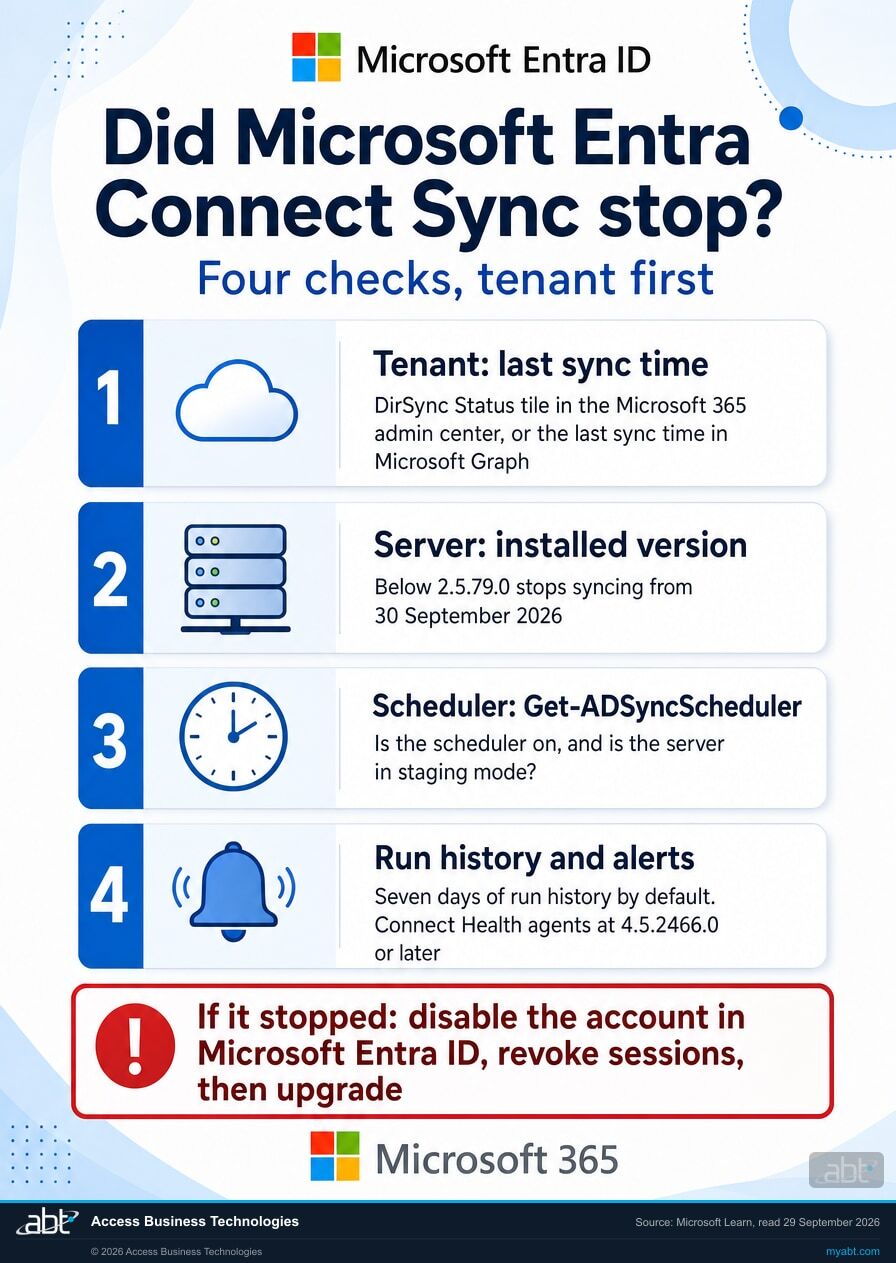
The tenant's last sync time
The DirSync Status tile in the Microsoft 365 admin center is the quick look. Microsoft Graph carries the same fact as a property of the organization, onPremisesLastSyncDateTime, which Microsoft defines as "The time and date at which the tenant was last synced with the on-premises directory." A time that has not moved since 30 September, on a tenant whose sync server is below 2.5.79.0, points at this change.
The installed version on the sync server
Open Microsoft Entra Connect from the Start menu and read the version in the wizard, or find it under Programs and Features alongside every other installed application. The ADSync PowerShell module that ships with the product reports the installed build without opening the wizard, which is the faster route across several servers.
The scheduler, to rule out the other causes
On the sync server, Get-ADSyncScheduler reports whether the scheduler is running its import, sync and export steps (SyncCycleEnabled), when the next cycle starts (NextSyncCycleStartTimeInUTC), and whether the server is in staging mode (StagingModeEnabled), which suppresses exports while imports carry on. A staging server that looks idle is working as designed; the question is whether the active server is syncing.
The run history and the alerts
Run this step after the version check, on a server below 2.5.79.0, the kind this cutoff stops. There, Synchronization Service Manager keeps the run history, seven days of it by default, so read it early and keep a dated copy if you want a record of when failures started, then close the window, because an open Synchronization Service Manager window suspends automatic upgrade. On 2.5.79.0 and 2.5.190.0 Microsoft warns against using the Synchronization Service Manager UI at all; those builds keep synchronizing through the cutoff, so the tenant check and Connect Health answer the question for them. In Microsoft Entra Connect Health, the overview for each sync service brings together server health, active and recently resolved alerts, synchronization errors and data freshness status. Keep the Health agents at or above their own 4.5.2466.0 minimum, or the alert picture is incomplete.
If it has stopped: contain first, then upgrade
An offboarding that falls inside the outage needs the cloud side too: disable the account in Microsoft Entra ID and revoke its sessions, as well as disabling it in Active Directory. The steps are further down this page. Then treat the upgrade as an emergency change and choose the build.
Check every server, including the one you forgot
An organization that has done a swing migration may still have more than one Connect server, and a staging server can sit a version behind. It is harmless while it stays in staging mode. It stops being harmless the moment somebody promotes it during an incident, and discovers that the server they just made active is below the minimum.
Microsoft is direct about the related hazard: a decommissioned sync server left on the network or powered up again by mistake tends to overwrite Microsoft Entra data with its old information, and can cause attribute values to revert on every sync cycle, which by default is every 30 minutes. If you find an old server during this check, finish the job and remove it.
If automatic upgrade was supposed to handle it
Get-ADSyncAutoUpgrade reports one of three states: Enabled, Suspended or Disabled. When it reads Suspended, adding -Detail shows the reason. The Application event log records upgrade results under the source Microsoft Entra Connect Upgrade, event IDs 300 to 399.
Microsoft lists the conditions that make a server ineligible, among them TLS below 1.2, an installation that was not an express settings or DirSync upgrade, a database other than SQL Server Express LocalDB, and a LocalDB of 8 GB or more. One detail is easy to trip over: if the Synchronization Service Manager window is open on the server, the upgrade is suspended until it is closed.
What does your version number mean now?
| Band | From 30 September 2026 | What else is true about it | Verdict |
|---|---|---|---|
| Below the minimum anything under 2.5.79.0 |
All synchronization services stop, and stay stopped until the server is upgraded. | If the build is also below 2.3.20.0, auto-upgrade cannot reach it, so the upgrade has to be done by hand. | Upgrade now |
| Exactly the minimum 2.5.79.0 |
Synchronization continues. | Reaches end of support on 23 October 2026. Microsoft's release notes also warn against using the Synchronization Service Manager UI on this build. | Plan the next upgrade |
| Supported, not current 2.5.190.0 to 2.6.91.0, except 2.6.79.0 |
Synchronization continues. | Each build carries its own end-of-support date in the release history, starting with 2 February 2027 for 2.5.190.0. The Synchronization Service Manager warning applies to 2.5.190.0 as well, and Microsoft says it is fixed in 2.6.1.0. | Check the date |
| Recalled 2.6.79.0 |
Absent from Microsoft's supported list. | Microsoft recalled it after an issue was identified post-release, and its note tells anyone who installed it to uninstall it and install the latest available version. | Replace now |
| Current build 2.6.92.0 as of 29 September 2026 |
Synchronization continues. | Released 23 September 2026 as a hotfix. Microsoft's note on it: this release includes security fixes and it recommends upgrading as soon as possible. It is also the build Microsoft now names for anyone who installed the recalled 2.6.79.0. | Current |
Version numbers change, and two builds shipped in the three weeks before the cutoff. The point of the table is the shape of the bands: check the release history for the current version on the day you do the work, and treat the number in any article, including this one, as a snapshot of the day it was written.
The offboarding gap a stopped sync opens
What stops when directory synchronization stops?
"All synchronization services will fail" is an accurate sentence and a quiet one. It becomes concrete once you look at what Connect Sync actually carries. Microsoft publishes the full attribute list, and three entries on it decide how much this matters to a regulated institution.
accountEnabled: the one that should worry you
Microsoft's attribute reference lists accountEnabled with the comment "Defines if an account is enabled". It appears in the synchronized set for every workload on that page: Microsoft 365 Apps for enterprise, Exchange Online, SharePoint Online, Teams, Azure Rights Management, Intune, Dynamics, third-party applications, and Windows 10 devices.
That attribute is how disabling an account in on-premises Active Directory becomes disabling an account in Microsoft 365. When synchronization is down, the checkbox gets ticked on-premises, the runbook gets signed off, and the change waits on-premises until synchronization runs again.
Whether the person can still sign in depends on how your tenant authenticates, and Microsoft documents this directly. Its guidance on choosing a hybrid authentication method says:
Currently, password hash synchronization doesn't immediately enforce changes in on-premises account states. In this situation, a user has access to cloud apps until the user account state is synchronized to Microsoft Entra ID. Organizations might want to overcome this limitation by running a new synchronization cycle after administrators do bulk updates to on-premises user account states. An example is disabling accounts.
In normal operation that gap is short. Microsoft's own comparison table puts it at up to a 30-minute delay for disabled accounts under password hash synchronization. The point of this page is what happens to that delay when the synchronization cycle it depends on has stopped: the limitation stops being a delay and starts being a state.
| Your sign-in method | Where authentication happens, per Microsoft | Disabling the AD account while synchronization is stopped |
|---|---|---|
| Password hash synchronization | In the cloud: the password hash is synchronized and Microsoft Entra ID validates the credentials. | Sign-in continues until the cloud account is disabled or synchronization resumes. Microsoft supports the disabled-account state here with "up to 30-minute delay", and that delay is the synchronization cycle. With no cycle running, the disable stays on-premises. This is the case that should worry you. |
| Pass-through authentication | "In the cloud, after a secure password verification exchange with the on-premises authentication agent" | New sign-ins are denied. Microsoft: pass-through authentication "enforces the on-premises account policy at the time of sign-in", and "access is denied when an on-premises user's account state is disabled". |
| Federation, for example AD FS | "On-premises" | New sign-ins are denied. Microsoft lists the same account states as supported, including disabled accounts, locked out, expired, and sign-in hours. |
Two qualifications apply to all three rows. A session that is already established is not the same as a new sign-in: access tokens and refresh tokens keep working until they expire or are revoked, which is what session revocation and Continuous Access Evaluation exist to shorten. And unless someone removes them in the cloud, the license, the group memberships and the mailbox remain in place for all three, because removing them on-premises is a directory change and directory changes are what stopped.
If you do not know which of the three your tenant uses, that is the next thing to establish, and it takes about as long as reading the version number.
Say exactly how much of this is Microsoft's
Most of it. Microsoft documents that all synchronization fails from the cutoff until the upgrade, that accountEnabled is one of the attributes synchronization carries, and, in its own words above, that password hash synchronization does not immediately enforce on-premises account state changes, naming disabling accounts as the example. The step we are adding is the short one: with synchronization stopped, the cycle that normally closes that gap within 30 minutes is not running.
Connecting the two is our step. Microsoft's pages on this change describe it as a synchronization outage, and the offboarding reading is ours.
The failure is quiet on the offboarding side. The sync engine logs its own failures on the server, and Connect Health raises alerts when its agents are current. What tends to produce no signal is the offboarding workflow itself: the help desk sees a completed task, and the record shows the account disabled, because on-premises it is. Unless someone checks the cloud side, the person doing the deprovisioning has no reason to suspect that half of it did not land.
Which is why the useful question is whether the person who ticked the box would ever hear about it.
member: access changes made by group stop landing
Group membership travels through the member attribute, and most institutions grant Microsoft 365 access by group precisely because it is the cleaner control. It is also the control that stops: moving somebody out of the group behind a shared mailbox, a SharePoint site or a licensed application changes nothing in the cloud until sync resumes.
The direction of that failure is worth stating plainly. Access you remove stays granted. Access you grant never arrives. The second tends to produce a support ticket quickly. The first tends to produce none.
pwdLastSet: what invalidates a token that is already issued
Microsoft describes pwdLastSet as a mechanical property "used to know when to invalidate already issued tokens", used by password hash synchronization, pass-through authentication and federation alike. So the timestamp that tells Microsoft Entra ID a password changed is itself something synchronization carries. That matters during an incident, when forcing an on-premises password reset is a standard first move against a suspected compromise.
What keeps working
Authentication itself is separate from synchronization. Users already present in Microsoft Entra ID go on working: mail keeps flowing, Teams keeps working, and files stay where they are. Conditional Access policies keep evaluating, and multifactor authentication keeps challenging. The users, mailboxes and files already in the tenant stay in place.
Sign-in is the one to qualify. Whether a given person can still authenticate depends on the method in the table above and on whether their session is already established, so treat "everyone keeps signing in" as true of the tenant as a whole and not of any account whose on-premises state changed during the outage.
What stops is change that starts on-premises. Accounts and groups synchronized from Active Directory stay in the state they were in when sync last ran, while changes made directly in the cloud, such as revoking a user's sessions, still apply. That is why this can run for weeks without anyone raising it, and why the checks above belong in the first days after 30 September.
We will read the tenant with you and tell you where you stand
A free security assessment covers this change alongside the rest of your identity posture, starting with the three answers that decide what it costs you: whether synchronization is running, which version each Connect server runs, and which sign-in method your tenant uses.
Get a free security assessmentWould your monitoring have told you?
Microsoft Entra Connect Health is the component that watches the sync server and raises alerts when it stops working. It runs as a set of agents, and on the same page that carries the Connect Sync deadline, Microsoft asks customers to move those agents to 4.5.2466.0 or higher by the same date, 30 September 2026, across the Connect Sync agent, the AD DS agent and the AD FS agent.
These are the alerts Microsoft lists as impacted for agents below that minimum:
| Component | Minimum version | What is affected below it |
|---|---|---|
| Connect Health, Connect Sync agent | 4.5.2466.0 | A named subset of alerts, including "Password Hash Synchronization has stopped working", "Password Hash Synchronization heartbeat was skipped in the last 120 minutes", "Connection to Microsoft Entra ID failed due to authentication failure", "Export to Microsoft Entra ID was Stopped. Accidental delete threshold was reached", and two service-start failures. |
| Connect Health, AD DS agent | 4.5.2466.0 | All alerts. |
| Connect Health, AD FS agent | 4.5.2466.0 | All alerts. |
Read the first row again. "Password Hash Synchronization has stopped working" is close to a description of the outage this page is about, and on a stale Health agent it is one of the alerts Microsoft lists as impacted. Microsoft adds a second limit on the same product: when Connect runs a non-default configuration, custom attribute filtering for example, the Health agent does not upload the error events related to Microsoft Entra Connect, which limits the evaluation of alerts. Microsoft documents a Settings option on the sync service in Connect Health to enable that monitoring.
What that correlation means
Microsoft has not said the two failures are designed to coincide, and the alert impact is a property of the agent version, separate from the synchronization stop. What makes it worth a section is practical: a Connect server that has drifted is a reason to check its Health agents too, and Microsoft has put both on the same deadline on the same page.
Which means the sensible order is to check both in the same sitting, and to treat a quiet monitoring dashboard as an unanswered question.
Which Entra Connect Sync version should you install now?
The current build: 2.6.92.0 as of 29 September 2026, a hotfix released 23 September 2026 that fixes an issue in 2.6.91.0 when enabling pass-through authentication through the wizard, and that Microsoft recommends installing as soon as possible because it includes security fixes. Almost everything written about this deadline resolves to a single instruction, get to 2.5.79.0, which is correct about the cutoff and incomplete about the work. Microsoft's release history points past it for three reasons.
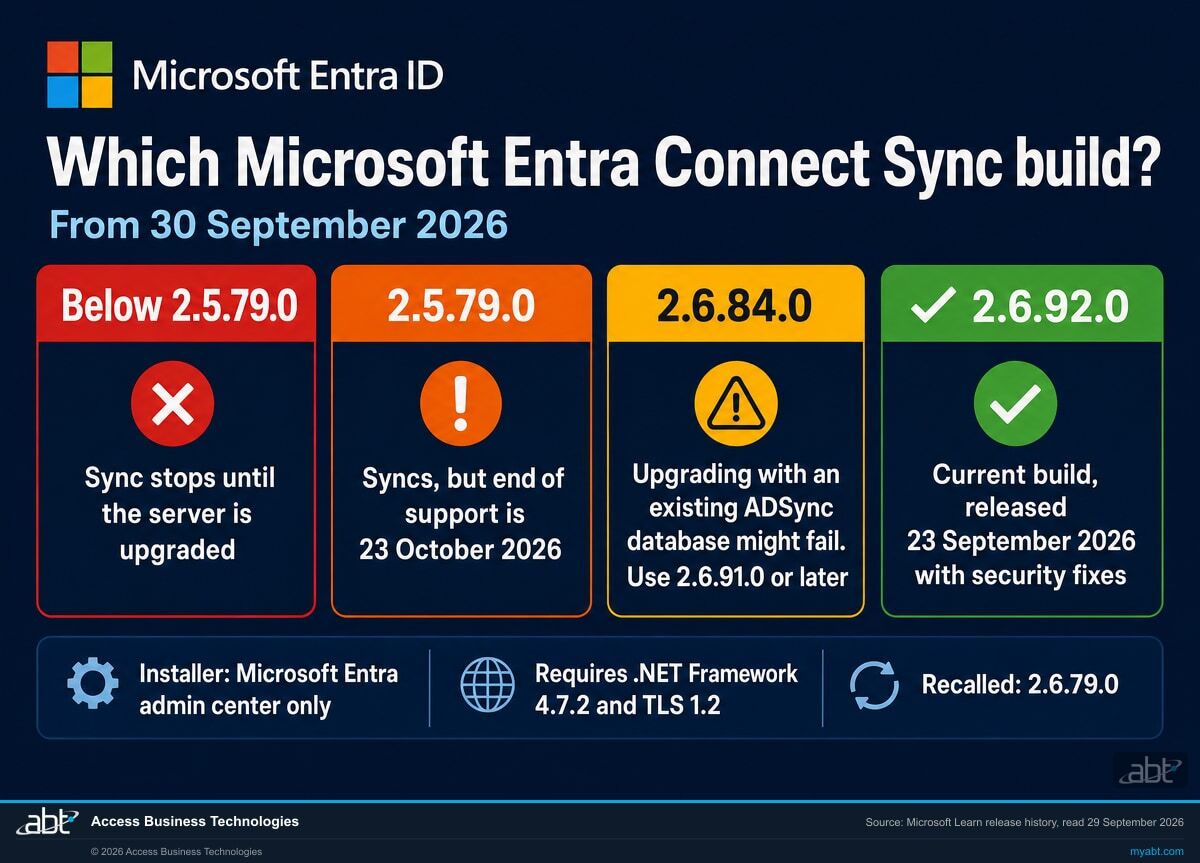
The minimum reaches end of support on 23 October 2026
Microsoft retires Connect Sync 2.x versions 12 months after a newer version is released, a policy in effect since 15 March 2023. The version release history puts the end of support for 2.5.79.0 at 23 October 2026, so a server upgraded to exactly the minimum needs a second upgrade within weeks. The notes for 2.5.79.0 and 2.5.190.0 also warn against using the Synchronization Service Manager UI on those builds, because doing so may cause the Connect wizard and automatic certificate renewal to fail. Microsoft says the issue is fixed in 2.6.1.0.
2.6.84.0 has a known issue with existing databases
Microsoft's known issues for 2.6.84.0 say that installing or upgrading to it with an existing ADSync database might fail with error 0xE0474352, and direct anyone installing or upgrading with an existing database to 2.6.91.0 or later. A server being upgraded where it stands already has its database, so we would pass over 2.6.84.0 as a target.
The recalled build now points to 2.6.92.0
Version 2.6.79.0 was recalled after an issue was identified post-release. Microsoft's note tells customers who installed it to uninstall it and install the latest available version, which the note now names as 2.6.92.0. This is the specific case where reading the release history beats searching for a download link.
Where the installer actually is
Microsoft states that the Connect Sync .msi is exclusively available in the Microsoft Entra admin center, under Microsoft Entra Connect on the Get started page. Two prerequisites are named on the same pages and are worth confirming before you run it: .NET Framework 4.7.2 and TLS 1.2.
Two checks before the new build goes on
A modified miiserver.exe.config. Microsoft's release history leads with a known issue for upgrades to 2.5.190.0 and 2.6.1.0: if miiserver.exe.config was previously modified, synchronization may fail after the upgrade with a System.IO.FileLoadException, because the upgrade leaves the modified file alone and a dependency binding goes missing. Microsoft has seen it where the file was edited under earlier guidance for password hash synchronization in FIPS-enabled environments, and documents a manual fix in the release history.
App-scoped Conditional Access. Version 2.6.91.0 adds Microsoft Graph permissions to Microsoft Entra Connect, and Microsoft asks anyone using app-scoped Conditional Access policies to review policies targeting Microsoft.Azure.SyncFabric or Microsoft 365 Reporting Service.
Three ways to upgrade, and when each one is right
| Method | When it fits | What it costs you |
|---|---|---|
| Automatic upgrade | Express installations that are already on 2.3.20.0 or higher and eligible. If this has been working, you are probably already past the minimum and this page is a confirmation exercise. | No manual intervention. Microsoft notes the auto-upgrade build can trail the newest release, because auto-upgrade carries critical fixes. |
| In-place upgrade | Microsoft's stated preference for a single server with fewer than roughly 100,000 objects, where the configuration has not drifted far from the defaults. | Microsoft notes that if there is an issue during the in-place upgrade, you can't roll back the new release or configuration. A full import and full synchronization may run afterwards, which can take hours, and the normal delta scheduler is suspended while it does. Microsoft suggests considering a weekend, and notes password synchronization continues during that run. On a server already past the cutoff, nothing synchronizes until the upgrade itself completes. |
| Swing migration | Microsoft's recommendation when you are making substantial configuration changes, upgrading the server operating system, or coming from an old build. Its explicit guidance: anyone who has not upgraded in 12 to 18 months should consider this instead. | Needs a second server. In exchange, production sync is not interrupted, the new configuration can be verified before it goes live, and the old server stays available if the new one misbehaves. |
Two things to get right around the change
Custom sync rules. Microsoft warns that if you have modified the out-of-box synchronization rules, an upgrade sets them back to default. Institutions with attribute filtering, custom joins, or anything built for a core banking or loan origination integration should export the custom rules first and confirm them afterwards. This is how an upgrade can succeed technically and still break an integration.
The old server. Finish decommissioning it. Microsoft's warning about rogue sync servers is unusually blunt: one left on the network or powered back on later can overwrite Microsoft Entra data with stale information and revert attribute values on every cycle. Uninstall the product and its components, or delete the virtual machine.
If a server is below the minimum on or after 30 September, the upgrade ends a live outage, so it belongs in an emergency change. Once it completes, watch the tenant's last sync time move. If you need a cycle sooner than the schedule, Microsoft's command is Start-ADSyncSyncCycle -PolicyType Delta. From 2.6.84.0, re-enabling the password hash synchronization cloud setting is an administrator's job, so confirm it shows as enabled after the upgrade.
What should you do while synchronization is down, and once it resumes?
While synchronization is down: offboard from both sides
Microsoft's emergency revocation guidance for a hybrid environment covers both directories. In Active Directory, disable the user and reset the password. In Microsoft Entra ID, clear Account enabled on the user's properties and select Revoke sessions on the overview page, or run Update-MgUser -AccountEnabled:$false and Revoke-MgUserSignInSession in PowerShell.
The Microsoft Entra steps are the ones that take effect while synchronization is stopped, and the Active Directory disable keeps the account disabled once it resumes.
Accounts disabled during the outage, and their sessions
Pull the offboarding tickets closed while synchronization was down and confirm each account shows as disabled in Microsoft Entra ID once the cycle completes. Revoke sessions for any account that was only disabled on-premises. Microsoft's emergency revocation guidance does this with Revoke sessions on the user's overview page in the admin center, or with Revoke-MgUserSignInSession in PowerShell, which revokes the user's Microsoft Entra ID refresh tokens. Access tokens already issued stay valid until they expire, by default a random 60 to 90 minutes according to Microsoft's token documentation.
Sign-ins by those accounts, before the logs age out
If any of those accounts signed in after it was disabled on-premises, the sign-in logs are where it shows. Microsoft keeps Microsoft Entra sign-in and audit logs for 30 days on Microsoft Entra ID P1 and P2 and seven days on the free tier, so read them before the first days of the outage age out, or route them to storage to keep them longer. The Microsoft 365 unified audit log is a separate record, with its own retention set in Microsoft Purview Audit.
Group changes and new accounts
Spot-check that group membership removed on-premises during the outage has taken effect in the cloud, starting with the groups behind shared mailboxes and sensitive SharePoint sites, and that accounts created for new hires in that window now exist in Microsoft Entra ID.
A record of the outage itself
After the upgrade to the current build, Synchronization Service Manager keeps seven days of run history by default. If you want a record of when synchronization stopped and when it resumed for your own incident file, keep a dated copy before it rolls off, alongside the version the server ran before and after the upgrade.
Should this be the moment you move to Cloud Sync instead?
Microsoft raises this on every page connected to the change, in the same words each time: if you are eligible, it recommends migrating from Microsoft Entra Connect Sync to Microsoft Entra Cloud Sync. Cloud Sync is a lightweight agent with its configuration held in the cloud, so the sync rules stop living on a Windows server you have to patch, upgrade and eventually decommission. Microsoft's stated reasoning is that new sync capability is going into Cloud Sync, and choosing it now avoids a later migration.
From version 2.6.91.0, Connect Sync includes a guided migration workflow to Cloud Sync covering configuration assessment, provisioning agent setup, staged activation and validation. Microsoft lists it as available only in the Azure public cloud. Two qualifications, both Microsoft's own, still decide the timing.
- Eligibility is conditional. Microsoft gates the recommendation on "if you're eligible" every time it makes it, and publishes a supported sync scenarios comparison to answer the question. Some configurations are not supported on Cloud Sync today. Read that comparison against your own environment.
- It is a project of its own. If synchronization has stopped, the Connect Sync upgrade restores it today. Cloud Sync is a decision for its own timeline, and the upgrade you install to restore synchronization is the one that brings the guided workflow with it.
The practical order: restore synchronization with the upgrade, then let the upgrade prompt the Cloud Sync question. They are two decisions on two timelines, and merging them is how a recoverable outage turns into a stalled project.
We read the environment and hand back the answer in writing
Where automatic upgrade has done its job, this ends quickly and in your favor, and that is a good outcome to have on paper. A free security assessment covers this change as part of a wider read of the tenant.
- Whether synchronization is running. The tenant's last successful sync, and when it stopped if it did.
- Every Connect server visible to us. Which is active, which is staging, and the installed version of each, checked against the server list in your own records.
- Whether auto-upgrade is on, eligible, and actually succeeding. The three are different questions and only the third one matters.
- The Connect Health agents. Version state against the 4.5.2466.0 minimum, so the monitoring is trustworthy before you rely on it.
- Custom sync rules and attribute filtering. What has been changed from the defaults, so an upgrade keeps your integrations intact.
- Your sign-in method. Password hash synchronization, pass-through authentication or federation, which is what decides whether a stopped sync leaves disabled accounts able to sign in.
- A named set of identity checks alongside it. Conditional Access policy coverage, privileged role assignments, registered authentication methods, and stale or unused accounts.
That list is the scope: a point-in-time technical review of the items named above, as they stand on the day we read them.
What it cannot do from the tenant alone: tell you which change window your board will approve, or which of your integrations depends on a custom rule somebody wrote in 2019. Those need your records, and we tell you exactly which ones to pull. The output is written, and you keep it whether or not you engage us for the work.
ABT manages Microsoft 365 tenants and hosts Azure environments for more than 750 financial institutions, so hybrid identity in a regulated setting is the environment we work in daily. ABT also operates M365 Guardian, its managed security service for credit unions, banks, and mortgage companies.
Where the facts on this page come from
Every Microsoft fact on this page traces to those pages. The offboarding reading, the order of the checks and the recommendations are ABT's. Microsoft's release history also moves: two builds shipped in the three weeks before the cutoff, and the recall note changed the build it names along with them. Check these pages against this one before you act on a version number.
The identity controls a stopped sync touches
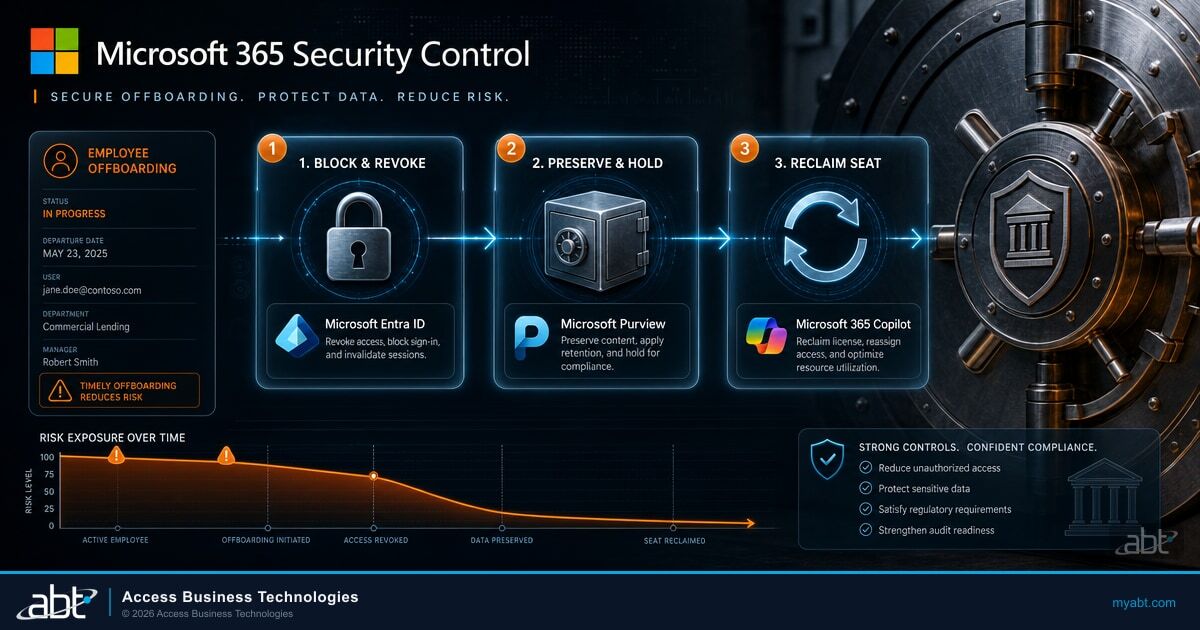
Microsoft 365 Employee Offboarding for Financial Institutions
The full runbook, including the steps that run in the cloud and therefore keep working when directory sync is down. Read it alongside this page.
Read the article ›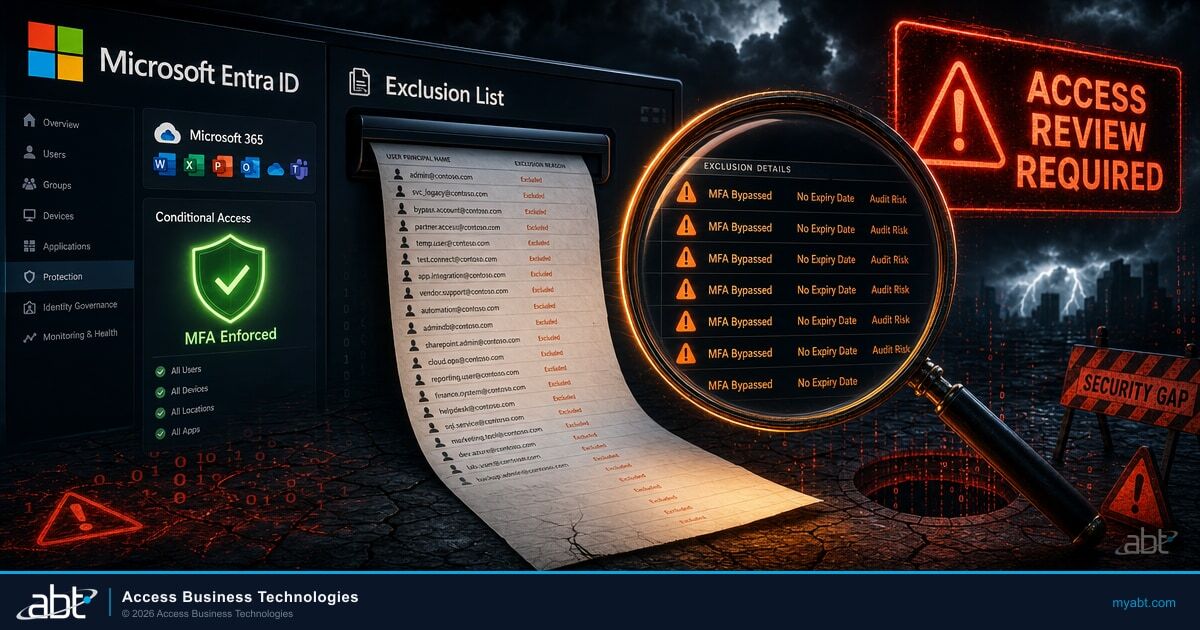
Conditional Access Exclusions: The List Nobody Reviews
The 2.6.91.0 notes ask you to review app-scoped Conditional Access. This is the wider problem: exclusions that outlive the reason they were added.
Read the article ›
Microsoft 365 Audit Log Retention for Financial Institutions
The Microsoft 365 unified audit log is the other half of reconstructing what changed during an outage, with retention set separately from the Microsoft Entra sign-in logs.
Read the article ›Answered from Microsoft's own documentation
From September 30, 2026, all synchronization services stop working on any server running a version below 2.5.79.0. Microsoft states this in an identical box on three of its own Learn pages, the version release history, the Connect Sync security article and the upgrade guidance, and the box adds that if you are unable to upgrade before the deadline, all synchronization services fail until you upgrade to the latest version. The cause is a back-end service change that hardens how Connect Sync authenticates to Microsoft Entra ID. Servers on 2.5.79.0 or later meet the cutoff's version requirement, and the tenant's last sync time confirms they are syncing.
Start with the tenant. The DirSync Status tile in the Microsoft 365 admin center shows the state, Microsoft Graph carries the last sync time as the organization property onPremisesLastSyncDateTime, and Microsoft lists admin center alerts and automated emails about a missing recent synchronization event as symptoms. The default schedule runs every 30 minutes, so a last sync time that has stopped moving is the first sign. Then read the version on the sync server: below 2.5.79.0 on or after September 30, 2026 points at this change. On the server, Get-ADSyncScheduler shows whether the scheduler is enabled and whether the server is in staging mode, which suppresses exports, and on a server below 2.5.79.0, Synchronization Service Manager keeps seven days of run history by default. Microsoft warns against using that interface on 2.5.79.0 and 2.5.190.0, builds that keep synchronizing through the cutoff.
Yes. Microsoft says you can restore the impacted functionality by upgrading to the latest version, and that all synchronization services fail during the period between September 30, 2026 and when you upgrade. The length of the outage is set by how long it takes somebody to notice it and complete the upgrade. Restoring synchronization resumes the flow of on-premises changes; anything that happened while it was down still needs its own review, starting with the accounts disabled in that window.
Open Microsoft Entra Connect on the sync server and read the version in the wizard, or find it under Programs and Features on the same machine. The ADSync PowerShell module that ships with the product reports the installed build without opening the wizard, which is the faster route across several servers. Check every server, because an organization that has done a swing migration may still have a staging server that sits a version behind.
Microsoft says customers who were auto-upgraded are not impacted by the service change, and asks customers who opted out of auto-upgrade, or whose auto-upgrade failed, to upgrade. Auto-upgrade also needs version 2.3.20.0 or higher, it is enabled by default only for express settings installations and DirSync upgrades, Microsoft lists conditions that make a server ineligible, such as TLS below 1.2, a database other than SQL Server Express LocalDB, or a LocalDB of 8 GB or more, and it suspends itself while the Synchronization Service Manager window is open on the server. Get-ADSyncAutoUpgrade reports whether it is enabled, suspended or disabled, the -Detail switch gives the suspension reason, and the Application event log records upgrade results under the source Microsoft Entra Connect Upgrade, event IDs 300 to 399.
The current build. As of September 29, 2026 that is 2.6.92.0, a hotfix released September 23, 2026 that includes security fixes and that Microsoft recommends installing as soon as possible. Three builds make poor landing points. 2.5.79.0 meets the minimum but reaches end of support on October 23, 2026, and Microsoft warns against using the Synchronization Service Manager UI on it. Installing or upgrading to 2.6.84.0 with an existing ADSync database might fail with error 0xE0474352, and Microsoft directs those installs to 2.6.91.0 or later. 2.6.79.0 was recalled, and Microsoft tells anyone who installed it to uninstall it and install the latest available version, 2.6.92.0. Check the release history on the day you do the work, because the current build changes.
Microsoft states that the Connect Sync .msi is exclusively available in the Microsoft Entra admin center, under Microsoft Entra Connect on the Get started page. Confirm two prerequisites before you run it: .NET Framework 4.7.2 and TLS 1.2. If the server's miiserver.exe.config was ever modified, for example under earlier guidance for password hash synchronization in FIPS-enabled environments, read Microsoft's known issue on that file in the release history first, because synchronization can fail after the upgrade until the file is corrected.
The users, mailboxes and files already in the tenant stay in place. Mail keeps flowing, files stay where they are, Conditional Access keeps evaluating and multifactor authentication keeps challenging. What stops is change that starts on-premises: synchronized accounts and groups stay in the state they were in when synchronization last ran, so new accounts are not created in the cloud, group membership changes made in Active Directory do not take effect, and attribute updates do not arrive. Changes made directly in the cloud, such as revoking sessions, still apply. Sign-in is the one thing to qualify, because for any account whose on-premises state changed during the outage the answer depends on whether the tenant uses password hash synchronization, pass-through authentication or federation. The failure is quiet because the visible services keep working, which is why it can run for weeks without a support ticket.
It depends on how your tenant authenticates, and Microsoft documents this directly. Its hybrid authentication guidance states that password hash synchronization "doesn't immediately enforce changes in on-premises account states" and that "a user has access to cloud apps until the user account state is synchronized to Microsoft Entra ID", giving disabling accounts as its example. Its comparison table supports disabled accounts under password hash synchronization with an up to 30-minute delay, and that delay is the synchronization cycle. So on password hash synchronization, with synchronization stopped, sign-in continues and the disable waits on-premises. On pass-through authentication and on federation such as AD FS the answer differs: Microsoft states that pass-through authentication enforces the on-premises account policy at the time of sign-in and that access is denied when an on-premises account is disabled, and it lists the same account states for federation. In all three cases an established session keeps working until its tokens expire or are revoked, and unless someone acts in the cloud, the license, group memberships and mailbox stay in place, because removing them on-premises is itself a directory change. Connecting this deadline to offboarding is our reading of those Microsoft statements.
Yes, from both sides. Microsoft's emergency revocation guidance for a hybrid environment disables the user and resets the password in Active Directory, then, in Microsoft Entra ID, clears Account enabled and revokes the user's sessions with Revoke sessions in the admin center, or with Update-MgUser and Revoke-MgUserSignInSession in PowerShell. The Microsoft Entra steps are the ones that take effect while synchronization is stopped, and the Active Directory disable keeps the account disabled once synchronization resumes.
Four things. Confirm that accounts disabled on-premises during the outage now show as disabled in Microsoft Entra ID, and revoke sessions for any that were only disabled on-premises, which Microsoft's emergency revocation guidance does with Revoke sessions in the admin center or Revoke-MgUserSignInSession in PowerShell. Read the sign-in logs for those accounts: Microsoft keeps Microsoft Entra sign-in and audit logs for 30 days on Microsoft Entra ID P1 and P2 and seven days on the free tier. Spot-check that group membership changes and new accounts from the outage window arrived. And keep a dated copy of the Synchronization Service Manager run history, which is kept for seven days by default, if you want a record of when synchronization stopped and resumed. On 2.6.84.0 and later, also confirm password hash synchronization shows as enabled, because re-enabling its cloud setting is an administrator's job from that build.
Yes. On the same page that carries the Connect Sync deadline, Microsoft asks customers to move the Connect Sync agent, the AD DS agent and the AD FS agent to 4.5.2466.0 or higher by the same date of September 30, 2026. Its impact table lists all alerts as impacted for the AD DS and AD FS agents below that version, and a specific subset for the Connect Sync agent that includes "Password Hash Synchronization has stopped working" and "Password Hash Synchronization heartbeat was skipped in the last 120 minutes". Be precise about what that is: the alert impact is a property of the agent version, separate from the synchronization stop, and Microsoft does not describe the two as causally linked. They are two requirements of one hardening program published together under one deadline. The practical point is that a server that has drifted is a reason to check its agents too, so check both together and treat a quiet dashboard as an open question.
Microsoft recommends migrating to Cloud Sync if you are eligible, and repeats that recommendation on every page connected to this change, on the reasoning that new sync capability is going into Cloud Sync and choosing it now avoids a later migration. Eligibility is conditional, and Microsoft publishes a supported sync scenarios comparison to settle it. A migration is a project of its own, so the sensible order is to restore synchronization with a Connect Sync upgrade first and then decide. From version 2.6.91.0, Connect Sync includes a guided migration workflow to Cloud Sync covering configuration assessment, provisioning agent setup, staged activation and validation, which Microsoft lists as available only in the Azure public cloud.
Microsoft documents three. Automatic upgrade suits express installations already on 2.3.20.0 or higher. An in-place upgrade is its stated preference for a single server with fewer than roughly 100,000 objects, with the caveat that Microsoft says you can't roll back the new release or configuration if there is an issue during the upgrade, and that a full import and full synchronization may run afterwards while the delta scheduler is suspended, though password synchronization continues. A swing migration uses a second server and is Microsoft's recommendation for substantial configuration changes or an operating system upgrade, and Microsoft suggests considering it for any server that has not been upgraded in twelve to eighteen months. Whichever you choose, export any custom synchronization rules first, because Microsoft warns that an upgrade resets modified out-of-box rules to default.
Finish the job. Microsoft warns that an old Connect server left on the network, or powered up again later by mistake, tends to overwrite Microsoft Entra data with its old information and can cause attribute values to revert on every sync cycle, which by default runs every thirty minutes. Its instruction is to completely uninstall the product and its components, or to permanently delete the server if it is a virtual machine. A powered-off virtual machine that somebody restores during an unrelated incident is exactly the scenario the warning describes.
Find out where your directory synchronization actually stands.
Tell us roughly how many users you have and whether this is already on a project list. Our engineers read the environment and come back in writing on the scope set out above: whether synchronization is running, the servers, the versions, the auto-upgrade state, the Health agents, your sign-in method and your customized sync rules. Deciding the change window and confirming which integrations depend on a custom rule needs your records too, and we name exactly which ones to pull.
ABT manages Microsoft 365 tenants and hosts Azure environments for more than 750 financial institutions. The assessment is a technical review and is not legal or compliance advice.
Get a free security assessment
A read of your environment, and a written answer on where your synchronization stands.
