

In This Article
- Why Multi-Branch Calyx Is Harder Than Single Office
- Seven Multi-Branch Challenges and How to Solve Them
- Centralize Operations with PointCentral
- Security and Compliance Across Every Branch
- Why Multi-Branch Lenders Need Managed IT, Not Generalist Support
- Scaling Without the IT Pain
- Frequently Asked Questions
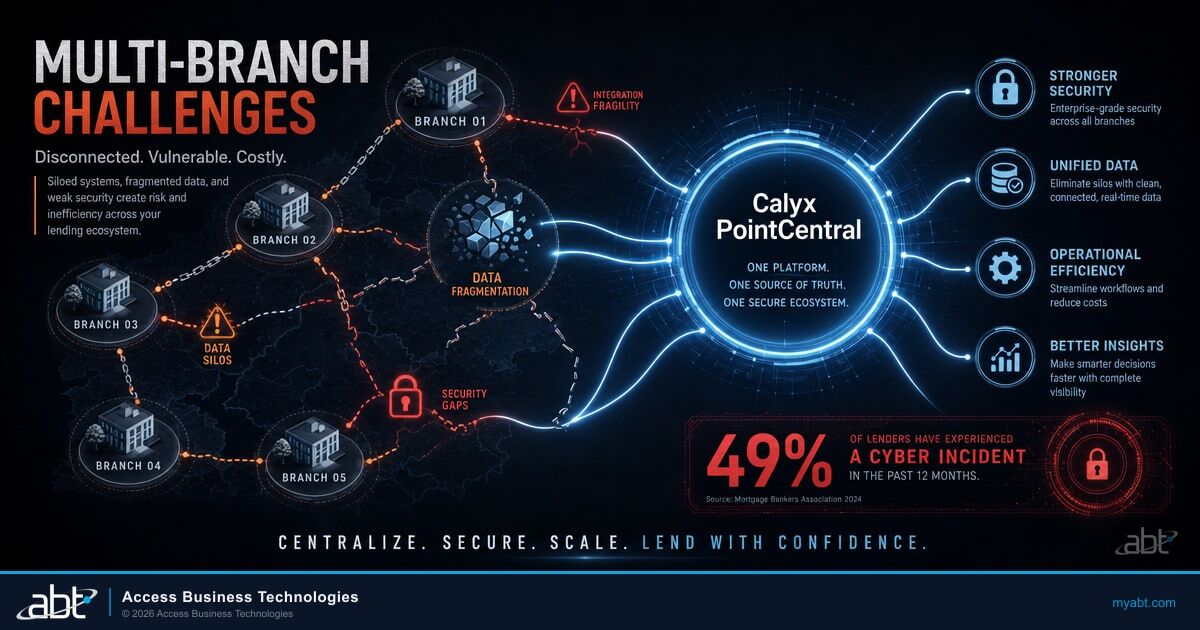
A recent Ncontracts survey of financial institutions found that 49% experienced a third-party cyber incident in the past year. For multi-branch mortgage lenders running Calyx across multiple locations, that number carries extra weight. Every new branch adds integration endpoints, user accounts, vendor connections, and network paths that need to be secured, monitored, and maintained consistently.
Multi-branch lending does not fail because of the LOS. It fails because the infrastructure underneath the LOS was built for a single office and never redesigned for scale. Calyx Point, Path, and PointCentral have the configuration depth to support dozens of branches. The question is whether your IT environment can keep up with the growth.
This guide covers the seven most common operational challenges multi-branch lenders face with Calyx and the specific strategies that solve them. It applies to community banks, credit unions, and mortgage companies running originations across more than one location.
Why Multi-Branch Calyx Is Harder Than Single Office
A single-office Calyx deployment is straightforward. One server room, one network, one set of vendor integrations, one team that knows where everything is. The bottlenecks are visible and the fixes are local. When you add a second branch, the math changes.
Each branch needs the same integrations, the same security controls, the same audit trails, and the same response time on every API call. Doing that consistently across five branches is a different exercise from doing it once. Doing it across twenty branches is a different exercise from doing it across five. The IT environment has to be designed for the scale you actually have, not the one you started with.
The Hidden Cost of Branch Drift
Branch drift is what happens when each location ends up with slightly different configurations, slightly different patch levels, and slightly different vendor connections. Drift accumulates quietly until an examiner pulls a sample of loan files from three branches and asks why the audit trails are inconsistent. By that point, the cleanup project is months long.
Seven Multi-Branch Challenges and How to Solve Them
Across the multi-branch deployments we have supported, the same seven challenges show up in roughly the same order. They are not exotic problems. They are the problems that single-office IT models cannot solve at scale. For context on how MSPs handle these integration patterns for lender platforms, read our companion article on how MSPs support platform lenders with automation and custom interfaces.
Inconsistent Calyx Configurations Across Branches
When each branch sets up its own Calyx environment, configurations drift. Pricing rules, document templates, user roles, and integration endpoints end up slightly different at every location. Loans started in Branch A do not process the same way in Branch B. The fix is policy-based configuration enforcement: a master Calyx configuration that propagates to every branch, with deviation alerts when any local change happens.
Permission Drift and Audit Trail Gaps
New hires get permissions copied from the last person in their role. Departing employees keep accounts active for weeks. Branch managers grant temporary elevated access that becomes permanent. The audit trail an examiner expects to see does not exist. The fix is centralized identity management through Microsoft Entra ID with role-based access control mapped to job function, not to whoever set up the previous user.
Branch-Level Vendor Integration Failures
A credit reporting API fails at one branch and works at the others. A document signing integration drops at a different location. Each branch troubleshoots independently and arrives at different workarounds. The fix is centralized integration monitoring that watches every API endpoint from every branch and alerts a single team when any connection degrades.
Inconsistent Patch and Update Schedules
Branch A applies a Windows patch on Tuesday. Branch B applies it three weeks later. Branch C never applies it. The compliance team has no visibility into which branches are current and which are not. The fix is a centralized patch management platform with branch-specific scheduling that still enforces a maximum lag before any patch becomes mandatory.
Network Reliability Variation by Branch
The downtown branch has fiber. The suburban branch has cable. The new acquisition has a mixed DSL/cable setup that drops twice a day. Loan officers in the slow branch close fewer loans simply because their applications time out. The fix is network standardization: redundant carriers, consistent firewall rules, and SD-WAN traffic shaping that gives Calyx and its integrations priority on every branch link.
Branch-Specific Compliance Variation
State-level lending requirements vary. License renewal cadences differ. Examiner expectations are not uniform. A branch in California faces different disclosure rules from a branch in Texas. The fix is a compliance configuration matrix maintained centrally, with branch-specific rules layered on top of a federal baseline that all branches share.
Distributed Support Without Central Coordination
Each branch calls a different local IT vendor. Tickets sit in five different queues. Issues that affect every branch get worked on five times. The fix is a single managed services partner that handles support for every branch through one ticket system with one escalation path.
Microsoft Entra ID Conditional Access policies applied at the tenant level propagate to every branch automatically. There is no per-branch configuration to keep in sync. Microsoft Intune does the same for device compliance. Lenders who centralize identity and device management in Microsoft 365 reduce branch-level configuration drift from a quarterly cleanup project to a near-zero ongoing task.

Centralize Operations with PointCentral
Calyx PointCentral was designed for the multi-branch lender. Where Calyx Point runs locally on each workstation and stores loan files in branch-level databases, PointCentral runs in a shared environment that all branches connect to. The operational difference is substantial.
With PointCentral, every branch sees the same configuration, the same pricing tables, the same document templates, and the same audit trail. Loan files do not live on a branch server. They live in a central database that every authorized user can access from anywhere. Patch deployments happen once at the central server, not at every branch workstation. Backups are unified. Disaster recovery is unified.
Calyx Point at Each Branch
- Local database at every location
- Branch-specific configurations drift over time
- Patches deployed branch-by-branch
- Backup strategy varies by location
- Disaster recovery depends on local IT
- Audit trail fragmented across branches
Calyx PointCentral Hosted in Azure
- Centralized database, every branch connects
- Single canonical configuration enforced
- Patches deployed once, all branches benefit
- Backup strategy unified and monitored
- Disaster recovery tested centrally
- Audit trail consolidated across all branches
ABT runs PointCentral hosting in dedicated Azure environments with locally redundant storage live, geo-redundant storage for backup, and the durability that comes with Azure's storage architecture. For details on the hosting model and the workstation versus hosted comparison, see our companion piece on why Calyx pairs with managed services for banks, credit unions, and mortgage companies.
Security and Compliance Across Every Branch
Every branch is a potential attack surface. Phishing emails sent to a single loan officer at a remote branch can compromise the central Calyx environment if security controls are not consistent across the entire operation. Multi-branch lenders need security designed for the scale they actually have.
The Microsoft 365 stack provides most of the technical controls a multi-branch lender needs. The work is in turning the controls on consistently and keeping them on.
- Microsoft Entra ID Conditional Access enforcing multi-factor authentication and device compliance on every login from every branch
- Microsoft Defender for Office 365 blocking phishing attempts before they reach branch inboxes
- Microsoft Defender for Endpoint on every workstation and laptop, regardless of which branch the device belongs to
- Microsoft Purview Information Protection classifying borrower data and enforcing protection rules across every branch
- Microsoft Sentinel centralizing security event data from every branch into one SIEM for analyst review
Compliance follows the same pattern. The Gramm-Leach-Bliley Act, the FTC Safeguards Rule, the Consumer Financial Protection Bureau regulations, and state-specific lending rules apply to every branch. Examiners pulling a sample of loan files will pull from multiple branches. The audit trail has to look the same regardless of which branch the file came from. For more on the regulatory side, see our piece on building CFPB-proof mortgage interfaces.
Branches do not fail audits because they ran differently. They fail audits because the evidence that each branch ran the same is missing.
Get a security grade for your multi-branch Calyx environment.
Find out where your branches are aligned and where they have drifted. A 30-minute assessment with an ABT specialist gives you a prioritized fix list.
Why Multi-Branch Lenders Need Managed IT, Not Generalist Support
Multi-branch lending is not a single-office IT problem multiplied by the branch count. It is a different operating model. The IT partner that ran your single office competently may not have the operating model to run twenty offices consistently.
A managed services partner built for multi-branch lending brings four things that local IT does not.
- Centralized monitoring that watches every branch from one operations center and dispatches the right team without the loan officer needing to know who to call
- Policy-driven configuration management that enforces the same Calyx, Microsoft 365, and security configurations at every branch with deviation alerts when anything changes
- Unified ticket and escalation paths so the same incident reported from two branches gets handled as one event, not two separate cases
- Compliance evidence collection that pulls audit trail data from every branch on demand for state and federal examinations
Across the multi-branch lenders we support, the largest single-day productivity gain comes from consolidating help-desk contact. When every branch knows there is one number to call, the typical loan-officer-to-resolution time drops from hours to minutes. The infrastructure savings are real; the productivity savings are larger.

For more on the operational discipline of growing across multiple locations, read our piece on the IT metrics that predict mortgage growth success.
Scaling Without the IT Pain
Adding a branch should be an operations decision, not an IT crisis. The lenders growing fastest in 2026 are the ones where new branch openings take days, not weeks; where the Calyx environment at the new branch matches the existing environment from day one; and where the security controls at the new branch are the same controls that protect every other branch.
That is what scalable IT looks like. The lenders who get it right keep their attention on closing loans. The lenders who do not spend that attention on IT cleanup projects instead.
Key Takeaway
Multi-branch Calyx scaling is an IT design problem, not a Calyx limitation. Centralized identity, centralized configuration, centralized integration monitoring, and a single managed services partner across every branch convert "we have branches" into "we operate as one company." Banks, credit unions, and mortgage companies that get this right scale their pipeline without scaling their IT pain.
Ready to scale Calyx without scaling the IT pain?
ABT has built and runs multi-branch Calyx environments for banks, credit unions, and mortgage companies across the country. Let us walk you through what consistency at scale looks like for your operation.
Frequently Asked Questions
Multi-branch Calyx requires the same integrations, security controls, audit trails, and response times at every location. Single-office IT models that rely on local knowledge break down at scale because branch configurations drift, permissions accumulate inconsistently, vendor integrations fail differently at each location, and audit trails fragment. The fix is centralized identity, centralized configuration, and a single managed services partner that operates every branch the same way.
PointCentral is purpose-built for multi-branch operations. Where Calyx Point runs locally on each workstation with a local database, PointCentral runs in a central environment that every branch connects to. The result is a single configuration, a unified audit trail, centralized patching, and consolidated disaster recovery. ABT runs Calyx PointCentral hosting in dedicated Azure environments with the durability and security controls financial institutions require.
Centralize identity in Microsoft Entra ID and assign Calyx permissions through role-based access control mapped to job function. New hires inherit role-based permissions automatically. Departing employees lose access through a single offboarding workflow. Branch managers cannot grant elevated access outside the role model. Audit logs capture every permission change across every branch with a consistent format examiners expect.
At minimum, every branch needs Microsoft Entra ID Conditional Access with multi-factor authentication, Microsoft Defender for Office 365 for email security, Microsoft Defender for Endpoint on every device, Microsoft Purview Information Protection for borrower data, and Microsoft Sentinel for centralized security monitoring. Applied at the tenant level, these controls propagate to every branch automatically without per-branch configuration drift.
With a managed services partner that has standardized the Calyx and Microsoft 365 configuration, a new branch can be productive in three to five business days. The deployment includes Calyx access, Microsoft 365 provisioning, security controls, integration configuration, and network setup. Without standardization, new-branch openings typically take four to six weeks of IT work before loan officers can close loans at the new location.
Multi-branch lenders face state-by-state variation in disclosure rules, license renewal requirements, and examiner expectations. The audit trail at each branch must be consistent enough that examiners pulling a sample from multiple locations see the same evidence format. The solution is a federal-baseline compliance configuration that all branches share, with state-specific rules layered on top, all maintained centrally rather than at each branch.