

In This Article
- What Scalable Mortgage Technology Actually Means
- Why Scaling Failures Cost More Than Downtime
- Five IT Metrics That Predict Growth Readiness
- Roadblocks That Kill Scaling Before It Starts
- How ABT and Mortgage Workspace Build Infrastructure for Growth
- Choosing the Right Mortgage IT Partner
- Frequently Asked Questions
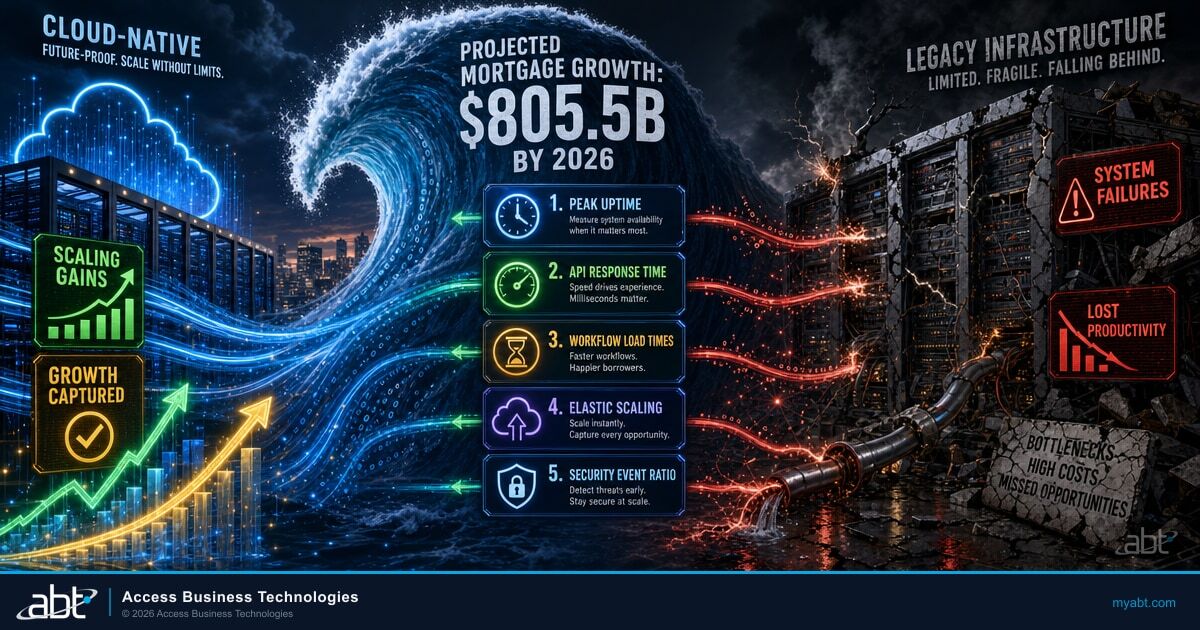
Commercial mortgage origination volume is projected to hit $805.5 billion in 2026, a 27% jump from 2025's $633.7 billion, according to the Mortgage Bankers Association. Purchase originations are forecast to grow 5.1% and refinances 8.3%. That volume has to flow through your systems, your integrations, your cloud infrastructure. The lenders who scale their IT before the wave hits will capture that growth. Everyone else will drown in ticket queues and system timeouts.
Meanwhile, 67% of mortgage lenders have already moved to cloud-based loan origination platforms. The gap between lenders with scalable infrastructure and those still running on-premise legacy stacks is widening every quarter. For banks, credit unions, and mortgage companies whose IT environment cannot absorb a 27% volume increase without breaking, these numbers are not good news. They are a warning.
This article breaks down the specific IT metrics that predict whether your mortgage technology is ready to grow, where the common failure points hide, and what a managed IT partner does to keep infrastructure ahead of demand.
What Scalable Mortgage Technology Actually Means
Scalability is not about surviving a traffic spike. It is about your entire technology stack absorbing more users, more loan files, more integrations, and more compliance demands without degrading performance or blowing the budget.
A scalable mortgage platform handles these simultaneously: more borrowers and team members across multiple branches without provisioning delays; higher concurrent loan volume during peak origination windows; new service integrations like eClosings, automated underwriting, fraud detection, and document management; and tighter compliance requirements from the Gramm-Leach-Bliley Act, the FTC Safeguards Rule, and state regulators like the New York Department of Financial Services.
The Workaround Tax
If your loan officers build workarounds to get around system limitations, that is not scaling. That is technical debt compounding at interest. Every workaround you tolerate today is a half-day of cleanup work you owe yourself in six months when the workaround breaks under load.
Why Scaling Failures Cost More Than Downtime
Most IT leaders think about scaling in terms of uptime. The real cost of scaling failures shows up in places that do not trigger alerts.
Lost pipeline velocity. When your LOS slows during volume spikes, loan officers lose 15 to 30 minutes per file on refresh cycles and resubmissions. Across 200 loans a month, that is 50 to 100 hours of lost productivity. No alert fires for that.
Integration brittleness. Credit pulls, automated underwriting, borrower portals, and CRM syncs all depend on API performance under load. One slow integration creates a cascade. Your underwriting queue backs up. Borrowers see stale status updates. Processors start making phone calls instead of trusting the system.
Compliance exposure. Regulatory technology has reduced compliance risk for lenders who embed know-your-customer and anti-money-laundering automation into their platforms. Lenders who scale volume without scaling compliance tooling end up reconstructing audit trails manually after the fact. Our piece on building CFPB-proof mortgage interfaces covers the regulatory side of that question in detail.
Talent burnout. When your IT environment cannot keep up, the bottleneck becomes the people who work around the system. Senior processors leave. Top loan officers move to lenders with better tech. The hidden cost of slow IT is the hiring cost when your best people walk.
Five IT Metrics That Predict Growth Readiness
Most lenders track loan-level metrics: cycle time, pull-through rate, cost-per-loan. Fewer track the IT-level metrics that determine whether those loan-level numbers can scale. The five below predict whether your environment is ready to absorb 2026 volume growth.
Median API Response Time Under Peak Load
Pick the busiest 20 minutes of your week and measure the median response time of your credit pull, automated underwriting, and document signing integrations. If the median doubles under peak load versus quiet hours, your integration layer is already saturated. The fix is not more network bandwidth. It is connection pooling, caching, and retry policies that managed IT partners configure as standard.
Time From User Request to Resolved Ticket
Track the median wall-clock time from when a loan officer reports an issue until the issue is resolved. Sub-30-minute resolution on routine tickets is the target for a healthy managed IT environment. If your median is multiple hours or days, the bottleneck is not the people. It is the process.
Patch Compliance Across All Endpoints
What percentage of your loan officer laptops and branch workstations are within seven days of the current critical patch level? If the number is below 90%, you have a security incident waiting to happen and a compliance finding waiting to be cited. Microsoft Intune reports this number cleanly when configured. Most lenders are not measuring it.
Identity Hygiene Score
Count the active Microsoft 365 accounts that have not signed in within 90 days. Compare to total active accounts. The ratio is your dormant-account percentage. Above 5% is a red flag. Above 10% is a regulatory finding. The fix is automated joiner-mover-leaver workflows in Microsoft Entra ID that deactivate dormant accounts on schedule.
Time to Provision a New Branch or Loan Officer
From the moment a new branch is greenlit (or a new loan officer is hired), how long until they can close a loan in your environment? If the answer is measured in weeks, you cannot scale to a 27% volume year. If the answer is measured in days, you can. The fix is policy-driven provisioning with role-based access control, standardized device images, and automated software deployment.
Microsoft Entra ID Identity Governance, Microsoft Intune device compliance reporting, and Microsoft Sentinel security posture management produce the metrics above as standard dashboards. The hardest part is not the data. It is interpreting it. Lenders running these dashboards without a managed services partner often have the data and miss the meaning.
The five metrics above are abstract on a slide. They become useful when paired against a real lender's environment, which is why the scaling assessments we run for prospective customers always start with a metric pull from the existing tenant before any recommendation is made.

Roadblocks That Kill Scaling Before It Starts
The metrics above tell you where you are. The roadblocks below tell you what stops most lenders from improving. Across the lenders we work with, four patterns show up repeatedly.
Roadblocks That Block Scaling
- On-premise LOS with manual patching
- Local IT vendor with no after-hours coverage
- Per-branch identity stores; no central directory
- Manual onboarding scripts maintained by one person
- No backup of audit log retention configuration
- Vendor integrations configured manually, not through API
Architectures That Enable Scaling
- Hosted LOS (Calyx PointCentral) with managed patching
- Managed IT partner with 24x7 NOC coverage
- Central Microsoft Entra ID directory across all branches
- Policy-driven onboarding through Microsoft Intune
- Microsoft Purview Audit Premium with extended retention
- Vendor integrations managed through versioned configuration
Most lenders sit between the two columns. The work to move from left to right is not glamorous, but it is finite. A managed IT partner with mortgage experience can execute the migration in a quarter or two; left to in-house IT and ad-hoc vendors, the same migration drags out for years.
The lenders who capture 2026 growth will not be the ones with the most loan officers. They will be the ones whose IT environment supports the loan officers they have.
Where does your IT environment sit on the scaling spectrum?
A 30-minute call with a mortgage IT specialist will benchmark your environment against the five metrics above and surface the top three roadblocks to your 2026 volume plan.
How ABT and Mortgage Workspace Build Infrastructure for Growth
Mortgage Workspace is the ABT brand for mortgage-specific managed IT services. The model is straightforward. We treat the IT environment as part of the origination operation, not as a separate cost center. The work breaks down into four ongoing functions.
- Operate the platform for Calyx Point, Path, and PointCentral; for Microsoft 365 and Azure; and for the integration layer between them. Patch on schedule. Monitor under load. Respond to incidents before loan officers feel them.
- Run identity, device, and data security through Microsoft Entra ID, Microsoft Intune, Microsoft Defender, Microsoft Purview, and Microsoft Sentinel. Apply the controls. Watch the signals. Tune what does not work.
- Maintain compliance evidence for the Gramm-Leach-Bliley Act, the FTC Safeguards Rule, the Consumer Financial Protection Bureau, state regulators, and cyber insurers. Pull the reports examiners ask for. Keep the audit trail intact.
- Plan for scale by tracking the five metrics above, surfacing the trends to lender leadership, and proposing the next architectural step before the current architecture breaks.

For more on how managed IT integrates with the LOS layer specifically, see our companion piece on why Calyx pairs with managed services. For the multi-branch dimension, see our piece on tackling multi-branch lending challenges with Calyx.
Choosing the Right Mortgage IT Partner
Not every managed IT provider can take a mortgage lender through a growth year. The shortlist is small because mortgage is a specialized vertical with regulatory and integration requirements that generalist providers do not see. When evaluating a partner, the must-haves are direct.
The most expensive partner change a mortgage lender ever makes is switching IT providers mid-growth-year. Pick the partner who can carry you through both volume and compliance change. The lowest-cost provider on the spreadsheet is almost never the lowest-cost provider once you account for the migration tax.
With that caveat in mind, the partner shortlist for a mortgage lender entering a growth year comes down to five non-negotiables. Anything less than the list below will create more work than it removes.
- Mortgage vertical experience across Calyx, Microsoft 365, and the integration layer that connects them, with documented references from banks, credit unions, and mortgage companies
- Compliance fluency in the Gramm-Leach-Bliley Act, the FTC Safeguards Rule, Consumer Financial Protection Bureau guidance, and state-specific lending rules
- 24x7 network operations center with documented response times that match origination peak windows, not nine-to-five business hours
- Microsoft Tier-1 Cloud Solution Provider status so the partner has the direct relationship with Microsoft engineering when an incident requires it
- Security audit trail sufficient for SOC 2 and cyber insurance carrier review, not just a marketing checklist
The lenders who pick a partner from that shortlist position themselves to absorb 2026 volume without rebuilding their IT environment mid-year. The ones who pick on price alone re-pick a year later, usually under more stress.
Key Takeaway
Scaling pains in 2026 will look exactly like scaling pains in every previous growth year: slow integrations, dropped tickets, audit findings, and burned-out staff. The lenders who turn pains into gains are the ones who measured the five metrics, fixed the roadblocks, and partnered with a managed IT provider that treats mortgage as a vertical, not an afterthought.
Ready to scale into 2026 without IT-driven cost-per-loan growth?
ABT and Mortgage Workspace run the Microsoft 365, Calyx, and integration layer for banks, credit unions, and mortgage companies across the country. Let us walk you through a scaling assessment for your operation.
Frequently Asked Questions
Scalable mortgage technology means the entire stack absorbs more users, more loan files, more integrations, and more compliance demands without degrading performance or inflating cost. A scalable platform handles concurrent volume during peak windows, new vendor integrations, multi-branch growth, and tightening regulatory requirements without forcing loan officers to build workarounds. If the team is creating workarounds, the system is not scaling.
Five metrics matter most: median API response time under peak load, time from user request to resolved ticket, patch compliance across all endpoints, identity hygiene score (dormant-account percentage), and time to provision a new branch or loan officer. Together they predict whether the IT environment can absorb a 27% volume year without breaking. Most lenders are not measuring these; the lenders that are have a meaningful planning advantage.
Lost pipeline velocity. When an LOS slows during volume spikes, loan officers lose 15 to 30 minutes per file on refresh cycles and resubmissions. Across 200 loans a month, that is 50 to 100 hours of lost productivity. No uptime alert fires for this, so it does not show up in IT dashboards, but it shows up directly in cost-per-loan and time-to-close. Senior staff burnout and turnover follow.
Dormant Microsoft 365 accounts are attack surface. Every account that has not signed in for 90 days is an account a phishing campaign or credential-stuffing attack can compromise without anyone noticing. Above 5% dormant accounts is a red flag; above 10% is a regulatory finding. Automated joiner-mover-leaver workflows in Microsoft Entra ID deactivate dormant accounts on schedule and keep the metric in the safe range.
Direct mortgage vertical experience across Calyx and Microsoft 365, compliance fluency in the Gramm-Leach-Bliley Act and the FTC Safeguards Rule, a 24x7 network operations center with response times matched to origination peak windows, Microsoft Tier-1 Cloud Solution Provider status for direct Microsoft engineering escalation, and a security audit trail sufficient for SOC 2 and cyber insurance carrier review. Generalist IT providers without these capabilities will struggle to support a growth year.