

In This Article
Identity is the productivity foundation. When Microsoft Entra ID is solid, your team's Microsoft 365 stack just works: loan officers move files, deposit operations clear, member services answers the phone, and the IT team focuses on the next quarter instead of yesterday's outage. The token service inside Entra ID is the piece that makes that productivity stack feel invisible to every banker, lender, and underwriter on staff.
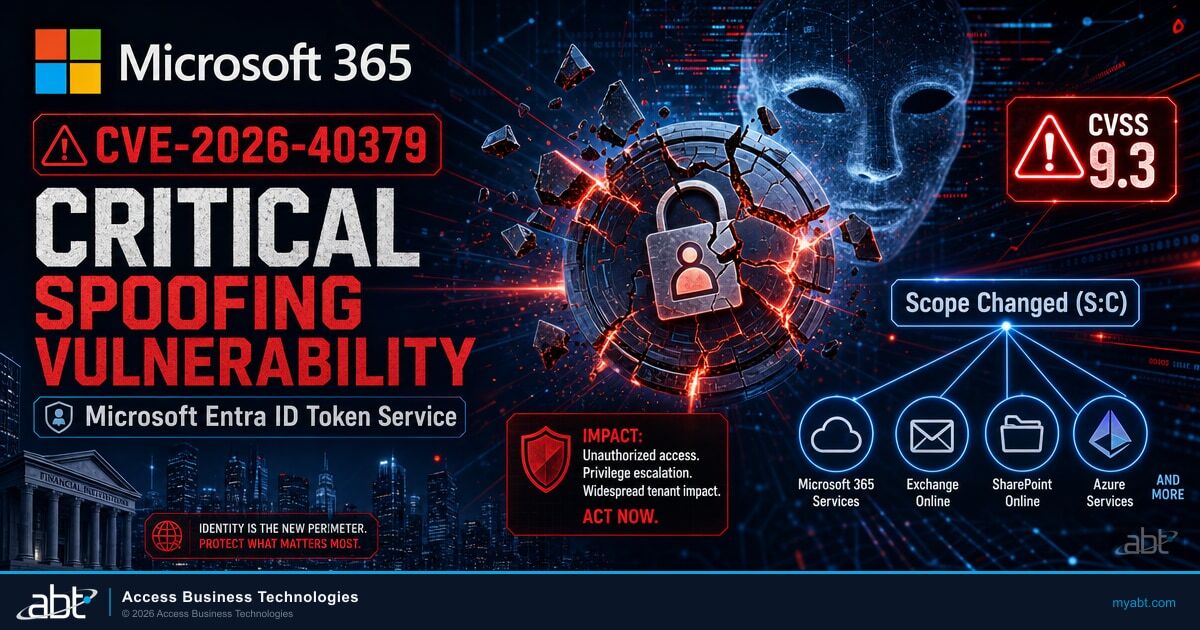
On May 12, 2026, Microsoft disclosed CVE-2026-40379, a critical spoofing vulnerability in Microsoft Enterprise Security Token Service (ESTS), the cloud-side component that issues authentication tokens for every Microsoft 365 and Microsoft Azure resource your tenant uses. Microsoft patched the service in its own infrastructure. No customer patch is required.
That single sentence sounds like a free pass. It is not. For banks, credit unions, and mortgage companies operating under the FFIEC Information Security Booklet and NCUA Letter 24-CU-02, a critical identity-layer CVE that touches the token service is a documented posture-review event whether or not it requires a download. This article walks through what CVE-2026-40379 is, what the cloud-fix model actually means for your environment, and the specific Microsoft Entra ID posture review your CISO and IT director should be working through this week.
What CVE-2026-40379 Actually Is
The official Microsoft Security Response Center title is "Microsoft Enterprise Security Token Service (ESTS) Spoofing Vulnerability." That precise framing matters because several internal trackers and early write-ups have labeled this CVE as an Elevation of Privilege issue. The MSRC-derived sources, NIST NVD, ZDI, the Cyber Security Agency of Singapore monthly patch bulletin, CrowdStrike, Tenable, and the Radar Offseq threat profile all classify it as a Spoofing vulnerability grounded in CWE-200, "Exposure of Sensitive Information to an Unauthorized Actor."
The difference matters operationally. An Elevation of Privilege CVE inside ESTS would imply an attacker turning a low-privileged token into an admin token. A Spoofing CVE in ESTS means an attacker can impersonate a user or service inside the token issuance path, which can produce the same downstream effect, but through a different mechanism: information exposure that lets the attacker forge or misuse tokens. The CVSS Scope-Changed metric (S:C) is what pushes the score from Important to Critical: a successful attacker reaches resources beyond ESTS itself, namely every Microsoft 365 and Microsoft Azure service that consumes ESTS tokens.
| CVSS 3.1 Metric | Value | What It Means in Plain English |
|---|---|---|
| Attack Vector (AV) | Network (N) | Exploitable from the public Internet, no local access required |
| Attack Complexity (AC) | Low (L) | No special preconditions; the path is reproducible |
| Privileges Required (PR) | None (N) | Attacker does not need an account in your tenant |
| User Interaction (UI) | Required (R) | A user has to take some action (a click, a session) to trigger the path |
| Scope (S) | Changed (C) | Impact extends beyond ESTS to every service that trusts ESTS tokens |
| Confidentiality (C) | High (H) | Significant sensitive data exposure on success |
| Integrity (I) | High (H) | Attacker can modify data or impersonate identities |
| Availability (A) | None (N) | The flaw does not directly cause an outage |
The exploitation picture, as of late May 2026, is reassuring on near-term risk. NIST and Tenable list the EPSS score (Exploit Prediction Scoring System, the FIRST.org probabilistic model for 30-day exploitation likelihood) at 0.00059. ZDI marks the CVE as Exploited: No and Public: No. Splashtop and Qualys both note that the May 2026 Patch Tuesday release contained no publicly disclosed zero-days. Microsoft did not place CVE-2026-40379 in the "Exploitation More Likely" subset of the May release.
A note on phrasing
Every statement about exploitation status in this article is correct as of the source publication dates. EPSS scores update daily, and Microsoft can re-classify exploitation status if new telemetry surfaces. The point of FI posture review is to assume the picture can change and to position your tenant for either outcome.
Why the "Exclusively Hosted Service" Designation Changes Your Job
NVD flags CVE-2026-40379 as an "Exclusively Hosted Service" vulnerability. That label is reserved for cloud components Microsoft owns and operates directly, not software that customers download and install. ESTS lives in Microsoft's data centers, on Microsoft's infrastructure, behind Microsoft's identity engineering team. When ESTS has a flaw, Microsoft pushes the fix to its own service. Your tenant inherits the corrected behavior the next time it talks to the token endpoint, which for most production tenants is within minutes.
For banks, credit unions, and mortgage companies, this changes the job description for the vulnerability response. There is no patch to schedule. There is no maintenance window to broker with line-of-business leaders. There is no question of which devices got the update and which ones did not. The infrastructure is corrected. What you owe your examiners, your board, and your own management team is documentation: a written record that you reviewed the advisory, confirmed the Microsoft-managed fix, ran a posture review on the controls that would have mattered if the flaw had been exploited against your tenant, and captured findings.
Why this matters for financial institutions
FFIEC IT Examination Handbook Information Security Booklet Section II.A specifies that institutions maintain a formal risk-management process covering material vendor and third-party services. NCUA Letter 24-CU-02 reiterates that cloud-provided technology, including identity services, must be inside the institution's documented vendor management program. A critical cloud-side CVE in Microsoft Entra ID that touches the token service is a posture-review event under both frameworks, regardless of whether a patch download is required.
Examiners want to see the posture review documented and dated, not just the assurance that "Microsoft handled it."
The flip side is that your IT team gets to spend its time on the controls that actually move the risk needle: phishing-resistant multifactor authentication, Conditional Access policy enforcement, Privileged Identity Management activation policy, and sign-in log forensics. Those are the controls a CVSS Scope-Changed identity vulnerability stress-tests. None of them require a patch installation either, which means a careful institution can convert what looks like a "wait for Microsoft" event into a productive identity-posture review that benefits the next audit cycle.
The Five-Step ESTS Token Flow (and Where Spoofing Slots In)
To understand why a flaw in ESTS reaches every Microsoft 365 service, it helps to walk the token issuance pipeline once. ESTS is the Microsoft Enterprise Security Token Service: the system that converts a successful authentication into a token that other Microsoft 365 and Microsoft Azure services will accept as proof of identity. Five things happen between a user clicking "Sign In" and that user opening Microsoft Outlook on the web.
The user's device sends credentials (password, certificate, FIDO2 key) to Microsoft Entra ID. Conditional Access policies evaluate the request: device compliance, location, sign-in risk, and authentication strength.
If Conditional Access grants the request, Entra ID passes the verified identity to ESTS along with claims (group memberships, role assignments, multifactor status).
ESTS mints a security token. The token contains the user identity, the scope of access granted, an expiration time, and a cryptographic signature that any downstream Microsoft service can verify.
The token returns to the user's device or to the requesting service (Microsoft Outlook, Microsoft Teams, Microsoft SharePoint, Microsoft Azure resource managers).
The downstream service inspects the token, verifies the signature against the ESTS public key, and grants access. The user opens their mailbox, joins a meeting, or kicks off an Azure deployment.
A spoofing flaw in step 3 is what makes CVE-2026-40379 a Scope-Changed Critical: a successful exploit lets an attacker influence the token mint in a way that downstream services then trust. The user's mailbox accepts the spoofed token. The Azure subscription accepts it. The Microsoft Teams meeting accepts it. The flaw is in one component, but the trust relationship reaches every service downstream.
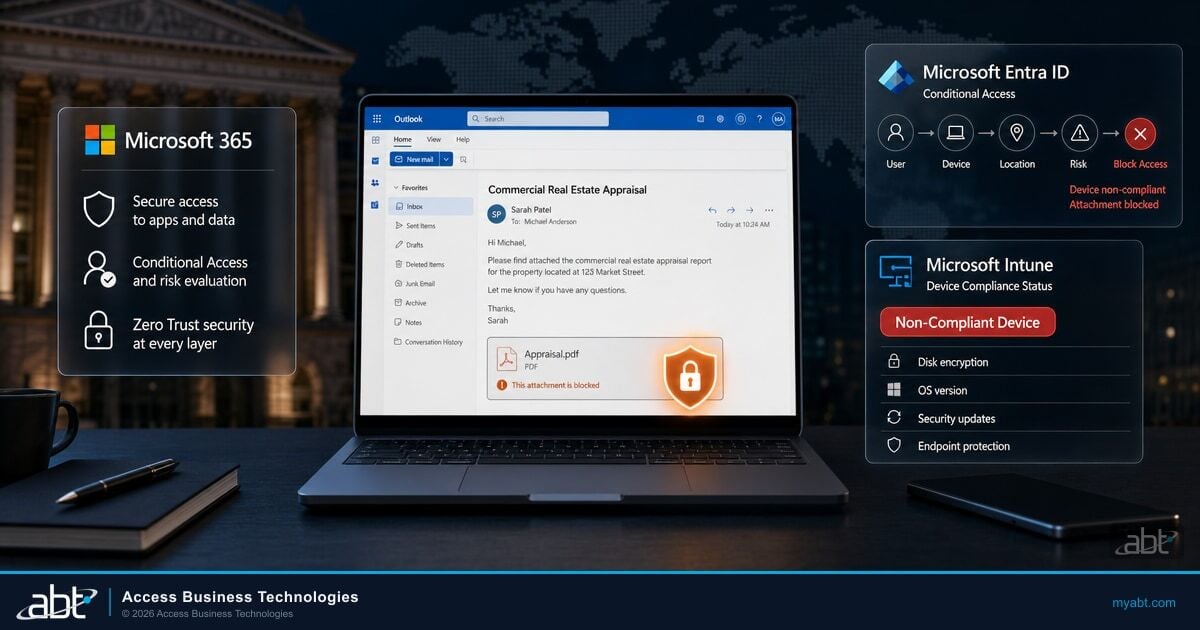
The good news for FI defenders is that the controls that would have detected an attempted exploit live in steps 1 and 2, before ESTS is even reached. Conditional Access at the front of the pipeline can block requests that fail device compliance, fail multifactor authentication strength requirements, or originate from a high-risk session. Microsoft Entra ID Protection can score the sign-in risk and step up the authentication challenge. The deeper your posture is in those two upstream steps, the less an ESTS-internal flaw matters in practice.

The FI Posture Review: Conditional Access, PIM, and Sign-In Forensics
The Microsoft-side patch is done. The institution-side work is a five-line posture review that any CISO at a community bank, credit union, or mortgage company can run this week. Each step references controls that any tenant on Microsoft 365 Business Premium, Microsoft 365 E3, or Microsoft 365 E5 already has access to, with Microsoft Entra ID P2 adding the higher-tier risk policies.
The Microsoft-side patch is done. The institution-side work is a documented posture review. Done well, the review costs an afternoon and earns examiner credibility for the rest of the cycle.
The five checks below run sequentially and can be split across IT operations and security operations roles depending on how the institution divides Entra ID responsibility. Treat the screenshots and exports as the audit trail; the work product is the documented evidence, not the spreadsheet of findings.
Open the Microsoft Entra admin center and review each Conditional Access policy that scopes to Global Administrator, Privileged Role Administrator, and other admin roles. State must be On (Grant), not Report-only. Authentication strength must be phishing-resistant: FIDO2, Windows Hello for Business, passkey, or certificate-based. Capture a screenshot of each policy's settings for the posture review record.
Conditional Access policy: block legacy authentication, scoped to all users, all applications. Legacy auth protocols (POP3, IMAP4, basic auth SMTP, older Exchange ActiveSync) bypass multifactor authentication entirely, and a spoofing-class vulnerability is exactly the kind of finding where a parallel legacy-auth pathway turns a non-event into a real incident.
Per Microsoft Message Center MC1282568, Microsoft tightened PIM activation to require Conditional Access reauthentication on every role activation. Confirm that policy is enabled and that activation requires phishing-resistant MFA, not just a password challenge. Privileged roles are exactly the identities a Scope-Changed spoofing exploit would target.
Pull Entra ID sign-in logs for the four-day window between the early MSRC disclosure note and the Patch Tuesday release. Filter for anomalous user agents, atypical sign-in locations, or unexpected token requests from privileged accounts. The point is not to find an exploit (none has been publicly observed); the point is to document that you looked, what you searched for, and what you found.
Banks, credit unions, and mortgage companies under FFIEC and NCUA examination need the paper trail. A short entry naming CVE-2026-40379, dating the review, listing the controls verified, naming the reviewer, and capturing findings is enough. The point is the documented chain of evidence, not a novella.
The five-step review fits inside a normal weekly IT operations meeting. Done once, it converts a passive cloud-fix CVE into an active posture validation that the institution can show to an FFIEC IT examiner, an NCUA cybersecurity supervisor, or a board IT committee member without scrambling.
Need help running the Entra ID posture review?
ABT manages Microsoft 365 tenants for more than 750 banks, credit unions, and mortgage companies. Our security team can walk your CISO through the CVE-2026-40379 posture review, document the findings, and feed them into your next FFIEC IT examination prep packet.
What Examiners and Boards Want to See
FFIEC IT Examination Handbook Information Security Booklet Section II.B (Access Control) and Section II.C (Authentication) lay out the access management and authentication controls examiners evaluate during an IT exam. NCUA Letter 24-CU-02 reiterates the same expectations for federally insured credit unions and reinforces that vendor-managed identity services fall inside the institution's responsibility envelope. Neither framework demands that institutions patch what Microsoft already patched. Both demand documented evidence that the institution noticed, reviewed, and validated its posture in response.
A board IT committee member reviewing the institution's response to CVE-2026-40379 should be able to read a one-page artifact that answers four questions: What is the advisory? What did Microsoft do? What did we do? What did we find? Each answer should reference the underlying source: the MSRC advisory URL, the NVD record, the Conditional Access policy snapshots, and the PIM activation policy export.
What examiners DO want to see
- A dated entry naming CVE-2026-40379 in the vulnerability management log
- Confirmation that the institution reviewed the MSRC advisory and the NVD record
- Evidence that Microsoft Conditional Access policies were verified in Grant mode for admin sign-ins
- Evidence that Microsoft Privileged Identity Management activation policy is enforced
- Evidence that Microsoft Entra ID sign-in logs were reviewed for anomalous activity
- The institution's documented decision on whether further action is warranted
What examiners do NOT want to hear
- "Microsoft handled it, so we did not need to do anything"
- "We assumed the patch was applied; we did not check"
- "We were not aware of the advisory until you asked about it"
- "Our Conditional Access policies are configured but we have not validated them recently"
- "We do not run sign-in log reviews on a regular cadence"
- "Our PIM policy is not enforced for privileged roles"
The asymmetry between the two columns is the point. The institution-side work for a cloud-managed CVE is not the patch deployment; it is the documented evidence of posture. The institutions that already have a tight Entra ID posture treat advisories like CVE-2026-40379 as a check-the-box re-validation. The institutions that do not have a tight posture treat the advisory as a wake-up call. Either way, the response is documented and dated.
The Pattern of Cloud-Side Entra ID CVEs in 2026
CVE-2026-40379 is not isolated. The first half of 2026 has produced a noticeable cadence of critical and high-severity CVEs in Microsoft's cloud identity services, all of which follow the same pattern: cloud-side fix, no customer patch, posture review on the FI side. Recognizing the pattern lets institutions build the posture-review muscle once and re-use it monthly.
The companion advisory most closely related to CVE-2026-40379 is CVE-2026-35431, the Microsoft Entra ID Entitlement Management SSRF vulnerability published in April 2026 with a CVSS of 10.0. Different mechanism (server-side request forgery in the entitlement management feature), same patching model (cloud-managed), same FI control surface (Conditional Access, PIM, sign-in log review). The May 2026 Storm-2949 threat actor profile (no CVE, but a documented attack pattern) shows the operational version of the same risk: an attacker who turns one identity into cloud-wide reach. The Storm-2949 response plan is the operational complement to the CVE-2026-40379 posture review.
The cadence is the signal
Microsoft has now disclosed multiple critical cloud-side Entra ID vulnerabilities in the first half of 2026. Each one tells the same story: identity is the new perimeter, the token service is the load-bearing component, and the institution-side work is posture review.
The institutions that operationalize a monthly posture-review cadence on Conditional Access, Privileged Identity Management, and sign-in logs are the ones that ride out advisories cleanly. The institutions that scramble for each new disclosure are the ones examiners flag during the cycle.
The operational implication for a community bank, credit union, or mortgage company IT team: pick a posture-review day on the calendar each month. Use a checklist similar to the one in the FI Posture Review section above. Record the findings. Roll the record into the quarterly board IT committee packet. The cost is an afternoon of senior IT time each month. The benefit is that the next examiner who asks "What is your process for responding to cloud-side identity advisories?" gets a documented answer instead of a surprised look.
M365 Guardian Detection Coverage and What ABT Is Doing
For ABT-managed tenants on M365 Guardian, the CVE-2026-40379 response is folded into the ongoing detection and response cadence rather than handled as a one-time alert. The Guardian operating model takes the controls described above and operates them continuously: Microsoft Conditional Access policies validated against the current baseline, Microsoft Entra ID Protection user-risk and sign-in-risk policies tuned to the FI baseline, Microsoft Defender for Cloud Apps anomaly policies tuned to detect post-token-mint misuse, Microsoft Defender XDR alert tuning, Microsoft Sentinel analytics rules updated to catch the patterns that a Scope-Changed identity exploit would produce.
Access Business Technologies is the largest Tier-1 Microsoft Cloud Solution Provider primarily dedicated to financial services in the United States. As your CSP, ABT manages the Microsoft 365 tenant under delegated administration; Microsoft hosts the underlying infrastructure. When a cloud-side CVE like CVE-2026-40379 lands, the manage-versus-host distinction is exactly the relationship that matters: Microsoft owns the service fix; ABT owns the tenant posture validation and the FFIEC-aligned documentation that the institution carries into its next IT exam.
For banks, credit unions, and mortgage companies on M365 Guardian, ABT runs the five-step posture review as part of the monthly operating cadence and feeds the evidence into the institution's vulnerability management log. The same telemetry also feeds the evidence pack ABT delivers for an FFIEC IT examination readiness review, so the posture work doubles as audit-ready governance.
The broader posture work that supports both the CVE-2026-40379 review and every cloud-side identity CVE that follows is documented inside the ABT Microsoft Entra ID security assessment for financial institutions. The assessment maps Microsoft 365 license tier (Microsoft 365 Business Premium, Microsoft 365 E3, Microsoft 365 E5, with Microsoft Entra ID P2 add-on) to the specific Entra ID controls each tier unlocks, and produces the kind of one-page posture artifact a board IT committee can read in five minutes.
Frequently Asked Questions
CVE-2026-40379 is a critical spoofing vulnerability in Microsoft Enterprise Security Token Service (ESTS), the cloud-side component that issues authentication tokens for Microsoft Entra ID. Microsoft disclosed the vulnerability on May 12, 2026, as part of the May 2026 Patch Tuesday release. The CVSS 3.1 base score is 9.3 Critical with vector AV:N/AC:L/PR:N/UI:R/S:C/C:H/I:H/A:N. NIST last modified the NVD record on May 21, 2026.
No. NIST flags CVE-2026-40379 as an "Exclusively Hosted Service" vulnerability, which means the vulnerable component is part of Microsoft's cloud infrastructure rather than software customers install. Microsoft has remediated the ESTS behavior server-side. Customer tenants inherit the corrected behavior automatically. The FI-side work is a documented posture review of Microsoft Conditional Access, Microsoft Privileged Identity Management, and Microsoft Entra ID sign-in logs, not a patch deployment.
As of the dates of the available reporting (NIST NVD, Tenable, ZDI, Splashtop, Qualys, Radar Offseq), there is no evidence of active exploitation. The Exploit Prediction Scoring System gives the vulnerability a 0.00059 score (very low near-term exploitation probability). ZDI lists Exploited: No and Public: No. Microsoft did not place the CVE in the "Exploitation More Likely" subset of the May 2026 release. Microsoft can re-classify exploitation status if new telemetry surfaces, so the posture review still matters.
The official Microsoft Security Response Center title is "Microsoft Enterprise Security Token Service (ESTS) Spoofing Vulnerability." NIST NVD, the Cyber Security Agency of Singapore monthly patch bulletin, ZDI, CrowdStrike, Tenable, Mondoo, and Radar Offseq all classify it as Spoofing grounded in CWE-200, exposure of sensitive information. A successful spoofing exploit in a token service can produce effects defenders sometimes describe as privilege escalation, because the attacker may impersonate higher-privileged accounts. The formal classification, however, is Spoofing. Use the primary-source framing when documenting the response.
The single highest-leverage policy to confirm is the one that requires a phishing-resistant authentication strength (FIDO2 key, Windows Hello for Business, passkey, or certificate-based authentication) for every privileged role assignment, including Global Administrator, Privileged Role Administrator, Exchange Administrator, SharePoint Administrator, and the Microsoft Entra Application Administrator family. That policy is what makes a spoofing exploit in the token service unable to translate into a meaningful admin compromise: the attacker cannot satisfy the phishing-resistant challenge even if the token mint is influenced.
ABT manages Microsoft 365 tenants for banks, credit unions, and mortgage companies under delegated administration. For cloud-side CVEs like CVE-2026-40379, ABT runs the five-step posture review (Microsoft Conditional Access verification, legacy authentication block, Microsoft Privileged Identity Management activation policy, Microsoft Entra ID sign-in log review, documentation) inside the M365 Guardian operating cadence. The same telemetry feeds the evidence pack ABT delivers for an FFIEC IT examination readiness review, so the posture work doubles as audit-ready governance documentation. Microsoft hosts the underlying ESTS infrastructure; ABT manages the tenant posture and the FI-side documentation.
Want a documented Microsoft Entra ID posture review for your institution?
ABT's identity security team can run the CVE-2026-40379 posture review on your tenant, capture the evidence into an examiner-ready packet, and align it with your FFIEC IT examination cycle. Banks, credit unions, and mortgage companies of every size can get the assessment scoped to the right Microsoft 365 license tier.