

In This Article
- The Complexity Crisis in Banking Cybersecurity
- More Tools, More Risk
- Anatomy of a Complexity-Driven Breach
- Why Manual Processes Can't Keep Up
- The Case for Centralized Security Management
- M365 Guardian: One Operating Model Over Defender and Sentinel
- What You Can Do This Week
- Frequently Asked Questions
The IT team at a community bank only has so many hours in a day. Every hour spent reconciling fifty security dashboards is an hour not spent moving the business forward. Radware's 2025 Financial Threat Analysis recorded a 27% year-over-year increase in cyberattacks against financial institutions, with an average of nearly 13,000 DDoS attacks per institution. The WEF's 2026 Global Cybersecurity Outlook reports that 72% of organizations see rising cyber risks. The attackers are getting smarter. The number of distinct attack vectors used in a single DDoS campaign rose 40% in 2024, reaching up to 69 vectors per event.
For community banks and credit unions, the threat is not abstract. You hold member Social Security numbers, account credentials, wire transfer records, and loan files. You are a high-value target with a growing attack surface. The fastest way to expand that attack surface is not a lack of security tools. It is too many of them. Productivity slows, blind spots widen, examiners notice.
The Complexity Crisis in Banking Cybersecurity
Here is the pattern ABT sees repeatedly after 25+ years serving 750+ financial institutions.
A community bank or credit union starts with basic security. Antivirus on workstations. Firewalls at the branch. Maybe a VPN for remote employees. As threats grow, they add layers. Endpoint detection. Email filtering. A separate MFA tool. A SIEM dashboard. A compliance scanner. Each addition addresses a real gap.
But nobody plans for how these tools interact. Or who monitors all of them. Or what happens when alerts from six different platforms compete for the same IT team's attention.
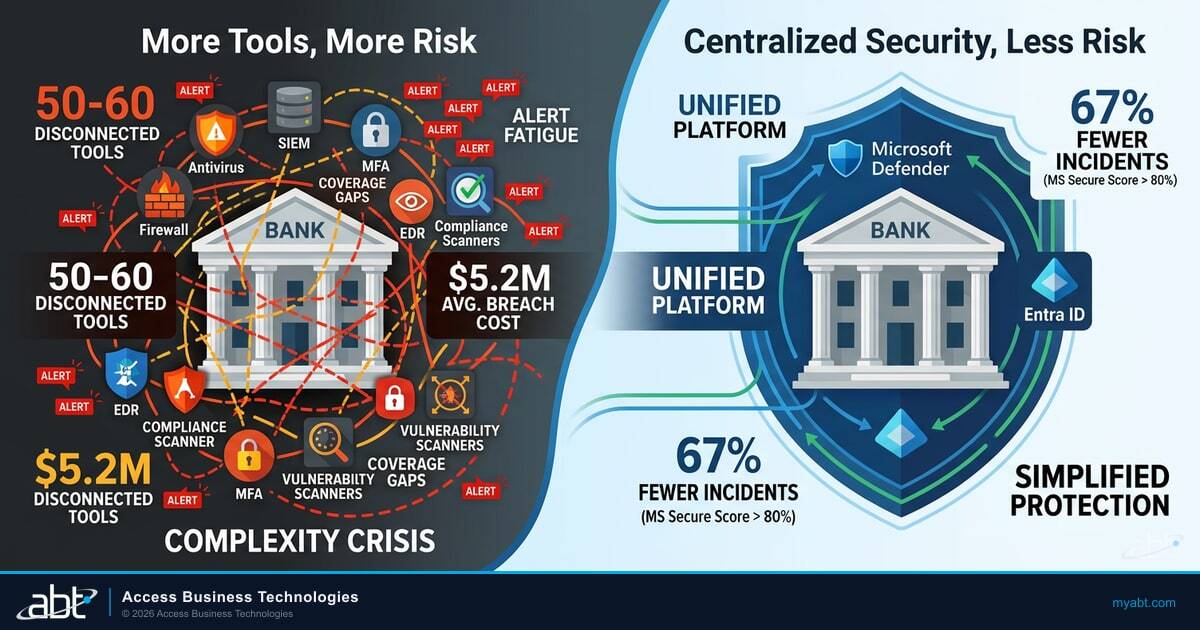
The WEF's research confirms this dynamic: 54% of large organizations cite third-party and vendor complexity as their biggest barrier to achieving cyber resilience. For community banks and credit unions with 3-person IT teams, the challenge is even more acute. The average financial institution runs between 50 and 60 distinct security tools. Each one generates alerts. Each one needs configuration. Each one creates another surface for misconfiguration.
More Tools, More Risk
Each disconnected security tool creates three problems:
1. Alert Fatigue
When five platforms generate alerts independently, the real threats get buried in noise. A critical sign-in anomaly from Microsoft Defender competes with low-priority compliance notifications from a separate scanner. IT teams learn to ignore the flood, and real attacks slip through. Research shows that 50% to 60% of security alerts at financial institutions go uninvestigated, not because the team does not care, but because the volume exceeds human capacity.
2. Coverage Gaps Between Products
Tool A monitors endpoints. Tool B watches email. Tool C tracks identity. None of them share context. A phishing email that leads to a compromised identity that then accesses an endpoint looks like three separate minor events. Only a unified view connects the dots into the coordinated attack it actually is. Microsoft Sentinel is the SIEM that does that correlation natively across Microsoft 365.
3. Configuration Drift
With multiple security products, keeping configurations aligned is a full-time job. One tool allows legacy authentication because it was not updated after a policy change. Another tool's logging conflicts with a third tool's agent. Small misconfigurations accumulate into serious vulnerabilities. Organizations with fragmented security stacks pay 26% more per breach on average, according to IBM's 2024 analysis.
Anatomy of a Complexity-Driven Breach
A community bank ABT worked with had over 1,000 user accounts and nearly 2,000 managed devices. Their security portfolio looked comprehensive on paper.
The reality underneath:
- 200+ devices running outdated operating systems that no security tool flagged because each tool only saw its own slice
- 15% of accounts with incomplete MFA registration spread across two different authentication platforms
- Dozens of stale accounts that appeared disabled in one system but remained active in another
- No unified dashboard where anyone could see the full picture
The breach started with a phishing email to the CFO. The CFO's device was one of the unpatched machines. Attackers exploited the outdated software, stole an MFA token, and accessed financial systems. Wire transfers totaling over $1 million were initiated before anyone detected the intrusion.
No single tool failed. The failure was systemic. Complexity created blind spots that no individual product could see.
FFIEC CAT Sunset: What It Means for Your Security Program
The FFIEC retired its Cybersecurity Assessment Tool (CAT) on August 31, 2025, after a decade of use. The CAT was a voluntary self-assessment framework released in 2015 to help financial institutions evaluate their cybersecurity preparedness. Its retirement signals a shift: federal banking regulators now expect continuous automated monitoring rather than periodic manual self-assessments. If your bank or credit union still relies on spreadsheet-based security reviews, the regulatory direction has moved past you.
Why Manual Processes Can't Keep Up
Many banking IT teams try to bridge complexity gaps with manual effort. Weekly spreadsheet audits. Monthly MFA checks. Quarterly device inventory reviews.
The math does not work. An institution with 1,000 accounts and 2,000 devices generates thousands of data points daily across identity, endpoint, email, and application layers. Manually reviewing even a fraction requires hours that IT teams do not have.
The FFIEC retired its Cybersecurity Assessment Tool in August 2025, acknowledging that manual self-assessment frameworks cannot keep pace with the threat landscape. The replacement guidance points toward continuous automated monitoring, exactly the approach that complexity undermines.
The Federal Reserve's July 2025 cybersecurity report to Congress specifically emphasized zero-trust adoption and continuous monitoring as priorities for financial institutions. NCUA examiners are asking credit unions pointed questions about automated threat detection capabilities. FDIC and OCC examination procedures increasingly focus on whether security controls operate continuously, not just during quarterly review cycles. Manual spreadsheet checks are the opposite of continuous monitoring.
Microsoft Security Intelligence Report, 2025"Organizations with a Microsoft Secure Score above 80% experience 67% fewer security incidents. Yet complexity routinely prevents financial institutions from reaching that threshold."
The Case for Centralized Security Management
The solution is not more security tools. It is fewer dashboards.
Centralization means consolidating security visibility into one platform that aggregates data from your existing Microsoft 365 environment. Here is what that changes:
- One view of device compliance through Microsoft Intune instead of checking your antivirus console, EDR agent, and patch management tool separately
- One identity authority through Microsoft Entra ID with Conditional Access instead of managing MFA across multiple platforms
- One alert pipeline through Microsoft Defender that correlates events across identity, endpoint, email, and cloud apps, then surfaces them in Microsoft Sentinel as the single SIEM of record
- One compliance dashboard that maps security controls to GLBA, FFIEC, NCUA, OCC, and state regulatory requirements
Microsoft's own data supports this approach. Organizations with a Secure Score above 80% experience 67% fewer security incidents according to the Microsoft Security Intelligence Report. Gartner predicts that by 2026, 50% of organizations will include real-time security scoring as a procurement requirement.
M365 Guardian: One Operating Model Over Defender and Sentinel
M365 Guardian is how ABT delivers this centralized operating model for community banks and credit unions. As a Tier-1 Microsoft Cloud Solution Provider, ABT manages each customer's Microsoft 365 tenant under delegated administrative privileges and applies a financial-services-tuned baseline across the Microsoft security stack. Defender is the active detection surface across identity, endpoint, email, and cloud apps. Microsoft Sentinel is the SIEM that correlates those signals into one incident timeline. Microsoft Purview is the audit and retention surface that holds the evidence. M365 Guardian is the operating model that keeps the configurations consistent, tracks the drift, and produces the artifacts a chief compliance officer can hand to an examiner without spending three weeks pulling screenshots.
That operating-model layer is what separates a Defender-and-Sentinel deployment from a deployment that actually pays off for a community bank. The Microsoft tools are powerful in any tenant. The difference is whether someone is watching them, tuning the analytic rules to the institution's actual risk profile, and rolling drift findings into the firm's vendor oversight program. Microsoft Sentinel out of the box generates default alerts. ABT tunes those rules to bank-specific attack patterns, including wire-transfer fraud signals, business-email-compromise impersonation chains, and core-banking access anomalies. Microsoft Defender for Office 365 ships with a usable phishing baseline. ABT layers anti-impersonation policies that catch the lookalike-domain attacks examiners flag in cycle reviews. M365 Guardian is the operating model that runs over the top, with the ABT 24x7 security operations center watching the Sentinel and Defender signals every minute of the day.
M365 Guardian does not replace your security tools. It orchestrates them. Every night, it pulls data from across your Microsoft 365 environment and produces a consolidated security posture assessment. It tracks:
- MFA compliance across every account, including registration gaps and token age
- Device health including OS version, patch status, and Microsoft Intune compliance policy adherence
- Stale and orphaned accounts that should be disabled or removed
- Sign-in anomalies like impossible travel, unfamiliar locations, or unusual access patterns from Microsoft Entra ID Identity Protection
- Microsoft Sentinel incident timelines correlated across Defender for Office 365, Defender for Endpoint, Defender for Identity, and Defender for Cloud Apps
- Security trend lines so leadership sees whether posture is improving or drifting week over week
One credit union client started with a Microsoft Secure Score of 32%. After implementing M365 Guardian and its associated hardening program, their score climbed to nearly 93%. More importantly, their IT team went from spending days on manual security reviews to receiving automated daily reports that told them exactly what needed attention. The productivity reclaim was the lead win. The audit-readiness improvement was the byproduct.
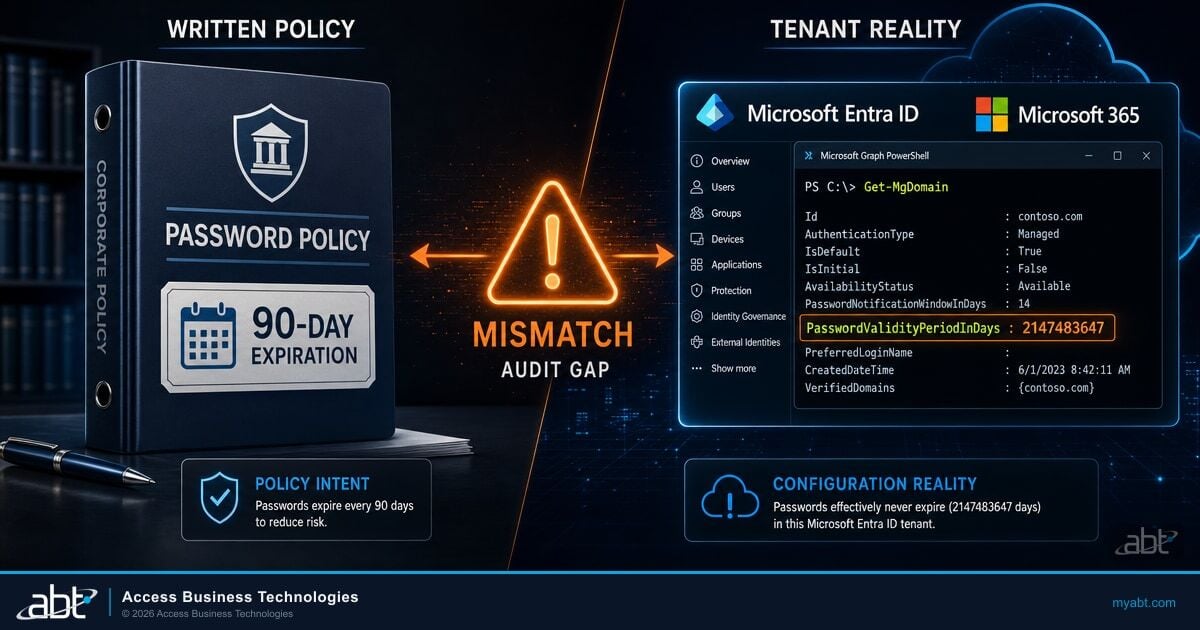
"Every examination we prepare institutions for reveals the same pattern: the controls exist, but the configuration doesn't match the policy. That gap is where examiners focus, and where breaches happen."
Serving 750+ financial institutions since 1999
See Where Complexity Is Costing You
ABT's M365 Guardian assessment maps your current tool landscape against what your Microsoft 365 environment can consolidate through Defender and Sentinel, and shows you the gaps examiners will find first.
What You Can Do This Week
- Count your security tools. List every platform that monitors, alerts, or reports on security. Include the ones that only one person knows how to check. If the count exceeds what your team can realistically monitor, complexity is already a risk.
- Check your MFA coverage. Not the percentage your tool reports. The actual registration status of every account in Microsoft Entra ID. Gaps always hide in the details.
- Run a Secure Score check. Your Microsoft Secure Score is a free baseline. If it is below 60%, you have work to do. If you do not know the number, that is the first problem to solve.
- Talk to a banking IT specialist. A Tier-1 CSP provider who understands both Microsoft 365 and financial services compliance can tell you exactly where your complexity creates risk.
Talk to a banking IT specialist about simplifying your security stack and closing the gaps complexity creates.
Frequently Asked Questions
IT complexity increases risk by creating blind spots between disconnected security tools. Each platform monitors its own domain without sharing context with others. A phishing attack that compromises an identity and then accesses an endpoint appears as separate minor events across different dashboards. Alert fatigue, configuration drift, and coverage gaps between products all compound as more tools are added without centralized orchestration. Financial institutions running 50 or more tools face average breach costs of $5.2 million compared to $3.8 million for those with consolidated stacks.
The FFIEC retired its Cybersecurity Assessment Tool on August 31, 2025. The CAT was a voluntary self-assessment framework released in 2015 to help financial institutions evaluate their cybersecurity preparedness. The replacement guidance from federal banking regulators points toward continuous automated monitoring frameworks rather than periodic manual assessments, reflecting the faster pace of modern cyber threats.
Every disconnected system, shadow IT workaround, and unmanaged endpoint creates a control gap that drags security metrics down. Banks and credit unions running 8 or more distinct security platforms typically plateau around 50% to 60% on security benchmarks because each additional system introduces configuration drift, inconsistent patching schedules, and identity sprawl. Consolidating to a unified platform stack is often the single most effective step toward reaching the 75% or higher range that regulators and cyber insurers expect from financial institutions.
M365 Guardian is an operating model layered over Microsoft Defender, Microsoft Sentinel, Microsoft Entra ID, Microsoft Purview, and Microsoft Intune, not an additional security product. ABT, as a Tier-1 Microsoft Cloud Solution Provider, manages each customer tenant under delegated administrative privileges and consolidates data from the existing Microsoft 365 security stack into a single dashboard with nightly automated assessments. Instead of adding another alert source to monitor, M365 Guardian unifies the alerts and data you already have into prioritized action items and compliance-ready reports. This reduces complexity rather than adding to it.
Microsoft Sentinel aggregates signals from Microsoft Defender for Office 365, Microsoft Defender for Endpoint, Microsoft Defender for Identity, Microsoft Defender for Cloud Apps, Microsoft Entra ID, and Microsoft Intune into a single security information and event management view. Instead of analysts switching between six dashboards to piece together a phishing-to-endpoint-to-wire-transfer chain, Sentinel correlates those events into one incident timeline. When ABT tunes the Sentinel analytic rules to bank-specific patterns, including wire-transfer fraud signals, business-email-compromise impersonation chains, and core-banking access anomalies, the real threats stop competing with vendor-default noise.
Radware's 2025 Financial Threat Analysis identified a 27% year-over-year increase in cyberattacks on financial institutions. The primary threats include phishing and social engineering attacks targeting employees with access to customer data, ransomware campaigns increasingly aimed at community banks and credit unions, and supply chain attacks exploiting trusted vendor relationships. The WEF's 2026 Global Cybersecurity Outlook adds AI-enhanced fraud and deepfakes as emerging concerns for the financial sector.