

We run security assessments for financial institutions every week. Credit unions, community banks, mortgage companies, insurance firms. The ones that worry us most aren't the organizations with low scores. They're the ones with high scores and the confidence that comes with them.
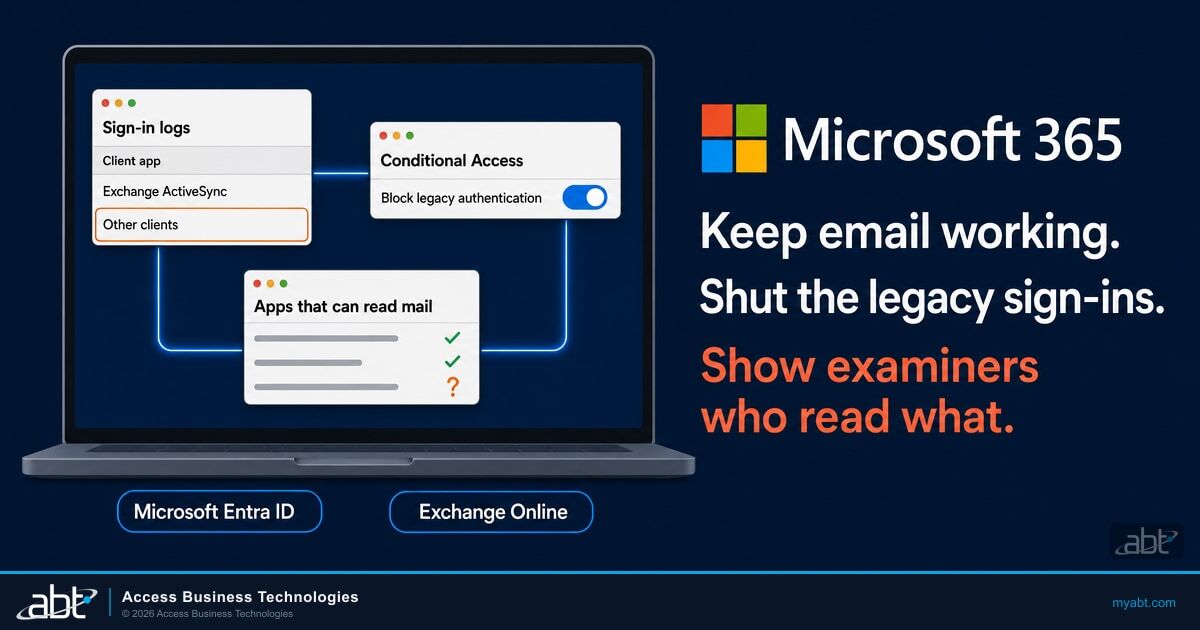
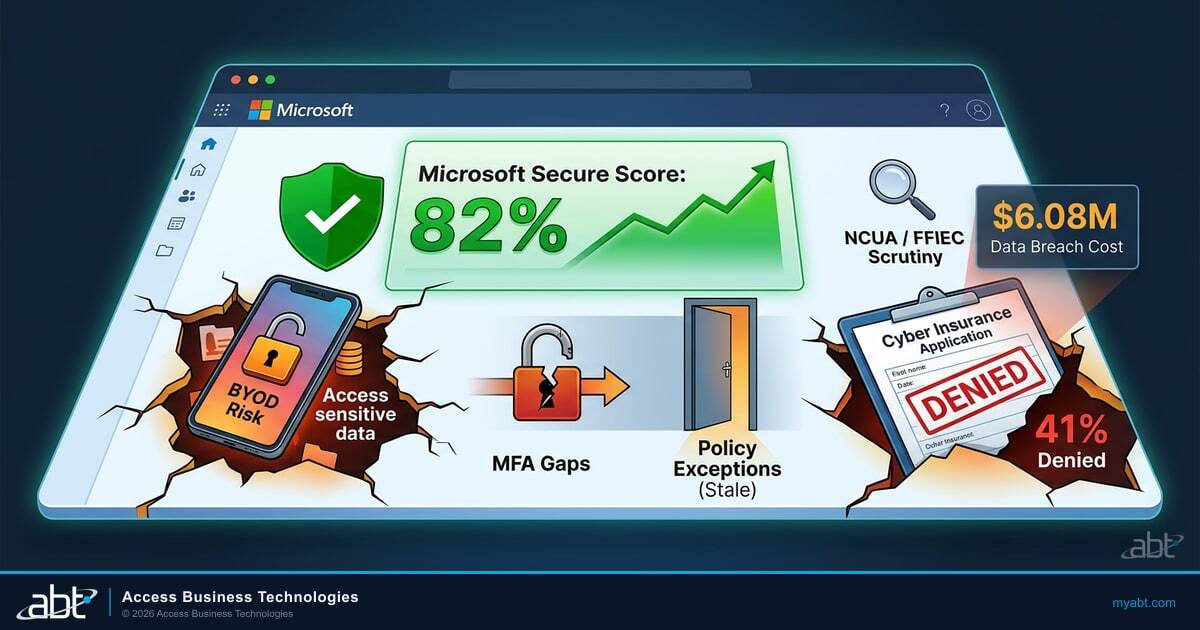
A high Microsoft Secure Score creates a dangerous illusion. The dashboard says 78%. Leadership sees green. IT moves on to other priorities. Meanwhile, personal phones are reading member data without mobile management. Three service accounts bypass MFA entirely. And the Conditional Access policy that was supposed to block legacy authentication has an exception list nobody has reviewed in over a year.
Those are Microsoft Secure Score gaps that don't show up on the dashboard. And those are the gaps that attackers and examiners find first.
In This Article
- Your Scorecard Isn't Your Security
- Personal Devices Are the Unmanaged Back Door
- A Security Gap Is a Business Problem
- Cyber Insurance Carriers Are Watching Your Score
- The Fix That Earns Trust Before Demanding It
- Security Moves at the Speed of Leadership
- From Scorecard to Secure
- From Microsoft Secure Score to M365 Guardian
- Frequently Asked Questions
Your Scorecard Isn't Your Security
Security scores measure what's easy to count. They don't measure everything that matters. Across hundreds of financial institution assessments, we routinely find three categories of security score blind spots hiding behind impressive dashboards:
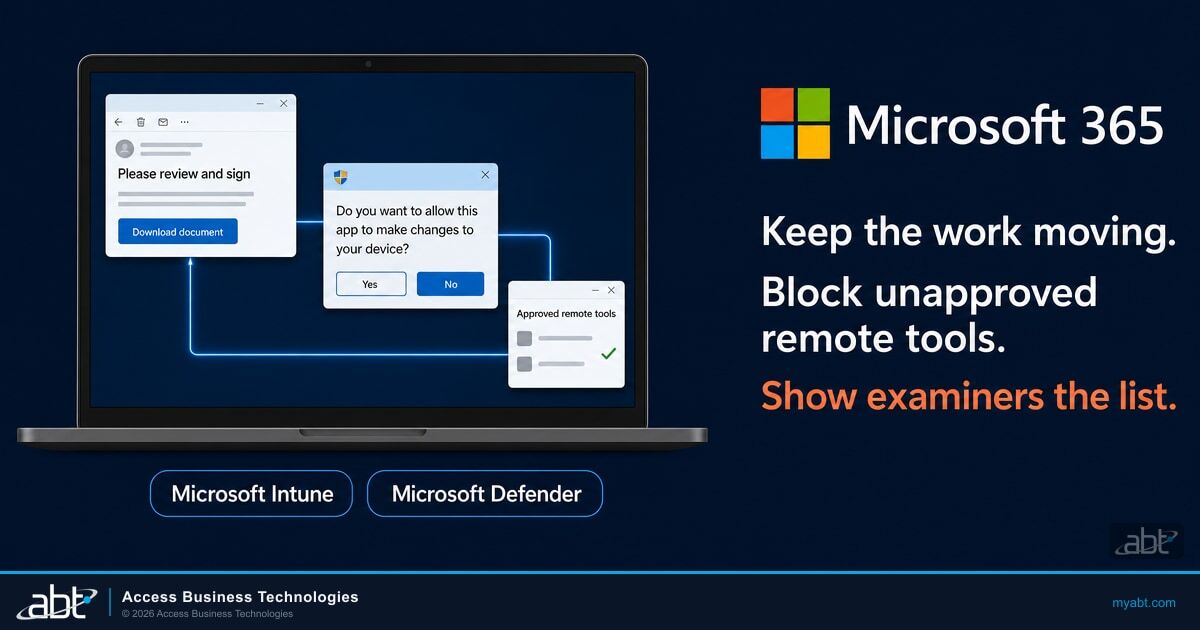
- Unprotected personal devices. Personal phones and tablets reading sensitive email, accessing documents, and clicking links without any mobile security controls. No app protection policies. No device compliance checks. Raw access to regulated data on unmanaged hardware.
- Policy exceptions that became permanent. Service accounts, legacy application integrations, and "temporary" Conditional Access bypasses that nobody cleaned up. Each one is a door left open. We've seen bypass lists grow to 15-20 accounts before anyone noticed.
- MFA enforcement gaps. Accounts that slipped through enrollment and service accounts running without certificate-based authentication because nobody configured it. An attacker only needs one unprotected account to establish a foothold. Closing the MFA gap properly means stepping up to just-in-time admin elevation with Microsoft Entra ID Privileged Identity Management so privileged accounts are protected even when the standing MFA enrollment is in place.
Attackers don't care about your aggregate score. They specialize in finding the one Conditional Access gap you forgot about. Your score won't chase exceptions, flag shadow BYOD, or catch the "temporary" workaround that became permanent. You have to look past the dashboard to see the real picture.
Personal Devices Are the Unmanaged Back Door
BYOD in financial services often translates to "Bring Your Own Risk." When a personal phone accesses customer data, member records, or borrower documents with zero safeguards, you've created an undocumented attack surface that no security score flags.
Lose the phone? No selective wipe capability. Click a phishing link? You've handed an attacker a foothold into your environment. Because the device isn't managed, you won't see the compromise in your monitoring tools.
The NCUA's 2026 supervisory priorities explicitly call out vendor management and security frameworks as examination areas. Unmanaged devices accessing member data through your Microsoft 365 tenant are exactly the kind of gap that triggers findings.
This is also where Microsoft Entra ID Conditional Access rules tuned for financial services stop being a checkbox and start being the control plane that decides whether an unmanaged phone gets to read regulated email in the first place.
BYOD security for financial services doesn't mean banning personal devices. It means putting work data in a secure container and drawing a clear line between personal and organizational data. People stay productive. Regulated data stays protected. Nobody's personal photos get inspected. Simple, respectful, enforceable.
A Security Gap Is a Business Problem
A cybersecurity incident at a financial institution isn't an abstract IT problem. It's an operational crisis that hits immediately:
- Credit unions: Core banking goes offline, members can't access accounts, the call center is overwhelmed, and the NCUA examiner wants an incident report within 72 hours. Under the NCUA's 72-hour mandatory cyber incident reporting rule, federally insured credit unions filed 892 cyber incidents between September 1, 2023 and May 1, 2024; through August 31, 2024 the total had grown to 1,072, with nearly seven in ten incidents tied to third-party vendors, per the NCUA's Cybersecurity and Credit Union System Resilience Annual Report to Congress (2025).
- Mortgage companies: Loan funding freezes, rate locks expire, the pipeline stalls, and borrower notifications trigger state attorney general inquiries.
- Community banks: Online banking goes down, wire transfers stop, business customers can't operate, and the OCC opens a supervisory review.
One unmanaged phone or a single account without MFA enforcement can cascade into frozen operations, regulatory notifications, and the kind of public cleanup that erodes customer trust for years. A managed IT provider built for regulated environments catches these gaps as part of normal operations. It is not about buying more tools. It is about closing the gaps your security score doesn't see. Most of the catastrophic gap categories above also intersect with Microsoft Purview Data Loss Prevention policies aligned to modern financial compliance, which is the layer Secure Score scores but does not enforce.
Cyber Insurance Carriers Are Watching Your Score
Cyber insurance underwriters have gotten aggressive about using Microsoft Secure Score data during the application process. A 2025 enterprise security analysis found that demonstrating a high Secure Score, specifically in MFA and Data Protection categories, directly affects premium pricing.
But here's the problem with relying on your score for insurance purposes: the same gaps that hide from your dashboard also hide from the score the carrier sees. If your Secure Score shows 82% but unmanaged personal devices are accessing regulated data without any mobile policies, you're presenting a risk profile to your insurer that doesn't match reality.
When a claim hits and the forensic investigation reveals unmanaged BYOD access or permanent MFA exceptions, that discrepancy between reported posture and actual posture becomes a coverage dispute. Financial institutions need their actual security posture to match what the dashboard reports.
The Fix That Earns Trust Before Demanding It
Our approach to mobile device security compliance is deliberately boring. It works, people accept it, and it doesn't wreck productivity. Here's how it rolls out:
MAM first. Start with Mobile Application Management. Put your work apps and data inside a locked container on a personal phone. Set a PIN for work apps, encrypt what's inside, block copy-paste to personal apps, and wipe the container remotely if the device is lost. The rest of the device stays untouched. No "IT can see my photos" concerns. No pushback from staff.
MDM when it makes sense. Once the container model is accepted, expand to Mobile Device Management for roles that require device-level controls. Enforce OS versions, encryption, screen lock requirements, jailbreak detection, and mobile threat defense. Use MDM for high-risk roles, shared devices, or situations where native mail access is required. Adoption goes smoother because you earned trust first.
This staged approach works for credit unions with 100 employees and mortgage companies with 500 loan officers. It scales because it starts with the least invasive, highest-impact control.
Security Moves at the Speed of Leadership
Tools don't enforce themselves. The financial institutions that actually close their MFA enforcement gaps and BYOD exposure do three things consistently:
- Set a date and mean it. A clear executive communication: "After this date, work data lives in a protected app or you don't get access." Friendly, firm, and privacy-conscious. No ambiguity.
- Show the scoreboard. Monthly reviews tracking BYOD coverage, exception cleanup, and MFA completion rates. When leadership watches the numbers, the numbers improve. When they don't, nothing changes.
- Make managers accountable. Give department leaders their team's compliance status, pre-written reminders, and office hours for help. "Everyone is responsible" isn't a motivational poster. It's a routing rule that puts follow-up where it belongs.
That's the difference between a security policy that lives in SharePoint and a program that actually protects your customers and your brand.
From Scorecard to Secure
Real security isn't the number on your dashboard. It's the absence of unmanaged back doors, lingering policy exceptions, and orphaned accounts. It's connecting those fixes to business outcomes: operations run on schedule, customers stay confident, examiners nod instead of writing findings, and insurance carriers see a risk profile that matches reality.
If your Microsoft Secure Score looks strong but something feels off, you're probably right. Start with the phone in everyone's pocket. Lock the data today, raise the device bar next, and let your leadership cadence turn policy into practice.
That's how you turn "secure on paper" into secure in production.
From Microsoft Secure Score to M365 Guardian
Microsoft Secure Score is the right baseline. ABT manages the Microsoft 365 tenant where that score lives, applies the Microsoft Entra ID Conditional Access, Intune device compliance, Microsoft Defender, and Microsoft Purview controls that move the score, and then layers M365 Guardian on top of it. Guardian is the operating model that closes the gaps Secure Score does not measure: the unmanaged personal phone reading member email, the Conditional Access exception that was supposed to be temporary, the service account running without certificate-based authentication, and the gap between a written policy and the enforcement evidence an examiner expects to see. Secure Score is a number. Guardian is the cadence work, the 24/7 security operations center, the documented exception cleanup, the Microsoft Sentinel SIEM correlation, and the examiner-ready evidence packet that turns the number into actual security posture for a regulated financial institution.
Close the Gaps Your Secure Score Doesn't Catch
ABT applies and monitors the Microsoft 365 controls that move Secure Score and runs the M365 Guardian operating model that closes the gaps Secure Score does not measure. A 30-minute conversation grades your current Microsoft 365 posture, surfaces the BYOD, exception, and MFA gaps an examiner is most likely to find first, and outlines what a Guardian-managed deployment would cover. No commitment, no quote, no obligation.
Frequently Asked Questions
The most common Microsoft Secure Score gaps include unmanaged personal devices accessing regulated data, service accounts that bypass multi-factor authentication, Conditional Access policy exceptions that were never cleaned up, and legacy authentication protocols that remain enabled. These gaps do not reduce the aggregate score but create exploitable attack surfaces that examiners and attackers find first.
Mobile Application Management creates a secure container for work apps and data on personal devices without managing the device itself. The organization controls the work container including encryption, PIN requirements, and remote wipe. Personal apps, photos, and browsing remain private and unmonitored. This balances BYOD security for financial services with employee privacy expectations.
Cyber insurance carriers now use Microsoft Secure Score data during underwriting, particularly MFA and Data Protection metrics. A high score can reduce premiums. However, gaps hidden from the dashboard such as unmanaged BYOD and permanent policy exceptions create a mismatch between reported and actual risk posture. If a forensic investigation after a claim reveals undisclosed gaps, coverage disputes follow.
Mobile Application Management controls work apps and data within a secure container on personal devices without managing the device itself. Mobile Device Management provides full device-level control including OS enforcement, encryption requirements, and threat detection. Most financial institutions deploy MAM first for broad coverage and employee trust, then add MDM for high-risk roles requiring device-level compliance checks.
Financial institutions should review their Microsoft Secure Score weekly at minimum with a deeper security assessment quarterly. The score itself should be treated as a starting point rather than a definitive measure. Weekly reviews should include exception list cleanup, MFA enrollment verification, Conditional Access policy validation, and BYOD compliance status. Annual point-in-time reviews are insufficient for regulatory expectations.