

In This Article
- The Number That Should Worry Every Banking Technology Vendor
- What "Deployed" Actually Means (And Does Not Mean)
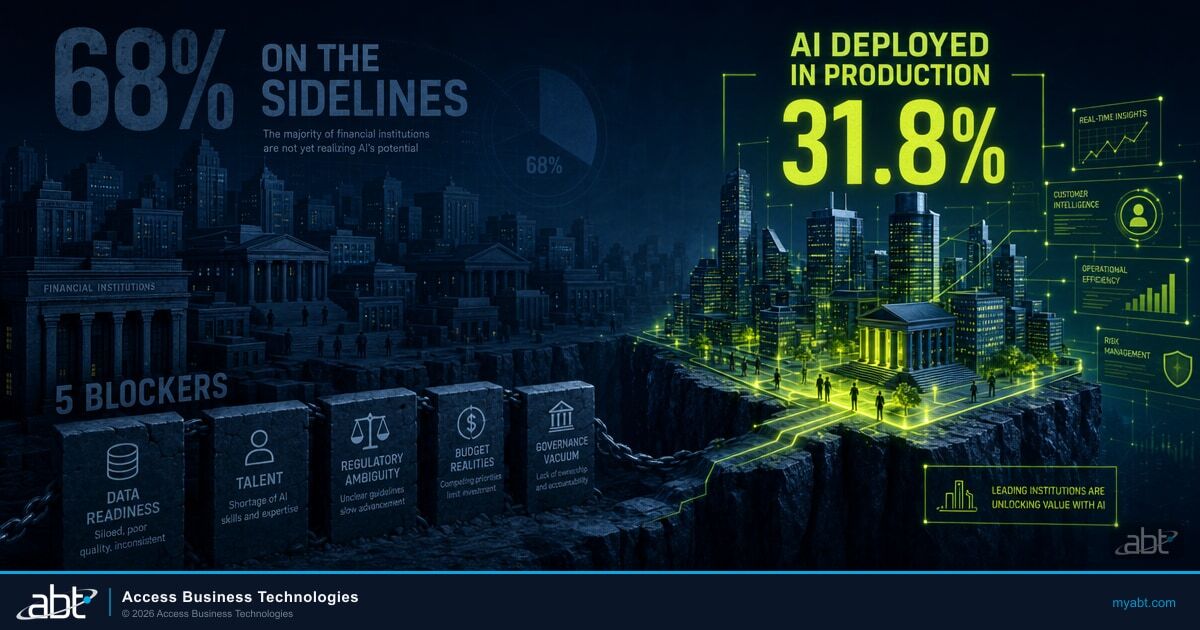
- The Five Blockers Keeping 68% on the Sidelines
- What the 31.8% Got Right
- Why the Gap Will Widen Before It Closes
- Bridging the Gap: From the 68% to the 31.8%
- How Microsoft Purview Maps Governance to Maturity Metrics
- The M365 Guardian Operating Model: How ABT Moves Institutions From 31.8% to Prepared 100%
- Frequently Asked Questions
After two years of AI hype, board mandates, and vendor keynotes, only 31.8% of financial institutions have deployed AI in production. That number comes from the Wolters Kluwer Q1 2026 Banking Compliance AI Trend Report, which surveyed 148 financial institutions. Another 29.1% are still piloting. The remaining 39.1% have not started. The gap between AI ambition and AI reality is wider than the industry wants to admit.
This article breaks down what Wolters Kluwer found, why the gap persists, what the 31.8% got right, how Microsoft Purview Audit, Data Loss Prevention, and sensitivity labels translate the survey's maturity language into auditable configuration, and how Access Business Technologies, a Tier-1 Microsoft Cloud Solution Provider that manages Microsoft 365 tenants for more than 750 financial institutions, applies the M365 Guardian operating model to close the distance between aspiration and production deployment.
The Number That Should Worry Every Banking Technology Vendor
31.8%. That is the share of financial institutions with AI running in production. Not experimenting. Not evaluating. Actually running.
The full picture from the Wolters Kluwer Q1 2026 report:
- 31.8% deployed in production, running AI in live operational workflows
- 29.1% actively piloting, testing AI in controlled environments
- 39.1% have not started, no pilot, no plan, no deployment
Combined, 60.9% of financial institutions have some form of AI activity. That sounds encouraging until you realize that "piloting" in financial services often means a sandbox project with no production path, no governance framework, and no timeline for scale. The Wolters Kluwer data supports this: only 12.2% of surveyed institutions describe their AI strategy as "well-defined and resourced." The rest are operating without a plan.
For context, Cornerstone Advisors' 2026 "What's Going On in Banking" survey of 416 executives found a higher number: 49% of banks and 59% of credit unions reporting some generative AI deployment. The difference likely reflects how each survey defines "deployed." Wolters Kluwer's threshold appears stricter, requiring production use rather than any form of AI tool usage. Regardless of which number you prefer, the conclusion is the same: a large portion of the industry is watching from the sidelines.
What "Deployed" Actually Means (And Does Not Mean)
Not all AI deployment is equal. The 31.8% figure includes a range of AI maturity levels, and lumping them together creates a misleading picture.
Legacy ML relabeled as "AI." Fraud scoring models have used machine learning for over a decade. Credit risk models rely on statistical techniques that predate the current AI hype cycle. Some of the 31.8% reflects institutions counting existing ML tools as AI deployment after a rebrand.
Vendor-embedded AI. When a core banking provider adds AI features to its platform, the financial institution gets AI capabilities without building anything. This counts as "deployed" in surveys but does not reflect internal AI capability.
Generative AI for internal productivity. Microsoft 365 Copilot for email drafting, document summarization, and meeting notes. Useful, and increasingly the entry point to broader Copilot Business adoption, but not the production-grade AI that transforms lending decisions, compliance monitoring, or member service.
True production AI integration. Automated underwriting decisions, real-time fraud detection with autonomous response, AI-driven compliance monitoring, agentic workflows that execute multi-step processes without human intervention. This is where the real value sits, and it represents a fraction of the 31.8%. This connects closely to OWASP Top 10 for Agentic AI.
The MIT study published in August 2025 quantified this reality: only 5% of integrated AI pilots have delivered significant value and been integrated at scale into workflows. The rest are stuck in what the industry calls "pilot purgatory," running indefinitely without a path to production.

The Five Blockers Keeping 68% on the Sidelines
The Wolters Kluwer data, combined with Gartner's research and KPMG's industry findings, reveals five consistent blockers that explain why the majority of financial institutions have not moved to production AI.
1. Data Readiness
Only 9.5% of institutions report being "very prepared" with data infrastructure to support AI/ML initiatives, according to the Wolters Kluwer report. AI models require clean, classified, accessible data. Most financial institutions have data locked in siloed core systems, legacy databases, and disconnected vendor platforms. Gartner predicts that through 2026, organizations will abandon 60% of AI projects unsupported by AI-ready data. The data problem is not a technology problem. It is a decade of deferred data governance.
2. Talent
Community banks and credit unions rarely have in-house data science expertise. The institutions that do have technical teams are competing for the same AI specialists as JPMorgan Chase (with its $18 billion annual technology budget and $2 billion dedicated AI investment). Informatica's CDO Insights 2025 survey found that 35% of organizations cite skills shortages as a top obstacle to AI success.
3. Regulatory Ambiguity
Financial institutions face a regulatory environment where AI guidance exists but enforcement precedent does not. Model risk management frameworks apply to AI, but the specifics are still being defined. State-level AI legislation like the Colorado AI Act creates compliance obligations that many institutions are still trying to understand. The result is institutional paralysis where legal and compliance teams block deployments they cannot clearly evaluate.
4. Budget Realities
AI costs more than the vendor demo suggested. The total cost includes data preparation, model training, infrastructure, governance tooling, staff training, and ongoing monitoring. Financial sector AI spending is projected to reach $97 billion by 2027, but that spending is concentrated in large institutions. Community banks and mid-size credit unions face the same pressure to adopt AI with a fraction of the budget.
5. Governance Vacuum
Many institutions lack a framework for responsible AI use. Research shows that 77% of organizations use AI but only 37% govern it. Without governance, every AI deployment carries unquantified risk. The institution cannot explain its AI decisions to examiners, cannot audit its models for bias, and cannot demonstrate the kind of controls that regulators will eventually demand.
Gartner reported in February 2025 that 85% of all AI projects fail due to poor data quality. Separately, a November 2025 study published by MIT found that 95% of generative AI pilots at companies are failing to deliver promised returns. These are not financial-services-specific numbers. They reflect the broader reality that AI deployment is harder than the hype suggests, and financial services institutions face even higher barriers due to regulatory and data complexity.
What the 31.8% Got Right
The institutions that successfully deployed AI share identifiable patterns. Success correlates with process maturity, not budget size. Some of the most effective AI deployments are happening at mid-size institutions that approached the problem methodically.
They started with governance, not technology. Successful deployers built AI governance frameworks before selecting AI tools. They defined acceptable use policies, established model risk management processes, and created oversight structures. This front-loaded investment pays off by clearing the regulatory and compliance obstacles that stall other institutions at the pilot stage.
They chose narrow use cases. Instead of "transform everything with AI," successful deployers picked one high-friction workflow and solved it completely. Document processing in lending. Fraud alert triage. Suspicious activity report drafting. Narrow scope means faster time to value and a concrete success story that builds institutional confidence.
They invested in data before AI tools. Microsoft's December 2025 research on AI transformation predictors found that "Frontier Firms" (those seeing 3x returns on AI investment) share a common trait: they invested in data foundations before layering AI on top. Data classification, quality improvement, and accessible data pipelines precede any model training. In Microsoft 365 terms, that means Microsoft Purview Information Protection labels applied to mailboxes, SharePoint sites, and Teams channels before Microsoft 365 Copilot ever processes a query.
They maintained human oversight. The institutions deploying AI successfully are not replacing human judgment. They are augmenting it. Human-in-the-loop models satisfy regulators, build internal trust, and catch the edge cases that models miss. Black-box AI decisions in lending or compliance create examiner risk that wipes out whatever efficiency the AI provided.
They built internal champions. Deployment stalls when IT drives the project alone. Successful institutions have business line champions who own the AI use case. When the lending VP advocates for AI in document processing because it solves their team's pain point, adoption follows naturally.

"Organizations will abandon 60% of AI projects unsupported by AI-ready data through 2026. The data problem is not a technology problem. It is a governance problem."
Gartner, February 2025Why the Gap Will Widen Before It Closes
The institutions already deploying AI are not standing still. They are compounding their advantage with every month of production experience.
S&P Global's research on AI in banking warned that leaders will soon pull away from the pack. The gap is not just in technology deployment. It is in data maturity, talent development, governance muscle, and institutional learning. The 31.8% are training their staff to work alongside AI. They are refining their models with production data. They are building the governance documentation that examiners will expect from everyone.
Meanwhile, the 68% waiting on the sidelines are falling further behind in ways that are difficult to recover from:
- Data debt compounds. Every month without a data governance program is another month of siloed, unclassified, inaccessible data accumulating. The longer you wait to address data readiness, the more expensive it becomes.
- Talent concentrates. AI-capable staff go where AI projects exist. Community banks and credit unions without active AI programs cannot recruit or retain the people who know how to deploy and manage AI systems.
- Competitive pressure builds. When one credit union in your market offers AI-powered loan decisions in 48 hours and you take 2 weeks, members notice. When Microsoft's banking AI playbook enables competitors to automate compliance workflows, your manual process becomes a competitive liability.
- Regulatory expectations evolve. Regulators who are currently permissive about AI governance will tighten expectations as deployment becomes standard. The institution that starts building governance in 2028 will face standards shaped by the institutions that started in 2025.
AI deployment is not a switch you flip. It is a muscle that takes time to develop. The deliberate caution that some CISOs are exercising makes sense for high-risk applications, but wholesale inaction creates risks of its own.
Bridging the Gap: From the 68% to the 31.8%
If your institution has not deployed AI in production, the path forward is not to panic-buy AI tools. It is to build the foundations that the successful 31.8% already have in place.
Step 1: AI inventory. Before you deploy anything new, find out what AI is already running in your environment. Your core banking provider, fraud system, and CRM likely have AI features already active. Shadow AI is a real risk when employees use AI tools that IT never approved. Start by knowing what exists.
Step 2: Readiness assessment. Evaluate your data infrastructure, talent capacity, governance maturity, and regulatory readiness. The AI readiness assessment framework provides a structured 25-point evaluation that identifies gaps before they become project failures.
Step 3: Governance framework. Write the AI governance policy before you select the AI tool. Define acceptable use, model risk management, bias monitoring, human oversight requirements, and incident response procedures. This is cheaper and faster than retrofitting governance after a regulator raises concerns. See also our breakdown of Treasury's 230-Control AI Risk Framework.
Step 4: Narrow pilot with clear success metrics. Pick one use case where AI can deliver measurable value within 90 days. Document processing in lending. Fraud alert triage. Call center summarization. Define success metrics before the pilot starts. If the pilot cannot demonstrate value in 90 days, kill it and try a different use case.
Step 5: Structured scaling. When the pilot succeeds, document the playbook and repeat it in the next department. Scaling AI is not about deploying bigger models. It is about replicating the governance, data, and change management processes that worked the first time. Our guide to AI Governance Mandates for Financial Institutions goes deeper on this.
The Wolters Kluwer data tells a story of an industry in transition. The 31.8% are not special. They are simply the ones who started building foundations while everyone else waited for certainty. Certainty is not coming. The institutions that act on imperfect information, with proper governance guardrails, will define the next era of financial services technology.
How Microsoft Purview Maps Governance to Maturity Metrics
Surveys like the Wolters Kluwer Q1 2026 report measure AI deployment maturity in qualitative bands: "very prepared," "well-defined and resourced," "governed." Those bands are easy to nod along to in a board meeting and hard to defend in an examination. The institutions in the 31.8% close that gap by translating maturity language into auditable Microsoft 365 configuration that produces evidence on demand. Microsoft Purview is the layer that does the translation. Purview Audit produces the time-stamped log of every create, modify, and delete action across Exchange Online, SharePoint Online, OneDrive, Teams, and Microsoft Entra ID, with Audit Premium extending retention to a full year and the option to extend to ten. Purview Data Loss Prevention enforces policies that block customer non-public information, account numbers, and member data from leaving controlled surfaces, including the surfaces that Microsoft 365 Copilot can summarize. Purview Information Protection sensitivity labels classify documents and emails so the AI tools, the retention policies, and the DLP enforcement all act on the same source of truth.
The result is that the same maturity metric a Wolters Kluwer survey asks about, whether the institution governs AI use, has a defensible answer: yes, with these Audit retention windows, these DLP policy hit counts, these sensitivity label distributions across the tenant, and these Copilot interaction logs. That moves the institution from "we are working on governance" to "here is the evidence." Examiners notice. Boards notice. The institutions that have done this work are the ones with the time and the muscle to move from pilot to production while everyone else is still describing the framework they intend to build.
The M365 Guardian Operating Model: How ABT Moves Institutions From 31.8% to Prepared 100%
Access Business Technologies is a Tier-1 Microsoft Cloud Solution Provider that manages Microsoft 365 tenants for more than 750 financial institutions. The firm's footprint covers community banks, credit unions, mortgage companies, and securities firms operating under federal and state regulatory oversight. For institutions still on the sidelines of the AI deployment gap, the operational pattern that moves them from the 68% to the prepared end of the spectrum has a name: M365 Guardian. Guardian is ABT's operating model that takes a community-bank or credit-union Microsoft 365 tenant from a configuration the institution hopes is right to a configuration the partner monitors, documents, and produces evidence for, every day. The Microsoft Purview Audit, DLP, and sensitivity label posture described above is one of the surfaces Guardian configures and reviews. Microsoft Defender for Office 365, Defender for Endpoint, Microsoft Sentinel, and Microsoft Entra ID Conditional Access are the others. Microsoft 365 Copilot rolls out on top of that posture, with Copilot interaction logging tied back to Purview Audit and Copilot data access constrained by Purview sensitivity labels and DLP. None of this is theoretical. It is the operating pattern ABT runs for more than 750 institutions today.
The 31.8% in the Wolters Kluwer survey are the institutions that already have a version of this operating model in place. The other 68% can adopt the same pattern without rebuilding their AI strategy from scratch. The path is to start with the Microsoft 365 tenant they already own, layer the M365 Guardian operating model on top through the partner relationship under Granular Delegated Administrative Privileges (GDAP), and use Purview, Defender, Sentinel, Entra ID, and Microsoft 365 Copilot in the configuration that produces audit evidence on demand. The institutions that take that path do not have to be in the 31.8% by the next survey cycle. They have to be on the path. The compounding advantages described earlier in this article begin the moment the foundations are in place, not on the day a Copilot pilot graduates to production.
Move Your Institution From the 68% to the Prepared End of the Spectrum
ABT runs the M365 Guardian operating model for more than 750 financial institutions, layering Microsoft Purview, Defender, Sentinel, Entra ID, and Microsoft 365 Copilot into a single managed posture that produces audit evidence on demand. A 30-minute conversation maps your current Microsoft 365 tenant, surfaces the AI governance gaps your next examiner is most likely to raise, and outlines what an ABT-managed deployment would cover. No commitment, no quote, no obligation.
Key Takeaway
The Wolters Kluwer Q1 2026 report draws a hard line between the 31.8% of financial institutions that have deployed AI in production and the 68% that have not. The line is not about budget or board mandate. It is about whether the institution has translated its AI governance language into auditable Microsoft 365 configuration. Microsoft Purview Audit, DLP, and sensitivity labels turn the survey's maturity bands into evidence. The M365 Guardian operating model is the pattern ABT applies for more than 750 financial institutions to keep that evidence ready every day, so Microsoft 365 Copilot and the broader Microsoft 365 surface can be deployed with the controls in place that examiners and boards already expect.
Frequently Asked Questions
The Wolters Kluwer Q1 2026 Banking Compliance AI Trend Report surveyed 148 financial institutions and found that 31.8% have deployed AI in production, 29.1% are actively piloting, and 39.1% have not started. Only 12.2% describe their AI strategy as well-defined and resourced, revealing a gap between adoption activity and strategic readiness.
Five primary blockers keep 68% of financial institutions from deploying AI: data readiness (only 9.5% report being very prepared), talent shortages in data science and AI engineering, regulatory ambiguity around AI governance expectations, budget constraints especially for community banks and credit unions, and a governance vacuum where 77% use AI but only 37% govern it.
Data readiness is the single biggest barrier. The Wolters Kluwer Q1 2026 report found only 9.5% of institutions report being very prepared with data infrastructure. Gartner predicts organizations will abandon 60% of AI projects unsupported by AI-ready data through 2026. Without clean, classified, accessible data, AI models cannot deliver reliable results regardless of the technology invested. Microsoft Purview Information Protection sensitivity labels are the practical entry point that prepares the tenant for both AI-ready data and the governance evidence examiners will look for.
Most financial institutions require 12 to 24 months to move from AI pilot to production deployment. However, many never make the transition. Gartner forecasts that 30% of generative AI projects will be abandoned after the proof-of-concept phase by end of 2025. The average organization scrapped 46% of AI proofs-of-concept before reaching production. Institutions that pair Microsoft 365 Copilot rollouts with Microsoft Purview governance from day one tend to shorten that cycle because the governance evidence is built up alongside the use case rather than retrofitted after a regulator raises concerns.
Successful AI deployers in banking share five common patterns: they build governance frameworks before selecting AI tools, choose narrow high-friction use cases rather than broad transformation, invest in data foundations before model training, maintain human-in-the-loop oversight that satisfies regulators, and cultivate business line champions who own the AI use case beyond the IT department. Inside Microsoft 365, that pattern shows up as Microsoft Purview Audit, DLP, and sensitivity labels in production before Microsoft 365 Copilot is rolled out at scale.
No. Waiting widens the gap. Institutions already deploying AI are compounding advantages in data maturity, talent development, and governance capability that late adopters will struggle to replicate. Community banks and credit unions should start with readiness assessments, governance frameworks, and narrow pilots rather than waiting for certainty that is not coming. The M365 Guardian operating model that ABT runs for more than 750 financial institutions is one path from the 68% to the prepared end of the spectrum without rebuilding strategy from scratch.
Microsoft Purview Audit produces the time-stamped log of every create, modify, and delete action across Exchange Online, SharePoint Online, OneDrive, Teams, and Microsoft Entra ID, with Audit Premium extending retention to a full year and the option to extend to ten. Purview Data Loss Prevention enforces policies that block customer non-public information from leaving controlled surfaces, including the surfaces Microsoft 365 Copilot can summarize. Purview Information Protection sensitivity labels classify documents and emails so the AI tools, the retention policies, and the DLP enforcement all act on the same source of truth. Together they turn the abstract maturity bands in surveys like the Wolters Kluwer Q1 2026 report into concrete audit evidence an examiner can review.