

In This Article
- What Tier-1 Direct-Bill CSP Actually Means for a Community Bank
- M365 Guardian: The Operating Model on Top of the License Stack
- The Generic MSP Gap in Banking Compliance
- Direct Microsoft Escalation: Why It Matters During Incidents
- Compliance Expertise That Generic MSPs Cannot Provide
- The Convergence Advantage: One Partner Instead of Four
- How to Evaluate Whether Your IT Provider Is Actually Tier-1
- Frequently Asked Questions
A community bank runs on Microsoft 365. Email, file storage, Teams collaboration, SharePoint intranets, identity management through Microsoft Entra ID. Microsoft touches every employee, every branch, and every transaction that does not run through the core banking system. When something breaks at the platform level, every minute the institution waits in a generalist support queue is a minute the tellers cannot process transactions and the lending team cannot pull credit reports. The structural fix is not a faster generic managed service provider. The structural fix is a Tier-1 Direct-Bill Cloud Solution Provider that manages the Microsoft 365 tenant under delegated admin and runs the M365 Guardian operating model on top of the license stack. Access Business Technologies manages Microsoft 365 tenants for 750+ financial institutions under that exact pattern.
Why ABT Runs the Tier-1 CSP + Guardian Operating Model for Community Banks
- M365 Direct-Bill CSP relationship means ABT transacts with Microsoft as the partner of record and manages the institution's Microsoft 365 tenant under delegated admin. The community bank gets the same Microsoft 365 product as direct purchase, with partner-side tenant management, support, and the Guardian operating layer on top.
- M365 Guardian operating model productizes the configuration, monitoring, and posture management that examiners look for. Lighthouse and the partner-side admin surface are the tools. Guardian is the practice ABT runs against them, continuously, across every tenant in the institution's footprint.
- Banking-grade configuration baseline tested against actual FFIEC, OCC, FDIC, and NCUA examination findings rather than generic SMB defaults. Conditional Access, Microsoft Purview retention and DLP, Microsoft Intune device compliance, Microsoft Defender for Office 365, and Microsoft Sentinel are tuned for community-bank workflows from day one.
For a community bank with a board, an examiner, and a vendor management program, the question is not whether to use Microsoft 365. The question is who runs the tenant on a day-to-day basis. A generic MSP can resell the licenses. A Tier-1 Direct-Bill CSP manages the tenant, applies the security and compliance baseline that examiners look for, and produces the evidence on demand. The Guardian operating model is what makes that ongoing tenant management productized rather than ad hoc.
What Tier-1 Direct-Bill CSP Actually Means for a Community Bank
Tier-1 Direct-Bill CSP is Microsoft's top program tier for Cloud Solution Provider partners. A Direct-Bill partner transacts directly with Microsoft, holds dedicated Microsoft support engineers, and is operationally accountable to Microsoft for how customer tenants are configured and operated. Most CSPs in the market are Indirect Resellers who transact through a distributor. The community bank will not typically see the distinction on the invoice, but the bank sees it in response time when a problem hits, in the depth of the partner's tenant configuration knowledge, and in the access the partner has to Microsoft's roadmap and partner-only tooling like Microsoft 365 Lighthouse.
For a community bank evaluating CSP partners, Tier-1 Direct-Bill status is a fast first-pass filter. The status is documented on Microsoft's partner program pages and is verifiable through the partner's Microsoft Solutions Partner credentials. ABT has held Tier-1 Direct-Bill CSP status since the original Microsoft CSP program launched, and the firm manages Microsoft 365 tenants for more than 750 financial institutions under that designation.
What the institution actually gets through the Direct-Bill relationship is the partner-side management layer Microsoft only grants to Tier-1 partners. That includes delegated administrative access scoped through Granular Delegated Administrative Privileges (GDAP), partner-side reporting across the bank's whole tenant footprint, the Microsoft 365 Lighthouse multi-tenant control plane the partner runs across managed tenants, and a direct escalation path to Microsoft engineering when something breaks at the platform level. None of that is available to an Indirect Reseller, and none of it is available to a generic MSP that resells licenses without holding CSP status at all.
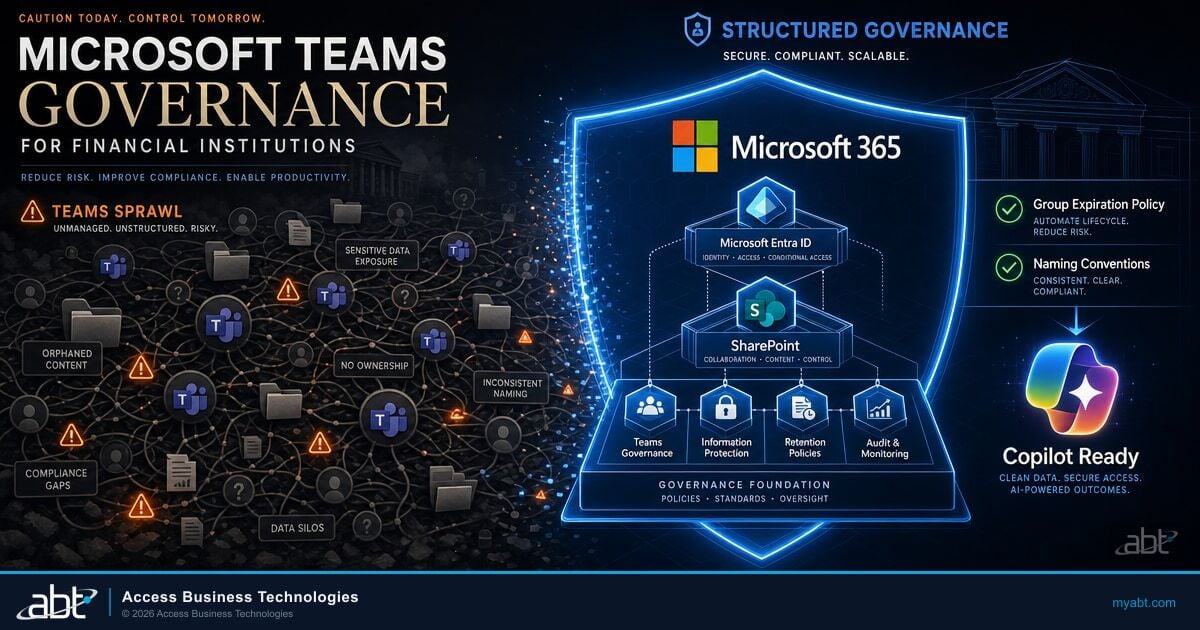
Microsoft 365 is the licensing baseline. The Tier-1 Direct-Bill CSP relationship is the structural difference that makes ongoing tenant management possible. ABT manages the community bank's Microsoft 365 tenant under delegated admin. Microsoft Entra ID supplies the identity layer (Conditional Access, multi-factor authentication, sign-in risk policies). Microsoft Intune enrolls and posture-checks every device that touches bank data. Microsoft Defender for Office 365 and Microsoft Defender for Endpoint handle the active threat side. Microsoft Purview Audit, DLP, and retention hold up the books-and-records side. Microsoft Sentinel aggregates the signals into a SIEM that supports incident detection and regulatory notification. The Tier-1 partner applies, monitors, and documents all of it across every tenant. ABT layers M365 Guardian, the bank-tuned operating model, on top.
M365 Guardian: The Operating Model on Top of the License Stack
Microsoft 365 is the licensing baseline. M365 Guardian is the operating model ABT runs on top of it. The Microsoft 365 admin centers and Microsoft 365 Lighthouse are the tools. Guardian is the practice. For a community bank, the practical difference between buying Microsoft 365 directly from Microsoft and buying it through ABT under a Tier-1 Direct-Bill CSP relationship is that ABT runs the tenant as a continuous function, not as an annual renewal exercise. The bank keeps its licensing. The bank retains its tenant ownership. The Guardian layer is added through the partner relationship.
The Guardian operating model brings three concrete disciplines to the tenant. Configuration as a baseline means Conditional Access, Microsoft Purview retention and DLP, Intune device compliance, Defender for Office 365 anti-phishing, and Sentinel analytic rules are applied to community-bank patterns from day one, not toggled on after an examiner asks. Continuous posture monitoring means license assignment, configuration drift, and security signals are reviewed against the baseline on a recurring cadence, with deviations surfaced inside the partner's dashboard before the next examination. 24x7 security operations center coverage means the Defender, Sentinel, and Entra ID Identity Protection signals are watched every minute of every day by an analyst trained on banking-specific attack patterns rather than generic SMB tooling.
None of these disciplines require the community bank to do anything different at the desktop. The chief compliance officer continues to work inside the bank's own Microsoft 365 admin centers. The IT team continues to manage Intune and Entra ID for the surfaces the bank wants to own. Guardian is the partner-side operating layer that ties the licensing decision, the security configuration, and the continuous monitoring together so the bank gets the productivity, security, and audit-readiness payoff without staffing a posture-management team in-house. For institutions that want to run a self-audit before the partner conversation, the Financial Compliance Made Simple: M365 Self-Audit Guide walks through the controls examiners look for. For a deeper look at how the Direct-Bill relationship reshapes the licensing math, the Microsoft 365 license downgrade guide covers right-sizing the seat stack as the institution grows. For multi-entity broker-dealers operating across affiliates and OSJs, the Deploying Microsoft Lighthouse for Broker-Dealer Compliance Standardization article shows how the same Guardian operating model standardizes posture across a federated regulatory perimeter.
The Generic MSP Gap in Banking Compliance
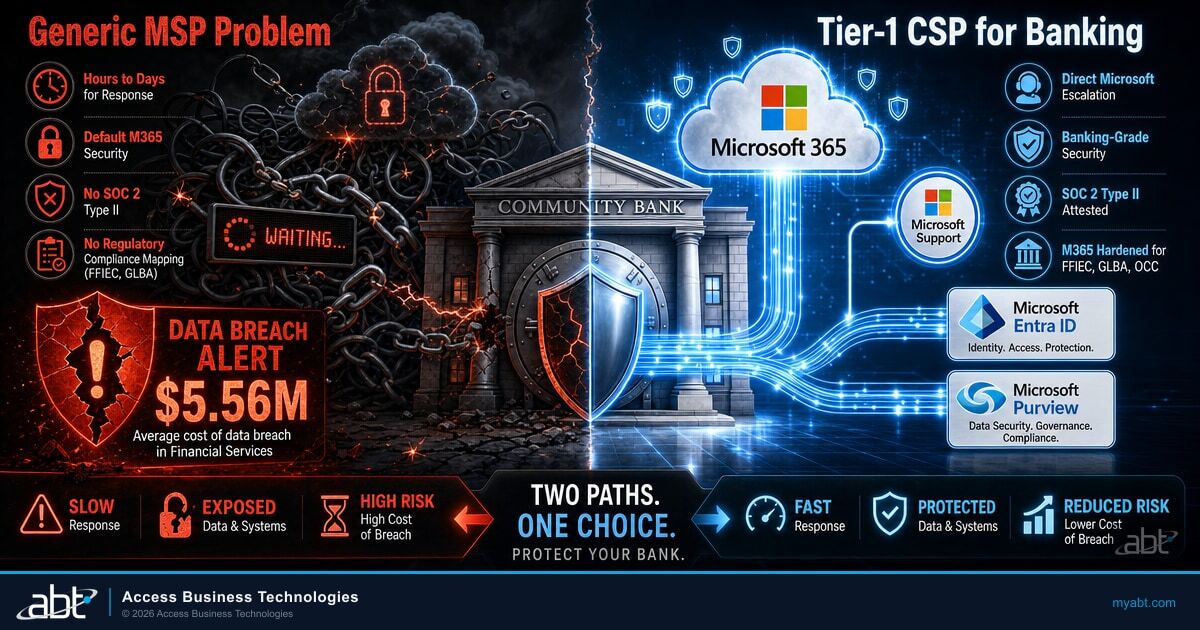
Generic MSPs serve law firms, medical offices, construction companies, and retail chains. The service model is built for businesses that need email, file sharing, and a help desk. They deploy Microsoft 365 with default tenant settings, install antivirus, and respond to support tickets. That model works for a 50-person marketing agency. It fails a community bank.
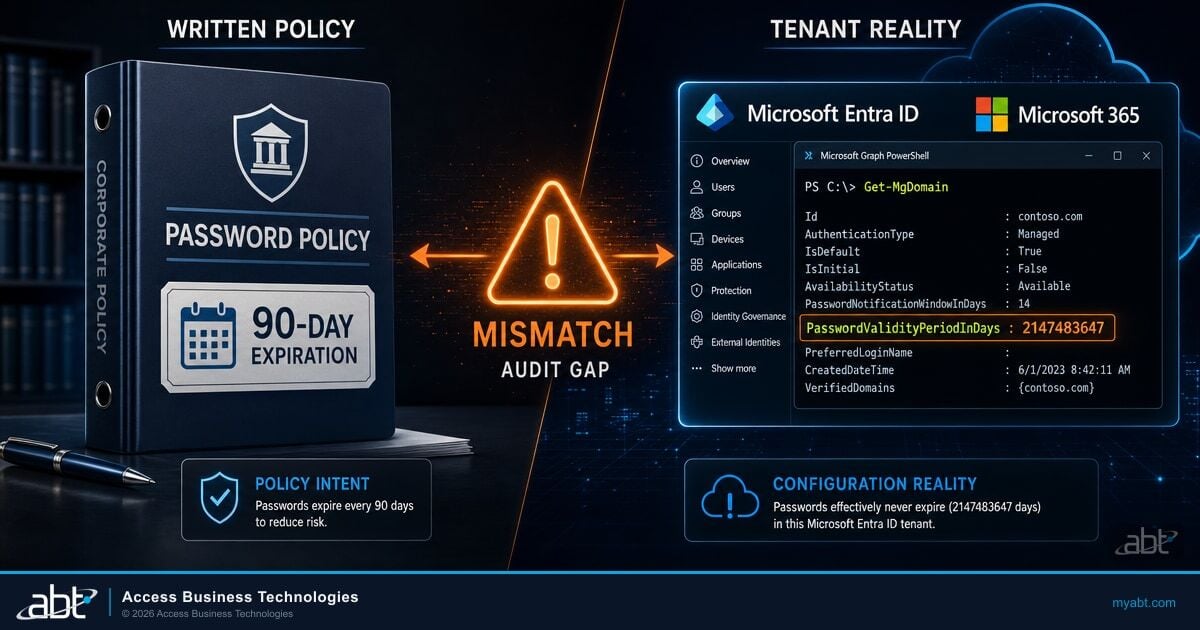
The reason is that a community bank's Microsoft 365 environment is subject to examination by the OCC, FDIC, or state banking department. Examiners expect to see Conditional Access policies that restrict sign-ins by device, location, and risk level. They expect Microsoft Purview Data Loss Prevention rules that prevent account numbers and Social Security numbers from being emailed outside the institution. They expect Purview Audit logging, retention policies, and encryption controls calibrated for financial data. They expect a documented vendor relationship with the partner who runs the tenant, with SOC 2 Type II attestation on file and an executed vendor oversight agreement that satisfies the 2023 Interagency Guidance on Third-Party Relationships.
A generic MSP has never built a tenant against the OCC's Third-Party Risk Management Guide for Community Banks. They cannot map their services to the FFIEC IT Examination Handbook or the NIST Cybersecurity Framework 2.0 functions examiners now reference. They do not maintain the compliance documentation the bank's examiner expects. The problem compounds at the vendor management level. In June 2023, the OCC, FDIC, and Federal Reserve issued joint Interagency Guidance on Third-Party Relationships, establishing that banks must apply rigorous oversight to critical third-party providers. The MSP is a critical third-party provider. If the MSP cannot produce a SOC 2 Type II report, the examiner will flag it. If the MSP cannot describe how its services map to the FFIEC handbook, the examiner will flag that too.
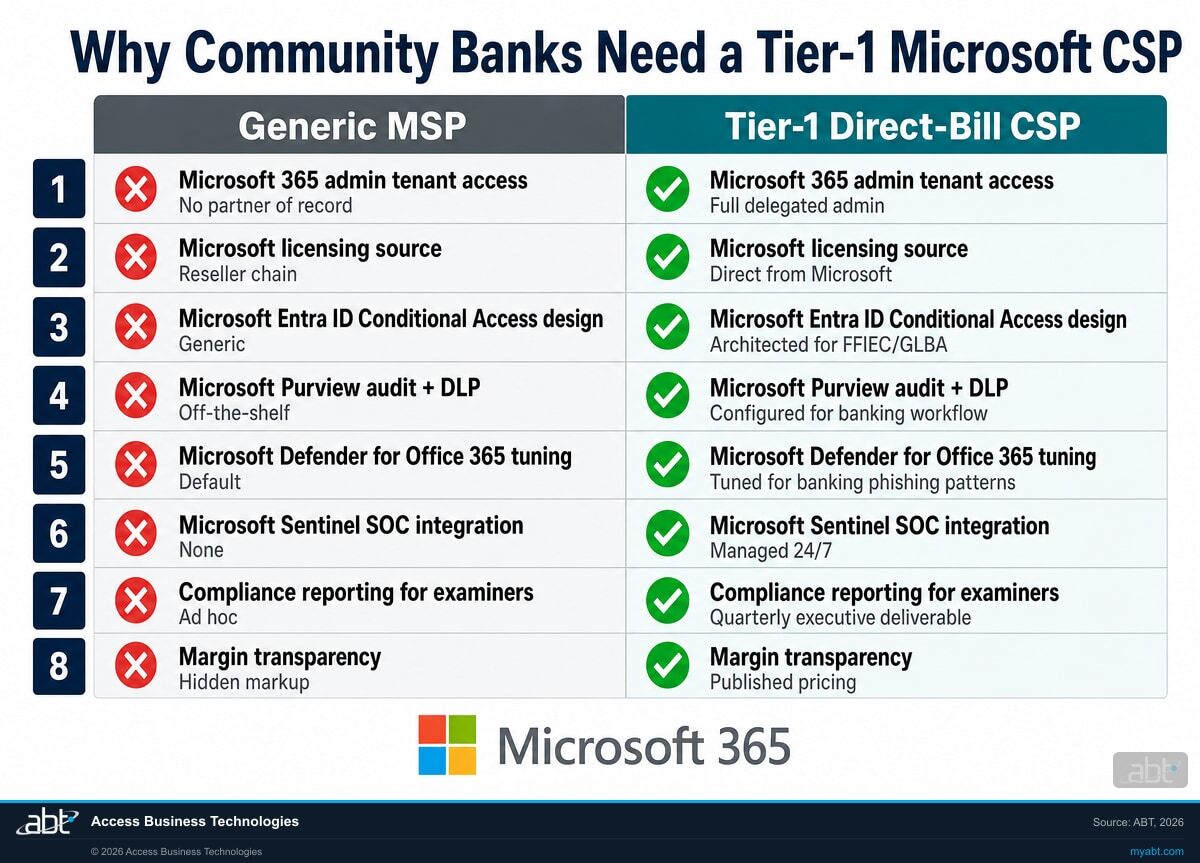
| Capability | Generic MSP | ABT as Tier-1 Direct-Bill CSP |
|---|---|---|
| License purchase path | Through a distributor (Tier-2) or off-program reseller | Direct with Microsoft as the partner of record |
| Tenant administration | Customer logs in and the MSP follows up by ticket | Partner-side delegated admin under GDAP with scoped roles |
| Microsoft escalation | Standard support queue, hours to days for response | Direct escalation to Microsoft engineering through the Direct-Bill relationship |
| Tenant configuration baseline | Default Microsoft 365 settings, MFA toggled on | M365 Guardian baseline tuned for community-bank workflows |
| Regulatory mapping | "Best practices" without traceability | FFIEC IT Examination Handbook, NIST CSF 2.0, OCC, FDIC, NCUA, GLBA |
| SOC 2 Type II attestation | Usually no, or Type I only | Yes, NDA-available, kept current |
| Security operations | Commodity tooling shared across industries | 24x7 SOC with Defender, Sentinel, and Entra ID Identity Protection coverage |
| Core banking integration experience | Rare or nonexistent | Proven integrations with Fiserv, FIS, Jack Henry, and other community-bank cores |
Direct Microsoft Escalation: Why It Matters During Incidents
Microsoft 365 platform outages happen. Microsoft has shipped multi-hour service incidents that affected Exchange Online, Microsoft Teams, and Microsoft Entra ID in recent years. Banks that rely on a generic MSP wait in the same standard support queue as every other business on the planet. The MSP opens a ticket, receives a generic acknowledgment, and waits for a generic resolution. Banks managed by a Tier-1 Direct-Bill CSP have a different experience. The partner escalates directly to Microsoft engineering, receives real-time updates from the product team, and communicates incident progress back to the institution in minutes rather than hours.
The same difference shows up during a security incident at the institution. An employee's credentials are compromised. An attacker accesses the bank's SharePoint environment and begins exfiltrating customer loan files. The IT partner needs to act fast.
- Revoke the compromised session tokens through Microsoft Entra ID immediately, before the attacker pivots
- Determine the scope of data accessed through Microsoft Purview Audit logs
- Isolate the affected account without disrupting branch operations
- Coordinate with Microsoft if the attacker leveraged a platform-level vulnerability
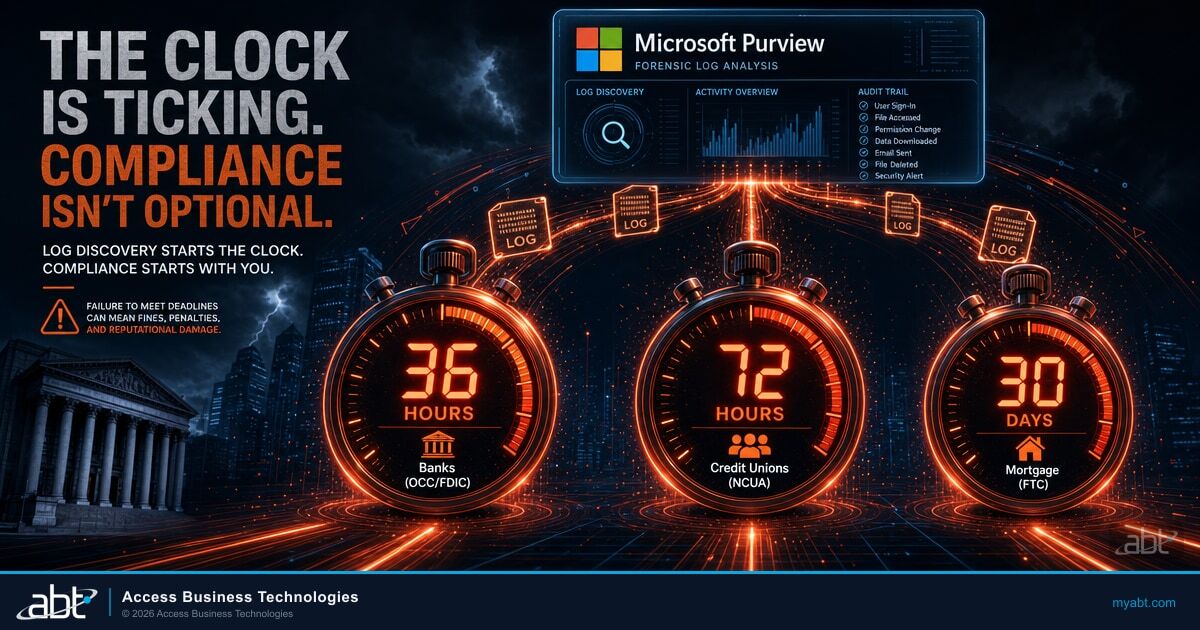
- Produce forensic evidence for regulatory notification (OCC computer-security incident notification requires reporting certain incidents within 36 hours)
A Tier-2 MSP routes through a distributor to reach Microsoft. The distributor triages it. Microsoft eventually picks it up. Response time is unpredictable. A Tier-1 Direct-Bill CSP reaches its assigned Microsoft support contact and pulls engineering-level help into the incident timeline immediately. When the bank's customer data and regulatory obligations are at stake, the difference between hours and minutes is not a premium. It is what the examiner expects.
Compliance Expertise That Generic MSPs Cannot Provide
Community banks operate under multiple overlapping regulatory frameworks. The FFIEC IT Examination Handbook. The GLBA Safeguards Rule. OCC vendor management expectations. FDIC examination procedures. State banking department requirements. Each has specific expectations for how IT controls are documented, tested, and maintained. A generic MSP sells IT services. They do not sell compliance readiness. The gap shows up in three specific places.
Tenant Configuration
Microsoft 365 ships with security and compliance features that are off by default. Conditional Access policies in Microsoft Entra ID, Microsoft Purview DLP rules, sensitivity labels, retention policies, Purview Audit logging, email authentication (SPF, DKIM, DMARC), and Microsoft Defender anti-phishing policies. A banking-aware Tier-1 Direct-Bill CSP configures these for community-bank workflows from day one because the partner has done it hundreds of times. The partner knows which Conditional Access policies block legacy authentication, which DLP templates catch account numbers in outbound email, and which sensitivity labels automatically encrypt documents containing borrower data. A generic MSP turns on MFA and calls it done.
Examination Documentation
When the OCC examiner arrives, they do not ask whether the IT is secure. They ask for specific evidence: Conditional Access policy configuration, DLP rule effectiveness reports, encryption verification, endpoint compliance status, administrator access logs, and incident response test results. A qualified Tier-1 partner running the M365 Guardian operating model maintains this documentation continuously because they know what examiners expect across FFIEC, OCC, FDIC, NCUA, and GLBA. A generic MSP scrambles to produce documentation they have never maintained.
Regulatory Awareness
Regulators have tightened oversight of the vendors banks depend on. In 2025, the OCC issued a Request for Information examining how community banks manage relationships with core service providers and other critical third parties. The IT partner needs to understand this regulatory trajectory in advance, not learn about it the day the examiner raises it. ABT tracks the OCC, FDIC, NCUA, FFIEC, FinCEN, and CFPB issuance pipelines because those issuances reshape what an examiner expects to find inside the bank's Microsoft 365 tenant the next quarter.
What the Marquis Breach Proved
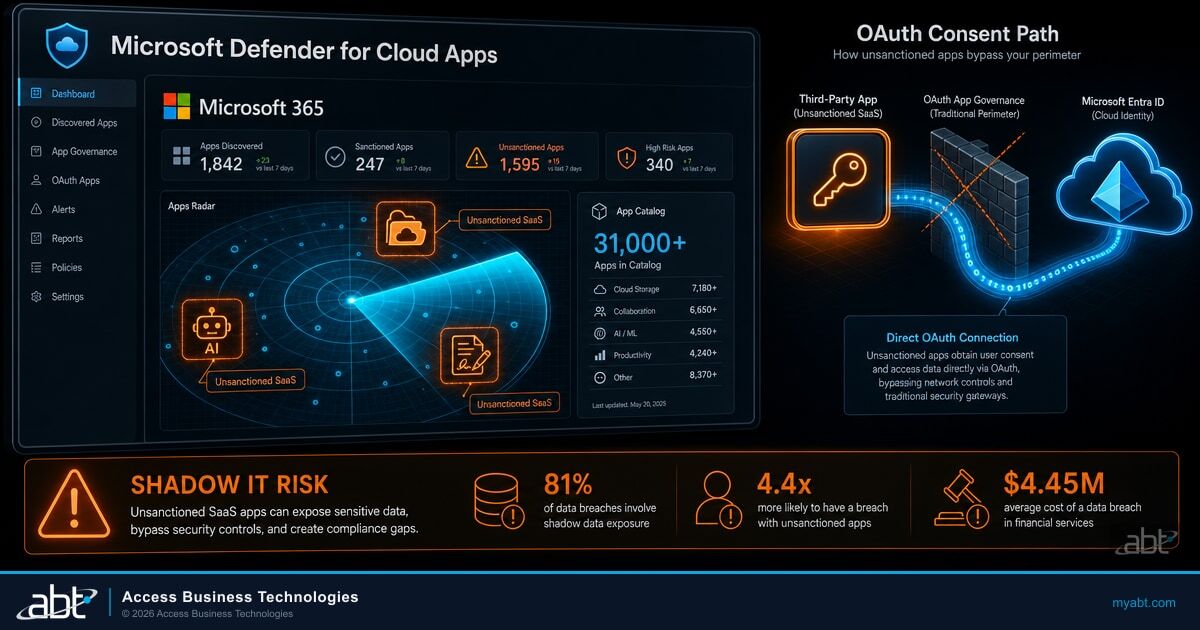
In August 2025, Marquis Software Solutions, a fintech vendor serving more than 700 banks and credit unions, was breached through a SonicWall firewall vulnerability. Attackers accessed data from 74 financial institutions, exposing 788,000 individuals' Social Security numbers, account details, and taxpayer IDs. Notification took nearly four months. The banks' own systems were never compromised. Their vendor's supply chain failed. If a specialized financial services vendor can suffer that kind of breach, a generic MSP with commodity tools and no banking-specific tenant configuration is carrying greater risk on a community bank's behalf.
The Convergence Advantage: One Partner Instead of Four
Most community banks buy IT services piecemeal. Microsoft licensing from one vendor. Managed IT support from a second. Cybersecurity monitoring from a third. Compliance consulting from a fourth. Each vendor knows its own piece. None of them knows the whole picture. The fragmented approach creates gaps that no individual vendor is responsible for filling. The licensing reseller does not know how the security settings affect compliance. The security vendor does not understand how the core banking integration works. The compliance consultant recommends policies the MSP does not know how to implement inside Microsoft 365.
A Tier-1 Direct-Bill CSP running the M365 Guardian operating model eliminates these gaps by owning the entire stack: licensing, tenant management, security configuration, monitoring, and compliance readiness, from a single partner that understands how each layer affects the others.
- One partner for the examiner to evaluate. Instead of mapping security controls across four vendors, the examiner reviews one relationship with one SOC 2 Type II report and one comprehensive set of documentation.
- No accountability gaps. When a security policy conflicts with a core banking integration, one team owns the problem. There is no finger-pointing between the MSP and the security vendor.
- Faster incident response. The team investigating the incident is the same team that built the tenant baseline, runs the SOC, and understands the regulatory notification requirements. No handoffs between vendors during a crisis.
- License posture tied to actual security posture. A Tier-1 partner can identify which employees need Microsoft 365 E5 security features versus Business Premium, because the partner sees the compliance requirements alongside the licensing portfolio.
A banking organization can be exposed to adverse impacts, including substantial financial loss and operational disruption, if it fails to appropriately manage the risks associated with third-party relationships.
OCC, FDIC, Federal Reserve Joint Interagency Guidance on Third-Party Relationships, June 2023
How to Evaluate Whether Your IT Provider Is Actually Tier-1
"Tier-1" is a specific Microsoft designation, not a marketing claim. Five questions filter the partner field for a community bank.
If they say yes, ask to see their Microsoft Partner Center page showing the Direct-Bill authorization. Tier-2 Indirect Resellers and non-CSP MSPs cannot show it. A Tier-1 partner can produce the Partner Center listing in the same meeting.
Tier-1 Direct-Bill CSPs hold partner-side Microsoft support agreements that provide direct escalation to Microsoft engineering. If the provider routes through standard customer support queues, they are not operating at Tier-1.
Not Type I. Type II verifies controls over a sustained period, and banking examiners look for it during third-party vendor reviews. If the provider does not have one, the examiner will flag it under the 2023 Interagency Guidance.
Names, not numbers. If the bank would be the partner's first or second financial institution, the partner lacks the examination experience and regulatory fluency the institution actually needs to walk into an exam clean.
A partner with banking experience can describe how specific services address each handbook booklet and each NIST CSF 2.0 function. A generic MSP will say they "follow best practices."
An OCC examiner opens a cycle examination. The examiner asks for Conditional Access policy configuration, DLP rule effectiveness reports, audit log retention, and the SOC 2 Type II report for the IT vendor. The MSP cannot produce documentation that traces specific Microsoft 365 controls to FFIEC handbook references. The bank's compliance officer assembles screenshots by hand. The examination stretches into a second sweep. The bank receives a finding for inadequate third-party vendor oversight.
The same examination opens. ABT produces the tenant configuration baseline, the Conditional Access policy export, the Purview DLP and retention configuration, the audit log retention proof, and the partner SOC 2 Type II report on demand. The compliance officer hands the package to the examiner. The exam closes on time. The bank has no IT finding on this surface.
Get a Microsoft 365 Tier-1 CSP Posture Review
ABT runs the Tier-1 Direct-Bill CSP and M365 Guardian operating model described in this article for community banks and credit unions managing Microsoft 365 at scale. A 30-minute conversation maps the bank's current tenant configuration, surfaces the gaps the next examiner is most likely to find, and outlines what an ABT-managed Tier-1 relationship would cover. No commitment, no quote, no obligation.
Key Takeaway
Microsoft 365 is the licensing baseline that every community bank already runs on. The structural difference between a generic MSP and a Tier-1 Direct-Bill Cloud Solution Provider is the partner-side tenant management layer Microsoft only grants to Tier-1 partners. M365 Guardian is the operating model ABT layers on top of that license stack, with banking-tuned configuration, continuous posture monitoring, and 24x7 security operations center coverage. The Tier-1 Direct-Bill CSP relationship is the structural difference that makes the operating model work, and it is the cleanest available route to consistent application of the Microsoft Entra ID, Intune, Defender, Purview, and Sentinel controls that map directly to FFIEC, OCC, FDIC, and NCUA examination expectations.
Frequently Asked Questions
A Tier-1 Direct-Bill Microsoft Cloud Solution Provider is a partner that transacts directly with Microsoft as the partner of record, holds dedicated Microsoft support engineers, and is operationally accountable to Microsoft for how customer tenants are configured and operated. The Direct-Bill designation is Microsoft's top program tier within the CSP program. Tier-2 Indirect Resellers transact through a distributor and do not hold the partner-side reporting access, the direct Microsoft escalation path, or the Microsoft 365 Lighthouse multi-tenant control plane access that Tier-1 partners hold.
Community banks depend on Microsoft 365 for daily operations and face regulatory examination of their IT controls by the OCC, FDIC, or state banking departments. A Tier-1 Direct-Bill CSP holds direct access to Microsoft engineering for incident escalation, operates at the scale Microsoft uses to validate operational maturity, and meets Microsoft's own security and operational standards as the partner of record. During platform outages and security incidents, a Tier-1 partner moves at minutes instead of hours, which is the response time examiners and the OCC computer-security incident notification rule expect.
Microsoft 365 is the licensing baseline. M365 Guardian is the operating model ABT runs on top of it as the Tier-1 Direct-Bill CSP partner of record. Direct purchase from Microsoft delivers the licenses. The Guardian operating model adds three concrete disciplines: a banking-tuned configuration baseline applied to Microsoft Entra ID, Microsoft Intune, Microsoft Defender, and Microsoft Purview from day one, continuous posture monitoring as Microsoft adds, retires, and rebundles capabilities, and 24x7 security operations center coverage on the Defender, Sentinel, and Entra ID Identity Protection signals coming out of the tenant. The community bank keeps its Microsoft 365 licensing and retains its tenant ownership. Guardian is the partner-side operating layer that ties everything together.
Ask the provider to show the Microsoft Partner Center page confirming Direct-Bill CSP authorization, the Microsoft Solutions Partner designation, and the partner-side support contract that provides direct escalation to Microsoft engineering. The Microsoft Partner Directory also lists capabilities and designations for verification. A legitimate Tier-1 Direct-Bill CSP will produce this information in the first meeting, because the partner invested significantly to earn and maintain the status and uses it as a competitive differentiator with banking buyers.
A CSP (Cloud Solution Provider) is a Microsoft designation that determines how a partner purchases, supports, and administers Microsoft 365 on behalf of customer tenants. An MSP (Managed Service Provider) is a broader term for any company that manages IT infrastructure. Most generic MSPs are not CSPs at all, or they are Tier-2 Indirect CSPs who buy licenses through a distributor. A community bank ideally wants a partner that is both a Tier-1 Direct-Bill CSP and a managed services partner with deep financial services expertise. The combination gives the bank Microsoft engineering escalation, partner-side tenant management, banking-aware configuration, and continuous compliance posture in one relationship.
A community bank's IT partner should demonstrate fluency with the FFIEC IT Examination Handbook, the NIST Cybersecurity Framework 2.0 (which examiners now reference after FFIEC retired the Cybersecurity Assessment Tool in 2025), the GLBA Safeguards Rule, OCC Third-Party Risk Management guidance, FDIC examination procedures, and applicable state banking department requirements. The partner should also understand the 2023 Interagency Guidance on Third-Party Relationships issued jointly by the OCC, FDIC, and Federal Reserve, which establishes expectations for how banks manage critical vendor relationships including their IT partner.
Yes. ABT is the largest Tier-1 Direct-Bill Microsoft Cloud Solution Provider primarily dedicated to financial services. ABT manages Microsoft 365 tenants for more than 750 financial institutions, including community banks, credit unions, mortgage companies, broker-dealers, and securities firms. As a converged partner, ABT delivers Microsoft licensing, partner-side tenant management under delegated admin, M365 Guardian operating model, managed IT, 24x7 SOC, and continuous compliance readiness through a single relationship. ABT holds SOC 2 Type II attestation and has supported financial institutions through regulatory examinations since 1999.