

In This Article
Automation has reduced mortgage processing errors by 35% for lenders who deploy it well. But plenty of teams see the opposite result. They invest in automation, flip the switch, and watch errors spike, compliance flags multiply, and staff revert to manual workarounds within weeks.
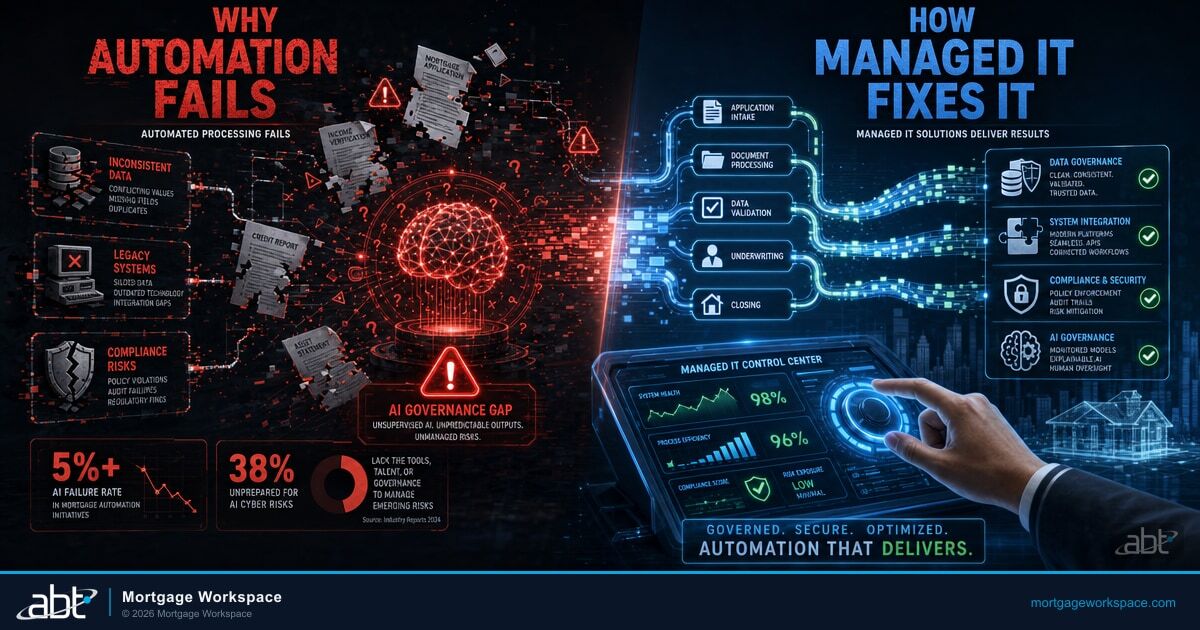
The problem is rarely the software. It is how data flows between systems, how legacy platforms connect (or do not), and whether the automation gets the ongoing technical support it needs. And now there is a new failure mode that most financial institutions have not addressed: AI-driven decisioning operating without governance frameworks. This article breaks down where automated mortgage processing fails and how managed IT services fix the root causes.
Why Automated Mortgage Processing Falls Short
Even with the right tools in place, automation does not always deliver. Several practical challenges block results, especially when systems are not aligned with how teams actually work.
Inconsistent Data Structures
Automation requires structured, uniform data. Mortgage lending produces the opposite. Income statements, credit reports, scanned forms, and borrower-uploaded documents arrive in dozens of formats with missing fields and inconsistent naming.
Rocket Mortgage faced this problem at scale, processing over 1.5 million documents per month with data so fragmented that their automation tools could not deliver accurate results until they rebuilt their data pipeline. Without clean inputs, even sophisticated automation produces unreliable outputs.
Legacy System Incompatibility
Many lenders still run software that was never built for modern automation. These systems operate in isolation. Data cannot flow between departments or tools. The result: delays, duplicate work, and a higher error rate than manual processing.
McKinsey research shows that more than half of front-to-back mortgage processes could be automated, but many originators still rely on labor-intensive fulfillment because their legacy systems cannot support end-to-end workflows.
This is the broken-interface root cause. The loan origination system stores one version of borrower truth. The core banking platform stores another. The servicing system holds a third. Document management sits in a fourth silo. Every "automation" project on top of that footprint is really an attempt to keep four data stores in sync by hand, by spreadsheet, or by brittle point-to-point integrations that break the next time a vendor pushes an update. ABT built MortgageExchange to be the integration spine that eliminates that root cause. MortgageExchange is the custom interface layer connecting LOS platforms (Calyx Point, Encompass, Path) to core banking systems (Fiserv DNA, Symitar Episys, Jack Henry, iCORE 360) and to the ancillary servicing, document management, and reporting systems lenders already run. Instead of four broken interfaces, the lender gets one operational spine, owned and maintained by ABT, that moves loan data cleanly across the entire pipeline and gives downstream automation a single trustworthy source to read from. For ABT's fuller take, see Overcoming Data Silos: How Chevron FCU Built a Core-Connected Ecosystem.
Evolving Compliance Requirements
Mortgage regulations change frequently. The CFPB updates data collection requirements. States like New York pass new consumer protection laws. Fannie Mae recently updated its Selling Guide with stricter information security requirements effective August 2026, including a 36-hour breach notification mandate. The Homebuyers Privacy Protection Act, passed in September 2025 and effective March 4, 2026, restricts how lenders can access and use consumer credit information for marketing.
Automation that is not actively maintained to reflect these changes becomes a liability. Outdated compliance rules in automated workflows create audit risk faster than manual processes do.
No Flexibility for Exception Cases
Automation handles repetitive, predictable workflows well. But mortgage applications involve borrowers with irregular income, missing documents, or unique property types. Without exception handling built into the system, those cases get pushed back to manual review. That defeats the purpose.
Map Your LOS-to-Core Integration Gaps
A 30-minute conversation with ABT covers your current LOS, core banking platform, servicing system, and document store. We outline where MortgageExchange would eliminate duplicate data entry and what an ABT-managed Microsoft 365 footprint would cover on top.
The AI Governance Gap: A New Failure Mode
The four failure modes above are infrastructure problems with known solutions. AI-driven decisioning introduces a different category of failure altogether. Two-thirds of mortgage lenders are now using or testing AI tools, according to HousingWire's 2026 research. But only a fraction have the digital foundation to scale it responsibly. That gap between adoption and governance is where the next generation of processing failures will originate.
Massachusetts reached a $2.5 million settlement with a lending company in 2025 for using AI models to make lending decisions that violated consumer protection and fair lending laws. The settlement required implementation of a detailed corporate governance structure for AI oversight. This was not a warning. It was an enforcement action with financial consequences.
AI governance failures in mortgage processing fall into three categories that traditional IT infrastructure monitoring does not catch.
Model validation gaps. When a lender deploys an AI tool for document classification, income verification, or risk scoring, that model needs initial validation and ongoing monitoring. The OCC and FDIC apply their existing model risk management guidance (SR 11-7 / OCC 2011-12) to AI systems. Yet many lenders adopt vendor AI models without independent validation, without understanding what data the models use, and without scheduled re-validation cycles. The model works until it does not, and nobody has defined what "not working" looks like until regulators or borrowers discover it.
Fair lending blind spots. AI models trained on historical lending data inherit the biases embedded in that data. The CFPB has stated clearly: "There are no exceptions to the federal consumer financial protection laws for new technologies." When an AI model denies an application, ECOA requires specific reasons in the adverse action notice. Many AI models cannot generate those reasons accurately because the interaction effects between variables are opaque. Lenders using AI for any part of the decisioning chain need continuous disparate impact testing, not annual reviews.
"In 2026, AI governance will shift from high-level principles to practical execution. Firms without clear ownership, visibility and controls around AI will face heightened compliance risk."
Smarsh, 2026 Regulatory and Compliance PredictionsAgentic AI without boundaries. The newest risk is agentic AI systems that make autonomous decisions and chain actions together without human checkpoints. Unlike rule-based automation that stops when it encounters an exception, agentic AI improvises. Research shows that banks with higher AI intensity incur greater operational losses than their less AI-intensive counterparts, driven by external fraud, client disputes, and system failures, according to the Federal Reserve Bank of Richmond. A single compromised AI agent can poison 87% of downstream decision-making within four hours, according to FinRegLab research. In a mortgage pipeline, that means flawed risk assessments feeding into underwriting, pricing, and compliance systems before anyone notices.
Freddie Mac recognized this gap. Bulletin 2025-16, effective March 3, 2026, requires mortgage sellers to operate a living, risk-based AI governance program with continuous monitoring, defined accountability, and alignment with established security standards. This is not a suggestion. It is a compliance requirement for every lender selling to Freddie Mac. See the full Freddie Mac AI mandate compliance checklist.
How Managed IT Services Fix These Problems
Most lenders cannot tackle these challenges alone. Managed IT services fill the technical gaps and make sure automation works the way teams need it to.

For ABT customers, that managed IT framework lands as three connected products on top of the Microsoft 365 tenant ABT manages. MortgageExchange is the integration spine that keeps LOS, core, servicing, and document data in sync so downstream automation reads from one trustworthy source. Mortgage BI is the visibility layer that turns the pipeline into dashboards loan officers, processors, and executives actually use, so the lender sees pipeline health, processing bottlenecks, and exception volume in real time rather than reconstructing it from spreadsheets after month-end. And M365 Guardian is ABT's operating model on top of Microsoft Entra ID, Microsoft Purview, Microsoft Intune, Microsoft Defender, and Microsoft Sentinel that handles the security, identity, and governance side, including the AI governance scaffolding that Freddie Mac Bulletin 2025-16 now requires. Integration spine, visibility, and security and governance arrive as one managed pattern, not three separate vendor relationships.
Data Consistency and System Integration
Managed IT teams prepare the data before feeding it into automation. They clean up messy inputs, set consistent formats, and build integration layers that connect older systems to modern tools. Lenders using integrated platforms report a $1,056 increase in gross profit per loan and a 20% improvement in client satisfaction, according to industry data.
73% of lenders have now adopted AI or ML tools for compliance and anomaly detection. A managed IT partner ensures those tools talk to each other and to the LOS, CRM, and document management systems already in place.
Ongoing Compliance Management
Managed IT providers monitor regulatory changes and apply system updates to keep automation compliant. Whether it is adjusting workflows for new state-level disclosures or implementing enhanced data privacy protocols, IT teams prevent automation from falling out of step with legal requirements.
They also document every step of the mortgage process for audit readiness. That documentation reduces the operational burden on compliance teams and creates defensible records if regulators ask questions.
AI Model Governance and Oversight
This is the gap most lenders cannot fill internally. Managed IT partners with financial services experience can implement the governance layer that AI tools require: model inventories documenting every AI system in use, validation schedules aligned with OCC and FDIC expectations, bias monitoring with regular disparate impact analysis, and agentic AI boundary controls that define which decisions require human approval. Without this governance layer, AI automation creates more risk than it eliminates.
Resilient Automation for Real-World Cases
IT partners help lenders customize automation to handle a broader range of scenarios. That includes setting up exception rules, deploying intelligent document tools that extract key information from non-standard formats, and training systems to identify missing data. This connects closely to Rewriting the Rules.
Instead of stopping when something looks different, the system adapts. This keeps the pipeline moving without constant manual intervention.
Monitoring and Proactive Support
Managed IT provides continuous oversight of automation performance. Real-time monitoring catches integration failures, performance degradation, and data quality issues before they affect borrowers. Proactive support reduces downtime and keeps workflows running during peak processing times.
What Successful Automation Looks Like
Commercial Bank of Texas: Eliminating Duplicate Data Entry
Commercial Bank of Texas managed loan data across Calyx Path and iCORE 360 without a direct connection. Staff entered the same information twice, increasing errors and slowing processing. ABT built a direct integration using MortgageExchange that automated data transfer between systems. Teams spent less time on manual tasks and maintained cleaner records.
Alpha Mortgage: Streamlining Appraisal Management
Alpha Mortgage managed a panel of 60+ appraisers through manual processes. Coordinating requests, tracking progress, and managing updates consumed hours daily. After deploying automation with proper IT support, the team reduced administrative overhead and shortened turnaround times across the appraisal workflow.
Interfirst Mortgage: 67% Faster Closing Packages
Interfirst Mortgage's closing process was slowed by document volume and complexity. Automation tools handled classification and data extraction, but the IT team's role in integrating those tools into daily workflows made the difference. Processing times dropped 67%, and data accuracy improved across the board.
Next Steps for Mortgage Lenders
Automated mortgage processing works when it is built on clean data, integrated systems, continuous IT support, and proper AI governance. Without those foundations, automation underperforms or creates new categories of risk.
Start with an honest assessment of your current state. Where does data get re-entered? Which systems do not talk to each other? Where do exception cases create bottlenecks? And critically: which AI tools are operating in your mortgage pipeline, and who is responsible for governing them? Those answers define the roadmap.
ABT runs MortgageExchange as the LOS-to-core integration spine, Mortgage BI as the pipeline visibility layer, and M365 Guardian as the security and governance operating model on the Microsoft 365 tenant ABT manages. Together they are the managed IT pattern ABT delivers for 750+ financial institutions, including dozens of independent mortgage banks and community banks running mortgage operations. Talk to a mortgage IT specialist about wiring the same pattern into your shop.
Wire MortgageExchange, Mortgage BI, and M365 Guardian Into Your Shop
ABT manages the Microsoft 365 tenant, runs MortgageExchange as the LOS-to-core integration spine, layers Mortgage BI for pipeline visibility, and runs M365 Guardian for security and governance. A 30-minute conversation maps your current footprint and outlines what an ABT-managed deployment would cover.
Frequently Asked Questions
Inconsistent data formats, legacy system incompatibility, outdated compliance rules, rigid exception handling, and AI governance gaps are the most common causes. Automation requires clean inputs, connected systems, ongoing maintenance, and proper model oversight to deliver results. Without managed IT support, these gaps cause errors and compliance risk that manual processes avoid.
Managed IT services clean and standardize data inputs, integrate legacy and modern systems, apply regulatory updates to automated workflows, build exception handling rules, implement AI governance frameworks, and provide real-time monitoring. Lenders with integrated systems report 20 percent higher client satisfaction and over $1,000 more gross profit per loan compared to those running disconnected platforms.
Two-thirds of mortgage lenders are using or testing AI, but only a fraction have governance frameworks in place. This means AI models are making lending decisions without proper validation, bias monitoring, or defined accountability. Freddie Mac Bulletin 2025-16, effective March 2026, now requires sellers to operate a risk-based AI governance program with continuous monitoring and formal controls. Lenders without these frameworks face both compliance risk and operational failures.
Smaller lenders often benefit the most because they lack in-house technical teams. A managed IT partner provides access to system integration, compliance monitoring, AI governance, and automation expertise without the cost of building a dedicated internal team. The result is enterprise-grade automation at a fraction of the overhead.
Most lenders see improvements in processing time, data accuracy, and system stability within the first few weeks. Full integration projects connecting LOS, CRM, and compliance tools typically take two to twelve weeks depending on complexity. AI governance framework implementation takes four to eight weeks. Quick wins like data cleanup and API connections deliver immediate ROI while larger projects build toward long-term efficiency gains.
MortgageExchange is ABT's custom interface layer that connects loan origination systems like Calyx Point, Encompass, and Path to core banking platforms like Fiserv DNA, Symitar Episys, and Jack Henry, plus servicing, document management, and reporting systems. Most automation projects fail because four or five data stores are kept in sync by hand or by brittle point-to-point integrations that break with every vendor update. MortgageExchange replaces that fragility with one operational spine that ABT owns and maintains, so downstream automation reads from a single trustworthy source rather than reconciling four versions of borrower truth.
Freddie Mac Bulletin 2025-16, effective March 3, 2026, requires mortgage sellers to operate a living, risk-based AI governance program. This includes continuous monitoring of all AI and ML systems used in mortgage operations, defined accountability with assigned ownership, formal controls aligned with established security standards, and documentation sufficient for regulatory examination. Sellers without these governance frameworks in place risk non-compliance findings during Freddie Mac reviews. ABT delivers that governance scaffolding through M365 Guardian, the firm's operating model on top of Microsoft Entra ID, Microsoft Purview, Microsoft Intune, Microsoft Defender, and Microsoft Sentinel.