
In This Article
- Why Data Silos Cost More Than You Think
- The Integration Challenge at Chevron FCU
- Building a Unified Solution with MortgageExchange
- What Changed After MortgageExchange
- The Core-to-Servicing Gap: Where Most Credit Unions Break
- Security and Compliance Architecture
- Building a Core-Connected Ecosystem
- How ABT and MortgageExchange Serve Credit Unions
- Frequently Asked Questions
Chevron Federal Credit Union serves 138,393 members and manages more than $5 billion in assets. It operates branches across multiple states and runs under several brand names. By any measure, this is a credit union with serious technology needs. And until recently, those needs were met by systems that worked well individually but refused to talk to each other.
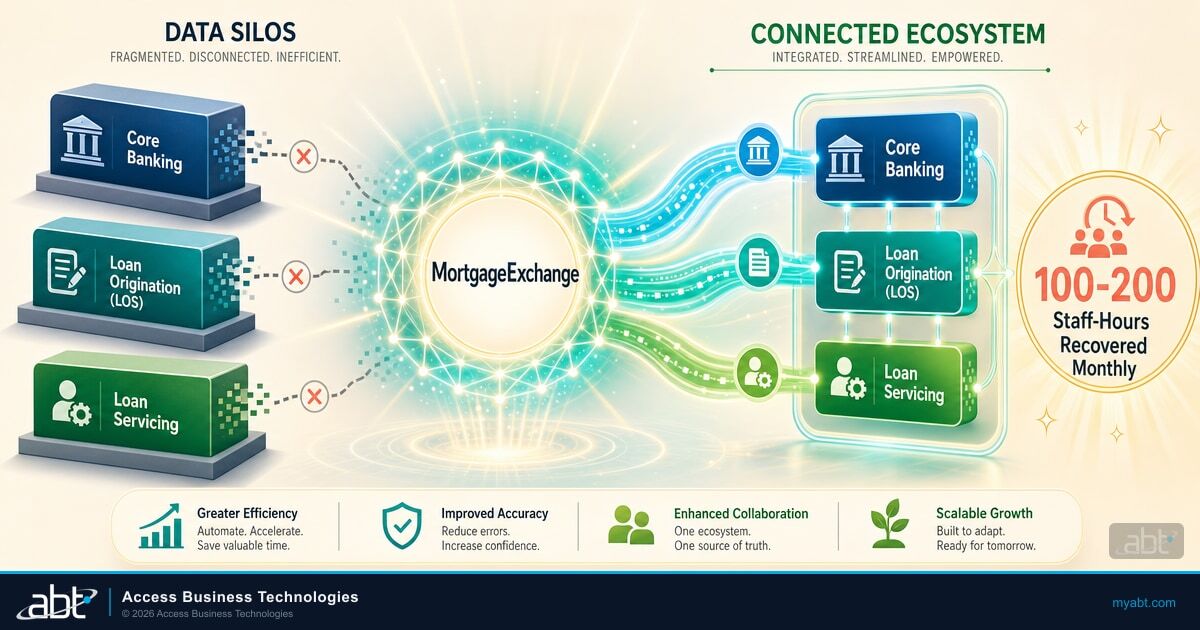
The Jack Henry Symitar core handled accounts. The Blue Sage loan origination system processed mortgage applications. Finastra Servicing Director managed post-closing. But none of these platforms shared data automatically.
Every mortgage that closed triggered a manual chain reaction. Staff re-keyed borrower details from the LOS into the core. They re-entered loan terms into the servicing platform. They reconciled discrepancies when fields didn't match. When something went wrong, the error propagated silently until someone caught it days later during a reconciliation pass.
Why Data Silos Cost More Than You Think
The visible cost of disconnected systems is staff time: people re-keying data between screens instead of serving members. But the hidden costs run considerably deeper.
Error remediation. When a mortgage application gets approved in Blue Sage and an employee manually enters the loan details into Symitar, every field is a typo opportunity. One wrong digit in an escrow calculation cascades into payment miscalculations that take hours to untangle. Multiply that across hundreds of loans per month and the remediation burden becomes a significant line item on any operations budget.
Compliance exposure. NCUA examiners expect consistent data across systems. When the core shows one loan balance, the LOS shows another, and servicing shows a third, the credit union has an examination finding. Those findings consume management attention, trigger remediation plans, and invite deeper scrutiny on the next cycle. The NCUA's 2026 supervisory priorities continue to emphasize data integrity and internal controls, with examiners reviewing credit unions' procedures for ensuring separation of duties across interconnected systems.
Member experience gaps. When a member calls to ask about their mortgage payment and the call center pulls up stale data because the servicing system hasn't been updated yet, the member loses confidence. In a market where online lenders provide real-time dashboards, that kind of lag erodes the relationship credit unions depend on.
The 2025 Jack Henry FinXTech Credit Union Survey surveyed technology leaders across institutions of all sizes and found that 58% identified integrating new technology with existing systems as their single biggest challenge. More than 700 credit unions run on Jack Henry's Symitar platform alone. The more systems a credit union adds, the more fragile the manual connections between them become.
The Integration Math Problem
Five systems produce ten possible point-to-point connections (n × (n-1) / 2). Each of those connections requires its own API maintenance, error handling, monitoring, and vendor-compatibility testing as updates roll out. A three-person IT team at a $5-billion credit union is not resourced to maintain ten independently managed integrations. The math argues for a hub.
The Integration Challenge at Chevron FCU
Chevron FCU's multi-platform environment made the integration problem acute. The credit union ran:
- Jack Henry Symitar for core banking: member accounts, deposits, and general ledger.
- Blue Sage for loan origination: mortgage applications from intake through closing.
- Finastra Servicing Director for post-closing: loan servicing, payment processing, and escrow.
- Fiserv wire transfer modules for fund movement.
- MeridianLink for account opening and membership changes.
None of these systems were designed to work together natively. Symitar doesn't have a built-in integration with Blue Sage. Blue Sage doesn't automatically board loans into Servicing Director. Each connection required custom mapping, field validation, and ongoing maintenance as vendors pushed updates.
Credit unions that try to solve this with point-to-point bridges (a direct connection between each pair of systems) run into the same math problem every time. Five systems produce ten possible connections. Each connection needs its own error handling, its own API maintenance, its own troubleshooting when something breaks at 2 a.m. And the credit union's IT team, often three to five people at institutions under $10 billion in assets, becomes responsible for maintaining all of it.
Chevron FCU's leadership knew this fragmentation was holding the institution back. Post-closing operations were particularly painful: after loans closed, boarding them to the servicing platform was a slow, manual affair that risked mismatched records and missed details. The credit union needed a unified approach that could bridge all of its disparate systems and create a cohesive data ecosystem.
The challenge isn't unique. That same Jack Henry 2025 survey found that 49% of credit unions reported at least one technology initiative falling short in the prior 18 months, with integration issues among the leading causes alongside insufficient vendor support and long implementation timelines. Institutions that had invested in upgrading individual platforms were still struggling because the connections between those platforms remained manual.
Building a Unified Solution with MortgageExchange
To eliminate these silos, Chevron FCU turned to MortgageExchange from Access Business Technologies. MortgageExchange is a cloud-managed integration platform designed to connect LOS, core banking, servicing, and ancillary systems through rules-based data routing. It serves as the data backbone that Chevron's infrastructure was missing.
Chevron FCU implemented MortgageExchange to bridge Symitar with Blue Sage, creating a two-way data exchange between the core and the LOS. This rules-driven approach means that once a loan application is approved or funded in Blue Sage, the relevant data (loan terms, member details, escrow calculations) automatically flows into Symitar without any human re-keying. Member information from the core propagates to the LOS as needed, keeping both systems in sync. The integration is configured with business rules to ensure data goes to the right fields and triggers at the right times, replacing what used to be swivel-chair copy-paste work with validated automation.

Core-to-Servicing Integration
Chevron FCU didn't stop at the core-to-LOS connection. The credit union extended MortgageExchange to the servicing layer and beyond. In a parallel project, Chevron linked Finastra's Servicing Director with Blue Sage through MortgageExchange, so new mortgages board into the servicing system at the moment of closing, with no manual intervention. The credit union also used MortgageExchange to connect the Fiserv wire transfer module, ensuring every critical banking platform became part of one unified data network.
The fact that MortgageExchange handles multiple integrations from a single platform matters. Each connection addresses a specific data exchange need, from core accounting entries to servicing onboarding, all through one centralized service maintained by ABT. When a vendor releases an update that changes an API endpoint or field name, ABT handles the connector maintenance. Chevron FCU's IT team doesn't troubleshoot it.
Chevron FCU's approach parallels what other credit unions have found when tackling similar multi-system complexity. CFCU Community Credit Union eliminated its own mortgage data disconnect through a comparable hub-and-spoke architecture, moving post-closing from a batch reconciliation process to real-time boarding. The underlying logic is consistent across credit unions: manual data movement between systems is a liability, not a workflow.
What Changed After MortgageExchange
After deploying MortgageExchange, the difference at Chevron FCU was immediate. Data now moves between the core, lending, and servicing systems in real time, eliminating the lag that previously plagued operations. The credit union no longer needs duplicate input across platforms. The integration handles it automatically.
This has led to fewer errors and inconsistencies, since there's no opportunity for typos or stale information when everything updates through validated channels. MortgageExchange provides what Chevron's staff describe as effortless data transfers: no manual input, no cross-checking, no afternoon spent hunting down a miskeyed field.
One immediate improvement showed up in post-closing operations. The moment a loan closes, all relevant details are already in the servicing system and core without delays or transcription mistakes. The servicing team engages members right away with confidence that the data is accurate. No more chasing down missing fields or correcting errors days after closing.
Operational Efficiency
The most visible change was the elimination of duplicate data entry. Staff who previously spent 30 to 60 minutes per loan re-keying information across platforms redirected that time to member service, exception handling, and pipeline management. For a credit union processing 200 loans per month, that represents 100 to 200 staff-hours recovered monthly. Those hours compound across a full year: up to 2,400 hours that the operations team reallocates to work that actually requires human judgment.
Data Accuracy
When data moves through validated channels instead of human keystrokes, error rates drop sharply. Every transfer passes through MortgageExchange's mapping and validation rules before reaching the destination system. If a field is missing or a value falls outside policy parameters, the platform flags it in real time rather than letting it propagate silently. Errors that used to surface days after closing now get caught at the source, before they reach the servicing platform.
Audit Readiness
Every data transfer is logged with timestamps, source and destination fields, and validation results. When NCUA examiners ask how a specific value moved from origination to servicing, Chevron FCU produces an integration log instead of relying on staff testimony. This automated audit trail reduces exam prep time and lowers the risk of findings related to inconsistent records.
The 2026 NCUA examination cycle places heightened emphasis on payment systems security and data integrity governance. Examiners are evaluating not just whether records are accurate, but whether institutions can demonstrate how those records were produced and who had access to modify them. Credit unions with manual data-transfer workflows struggle to answer that question cleanly. Institutions with logged, rule-governed integration flows answer it with documentation.
Scalability
Because MortgageExchange runs on cloud infrastructure managed by ABT, it scales with loan volume without the credit union standing up new servers or hiring additional IT staff. When Chevron adds a new platform (a document management system, a CRM, a compliance tool), it connects once to MortgageExchange. The hub-and-spoke architecture means adding a system is an incremental effort, not a re-architecture project. The tenth connection costs the same as the first.
See how Thrivent FCU connected four major platforms without building point-to-point integrations: Thrivent FCU: From Four Great Systems to One Orchestrated Flow
The Core-to-Servicing Gap: Where Most Credit Unions Break
If there's one integration that delivers outsized returns, it's the connection between the LOS and the servicing platform. Post-closing operations are where most credit unions still rely on manual processes. After a loan closes, someone generates a boarding file, someone else validates it, and someone transfers it to the servicing system. This often happens in batch cycles (once a day or once a week), which means new loans sit in limbo while members wait for their first payment details.
What Batch Processing Actually Means for Borrowers
When a credit union runs daily batch boarding, a mortgage that closes at 4 p.m. on a Tuesday may not appear in the servicing system until Wednesday morning at best. If the batch fails validation, the boarding gets deferred until Thursday. Meanwhile, the member is trying to confirm their first payment amount, and the member services team has nothing to show them. That gap is preventable.
With MortgageExchange handling the LOS-to-servicing connection, boarding happens at the moment of closing. The servicing team gets a validated package with correct loan terms, escrow details, and member information. No waiting for batch runs. No chasing missing fields. No correcting transcription errors three days after closing.
For members, this means faster access to their loan information, accurate first payment details, and a smoother transition from the closing table to ongoing servicing. For staff, the post-closing queue shrinks from a daily fire drill to a monitoring task. For compliance teams, the timestamp on every boarding event provides a defensible audit record that manual batch processes cannot produce.
First Citizens Bank's mortgage integration team encountered this same friction at scale when connecting Empower to Phoenix through MortgageExchange. Their LOS-to-servicing integration eliminated boarding delays that had been slowing post-closing efficiency across their mortgage division. The underlying problem and the solution were consistent with what Chevron FCU addressed: batch processes are a liability that real-time integration eliminates.
Security and Compliance Architecture
Financial data moving between systems creates security surface area. MortgageExchange addresses this by encrypting data in transit and at rest, running on bank-grade cloud infrastructure with SOC 2 compliance, and maintaining access controls that limit which systems can read and write which fields.
For credit unions subject to NCUA examination, GLBA requirements, and state-level data protection regulations, having a centralized integration layer simplifies the compliance picture. Instead of auditing ten point-to-point connections with different security configurations, the credit union audits one platform with a consistent security model.
Credit unions operating on Microsoft Azure infrastructure benefit from the same bank-grade compliance posture that governs enterprise financial services worldwide. Azure's SOC 2 Type II, ISO 27001, and FedRAMP authorizations satisfy the NCUA's third-party risk management requirements for cloud-hosted integration platforms. ABT, as a Tier 1 CSP, manages MortgageExchange on Azure infrastructure and maintains the vendor oversight documentation that examiners review under the NCUA's 2026 supervisory framework.
Source: Microsoft Azure Compliance Documentation; NCUA 2026 Supervisory Priorities (vendor and third-party risk management)
The NCUA's 2026 examination cycle reflects a significant shift in how examiners evaluate technology governance. Payment systems security has emerged as a top priority, with examiners assessing governance frameworks, vendor oversight, and security controls across all platforms that touch member data. The agency's OIG identified AI implementation as one of its top management and performance challenges for 2026, requiring credit unions to demonstrate that technology adoption is matched by governance capability. Board-level cybersecurity briefings are now an examination requirement, with documentation of annual training expected as standard.
Credit unions with manual integration workflows face a specific vulnerability under this framework. When data moves between systems via spreadsheets, FTP transfers, or staff-initiated batch files, the audit trail is whatever staff recorded manually. When data moves through MortgageExchange, the platform generates a timestamped, field-level log of every transfer that examiners can verify independently. The compliance question shifts from "can you show us what happened" to "here is the log."

Building a Core-Connected Ecosystem
The broader lesson from Chevron FCU isn't about any single integration. It's about the architectural decision to treat connectivity as a managed service rather than a collection of one-off projects.
Credit unions that build core-connected ecosystems share three characteristics:
- They connect the core first. The core banking platform is the hub. Everything else (LOS, servicing, account opening, compliance tools) connects through MortgageExchange to the core. This creates a single source of truth for member data.
- They treat integration as an operating expense, not a capital project. One-time integration projects decay as vendors push updates. MortgageExchange maintains connectivity continuously as a managed service, with ABT absorbing connector maintenance as part of the engagement.
- They plan for the next system, not just the current ones. A hub-and-spoke architecture makes adding new platforms incremental instead of exponential. The tenth connection costs the same as the first.
This shift in architecture philosophy has tangible downstream effects. Credit unions that built point-to-point connections five years ago are now maintaining integrations that break every time a vendor pushes a major update. Those that moved to hub-and-spoke models with ABT managing the connectors have effectively outsourced that maintenance burden permanently.
Key Takeaway
- Manual data entry between mortgage systems costs 30 to 60 minutes per loan
- 58% of credit union technology leaders name system integration as their top challenge (Jack Henry 2025 FinXTech)
- Real-time boarding eliminates the batch-processing delays that leave members without accurate first payment details
- NCUA 2026 examiners expect timestamped, auditable records of how data moved between systems
- A hub-and-spoke model reduces 10 point-to-point connections to one managed integration layer
For credit unions still running swivel-chair processes between disconnected platforms, the path forward starts with an honest inventory: how many systems hold member data, how many staff hours go to manual transfers, and what the error remediation costs look like. That inventory usually makes the business case self-evident.
How ABT and MortgageExchange Serve Credit Unions
Access Business Technologies is a cloud-first managed service provider and Tier 1 Microsoft CSP serving more than 750 financial institutions. ABT's MortgageExchange platform connects LOS, core banking, servicing, and account-opening platforms through rules-based middleware, with ongoing monitoring, connector maintenance, and vendor compatibility management included.
If your credit union is managing data flow between disconnected systems with manual processes, the integration case looks similar regardless of your specific platform stack. The variables are which systems you run and how many loans per month flow through them. The constant is that manual data movement creates error risk, compliance exposure, and audit vulnerability that managed integration eliminates.
Frequently Asked Questions
Data silos occur when credit union systems like the core banking platform, loan origination system, and servicing software store member information independently without automated synchronization. MortgageExchange connects these systems through rules-based middleware, automatically routing validated data between platforms so staff no longer re-enter information manually across disconnected systems.
Symitar does not natively integrate with Blue Sage or most third-party LOS platforms. MortgageExchange bridges the gap by creating rules-based data exchanges that automatically synchronize loan data, member records, and account information between Symitar and Blue Sage. When a loan reaches a milestone in Blue Sage, MortgageExchange pushes validated data to Symitar without manual re-entry.
A core-connected ecosystem is an architecture where the core banking platform serves as the central hub, with all other systems (LOS, servicing, account opening, compliance tools) connected through MortgageExchange. Data flows automatically between systems using validated channels, creating a single source of truth for member information and eliminating manual data transfers between platforms.
MortgageExchange reduces examination risk by maintaining consistent data across all systems through validated, logged transfers. Every data movement is timestamped and auditable, replacing the manual processes that create discrepancies examiners flag. Credit unions produce integration logs instead of relying on staff testimony to explain how values moved between platforms, which is particularly important under NCUA's 2026 supervisory priorities emphasizing payment systems security and data integrity.
Post-closing automation through MortgageExchange boards new loans into the servicing platform at the moment of closing, eliminating manual boarding files and batch processing delays. The servicing team receives a validated package with correct loan terms, escrow details, and member information immediately. Members get faster access to payment information and accurate first statements without waiting for overnight batch runs.
MortgageExchange uses a hub-and-spoke architecture that connects multiple systems simultaneously through one managed integration layer. Chevron FCU runs five platforms through MortgageExchange: Symitar, Blue Sage, Finastra Servicing Director, Fiserv wire transfer, and MeridianLink. Adding a new system requires one new connection to MortgageExchange, not a separate point-to-point bridge for each existing platform.