

In This Article
- Is there a Fannie Mae or Freddie Mac VPN requirement?
- What Fannie Mae's Supplement says
- What Freddie Mac's Guide Section 1302.2 says
- The combined remote access checklist, by Guide
- Where a VPN fits
- How Global Secure Access maps to each control
- Three limits to plan around
- The annual pen test needs an independent third party
- Fannie Mae's implementation date and the 36-hour clocks
- Licensing, and how ABT helps
- Frequently Asked Questions
A processor working from home needs the loan origination system, the shared drive with the borrower files, and Microsoft 365, and she needs them fast enough to close on time. For years the default answer has been a virtual private network, or VPN, that drops her laptop onto the office network. Lenders are now hearing a sharper version of that answer from some auditors and consultants: Fannie Mae and Freddie Mac want all remote traffic routed through a VPN at the office.
We read the current text of both Guides to check. Fannie Mae's information security rules and Freddie Mac's Seller/Servicer Guide ask for written, enforced remote access controls with monitoring and logs, multifactor authentication (MFA) on the access each Guide names, and an annual penetration test by an independent third party. A VPN is one good way to meet the remote access part. Microsoft Entra Global Secure Access is another, and it can limit each user to the applications they need.
This guide is for IT and compliance teams at mortgage companies, banks, and credit unions that sell loans to or service loans for the government-sponsored enterprises (GSEs). It quotes the Guide text with links, turns it into a checklist, shows how Global Secure Access lines up with each control, and names the limits to plan around. Fannie Mae's new Supplement becomes mandatory on January 18, 2027, and its MFA line now reaches Confidential Information and externally facing systems supporting services performed under the Underlying Agreements. For most lenders, that includes systems remote staff sign in to every day.
ABT wrote this guide from the Microsoft 365 side: as the largest Tier-1 Microsoft Cloud Solution Provider in the mortgage industry, ABT manages Microsoft 365 tenants for lenders and serves 750+ financial institutions.
Is there a Fannie Mae or Freddie Mac VPN requirement?
Neither Guide names a VPN. We searched the full text of Fannie Mae's current Information Security and Business Resiliency Supplement, the new version that takes effect January 18, 2027, and Freddie Mac's Guide Section 1302.2, effective July 1, 2026. None of the three contains "VPN" or "virtual private," and none requires traffic to pass through an office or a fixed location.
What they require is a remote access program you can show: written requirements, enforcement, MFA, monitoring, and evidence. Any technology that delivers those can meet the control, whether it's a VPN, Microsoft Entra Private Access, or another product that checks each user and device before opening a single app, a category known as zero trust network access.
What Fannie Mae's Supplement says
Fannie Mae keeps its security controls in a separate document. Selling Guide A3-4-01 says lenders "must implement an Information Security Program that at a minimum, meets the requirements in the Supplement." Section 3.1 of that Supplement covers access management, and remote access is one line in it.
Remote access requirements, including mechanisms to monitor and control remote access
The new version, announced in Bulletin 26-01, tightens MFA. The current text asks for MFA "where applicable" and requires it on privileged accounts. The 2027 text drops "where applicable" and says: "MFA must be implemented for access to privileged accounts, Confidential Information, and externally facing systems supporting services performed under the Underlying Agreements." For most lenders, that is likely to reach email, the loan origination system, and the externally facing portals that support Fannie Mae business.
Two more sections touch remote access. Section 3.12 asks you to "Implement mechanisms to monitor network traffic and detect anomalous network traffic," and to block traffic to and from public networks unless policy permits it. Section 3.4 sets the testing bar, which we cover in the pen test section below.
What Freddie Mac's Guide Section 1302.2 says
Freddie Mac writes its requirements into the Single-Family Seller/Servicer Guide itself. Section 1302.2, Information security, has an access control list with two lines that matter here.
Define and enforce remote access requirements, including acceptable use, approvals and recertification processes
Define and enforce requirements for multifactor authentication where applicable (privileged sessions, remote connectivity, applications housing Freddie Mac confidential information or Protected Information, etc.)
Freddie Mac goes further than Fannie Mae on network design. Section 1302.2 asks you to "Define a network segmentation strategy, commensurate with the Seller/Servicer's risk profile," and to run "continuous monitoring of endpoint detection and response and remote access technologies to detect any misuse or abuse." It also lets you use an outside firm: "The Seller/Servicer may elect to use an external vendor for information security monitoring, subject to the provisions of this Chapter 1302."
Both GSEs require written, enforced remote access controls with monitoring and logs, plus MFA where each Guide calls for it: Freddie Mac names remote connectivity, and Fannie Mae's 2027 text names "privileged accounts, Confidential Information, and externally facing systems supporting services performed under the Underlying Agreements." Neither names a VPN. A VPN can support the control when it is scoped, configured, monitored, and documented to that standard, and so can Microsoft Entra Private Access with Conditional Access.
The combined remote access checklist, by Guide
Here's the remote access program the two Guides describe, item by item, with the section that asks for it. Where an item comes from one Guide, the section reference names that Guide. Use it as the outline for your written policy and for the evidence file you hand an auditor.
Acceptable use, who approves access, and how often access is recertified (Freddie Mac 1302.2), within the remote access requirements and annual access review in Fannie Mae 3.1.
A technical control that applies the policy, such as Conditional Access or a VPN gateway policy. Fannie Mae 3.1 ("monitor and control"); Freddie Mac 1302.2 ("define and enforce").
Freddie Mac names remote connectivity, where applicable. Fannie Mae requires MFA for privileged accounts today and, from January 18, 2027, adds Confidential Information and externally facing systems supporting services performed under the Underlying Agreements.
Detect anomalous traffic and misuse of remote access technologies. Fannie Mae 3.12; Freddie Mac 1302.2.
Documented in policies and procedures, sized to your risk profile, and requiring physical and logical segmentation from the user environment. Freddie Mac 1302.2.
On the systems that store, access, process, or transmit GSE confidential information, or that connect to GSE systems. Fannie Mae 3.4; Freddie Mac 1302.2.
Both GSEs also hold you responsible for your vendors. Fannie Mae's Supplement makes the company responsible for third-party failures "to the same extent as if such failure were committed by the Company," and Freddie Mac's Section 1302.2 requires a written agreement with Related Third Parties that handle its confidential information. If an IT provider runs your remote access, its controls go in your file.
For ABT's own security controls, that file can hold our SOC 2 Type II report. ABT is independently audited under a SOC 2 Type II examination of its security controls by an independent CPA firm, and the report is available under a non-disclosure agreement. Our guide to vendor due diligence on Microsoft 365 covers what that file holds.
Where a VPN fits
A well-run VPN meets the remote access line in both Guides. It encrypts the connection, it can require MFA at the gateway, and its logs show who connected and when. Many lenders run one today, and it can stay.
The only VPN text we found at Freddie Mac is in its advisory Multifamily Information Security Best Practices Manual, which lists VPNs as an example tool and calls its contents suggested tips for Multifamily. The Single-Family Guide that binds lenders asks for the outcome, so the decision comes down to which tool gives you the cleanest control and the best evidence.
That's where the design differs. A VPN typically places the laptop on the office network, where it can often reach more than the two or three applications the user needs. Per-app access narrows that reach, which also helps with Freddie Mac's segmentation line.
How Global Secure Access maps to each control
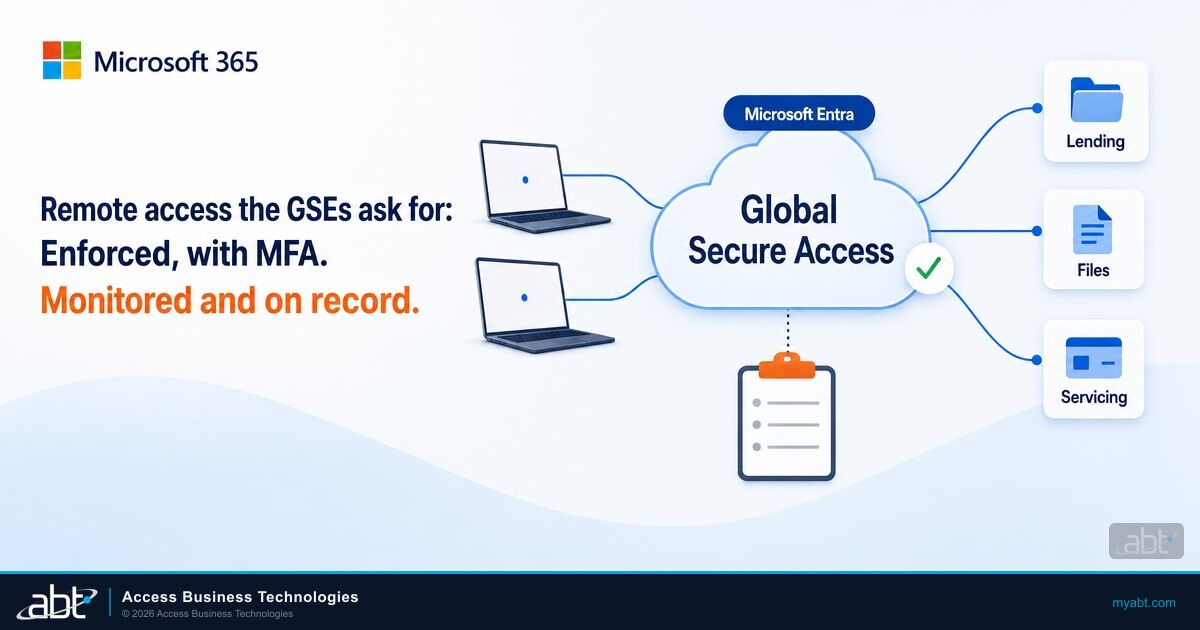
Microsoft Entra Global Secure Access combines Microsoft Entra Private Access, for internal applications, and Microsoft Entra Internet Access, for web and software-as-a-service traffic. Microsoft's Private Access overview says: "Remote workers don't need to use a VPN to access these resources if they have the Global Secure Access Client installed." Each published app, whether a file share, a Remote Desktop server, or an internal web app, can be targeted by Conditional Access, so you can require MFA and a compliant device before anyone reaches it.
For the processor from the opening, the morning VPN connection drops out of her day. With the client installed, she opens the shared drive and an on-premises or Azure-hosted loan origination system directly, and those checks run on the way in.
Our Global Secure Access guide for financial institutions walks through the licensing and a five-step VPN replacement rollout. This table maps the pieces to the Guide text. The compliant device requirement in it is the implementation ABT recommends alongside the MFA the Guides quote.
| Guide requirement | Global Secure Access control | What you keep on file |
|---|---|---|
| Remote access requirements with mechanisms to monitor and control (Fannie Mae 3.1); define and enforce (Freddie Mac 1302.2) | Private Access publishes each app on its own; Conditional Access decides who reaches it | The written policy, the approved app list, and access recertifications |
| MFA for remote connectivity, where applicable (Freddie Mac); MFA for Confidential Information and externally facing systems supporting services performed under the Underlying Agreements (Fannie Mae, from January 18, 2027) | Conditional Access requiring MFA and a compliant device on every private app and on Microsoft 365 sign-ins | Policy exports and sign-in logs showing MFA applied |
| Monitor network traffic and detect anomalies (Fannie Mae 3.12); monitor remote access technologies (Freddie Mac 1302.2) | Traffic logs that show "who accessed what traffic from where to where and with what result," exported to Microsoft Sentinel or Log Analytics | Alert rules, review records, and the retention period |
| Network segmentation strategy (Freddie Mac 1302.2) | Per-app access in place of network-wide reach, alongside the physical and logical segmentation your strategy requires; user groups assigned per app | The segmentation strategy document |
| Annual independent third-party pen test (both) | Outside Global Secure Access; the tester scopes the published apps and connectors | The tester's report and remediation records |
The record is the practical gain. When an auditor asks how remote access is controlled, you can show the app list, the users assigned to each app, the Conditional Access policy that applied, and the traffic log for any connection. For the policy layer under all of it, see our guide to Conditional Access policies for financial institutions.
Three limits to plan around
Global Secure Access can carry the technical side of the remote access controls, and three details in Microsoft's documentation shape the design. Plan for them before the pilot.
- Hosted desktops. Microsoft's Windows client page says "Azure Virtual Desktop multi-session isn't supported." Install the client on the device each person signs in from, and plan the session hosts' own network path separately.
- No fixed egress address. Microsoft's points of presence page states that "Global Secure Access doesn't provide dedicated or static public IP addresses per individual data center or geographic location." When a vendor allow-lists your office IP address, source IP anchoring "routes application traffic through your private network connector so that a SaaS app sees your known egress IP address."
- Thirty days of logs in the service. Microsoft's logging page says traffic logs are "retained within the system for 30 days." Export them to Microsoft Sentinel or Log Analytics to keep them for your written retention period.
The vendor allow-list case comes up often in mortgage lending, because pricing engines, investor portals, and document vendors sometimes restrict sign-ins to known addresses.
An investor portal accepts sign-ins only from your office IP address, and your remote processors move from the VPN to Global Secure Access.
Publish the portal's address in Private Access with source IP anchoring, so the traffic leaves through your private network connector and, with that connector running in your office, the portal still sees your known office address.
One more setting protects Microsoft 365 sign-ins when an attacker steals a user's sign-in token and tries to reuse it from another computer. Microsoft calls it the compliant network check. It blocks a stolen token replayed from any device outside your organization's compliant network, which is the Global Secure Access connection for your tenant, since "Microsoft Entra ID immediately denies the request." Microsoft's known limitations add that the "Compliant network check is currently not supported for Private Access applications," so use it for Microsoft 365 sign-ins and use MFA plus device compliance on the private apps.

The annual pen test needs an independent third party
Independence is where the Guides are strict. Fannie Mae's Section 3.4 requires "An independent third-party penetration test that is conducted at least annually on systems or system components used to store, access, process or transmit Confidential Information or connect to a Fannie Mae system." Freddie Mac's Section 1302.2 says: "Not less than annually, employ a qualified and independent third party to conduct penetration testing on systems or system components used to store, access, process and/or transmit Freddie Mac confidential information or Protected Information or connect to System(s)."
Neither Guide defines "independent." ABT recommends a named outside firm that did not build or run the environment it tests.
Vulnerability scanning is different. Fannie Mae asks for "Vulnerability scanning/testing conducted on a regular basis," and neither Guide attaches a third-party requirement to scanning. Your IT provider can run the scanning, and an outside firm runs the annual pen test.
Fannie Mae's 2027 Supplement also says the annual independent security assessment in Section 3.3 must "be performed by an independent third-party security professional." Our guide to Microsoft 365 penetration testing for financial institutions covers how to scope a test of a Microsoft 365 tenant.
Fannie Mae's implementation date and the 36-hour clocks
Fannie Mae's implementation date is January 18, 2027. Fannie Mae's Supplement page says "your organization must complete full implementation by Jan. 18, 2027." The MFA line is the change most likely to need work, because it reaches Confidential Information and externally facing systems supporting services performed under the Underlying Agreements.
Both GSEs set a 36-hour incident clock
Fannie Mae's Supplement requires notice "no later than 36 hours after identification of the Cybersecurity Incident," and the January 18, 2027 text adds "or the reasonable conclusion a Cybersecurity Incident may have occurred." Freddie Mac's Section 1302.5 requires notice "no later than 36 hours after discovering the Incident." Traffic and sign-in logs you can search quickly help you meet that clock.
The 36-hour clock can start on any day, and it sits beside the other reporting clocks a lender may face, which our guide to the 36-hour, 72-hour, and 30-day incident reporting clocks lays out side by side.
Licensing, and how ABT helps
Microsoft's Entra pricing page lists Microsoft Entra ID P1, which carries Conditional Access and MFA, as included with Microsoft 365 Business Premium. Private Access comes with the Microsoft Entra Suite, which Microsoft's Entra Suite page listed at $12.00 per user per month, paid yearly, on November 16, 2026. The same pricing page lists Microsoft Entra Global Secure Access on its own, and ABT can license either one for just the users who need Private Access.
GSE Remote Access Readiness on Microsoft 365
Compare today's remote access, MFA, and logging against Fannie Mae 3.1, 3.4, and 3.12 and Freddie Mac 1302.2, and list the gaps.
Acceptable use, approvals, recertification, and the segmentation strategy Freddie Mac asks for.
Require MFA and a compliant device for remote connections and for every system the 2027 Fannie Mae text reaches.
Publish the loan origination system, file shares, and vendor portals your policy names, each to the user groups it approves, with source IP anchoring for portals that allow-list your office address. The app list and assignments become part of your segmentation evidence, alongside the physical and logical segmentation your written strategy requires.
Export traffic and sign-in logs to Microsoft Sentinel for your written retention period and review alerts.
Give your independent pen test firm the scope, the published apps, and the policy exports, and track the fixes.
ABT, a Tier-1 Microsoft Cloud Solution Provider serving 750+ financial institutions, licenses Microsoft 365 and Microsoft Entra and manages the tenants they run in. For a lender facing the January 18, 2027 date, our team can map your current setup to the Guide text and deploy Private Access with the Conditional Access policies behind it. We then export the logs to Microsoft Sentinel and assemble the evidence your auditor and your pen test firm will ask for. Through M365 Guardian, Conditional Access, MFA, and Intune device compliance stay configured after the project ends and are monitored for drift, and a configuration change that weakens them is flagged for review.
The first step is a look at where your MFA and Conditional Access stand today. ABT's free Security Assessment reviews MFA coverage, Conditional Access policies, legacy authentication exposure, and admin account hygiene, and you receive a written report. Mortgage companies under the FTC Safeguards Rule can pair it with our FTC Safeguards Rule guide for mortgage lenders on Microsoft 365.

Map your remote access to Fannie Mae's January 18, 2027 text and Freddie Mac's Section 1302.2
ABT licenses Microsoft 365 and Microsoft Entra and manages the tenant they run in. The free Security Assessment shows where your MFA and Conditional Access stand today, and an ABT strategist can walk the results against the Fannie Mae and Freddie Mac text with you.
Frequently Asked Questions
No. Fannie Mae's Information Security and Business Resiliency Supplement and Freddie Mac's Guide Section 1302.2 require written, enforced remote access controls with monitoring, plus MFA on the access each Guide names, and neither names a VPN. A VPN is one valid way to meet the control. Microsoft Entra Private Access with Conditional Access is another.
Section 3.1 requires "Remote access requirements, including mechanisms to monitor and control remote access." It requires MFA for privileged accounts today, and from January 18, 2027 also for Confidential Information and externally facing systems supporting services performed under the Underlying Agreements. Section 3.12 adds network traffic monitoring, and Section 3.4 requires an annual independent third-party pen test.
Section 1302.2 says to define and enforce remote access requirements, including acceptable use, approvals, and recertification, and to require multifactor authentication for remote connectivity where applicable. It also asks for a network segmentation strategy, monitoring of remote access technologies, and an annual pen test by a qualified and independent third party.
Microsoft Entra Global Secure Access can cover the remote access side. Private Access publishes each app on its own, Conditional Access enforces MFA and device compliance, and traffic logs show who reached what. Export the logs past Microsoft's 30-day retention, and plan around Azure Virtual Desktop multi-session hosts and the lack of a fixed egress IP address.
Both GSEs require an independent third-party penetration test at least once a year. Neither defines "independent," so ABT recommends a named outside firm that did not build or run the environment. Vulnerability scanning carries no third-party requirement, so your IT provider can run it.
Fannie Mae published the new Information Security and Business Resiliency Supplement under Bulletin 26-01, and lenders must complete full implementation by January 18, 2027. The largest change for remote access is the MFA line, which now covers Confidential Information and externally facing systems supporting services performed under the Underlying Agreements, along with privileged accounts.