

In This Article
- The Difference Between "Licensed" and "Managed"
- What "Managed" Actually Means at the Tier-1 Direct-Bill CSP Level
- The M365 Guardian Operating Model on Top of the Managed Tenant
- Security: The Guard Dogs That Never Sleep
- Productivity: Beyond "Have You Tried Restarting It?"
- Strategy: Turning Microsoft 365 Into a Competitive Advantage
- Connecting the Dots: From Licenses to Leverage
- The Hurdles: Why Some Institutions Hesitate
- ABT: When Microsoft 365 Needs a Guardian
- Frequently Asked Questions
You sign the checks every month. You see the line item for "Microsoft 365" right there on the P&L. Your loan officers use Outlook. Your compliance team shares audit documents in SharePoint. Your branch managers send messages in Teams. But beyond that, the technical details of what you are actually paying for might feel like a black box.
For many leaders at financial institutions, Microsoft 365 lives in a binary state: it works or it is broken. Viewing the platform that way leaves money and security on the table. When you move to managed Microsoft 365 services, you stop paying for software licenses alone and start paying for a strategic asset that protects member data, satisfies regulators, and accelerates growth. Access Business Technologies manages Microsoft 365 tenants for more than 750 financial institutions under a Tier-1 Direct-Bill CSP relationship, and this article walks through what "managed" actually means at that level.
Why ABT Manages Microsoft 365 for Community Banks, Credit Unions, and Mortgage Companies
- Tier-1 Direct-Bill CSP relationship means ABT transacts with Microsoft as the partner of record and manages the tenant through delegated admin access. The institution gets the same Microsoft 365 product as direct purchase, with the partner-side configuration, support, and Guardian operating layer that direct purchase does not include.
- M365 Guardian operating model is ABT's productized layer on top of the managed tenant. It covers continuous license posture management, security baseline enforcement, 24x7 SOC coverage, and audit-evidence production aligned to FFIEC, NCUA, FDIC, and GLBA examination expectations.
- 750+ financial institution footprint means the playbook for community banks, credit unions, and mortgage companies is tuned to the actual mix of frontline tellers, branch staff, lending officers, processors, underwriters, and C-suite, not a generic SMB optimization template.
If you have ever wondered whether you are driving a Formula 1 car like a golf cart, this guide is for you. We will strip away the jargon and look at what a managed Microsoft 365 architecture really delivers to your bottom line, and what it means to manage that architecture through a Tier-1 Direct-Bill Cloud Solution Provider rather than a generic IT reseller.
The Difference Between "Licensed" and "Managed"
There is a widespread misconception that buying the license solves the problem. It does not. Buying a license gives you access to the tool, but it does not build the house.
When your credit union, bank, or mortgage company operates with a "licensed-only" mindset, you are handed the keys to a complex ecosystem and told, "Good luck." A managed Microsoft 365 approach changes that dynamic entirely. It shifts responsibility for the Microsoft 365 architecture, licensing, and platform strategy from your already-full plate to a team whose sole job is keeping that engine running at peak performance.
The managed-vs-licensed distinction matters even more in regulated environments. A licensed-only setup means your internal team owns every security configuration, every compliance control, and every audit response tied to Microsoft 365. A managed Microsoft 365 service provider takes ownership of those configurations so your team can focus on serving customers and members.
What "Managed" Actually Means at the Tier-1 Direct-Bill CSP Level
"Managed Microsoft 365" gets used loosely. Some providers mean "we will reset your password and reboot Outlook for you." Others mean "we will resell you the licenses and check in once a year." Neither of those is what a Tier-1 Direct-Bill Cloud Solution Provider does. The distinction matters because it changes who actually has the operational keys to your Microsoft 365 environment, and how quickly things get fixed when an examiner asks a question or a phishing email lands in a loan officer's inbox at 4:45 on a Friday.
A Microsoft Direct-Bill CSP transacts with Microsoft as the partner of record and manages the customer's Microsoft 365 tenant through delegated admin access. Microsoft owns the underlying infrastructure. The CSP owns the configuration, the monitoring, the response, and the operational accountability. That is different from an indirect reseller who hands you the license and walks away, and it is different from a generic managed services provider who has no formal Microsoft partner relationship and therefore cannot apply partner-side controls, cannot use the partner-only multi-tenant management surfaces, and cannot escalate to Microsoft on your behalf the way a Direct-Bill partner can.
For a financial institution, that distinction shows up in three concrete ways. First, the partner is operationally accountable to Microsoft for how your tenant is configured, which means the partner has skin in the game when an examiner asks about your security baseline. Second, the partner can apply consistent configurations across every tenant in your footprint using the same partner-side surfaces Microsoft built for CSPs, which is how you get the same Conditional Access policy, the same Defender posture, and the same retention rule applied at the home office and the new branch you opened last quarter. Third, the partner relationship under Granular Delegated Administrative Privileges (GDAP) scopes access per role and per tenant rather than handing the partner a single Global Administrator account, which aligns with the least-privilege expectations examiners look for under FFIEC, NCUA, and SEC supervision rules.
Access Business Technologies is a Tier-1 Direct-Bill CSP. The institution keeps its Microsoft 365 licensing and retains tenant ownership. ABT manages the tenant under the partner relationship.
The M365 Guardian Operating Model on Top of the Managed Tenant
Microsoft 365 is the licensing baseline. The Tier-1 Direct-Bill CSP relationship is the operational frame. M365 Guardian is the operating model ABT runs on top of both. Microsoft 365 admin center and Microsoft 365 Lighthouse are the tools. Guardian is the practice that turns those tools into a continuous service rather than a quarterly project.
For a community bank, credit union, or mortgage company, the practical difference between buying Microsoft 365 directly and buying it through ABT under the Guardian operating model is that ABT runs Microsoft 365 as a continuous function with documented disciplines, not as a once-a-year renewal exercise punctuated by emergency tickets. The Guardian operating model includes four concrete disciplines that show up in the institution's actual cost line, security posture, and examination readiness. This connects closely to Business Intelligence for Financial Institutions.
Continuous license posture management. New hires get rightsized at provisioning. Role changes trigger a license review. Separations free the seat back into the pool. Add-on usage gets reviewed against the last 90 days of activity. Most institutions lose 20-35% of their Microsoft 365 spend to seats that nobody uses, add-ons that no one logs into, and tier mismatches between job role and license SKU. Guardian closes that drift continuously.
Security baseline enforcement. Multi-factor authentication, Conditional Access, Microsoft Defender for Office 365 anti-phishing, Microsoft Defender for Endpoint device posture, Microsoft Intune device compliance, and Microsoft Purview retention all sit at vendor defaults out of the box. Guardian applies a financial-services baseline tuned to FFIEC, NCUA, FDIC, and GLBA expectations and re-verifies that baseline on a published cadence, rather than trusting that the configuration drawn up during onboarding still holds two years later.
24x7 SOC coverage layered on top. Guardian MxDR runs the security operations center that watches the signals coming out of Microsoft Defender, Microsoft Sentinel, and Microsoft Entra ID Identity Protection. The license stack feeds the signal sources. Guardian operates them. For a community bank or credit union, the practical effect is that the institution does not have to staff a 24x7 SOC internally to get 24x7 SOC coverage on its Microsoft 365 footprint.
Audit-evidence production. Microsoft Purview Audit produces the time-stamped trail across Exchange Online, SharePoint Online, OneDrive, Teams, and Microsoft Entra ID. Guardian configures Purview retention to a financial-services floor, holds the litigation-hold and eDiscovery surfaces ready for examiner request, and produces the cross-surface reports a CFO, CIO, or Chief Risk Officer can hand to an examiner without spending two weeks pulling screenshots.
Security: The Guard Dogs That Never Sleep
Cybersecurity keeps financial institution executives up at night for good reason. Regulators at the NCUA, FDIC, and state agencies expect you to prove your controls work. The threat landscape evolves faster than any single internal IT generalist can track.
When you opt for managed Microsoft 365 services through ABT, you are not just getting antivirus software. You are getting a hardened tenant. In a managed environment, ABT configures the hundreds of Microsoft 365 security settings that are left wide open by default: Microsoft Entra ID Conditional Access policies, multi-factor authentication enforcement, Microsoft Purview Data Loss Prevention rules for member NPI, and email authentication (SPF, DKIM, DMARC) to stop spoofing of the institution's domain. Our guide to Is Your Microsoft 365 Tenant Ready for Copilot? A Financial Services Rea goes deeper on this.
You get continuous monitoring through Guardian MxDR. Specialized tools watch your environment around the clock. If a user tries to bypass MFA, or if a sign-in suddenly looks suspicious, the team spots it and revokes the session before data leaves the building. For a community bank facing FFIEC examination requirements or a mortgage company preparing for a GSE audit, that level of visibility is not optional. It is the baseline regulators expect.
Why Default Settings Are Dangerous
CISA found Microsoft 365 default configurations dangerous enough to issue Binding Operational Directive 25-01 in December 2024, mandating 47 specific security changes across Microsoft Entra ID, Exchange Online, SharePoint, Teams, and Microsoft Defender for all federal agencies. MFA disabled on admin accounts, mailbox auditing off, legacy authentication protocols enabled, all out of the box. If the federal government cannot trust the defaults, neither should your institution.
Productivity: Beyond "Have You Tried Restarting It?"
We have all been there. A critical loan closing deadline is approaching, and Outlook decides to freeze. In a traditional IT support model, you submit a ticket and wait.
Managed Microsoft 365 services flip that script. Instead of reactive break-fix support, you get proactive maintenance under the Guardian operating model. The partner is often fixing issues in the background before your staff notices a slowdown. See also our breakdown of The Blueprint for a Fully Connected Microsoft 365 Workflow in Financial.
True productivity is not just about fixing broken things. It is about optimizing the things that already work. A managed provider ensures SharePoint is organized so compliance documents do not disappear into a digital void. The provider configures Microsoft Teams so your loan-processing team collaborates efficiently rather than drowning in notifications. The provider handles updates and patches so your staff starts the day working, not waiting for a progress bar.
For a credit union with 15 branches or a mortgage company with 200 loan officers, that proactive model translates directly into fewer lost hours and faster member service.
Strategy: Turning Microsoft 365 Into a Competitive Advantage
This is where Microsoft 365 architecture separates managed from licensed. A managed Microsoft 365 provider acts less like a mechanic and more like a fractional CIO whose desk is parked inside your Microsoft 365 footprint year-round.
The difference between Microsoft 365 as a cost center and Microsoft 365 as a growth engine is not the software you buy. It is whether someone is actually optimizing what you already own.
ABT reviews your usage and your business goals. Are you paying for duplicate licenses across merged branches? Are there features in your current subscription, including Microsoft Power Automate or Microsoft 365 Copilot Business, that could automate the manual compliance report your operations manager spends four hours building every Friday?
By analyzing your workflow, ABT restructures your licensing through the Guardian operating model to deliver maximum Microsoft 365 return for financial institutions. If your bank plans to acquire a competitor or your mortgage company opens a new production center, the roadmap to expand the Microsoft 365 footprint is already in hand on day one. That planning is the difference between Microsoft 365 as a cost center and Microsoft 365 as a growth engine.
Connecting the Dots: From Licenses to Leverage
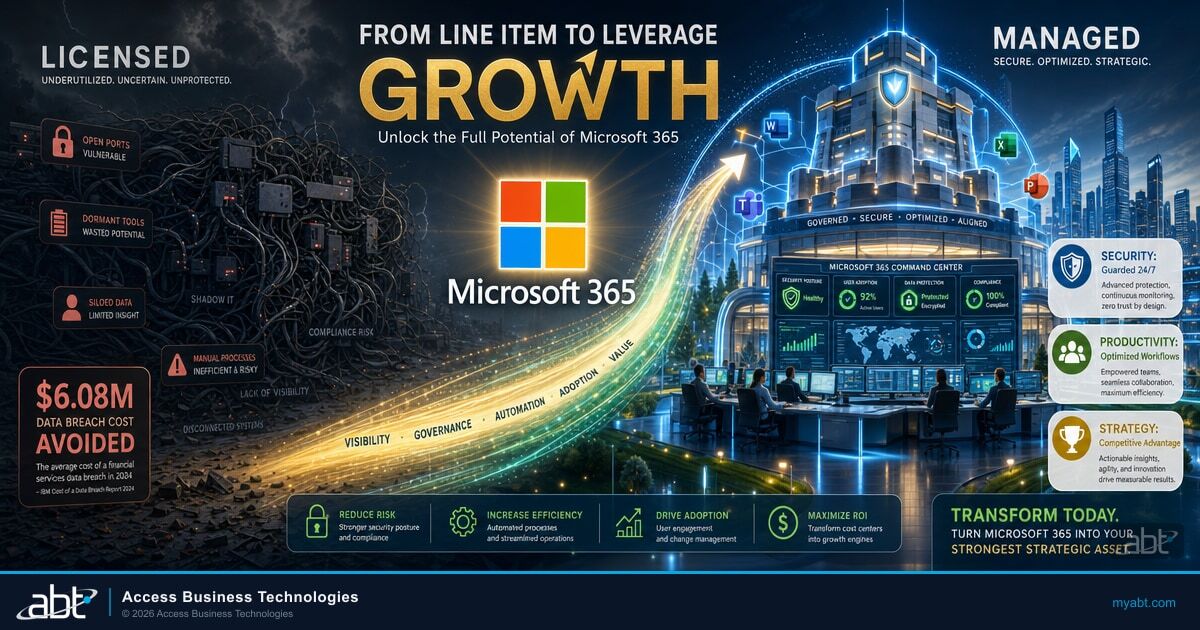
If you read our companion article, From Licenses to Leverage: Running Microsoft 365 as a Platform, you know the goal is a mindset shift. Microsoft 365 is not a utility bill. It is a platform you can leverage for growth.
Managed Microsoft 365 services through a Tier-1 Direct-Bill CSP are the execution of that philosophy. The companion article outlined why you should view the platform as an asset. The managed-service model under the M365 Guardian operating model is how you achieve it. It bridges the gap between potential and reality.
You cannot leverage a platform if you are constantly struggling to maintain it. For financial institutions juggling GLBA requirements, examiner expectations, and member experience improvements, managed services clear the operational fog so leadership can focus on what the platform makes possible: better data, smarter automation, and stronger competitive positioning. For a related view of how the same managed model applies to license rightsizing, see our companion guide on stopping Microsoft 365 shelfware in financial institutions.
The Hurdles: Why Some Institutions Hesitate
If the benefits are clear, why do some financial institutions hold back? It usually comes down to three friction points.
1. The Fear of Disruption
"If it is not broken, do not fix it." Migration feels risky. Executives worry that switching to a managed model will cause downtime during loan closing season or disrupt member-facing systems. The reality is that expert-led migrations are staged and tested to maintain business continuity. The risk of staying on an unpatched, misconfigured system is far greater than the risk of a planned upgrade.
2. The Cost Fallacy
"We can save money doing it ourselves." On the surface, the monthly fee for managed services looks higher than buying licenses alone. But when you add up the cost of a single data breach (average $6.08M in financial services per IBM's 2024 report), unoptimized licenses bleeding budget every quarter, and the salary of internal staff trying to manage a platform that changes monthly, the managed model proves more cost-effective. It is the difference between paying for prevention and paying for recovery.
3. Change Management
People resist new workflows. Moving to a managed platform might change how your team accesses files or authenticates into systems. A quality partner does not just deploy technology. The partner manages the human side, providing training and support so your tellers, loan officers, and back-office staff embrace the change rather than working around it.
Financial Services Leads Managed Services Adoption
Banking, financial services, and insurance captured 34% of the global managed services market in 2025, the largest share of any industry. The sector is projected to nearly double its managed services spending by 2033, driven by AI deployment, compliance requirements, and cloud infrastructure demands.
ABT: When Microsoft 365 Needs a Guardian
For leaders at regulated financial institutions, the stakes are higher than they are for a typical SMB. Compliance is not optional. Examiner findings carry real consequences. Member trust is the foundation of the business.
This is where generalist IT providers fall short. They sell licenses but cannot answer questions about GLBA data retention, NCUA cybersecurity expectations, or FFIEC examination preparation. They are not Microsoft partners of record, so they cannot apply partner-side controls, cannot use the multi-tenant management surfaces that Microsoft built for CSPs, and cannot escalate to Microsoft when an institution needs an answer in hours rather than weeks.
Partnering with Access Business Technologies means working with a Tier-1 Direct-Bill Microsoft Cloud Solution Provider that has served 750+ financial institutions across banking, credit unions, mortgage companies, and securities firms for more than 25 years. ABT manages your Microsoft 365 tenant under the partner relationship. The M365 Guardian operating model wraps the managed tenant with continuous license posture management, security baseline enforcement, 24x7 SOC coverage through Guardian MxDR, and audit-evidence production aligned to financial-services examination expectations.
You get the same Microsoft product. You gain the specialized governance, compliance-aware monitoring, and responsive support that turn a commodity license into a strategic asset.
Stop treating your Microsoft 365 environment like a utility bill. Start treating it like the engine of your institution.
Your Microsoft 365 Tenant Has Hundreds of Security Settings Left at Default
ABT manages your Microsoft 365 tenant under a Tier-1 Direct-Bill CSP relationship and applies the M365 Guardian operating model on top, so your team can focus on serving members instead of chasing compliance gaps. A 30-minute conversation reviews your current tenant posture, surfaces the gaps your next examiner is most likely to find, and outlines what an ABT-managed deployment would cover.
Frequently Asked Questions
Yes. Buying Office 365 or Microsoft 365 licenses gives you the software: Word, Excel, Outlook, Teams, and the rest of the suite. Managed Microsoft 365 services through a Tier-1 Direct-Bill Cloud Solution Provider include the software plus ongoing security configuration, 24x7 monitoring, continuous license posture management, audit-evidence production aligned to financial-services regulators, and a partner of record who is operationally accountable to Microsoft for how your tenant runs. The difference is the operating model on top of the license.
A Tier-1 Direct-Bill Cloud Solution Provider is a Microsoft partner that transacts directly with Microsoft and is operationally accountable to Microsoft for how customer tenants are configured and run. For a financial institution, that designation matters in three ways. First, the partner has skin in the game when an examiner asks how your security baseline got set. Second, the partner can apply consistent configurations across every tenant in your footprint through the partner-only management surfaces Microsoft built for CSPs. Third, the partner relationship under Granular Delegated Administrative Privileges scopes access per role rather than handing the partner a single Global Administrator account, which lines up with the least-privilege expectations examiners look for.
M365 Guardian is ABT's operating model on top of the managed Microsoft 365 tenant. It is the productized way ABT delivers ongoing governance, security, license rightsizing, and audit-readiness as a continuous service rather than a quarterly project. Guardian includes continuous license posture management (rightsizing seats at provisioning, role change, and separation), security baseline enforcement aligned to FFIEC, NCUA, FDIC, and GLBA expectations, 24x7 SOC coverage through Guardian MxDR over Microsoft Defender and Microsoft Sentinel, and audit-evidence production using Microsoft Purview Audit. The licensing baseline is Microsoft 365. The operating model on top is Guardian.
No. A reputable managed service provider plans the migration in stages to prevent data loss and minimize downtime. Most configuration work happens in the background. Your loan officers, tellers, and back-office staff keep working while the environment is hardened and optimized around them. ABT's onboarding flow is built around financial-services calendars, so deployment milestones avoid loan closing seasons, audit windows, and other high-impact periods that examiners and members both care about.
Microsoft 365 is a massive platform that changes monthly. Keeping up with security threats, compliance updates, and new feature releases is a full-time specialization. Internal IT teams can absolutely operate Microsoft 365, but the math of doing it well at a regulated financial institution rarely pencils out below a certain size. Managed services through a Tier-1 Direct-Bill CSP augment your internal team by handling tenant hardening, monitoring, license posture, and audit-evidence production so your staff can focus on day-to-day support and the higher-judgment work examiners actually want them doing.
A managed provider configures Microsoft Purview Data Loss Prevention policies, enforces Microsoft Entra ID Conditional Access, maintains Microsoft Purview Audit trails, and monitors for compliance drift across every tenant in the institution's footprint. For institutions facing GLBA, NCUA, FFIEC, or state examiner requirements, those controls provide documented evidence that your Microsoft 365 environment meets regulatory expectations. The Guardian operating model is the layer that produces the cross-surface reports a CFO, CIO, or Chief Risk Officer can hand to an examiner without spending two weeks pulling screenshots.
Access Business Technologies is a Tier-1 Direct-Bill Microsoft Cloud Solution Provider that has served 750+ financial institutions for more than 25 years. The combination is rare. Most large national resellers (SHI, CDW, Insight) carry the partner status but lack vertical specialization in financial services. Most regional managed services providers focused on financial services lack the Tier-1 Direct-Bill CSP relationship that lets them apply partner-side controls and escalate to Microsoft as a partner of record. ABT carries both. The M365 Guardian operating model on top of the managed tenant is the practice that turns those credentials into a continuous service the institution can actually rely on at examination time.