

In This Article
- Your Annual Audit Was Outdated Before the Fieldwork Started
- The Velocity Problem: Regulatory Changes Outpace Annual Reviews
- Why AI Breaks the Annual Audit Model
- Living Compliance: The Continuous Monitoring Framework
- The Technology Stack for Continuous Compliance
- How Microsoft Purview, Sentinel, and Entra ID Build Always-On Audit Evidence
- What Regulators Actually Think About Continuous Monitoring
- From Annual Snapshots to Living Compliance: The Transition Plan
- The M365 Guardian Operating Model: Continuous Compliance Across 750+ Financial Institutions
- Frequently Asked Questions
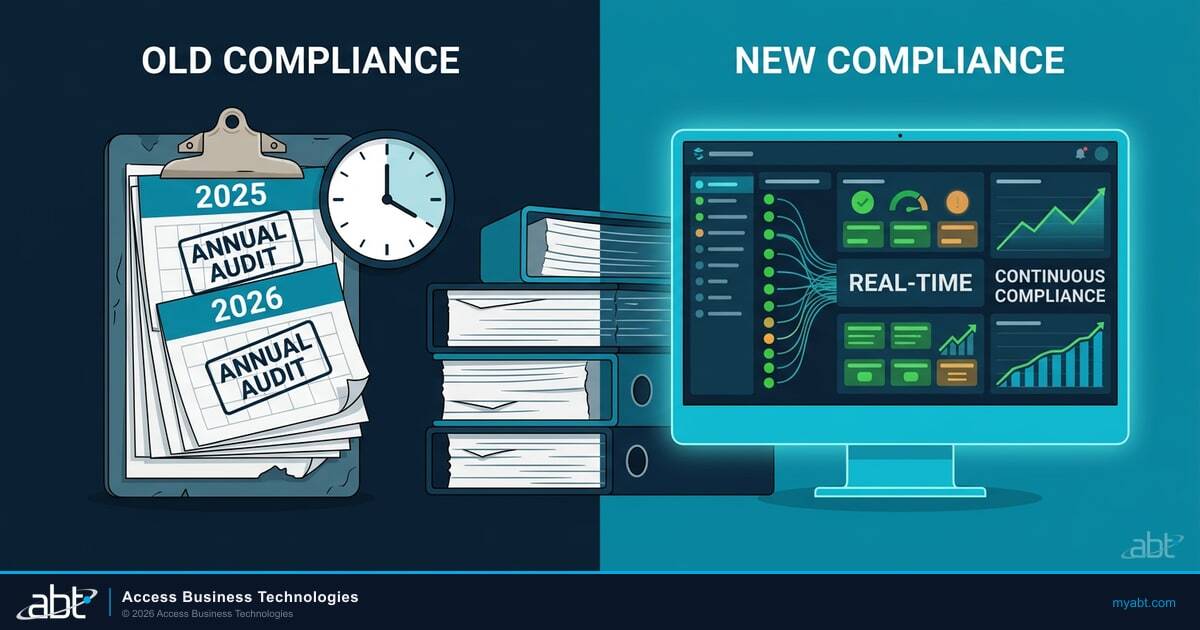
Annual compliance audits assume the world changes slowly enough for a yearly snapshot to catch problems. That assumption is breaking down. A regulatory change can invalidate your compliance posture between audit cycles. A new examination procedure can shift what examiners expect to see. By the time your annual audit starts, the findings are already stale. Financial institutions need a different model: living compliance that monitors continuously, collects evidence automatically, and alerts in real time. Access Business Technologies operates Microsoft 365 tenants for 750+ financial institutions, and the operating model that runs that footprint is built around continuous compliance evidence, not annual snapshots.
This is not futuristic thinking. The technology already sits inside the Microsoft 365 tenants most institutions are already paying for. Gartner predicts that by 2026, 70% of enterprises will build automated compliance checks directly into their technology workflows. The institutions that make this shift will spend less on audit preparation, catch compliance gaps faster, and face examiners with confidence instead of scrambling to assemble evidence binders.
Your Annual Audit Was Outdated Before the Fieldwork Started
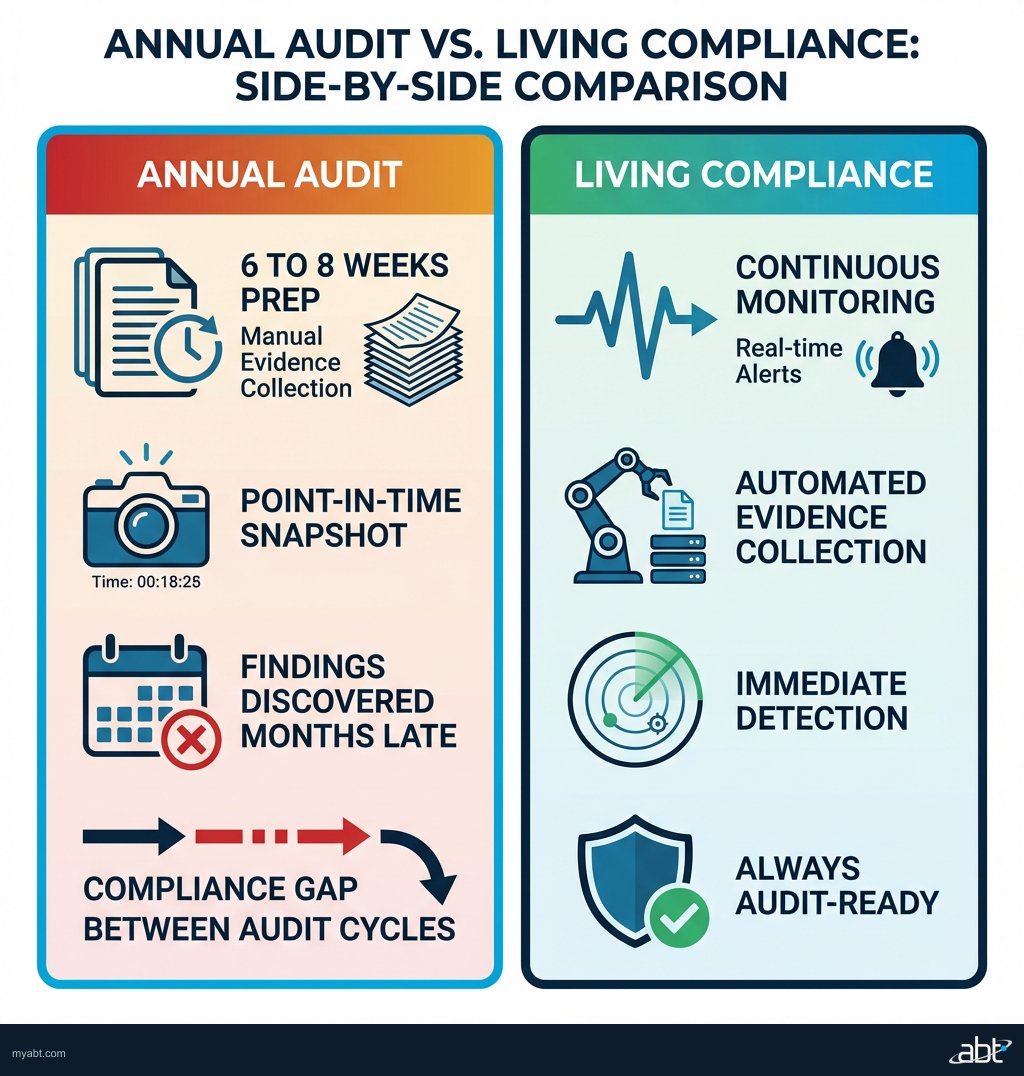
The traditional compliance cycle at a financial institution looks like this: 6 to 8 weeks of preparation (gathering documentation, testing controls, assembling evidence), 2 to 4 weeks of fieldwork (auditors on site, sampling transactions, interviewing staff), 4 to 6 weeks of remediation (fixing findings, documenting corrective actions). The entire cycle takes 12 to 18 weeks from start to close. For ABT's fuller take, see Why Generic MSPs Fail Financial Services Compliance.
During those 12 to 18 weeks, and during the months between cycles, the institution operates without real-time visibility into its compliance posture. Policy changes happen. New regulatory guidance drops. Staff turnover disrupts processes. System configurations drift from approved baselines. None of these changes wait for the next audit cycle. See also our breakdown of Treasury's 230-Control AI Risk Framework.
The result is a compliance program that is always looking backward. The audit tells you where you were three months ago. It does not tell you where you are today. That gap between "were compliant" and "are compliant" is where real risk lives. This connects closely to Shadow AI in Banking: The Risk Your Compliance Team Can't See.
The AI Governance Gap Is Your Biggest Risk
Every financial institution will deploy AI. The question is whether your governance framework is ready. Get your readiness score before your competitors get their results.
The Velocity Problem: Regulatory Changes Outpace Annual Reviews
Financial institutions face a constant stream of regulatory updates. In 2025 alone, the SEC initiated 200 enforcement actions in the first quarter. New BSA/AML examination procedures took effect for community banks in February 2026. The CFPB updated small business lending data requirements. State-level AI legislation like the Colorado AI Act created compliance obligations that did not exist 12 months earlier.
The volume of change is not the problem. The problem is the speed at which institutions can absorb it. Annual compliance cycles can accommodate one or two major regulatory changes per cycle. When dozens of updates arrive per quarter across BSA/AML, fair lending, cybersecurity, privacy, and AI governance, the annual model cannot keep up.
Regulatory change management tools can deliver 20% to 40% time savings, according to industry research, but only if the compliance function is structured to process changes continuously rather than batching them for the next audit cycle. A change that arrives in January and is not implemented until the September audit creates a nine-month compliance gap that examiners will find.
Why AI Breaks the Annual Audit Model
Traditional compliance controls were designed for static systems. Lending policies written in a manual. Transaction monitoring rules coded by a developer. Access controls configured once and reviewed quarterly. These controls change through deliberate, documented processes.
AI introduces compliance challenges that change without anyone touching the code:
Model drift. AI model outputs change over time as data distributions shift. A credit scoring model trained on 2024 data may produce different risk assessments on 2026 data even though the model itself was never modified. This drift can push outcomes into discriminatory territory without anyone realizing it until the next model validation, which for most institutions happens annually.
Data drift. The data feeding AI models changes continuously. Customer demographics shift. Economic conditions change. New data sources are added. These changes affect model performance in ways that quarterly reviews cannot catch. A model that was fair and accurate at deployment may become neither six months later.
Emergent bias. Some bias patterns only appear at scale. A lending model might perform fairly across the test dataset but produce disparate impacts when applied to the full loan portfolio. These patterns require continuous monitoring, not periodic sampling.
Autonomous decision-making. Agentic AI systems take actions without human review for each decision. A fraud detection agent that autonomously blocks transactions can create fair lending issues if its decisions correlate with protected characteristics. Annual reviews of AI decisions are meaningless when the agent makes thousands of decisions per day.
US regulators are already moving in this direction. The OCC, FDIC, and Federal Reserve issued joint guidance on AI risk management for financial institutions, and the CFPB has made clear that existing fair lending and consumer protection requirements apply fully to AI-driven decisions. Annual audits will not satisfy these evolving expectations.
The FFIEC's Examination Modernization Project is actively moving toward technology-enabled, risk-based examinations. The OCC's updated BSA/AML examination procedures, effective February 2026, reflect a shift toward ongoing monitoring expectations. Examiners are no longer satisfied with point-in-time evidence. They want proof that controls operated continuously throughout the examination period.
Living Compliance: The Continuous Monitoring Framework
Living compliance replaces the annual audit mentality with a continuous monitoring posture. Instead of asking "Were we compliant last quarter?" it asks "Are we compliant right now?"
The framework has four pillars:
Automated Policy Checks
Compliance rules are translated into automated checks that run continuously against live systems. Configuration baselines, access control policies, and data handling rules are codified as machine-readable policies that are evaluated in real time. When a system drifts from its approved configuration, the check fails and generates an alert immediately.
Real-Time Alerting
Compliance deviations trigger immediate notifications to the responsible team. Not an email that sits in a queue for three weeks. A structured alert with the specific control that failed, the system affected, the risk severity, and the recommended remediation. The alert includes enough context for the compliance team to act without conducting a separate investigation.
Automated Evidence Collection
The most expensive part of traditional audit preparation is evidence collection. Staff spend weeks pulling screenshots, exporting logs, documenting configurations, and assembling binders. In a living compliance model, evidence is collected automatically and continuously. System configurations are captured daily. Access reviews are logged in real time. Policy compliance is documented as controls execute. When the auditor arrives, the evidence is already organized and current.
Rolling Risk Assessments
Instead of a single annual risk assessment, living compliance maintains a rolling view of risk that updates as conditions change. New regulatory guidance shifts risk scores. System changes trigger re-evaluation. Security metrics and control performance data feed directly into risk dashboards. Compliance leadership sees the current risk posture at any moment, not a snapshot from six months ago.
The Technology Stack for Continuous Compliance
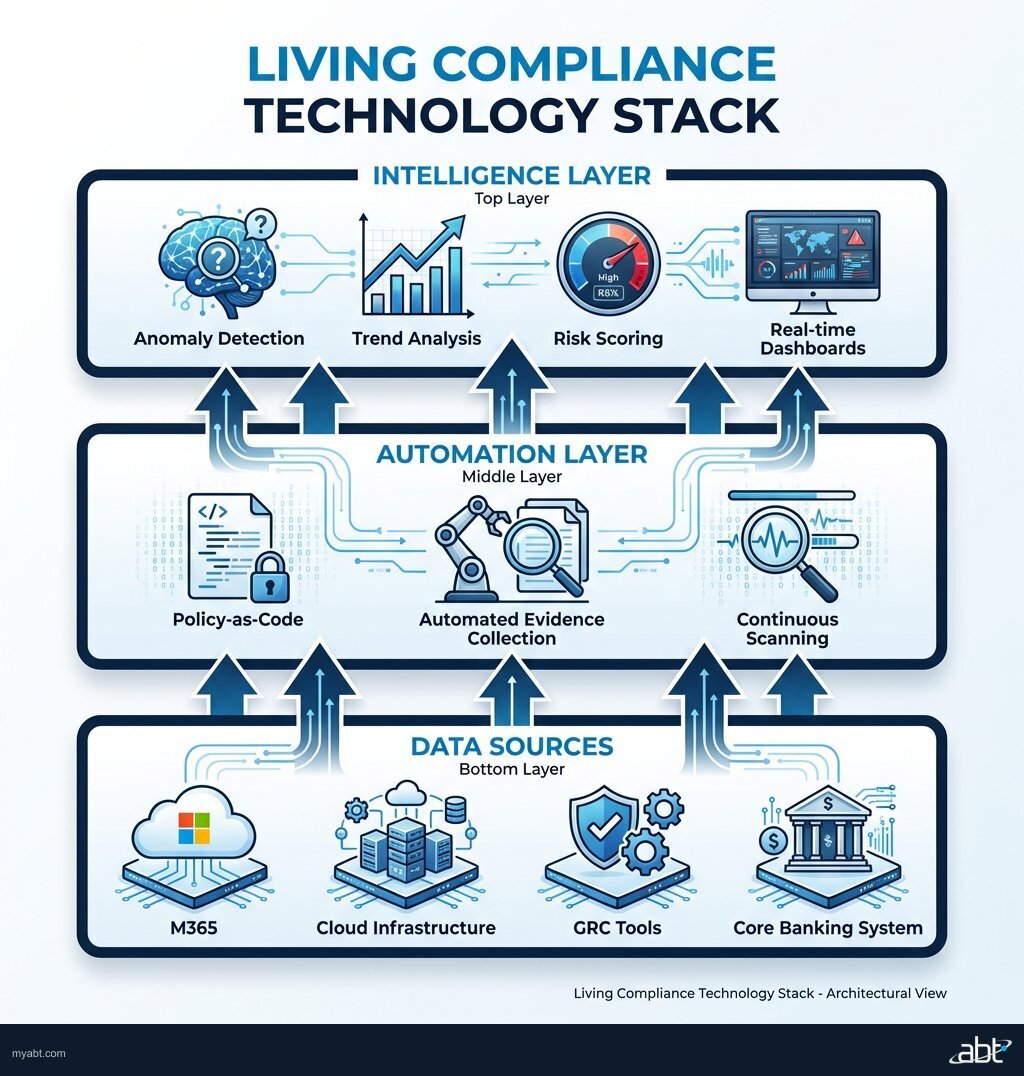
Living compliance requires technology, but it does not require ripping out your existing infrastructure. Most of the capabilities already exist in tools financial institutions are paying for.
Microsoft 365 compliance tools. Microsoft Purview provides data classification, sensitivity labeling, and data loss prevention monitoring across the Microsoft ecosystem. Microsoft 365 Compliance Manager scores your compliance posture continuously against regulatory frameworks including FFIEC, NIST, and GDPR. These tools are already included in many Microsoft 365 licenses but remain underutilized at most financial institutions.
GRC platforms with real-time data feeds. Modern governance, risk, and compliance tools connect to cloud environments, identity systems, and operational databases to pull compliance evidence automatically. Gartner predicts legal and compliance departments will increase GRC tool investment by 50% by 2026, driven by continuous monitoring demand.
AI-powered anomaly detection. Machine learning models that monitor compliance data for deviations from expected patterns. Unusual transaction volumes, access pattern changes, configuration drift, and policy violations can all be detected automatically and flagged before they become audit findings.
Automated audit trail generation. Every system interaction, policy change, access grant, and configuration modification is logged automatically with timestamps, user attribution, and business justification. When examiners request evidence, the audit trail is already complete.
Automated compliance checks in change management. Compliance policies can be embedded directly into your technology change management process. A system change that violates a compliance policy is flagged before it goes live. This brings the same rigor to regulatory compliance that your institution already applies to security reviews.
How Microsoft Purview, Sentinel, and Entra ID Build Always-On Audit Evidence
The Microsoft 365 control surface most financial institutions already license is, in practice, a continuous compliance platform that most institutions never operationalize. Microsoft Purview Audit produces the time-stamped trail of every create, modify, delete, and access event across Exchange Online, SharePoint Online, OneDrive, Teams, and Microsoft Entra ID. Purview Audit Premium extends retention to one year with an option to extend to ten, which is the practical floor for most books-and-records and BSA/AML record retention requirements. Microsoft Purview retention policies bind tamper-evident retention to the mailboxes, sites, and channels where customer correspondence and order tickets actually live. The audit log is not a periodic export. It is a streaming evidence layer that an examiner can be granted scoped read access to inside the firm's own admin console.
Microsoft Sentinel is the SIEM correlation layer that turns the raw Purview, Defender, and Entra ID signals into continuous compliance evidence. Sentinel ingests sign-in events from Microsoft Entra ID, mail-flow events from Microsoft Defender for Office 365, endpoint events from Microsoft Defender for Endpoint, and audit events from Microsoft Purview, then correlates them against analytic rules tuned to financial-institution risk patterns: a registered representative signing in from an unfamiliar country, a privileged account modifying retention policies, a Conditional Access policy exception that opens an MFA gap, an off-channel messaging app being installed on a managed device. Microsoft Entra ID Conditional Access provides the policy-enforcement layer that those Sentinel signals monitor against. Conditional Access enforces MFA in Grant mode, blocks legacy authentication, locks down sign-ins from non-compliant devices, and requires step-up authentication for high-risk events. When any of those policies drifts or gets bypassed, the change shows up in the Purview Audit log within minutes and surfaces as a Sentinel alert. That is what always-on audit evidence actually looks like inside a Microsoft 365 tenant. It is not a quarterly extract. It is a live record.
"Modern solutions leverage AI, automation, and continuous monitoring to anticipate risks, streamline evidence collection, and reduce audit fatigue, elevating GRC from a reactive function to a strategic advantage."
Gartner Market Guide for Continuous Compliance Automation, 2025What Regulators Actually Think About Continuous Monitoring
Financial institutions often hesitate to adopt continuous compliance because they are unsure whether regulators will accept the approach. The evidence suggests regulators are moving in this direction faster than most institutions realize.
FFIEC Examination Modernization. The FFIEC's Examination Modernization Project specifically calls for "leveraging technology and shifting examination work from onsite to offsite." This language signals a shift toward continuous data exchange between institutions and examiners, not just periodic on-site visits.
OCC risk-based supervision. The OCC has moved toward risk-based supervision that focuses examiner attention on the areas of highest risk. Institutions that can demonstrate continuous monitoring of high-risk areas receive less intensive examination in those areas. This creates a direct incentive for continuous compliance.
NCUA examination evolution. The NCUA is evolving its examination methodology to accommodate the pace of technology change at credit unions. As credit unions adopt AI and digital services, the examination framework is adapting to evaluate ongoing controls rather than just point-in-time snapshots.
The regulatory trajectory is clear. Examiners are increasingly asking for evidence that controls operated continuously, not just that they were in place during the audit sample period. The OWASP Top 10 for Agentic AI adds another dimension: institutions deploying AI agents will face security and compliance expectations that can only be met through continuous monitoring.
FNMA and agency audit expectations continue to tighten, and examiners are increasingly asking for evidence of ongoing controls rather than point-in-time snapshots. The CFPB, OCC, and FDIC are all signaling that compliance documentation must reflect current operations, not last quarter's review. Institutions that build continuous compliance infrastructure now will spend less time scrambling before audits and more time demonstrating controls that actually work.
From Annual Snapshots to Living Compliance: The Transition Plan
Moving from annual compliance to continuous monitoring does not happen overnight. The transition works best as a phased approach that starts with the highest-risk areas and expands over time.
Phase 1: Identify highest-risk compliance areas for continuous monitoring. Not everything needs continuous monitoring on day one. Start with the areas that create the most examiner findings, carry the highest penalties, or change the fastest. For most financial institutions, this means BSA/AML transaction monitoring, cybersecurity configuration management, access control compliance, and AI model governance if applicable.
Phase 2: Automate evidence collection for those areas. Replace manual evidence gathering with automated data pulls from your systems of record. Connect your GRC platform to your core banking system, your Microsoft 365 environment, and your identity management infrastructure. The goal is to eliminate the weeks of preparation time that precede every audit.
Phase 3: Build real-time dashboards for compliance leadership. Give your CCO and compliance team a live view of compliance posture across the areas you are monitoring. Red/yellow/green status indicators. Trend lines showing improvement or degradation. Drill-down capability to investigate specific deviations. This dashboard replaces the quarterly compliance report with a living view.
Phase 4: Integrate compliance checks into change management. Every system change, policy update, or vendor modification should trigger a compliance impact assessment. Not a bureaucratic approval chain. An automated check that evaluates whether the change affects any monitored compliance controls and flags potential impacts before the change goes live.
Phase 5: Shift audit resources from data gathering to analysis. When evidence collection is automated and compliance posture is monitored continuously, your audit function can focus on what matters: analyzing trends, identifying systemic issues, and providing strategic guidance to the business. This is where the real value of living compliance emerges. Audit becomes a strategic function rather than a data collection exercise.
The financial institutions that make this transition will find that compliance costs drop, examiner findings decrease, and the compliance function becomes a competitive advantage rather than a cost center. The Wolters Kluwer data shows that institutions aligning with regulators adopt AI more successfully. Living compliance is the mechanism for that alignment.
The M365 Guardian Operating Model: Continuous Compliance Across 750+ Financial Institutions
A small community bank does not have a 24/7 SOC analyst pool, a dedicated Microsoft Purview administrator, and a Sentinel detection engineer on staff. The institutions that have moved to a living compliance posture have outsourced the operational work to a partner whose entire footprint is built around it. That partner model has a name at ABT: M365 Guardian. Guardian is the operating model layered on top of the Microsoft 365 stack that runs Purview Audit retention, Sentinel correlation rules, and Microsoft Entra ID Conditional Access enforcement as a continuous service rather than a quarterly project. ABT runs Guardian for 750+ banks, credit unions, mortgage companies, and securities firms. The institution keeps its Microsoft 365 licensing and its tenant ownership. ABT manages the tenant under the partner relationship, tunes the analytic rules to the firm's actual risk profile, monitors the alerts as they fire, and produces the audit-ready evidence reports that a CCO can hand to an examiner without three weeks of preparation.
The shift from annual audit to living compliance is not a software purchase. It is an operating model change. ABT's Guardian footprint across 750+ financial institutions is the pattern-recognition asset that lets the operating model actually work. A configuration drift that appeared at one credit union in March shows up as a tuned Sentinel rule across every Guardian tenant in April. A new BSA/AML examination question that surfaced at a community bank in February becomes a Purview Audit query template that every Guardian institution inherits in March. The annual-audit model cannot keep pace with what examiners now expect. The Guardian operating model can, because it is already running. ABT manages Microsoft 365 tenants for 750+ financial institutions, and continuous compliance is what that management looks like in practice.
Move to Living Compliance With M365 Guardian
ABT runs continuous compliance for 750+ financial institutions on the Microsoft 365 stack: Microsoft Purview Audit, Microsoft Sentinel correlation, Microsoft Entra ID Conditional Access, and the M365 Guardian operating model that ties them together. A 30-minute conversation maps your current Microsoft 365 footprint, surfaces the gaps your next examiner is most likely to find, and outlines what an ABT-managed Guardian deployment would cover. No commitment, no quote, no obligation.
Frequently Asked Questions
Living compliance is a continuous monitoring approach that replaces traditional annual audit cycles with automated policy checks, real-time alerting, automated evidence collection, and rolling risk assessments. Instead of asking whether you were compliant last quarter, living compliance tells you whether you are compliant right now, with documentation that updates continuously. The technology layer that makes living compliance practical for financial institutions usually sits inside the Microsoft 365 tenant the firm already licenses: Microsoft Purview Audit, Microsoft Sentinel, and Microsoft Entra ID Conditional Access produce the continuous evidence trail that an examiner can be given scoped access to without a multi-week extract process.
AI introduces compliance challenges that change without human intervention. Model drift alters outputs over time. Data drift affects model accuracy. Emergent bias patterns appear at scale. Autonomous AI agents make thousands of decisions daily. These changes happen continuously between audit cycles, creating compliance gaps that annual reviews cannot detect until months after problems begin. Continuous monitoring through Microsoft Purview Audit, Microsoft Sentinel correlation, and Microsoft Entra ID sign-in risk policies catches these shifts in real time rather than at the next annual review.
The three Microsoft 365 products each carry a different layer of the continuous compliance picture. Microsoft Purview Audit produces the time-stamped evidence trail of every create, modify, delete, and access event across Exchange Online, SharePoint Online, OneDrive, Teams, and Microsoft Entra ID, with Purview Audit Premium extending retention to one year and up to ten years with the add-on. Microsoft Entra ID Conditional Access enforces the policy baseline: MFA, blocked legacy authentication, device-compliance requirements, and step-up authentication for high-risk sign-ins. Microsoft Sentinel correlates the Purview audit signals, the Microsoft Defender detection signals, and the Entra ID sign-in events into a single SIEM view with analytic rules tuned to financial-institution risk patterns. Together they produce a live record of compliance posture that updates within minutes of any drift, rather than a quarterly snapshot.
M365 Guardian is the operating model Access Business Technologies layers on top of the Microsoft 365 control stack to run continuous compliance as a managed service rather than a quarterly internal project. Guardian includes the Microsoft Purview Audit retention configuration, the Microsoft Sentinel analytic rules tuned to financial-institution risk profiles, the Microsoft Entra ID Conditional Access baselines, the Microsoft Intune device compliance policies, and the 24/7 security operations work that monitors the Defender and Sentinel signals every minute. ABT manages this stack for 750+ banks, credit unions, mortgage companies, and securities firms. The institution keeps its Microsoft 365 licensing and tenant ownership. ABT runs the operating model as the Tier-1 Cloud Solution Provider partner under the delegated administration relationship.
The biggest savings come from eliminating manual evidence gathering, which typically consumes six to eight weeks before each audit. With continuous evidence collection through Microsoft Purview Audit and the Microsoft Sentinel incident timeline, the audit-ready evidence is always current and organized when examiners arrive, removing the preparation scramble. Industry research from Gartner and others reports that audit management automation can reduce overall compliance overhead by 15% to 40% depending on the maturity of the deployment, with most of the gain coming from staff time recovered from evidence assembly.
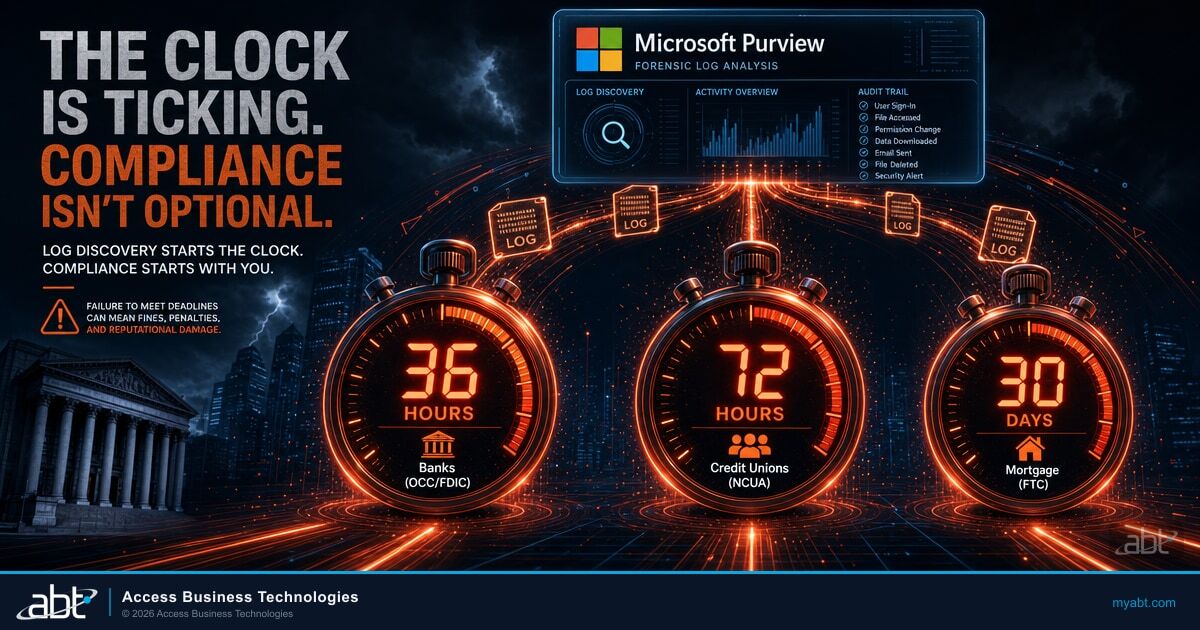
Yes. The FFIEC Examination Modernization Project calls for leveraging technology and shifting examination work from onsite to offsite. The OCC rewards continuous monitoring with less intensive examinations in those areas. The CFPB, FDIC, Federal Reserve, and NCUA are all signaling increased expectations for ongoing control evidence rather than point-in-time snapshots. The amended SEC Regulation S-P incident response timeline (30-day customer notification) is itself a continuous monitoring requirement; an annual audit cycle cannot meet it.
Start with the areas that generate the most examiner findings and carry the highest penalties: BSA/AML transaction monitoring, AI model governance, cybersecurity configuration management, and access control compliance. These four areas change frequently, carry significant regulatory risk, and benefit most from real-time visibility rather than periodic reviews. Each maps cleanly to a Microsoft 365 control surface: Microsoft Sentinel for transaction-related alerts, Microsoft Purview for evidence and retention, Microsoft Defender for endpoint and email signals, and Microsoft Entra ID Conditional Access for access control enforcement.
AI model drift occurs when model outputs change over time as data distributions shift, even without code modifications. A credit scoring model may produce increasingly biased results as demographic patterns evolve. Annual model validations cannot catch drift that begins weeks after deployment. Continuous monitoring of model performance metrics detects drift early, before outputs create fair lending violations or disparate impact.
Key Takeaway
Annual compliance audits cannot keep pace with AI-era regulatory velocity. Living compliance, built on Microsoft Purview Audit, Microsoft Sentinel SIEM correlation, and Microsoft Entra ID Conditional Access, produces always-on audit evidence rather than quarterly snapshots. ABT's M365 Guardian operating model runs this stack for 750+ financial institutions as a managed service, so the compliance team walks into every examination with the evidence already in hand instead of three weeks of preparation work.