

In this article:
Community banks face a cybersecurity problem that larger institutions solve with headcount. JPMorgan spends $15 billion a year on technology. Your bank has maybe two IT staff managing everything from teller workstations to core banking integrations to the next FFIEC cybersecurity assessment.
That gap is where managed IT services for community banks stop being a cost center and start being a competitive advantage. Community bank cybersecurity requires a provider who understands both the threat landscape and the regulatory response. The right provider gives a 200-person bank the same security infrastructure and compliance posture that a regional bank with a 30-person IT department maintains. The wrong provider gives you antivirus and a help desk.
This guide covers what community banks should look for in a managed IT provider, which regulatory requirements your provider must understand, and how to tell the difference between a generic managed service provider (MSP) and one that actually knows banking.
Note: While this article focuses on community banks, credit unions face nearly identical requirements under the NCUA, and mortgage companies have parallel obligations under the FTC Safeguards Rule. The evaluation criteria below apply to any financial institution choosing a managed IT provider.
Why Community Banks Need Specialized Managed IT Services
Banking IT isn't office IT. Your environment has regulatory, data, and operational requirements that most managed service providers have never dealt with:
- Examiner scrutiny. OCC and state banking examiners don't ask if you have antivirus. They ask how you assess and mitigate cybersecurity risk across your entire operation, from core banking to email to mobile banking apps. They expect written policies, evidence of testing, and documented incident response plans.
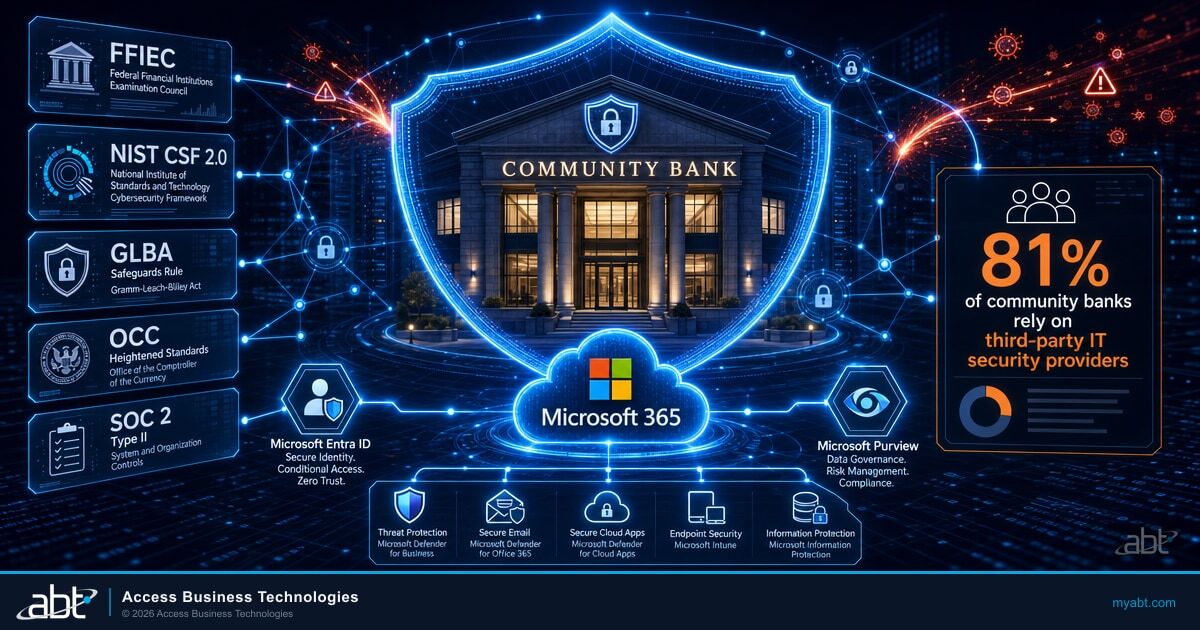
- FFIEC compliance framework. The FFIEC retired its Cybersecurity Assessment Tool (CAT) on August 31, 2025, and now directs institutions to NIST Cybersecurity Framework (CSF) 2.0 as the successor reference. A managed IT provider that doesn't understand how to translate CAT maturity language into CSF 2.0 Functions (Govern, Identify, Protect, Detect, Respond, Recover) can't help you prepare for a modern exam, and they definitely can't help you close the gaps your examiner will expect documented.
- Customer data density. Deposit accounts, loan records, wire transfer details, Social Security numbers, tax IDs. A single breach at a community bank can expose the financial lives of an entire town. The reputational damage alone can drive depositors to a competitor.
- Core banking integration. FIS, Fiserv, Jack Henry, Corelation. Your core system connects to everything: online banking, mobile apps, wire systems, general ledger (GL), loan origination, document imaging. Securing those integrations without breaking them requires someone who understands how banking infrastructure actually works.
- Anti-money laundering compliance (BSA/AML). Your transaction monitoring, suspicious activity reporting, and customer due diligence processes all run on IT infrastructure. When that infrastructure has problems, your compliance has problems.
A provider that doesn't understand banking operations will either lock your environment down so tightly that tellers can't process transactions, or leave it open enough that your next OCC exam becomes a problem.
FFIEC, GLBA, and OCC: The Regulatory Stack Your IT Provider Must Know
Community banks operate under overlapping federal and state regulatory frameworks. Your managed IT provider needs to understand all of them, not just the one they Googled before the sales call.
FFIEC Cybersecurity Assessment (Post-CAT Era)
The FFIEC retired its Cybersecurity Assessment Tool on August 31, 2025, and now points institutions to NIST CSF 2.0 as the reference framework examiners expect. Boards that still run last year's CAT spreadsheet get the same finding: your framework is stale. Your managed IT provider needs to know how CAT's five maturity domains (cyber risk management, threat intelligence, cybersecurity controls, external dependency management, cyber incident management) translate into the six CSF 2.0 Functions (Govern, Identify, Protect, Detect, Respond, Recover) because that is how your examiner is going to ask the questions now.
Your IT provider should know which CSF 2.0 Function your bank is weakest in and have a specific plan to move you from partial to risk-informed to repeatable to adaptive implementation. If they are still quoting CAT maturity levels as the scoring rubric, they aren't qualified to manage a bank's IT in 2026.
GLBA Safeguards Rule
The Gramm-Leach-Bliley Act requires financial institutions to protect customer information through administrative, technical, and physical safeguards. The FTC's updated Safeguards Rule (effective June 2023) added specific requirements that directly affect your IT environment:
- Designated qualified individual responsible for information security
- Written risk assessment with documented criteria
- Encryption of customer information in transit and at rest
- Multi-factor authentication for any individual accessing customer information
- Continuous monitoring or annual penetration testing
- Incident response plan with specific notification procedures
Your IT provider should be able to show you exactly how your Microsoft 365 environment, your endpoints, and your network satisfy each of these requirements. If they can't produce that evidence, you can't produce it for your examiner.
OCC Heightened Standards
For OCC-supervised banks, the heightened standards go beyond GLBA. OCC examiners evaluate your third-party risk management program, which means your managed IT provider is itself subject to examination scrutiny. They'll ask about your provider's SOC 2 attestation, their business continuity plans, their own security controls, and whether you've performed due diligence on them as a vendor.
If your IT provider doesn't have a SOC 2 Type II report, you have a gap in your vendor risk management program that your examiner will find.
The OCC, FDIC, and Federal Reserve finalized interagency guidance on third-party risk management in June 2023, with enforcement ramping through 2025. The updated guidance explicitly requires banks to conduct ongoing monitoring of technology service providers, not just onboarding due diligence. If your managed IT provider can't produce current SOC 2 reports and evidence of their own security program, your third-party risk management program has a gap examiners will flag.

What Your Managed IT Provider Must Deliver
Not every MSP is built for banking. Here's what separates managed IT services for community banks from generic business IT support.
Microsoft 365 Governance for Banking
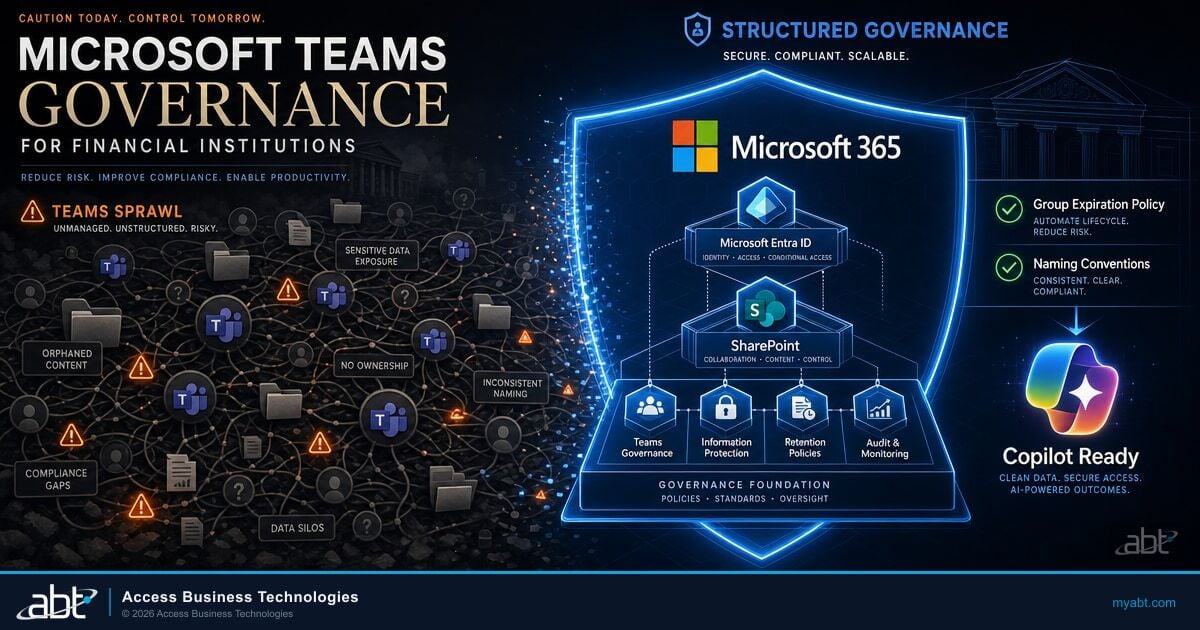
Most community banks run on Microsoft 365. The right provider doesn't just resell licenses; they manage the tenant under delegated administrative access and configure:
- Microsoft Entra ID Conditional Access policies that restrict access based on device compliance, location, and risk level. Not just "require MFA." Policies that block legacy authentication, require compliant devices for accessing customer data, and restrict access from unmanaged personal devices.
- Microsoft Purview Data Loss Prevention (DLP) rules that prevent customer account numbers, Social Security numbers, and loan documents from being emailed to personal accounts or uploaded to consumer cloud storage.
- Information barriers between departments where regulators require separation (trust department from commercial lending, for example).
- Retention policies aligned with your records retention schedule. Banking regulators expect specific retention periods for different document types. Your IT provider should configure these in Microsoft Purview, not leave it to each employee's judgment.
Endpoint Security That Satisfies Examiners
Antivirus is table stakes. For a community bank, endpoint security means:
- Microsoft Defender for Endpoint or equivalent Endpoint Detection and Response (EDR) with 24/7 monitoring. Not "we'll check the alerts on Monday."
- Microsoft Intune device compliance enforcement. If a laptop falls out of compliance (missed patches, disabled encryption), it loses access to banking systems automatically.
- Application control. Teller workstations should only run approved applications. No employee should be installing personal software on machines that access core banking.
- Full disk encryption verified and reportable. When your examiner asks for proof that all laptops are encrypted, your provider should produce that report in minutes, not days.
"Configurations should be monitored for unauthorized changes, and misconfigurations should be identified."
FFIEC IT Examination Handbook, Information Security Booklet, II.C.10(a) Configuration ManagementSOC 2 Type II Attestation
This isn't a marketing badge. It's a requirement for your vendor risk management program. A SOC 2 Type II report means an independent auditor has verified that your IT provider's security controls work as described over a sustained period (typically 6 to 12 months). SOC 2 Type I only confirms controls exist at a point in time. Type II confirms they actually work.
Ask for the full report, not a summary. Read the exceptions section. If there are material exceptions, ask what they've done to remediate.
Incident Response Planning
When a community bank experiences a security incident, the response has regulatory dimensions that don't exist in other industries. Your provider should maintain a documented incident response plan that covers:
- Containment procedures specific to banking systems (isolating core banking vs shutting down everything)
- Notification timelines for your primary regulator (OCC, FDIC, or state banking department)
- Suspicious Activity Report (SAR) filing coordination if the incident involves potential fraud
- Customer notification procedures under state breach notification laws
- Evidence preservation for potential law enforcement involvement
If your IT provider's incident response plan is a generic template that says "notify affected parties," it wasn't written for a bank.
Vendor Risk Management Support
Community banks rely heavily on third-party technology providers. Your managed IT provider should help you assess and document the security posture of your critical vendors, not just manage your internal infrastructure. This means helping you collect and evaluate SOC 2 reports from your core processor, your online banking provider, your wire transfer vendor, and your document imaging system.
Red Flags When Evaluating a Managed IT Provider for Your Bank
These aren't minor concerns. Any one of these should make you question whether a provider is ready for banking. For more details, see our guide on FFIEC cybersecurity assessment requirements.
- No SOC 2 Type II report. If they can't pass their own security audit, they can't manage yours.
- They don't know what FFIEC stands for. Ask them to describe how they'd help you prepare for your next FFIEC cybersecurity assessment. If they can't answer specifically, they've never done it.
- They're an indirect reseller, not a Microsoft Direct-Bill Cloud Solution Provider. An indirect reseller buys licenses from a distributor and hands you the bill. A Microsoft Direct-Bill CSP transacts directly with Microsoft and manages your Microsoft 365 tenant under delegated administrative access. For a bank that needs configuration consistency across every employee and every device, the difference matters.
- Their pricing is based on "per user" with no banking-specific services. A provider charging $150/user/month for the same package they sell to law firms and accounting firms isn't giving you banking-grade security.
- No experience with core banking integrations. Ask which core systems they've worked with. If the answer is "we can figure it out," that means they haven't done it.
- They can't explain their monitoring capabilities. "We monitor 24/7" means nothing if they can't tell you what they monitor, what triggers an alert, and what their response time targets are.
- No documented incident response plan for banking clients. A generic incident response plan won't address regulatory notification requirements, Suspicious Activity Report coordination, or evidence preservation for bank examiners.
- They recommend consumer-grade tools. If they suggest Dropbox for file sharing or use free antivirus, they don't understand the data protection requirements for financial institutions.

How ABT Works With Community Banks
Access Business Technologies has managed Microsoft 365 environments for financial institutions since 1999, currently supporting 750+ banks, credit unions, and mortgage companies under the same operating model. Two pieces of that model do most of the work for community banks: Microsoft Direct-Bill Cloud Solution Provider status, and a productized managed-IT operating model layered on top of it.
Microsoft Direct-Bill Cloud Solution Provider for community banks. ABT is a Tier-1 Microsoft Direct-Bill Cloud Solution Provider. That means ABT transacts directly with Microsoft for your Microsoft 365 licensing and manages your Microsoft 365 tenant under delegated administrative access. ABT is not an indirect reseller buying licenses from a distributor and handing you the bill, and ABT is not a generic MSP that touches your tenant through a service account. For a community bank, the practical difference is configuration consistency: Conditional Access policies, DLP rules, retention settings, and audit log retention are applied across the tenant the same way every time, and the configurations are documented in a form your OCC, FDIC, or state examiner can read without translation. Microsoft owns and operates the Microsoft 365 service infrastructure; ABT manages your Microsoft 365 tenant under delegated administrative access through the Cloud Solution Provider partnership. For the Azure environments that sit alongside it (custom-hosted banking applications, dedicated workloads), ABT hosts those Azure workloads under the same partner relationship.
The M365 Guardian operating model and App Pilot, the productized managed IT for financial institutions. The Microsoft Direct-Bill relationship gives ABT the access. The M365 Guardian operating model is what ABT does with that access. M365 Guardian is the productized control framework that continuously monitors your Microsoft 365 tenant against an 80-policy financial-institution baseline layered over Microsoft Secure Score, maps configuration gaps to NIST CSF 2.0 Functions and GLBA Safeguards Rule controls, and tracks remediation progress in evidence packages your examiner expects. App Pilot is the companion application-management product that enrolls and posture-checks the line-of-business applications your bank runs alongside Microsoft 365 (core banking clients, loan origination tools, document imaging, custom integrations) so the device and application surface stays inside the same compliance baseline. Together, M365 Guardian and App Pilot are how ABT productizes managed IT for financial institutions instead of leaving every bank to assemble it on its own. The same operating model is deployed across the 750+ financial institutions ABT serves.
- M365 Guardian operating model. ABT's M365 Guardian continuously monitors your Microsoft 365 tenant against an 80-policy financial-institution baseline layered over Microsoft Secure Score. It doesn't just report your Secure Score. It identifies specific configuration gaps, maps them to NIST CSF 2.0 Functions and GLBA Safeguards Rule controls, and tracks remediation progress so you have documentation ready for your examiner.
- FFIEC assessment support. ABT helps community banks prepare for FFIEC cybersecurity assessments under the post-CAT reference (NIST CSF 2.0) by mapping your current Microsoft 365 posture against the six CSF 2.0 Functions, identifying gaps, building remediation plans, and assembling the evidence packages your examiner expects.
- Banking-specific compliance documentation. ABT maintains compliance evidence libraries for banking clients that include Conditional Access policy documentation, DLP rule configurations, encryption verification reports, and endpoint compliance summaries. When your examiner asks, you have it.
- Free security assessment. ABT offers a free Microsoft 365 security assessment that grades your tenant configuration against financial services security benchmarks. You get a report showing where your environment stands and what needs to change before your next exam.
Key Takeaway
Managed IT for community banks is a different product from generic business IT support. The right provider is a Microsoft Direct-Bill Cloud Solution Provider managing your Microsoft 365 tenant under delegated administrative access, with a productized operating model (in ABT's case, M365 Guardian and App Pilot) that produces the configuration consistency, evidence documentation, and FFIEC-aligned posture your next examination expects. A generic MSP cannot stand in for that, and an indirect reseller cannot give you the tenant-level configuration control the role requires.
Frequently Asked Questions
Managed IT services for community banks include Microsoft 365 administration and security under delegated administrative access, endpoint protection with EDR monitoring, network security management, FFIEC cybersecurity assessment preparation, GLBA compliance support, core banking integration management, help desk support, and incident response planning. A qualified provider also handles vendor risk management support and produces the compliance documentation that banking examiners require. The strongest providers are Microsoft Direct-Bill Cloud Solution Providers, which transact directly with Microsoft and manage the tenant configuration rather than reselling licenses through a distributor. For more details, see our guide on credit union cybersecurity beyond basics and our explanation of why generic MSPs fail regulated industries.
Managed IT services for community banks typically cost more than generic business IT support because banking-specific security requirements, compliance documentation, and regulatory exam preparation require specialized expertise. Pricing varies based on user count, core banking integration complexity, Microsoft 365 license mix, and the scope of compliance support included. Pricing from a Microsoft Direct-Bill Cloud Solution Provider that manages the tenant and runs a productized operating model like M365 Guardian and App Pilot is structured differently from a per-seat MSP help desk contract.
The FFIEC retired its Cybersecurity Assessment Tool on August 31, 2025, and now directs institutions to NIST Cybersecurity Framework (CSF) 2.0 as the successor reference. CSF 2.0 organizes controls under six Functions (Govern, Identify, Protect, Detect, Respond, Recover), and most of the evidence your examiner will ask for is IT-generated: access management, network security, endpoint protection, logging, and incident response. A managed IT provider experienced with the CAT-to-CSF 2.0 translation identifies gaps, builds remediation plans, and prepares the documentation before your examination rather than during it.
Community banks should choose a managed IT provider with specific banking experience over a local generalist. Local providers rarely have FFIEC compliance, core banking integration, or banking incident response experience. A specialized provider holds SOC 2 Type II certification, holds Microsoft Direct-Bill Cloud Solution Provider status so the Microsoft 365 tenant is managed rather than just resold, produces compliance documentation examiners expect, and understands core system integrations that generalists haven't touched.
A managed IT provider for community banks should hold SOC 2 Type II attestation at minimum, verifying their security controls work over a sustained period. Additional qualifications include FFIEC cybersecurity assessment experience, GLBA Safeguards Rule knowledge, OCC examination familiarity, and Microsoft Direct-Bill Cloud Solution Provider status, which is the top Microsoft Cloud Solution Provider program tier and the one under which the partner manages the Microsoft 365 tenant directly rather than reselling licenses indirectly.
Community banks should configure Microsoft Entra ID Conditional Access policies that enforce multi-factor authentication for all users, block legacy authentication protocols, require device compliance for core banking access, and restrict sign-ins from unmanaged devices. Microsoft Purview Data Loss Prevention (DLP) rules should detect and block sharing of customer Social Security numbers, account numbers, and loan data outside the organization. Additional configurations include DMARC email authentication to prevent domain spoofing, Microsoft Purview sensitivity labels for document classification, and Purview Audit logging sufficient to produce evidence packages for OCC and FFIEC examiners. A Microsoft Direct-Bill Cloud Solution Provider running an operating model like M365 Guardian applies these consistently across the tenant and produces the documentation in a form your examiner will accept.
Technical Reference
The following tables provide definitions for regulatory frameworks and technical terms used in this article.
Regulatory Frameworks
| Term | Full Name | What It Means |
|---|---|---|
| FFIEC | Federal Financial Institutions Examination Council | Interagency body that publishes the IT Examination Handbook. Retired the Cybersecurity Assessment Tool (CAT) on August 31, 2025, and now points institutions to NIST CSF 2.0. |
| GLBA | Gramm-Leach-Bliley Act | Federal law requiring financial institutions to protect customer information through administrative, technical, and physical safeguards. |
| OCC | Office of the Comptroller of the Currency | Federal regulator for national banks. Conducts IT examinations using FFIEC framework. |
| NCUA | National Credit Union Administration | Federal regulator for credit unions. Uses the same FFIEC examination framework as OCC. |
| FTC Safeguards Rule | Federal Trade Commission Safeguards Rule | Requires mortgage companies and non-bank financial institutions to maintain comprehensive information security programs. |
Glossary
| Term | Definition |
|---|---|
| BSA/AML | Bank Secrecy Act / Anti-Money Laundering, regulations requiring financial institutions to detect and report suspicious transactions. |
| Conditional Access | Microsoft Entra ID login policies that control who can access what, from which devices, and under what conditions. |
| CSP (Direct-Bill) | Microsoft Cloud Solution Provider, the top Microsoft program tier under which a partner transacts directly with Microsoft for licensing and manages customer Microsoft 365 tenants under delegated administrative access. |
| DLP | Data Loss Prevention, rules in Microsoft Purview that detect and block sensitive data from leaving the organization. |
| DMARC | Email authentication protocol that prevents attackers from sending emails that appear to come from your domain. |
| EDR | Endpoint Detection and Response, security software (such as Microsoft Defender for Endpoint) that monitors devices for threats and enables rapid response to incidents. |
| MSP | Managed Service Provider, a company that remotely manages a customer's IT infrastructure and systems. |
| SAR | Suspicious Activity Report, a filing required when a financial institution detects potential fraud or money laundering. |
| SOC 2 Type II | Independent audit that verifies a vendor's security controls work as described over a sustained period (typically 6-12 months). |