

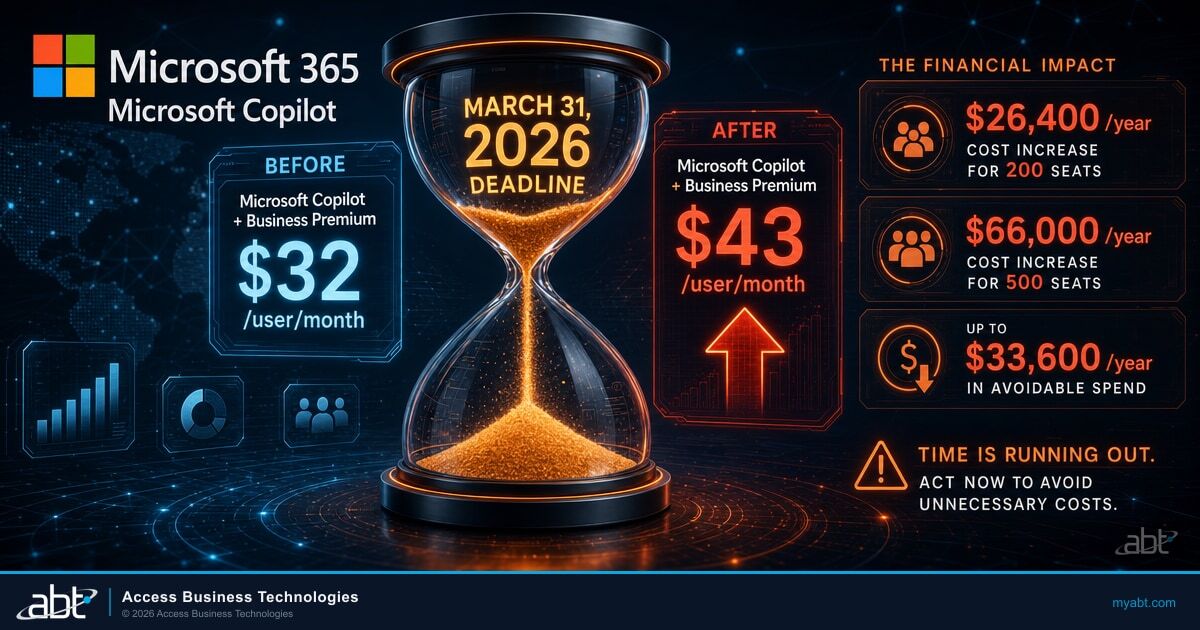
Microsoft's promotional pricing on Business Premium + Copilot bundles expires March 31, 2026. After that date, the combined cost jumps from $32 per user per month to $43. For a 200-seat community bank, that gap is $26,400 per year. For a 500-seat mortgage company, $66,000.
This is a straightforward math problem, but most financial institutions are making it harder than it needs to be. They are either overpaying for Microsoft 365 plans they do not fully use, under-licensing compliance features their examiners expect, or missing the promotional window entirely because nobody flagged the deadline.
Here is the current Copilot pricing landscape, where institutions lose money on licensing, and how to run a cost optimization review before the March 31 window closes.
The Current Copilot Pricing Landscape for Financial Services
Microsoft restructured its Copilot pricing in December 2025. The changes introduced Microsoft 365 Copilot Business, a tier designed for organizations with fewer than 300 users. It also created bundle pricing that combines your base Microsoft 365 subscription with Copilot into a single SKU at a discount.
The promotional bundles run from December 1, 2025 through March 31, 2026. They require an annual commitment, apply to 10-300 seats, and lock in the discounted rate for 12 months.
Base Microsoft 365 Plans (Per User, Per Month)
| Plan | Current Price | After July 1, 2026 |
|---|---|---|
| Business Standard | $12.50 | $14.00 |
| Business Premium | $22.00 | $22.00 (no change) |
| Microsoft 365 E3 | $36.00 | $39.00 |
| Microsoft 365 E5 | $57.00 | $60.00 |
Copilot Add-On Pricing
- Copilot Business (1-300 users): $21/user/month standard; $18/user/month promotional through March 31, 2026
- Copilot Enterprise (300+ users): $30/user/month
The Bundle That Matters Most
The Business Premium + Copilot Business bundle at $32/user/month is the one most financial institutions should evaluate first. It delivers Business Premium's full security stack (Intune, Defender for Endpoint, Conditional Access, Purview DLP) alongside Copilot in Word, Excel, Outlook, PowerPoint, and Teams.
Without the bundle, those two products cost $22 + $21 = $43/user/month. The promotion saves $11 per seat, per month. For a 200-seat institution, that is $26,400 in annual savings locked in with a single purchasing decision before the deadline.
The Business Premium + Copilot bundle at $32/user/month is available from December 1, 2025 through March 31, 2026. Requirements: annual commitment, 10-300 seats, new Microsoft 365 commercial subscription. Promotional pricing applies to the first year only. There is also a Business Standard + Copilot bundle at $22/user/month (standard: $33.50), a 35% discount through the same deadline.
Know Your AI Readiness Score
The institutions deploying AI successfully aren’t the early adopters, they’re the well-prepared ones. See if your foundation is ready for what’s coming.
Four Licensing Mistakes That Cost Financial Institutions Thousands
Copilot pricing mistakes in financial services go beyond overspending. They create compliance gaps that examiners will find. Here are the four errors ABT sees most across banks, credit unions, and mortgage companies.
1. Paying for Features They Already Have
Microsoft 365 Copilot Chat is now included at no additional cost with every eligible Microsoft 365 subscription. Basic AI-powered assistance in Word, Excel, PowerPoint, and OneNote is already available in your tenant. Many institutions either do not know this feature exists or are paying a separate vendor for AI tools that duplicate what they already own.
The paid Copilot tiers add deeper integration: pulling data from your SharePoint, analyzing email patterns, summarizing Teams meetings. That is worth the investment. But if your staff just needs occasional help with drafting and formatting, check whether Copilot Chat already covers the use case.
2. Over-Licensing with E5 When E3 Covers the Need
E5 costs $57/user/month (rising to $60 in July). E3 costs $36 (rising to $39). The difference is $21 per seat, or $50,400 per year for a 200-person organization.
E5 includes Phone System, Power BI Pro, and advanced eDiscovery. Many financial institutions landed on E5 because a previous IT provider recommended it without auditing which features the institution actually uses. If your compliance requirements can be met with E3 plus targeted add-ons like Purview for DLP, the savings are substantial and can offset a Copilot deployment.
3. Under-Licensing Compliance Features
The opposite problem is more dangerous. Some institutions run on Business Standard ($12.50/user/month) because the price is right, but that plan lacks the controls regulators expect: no Intune device management, no Conditional Access policies, no Defender for Endpoint, no Data Loss Prevention.
For organizations subject to GLBA, FFIEC examination requirements, or NCUA cybersecurity guidance, these are baseline expectations. Deploying Copilot on top of a weak security foundation creates more risk, not less, because Copilot accesses everything the user can access.
4. Ignoring Governance Costs
The per-seat license fee is not the total cost of Copilot. Before Copilot touches your tenant, you need DLP policies preventing sensitive loan data from surfacing in the wrong context, Conditional Access rules restricting Copilot to managed devices, and sensitivity labels on documents containing nonpublic personal information. Institutions that skip governance create a compliance liability.
"70% of Fortune 500 companies have piloted or deployed Copilot, but most remain in pilot mode. Only 5% of organizations that finished pilots moved to larger deployment in 2025."
Gartner, 2025 Microsoft 365 and Copilot SurveyThe Real Cost of Waiting Past March 31
The Copilot promo deadline is not the only pricing event on the calendar. Microsoft has announced base price increases for multiple Microsoft 365 plans taking effect July 1, 2026. E3 goes from $36 to $39 (8.3% increase). E5 goes from $57 to $60 (5.3% increase). Business Standard jumps from $12.50 to $14 (12% increase).
For institutions still on Enterprise Agreements, Microsoft removed volume discounts in November 2025. The combined impact of EA discount removal plus July price increases can reach 20% for large organizations.
Here is what a 200-seat institution faces if it delays:
- Miss the March 31 Copilot promo: $11/seat/month more = $26,400/year in extra Copilot cost
- Miss the July 1 base price lock-in: $1-$3/seat/month more on base plans = $2,400-$7,200/year
- Combined exposure: Up to $33,600/year in avoidable spend for a mid-size institution
Microsoft 365 E3 rises from $36 to $39/user/month. E5 rises from $57 to $60. Business Standard rises from $12.50 to $14. Business Premium stays at $22. The E3 increase includes new Intune features (Remote Help, Advanced Analytics, Plan 2) and Defender for Office 365 P1. E5 gains Security Copilot and Intune Endpoint Privilege Management. Source: Microsoft 365 Blog, December 4, 2025.
The Competitive Cost of Delay
Financial institutions that deploy Copilot now are building institutional knowledge. Loan officers learn document summarization. Compliance teams draft policy reviews faster. IT staff use Copilot for PowerShell scripts and troubleshooting. Every month of delay is a month your competitors build AI fluency your team will not have.
Shadow AI Is Already in Your Tenant
Your employees are already using AI tools. They paste customer data into ChatGPT, use personal Microsoft accounts for free Copilot access, and upload loan documents to third-party summarization tools. None of that activity is governed, logged, or compliant. Deploying Copilot inside your managed tenant replaces shadow AI with governed AI. Every interaction runs within your security boundary, respects DLP policies, and generates audit trails.
How to Run a License Optimization Review Before the Deadline
A license optimization review takes your current Microsoft 365 environment and models the most cost-effective path to Copilot. Here is the process ABT uses with financial institutions:
Step 1: Audit Current Licensing
Pull your Microsoft 365 license assignment report. For every user, map which plan they are on and which features they actually use. Most institutions discover 20-40% of licensed features go unused. E5 users who never touch Power BI Pro or Phone System can move to E3 with targeted add-ons.
Step 2: Map Compliance Requirements to Licensing Tiers
FFIEC examination procedures reference multi-factor authentication, endpoint protection, and data loss prevention. GLBA's Safeguards Rule requires access controls and audit trails. NCUA cybersecurity guidance emphasizes device management and conditional access. Each maps to specific Microsoft 365 features available only in certain plans. Your licensing tier should match your regulatory obligations, not exceed them and not fall short.
Step 3: Model Three Cost Scenarios
- Current state: What you pay today with no changes
- Optimized + Copilot before March 31: Right-sized licensing plus the promotional bundle
- Copilot after March 31 + July increases: Right-sized licensing plus standard Copilot pricing, plus base price increases
The delta between scenario 2 and scenario 3 is the cost of waiting. For most institutions ABT works with, the gap ranges from $15,000 to $75,000 per year depending on seat count and current licensing mix.
Step 4: Build the Business Case
Your CFO needs three numbers: annual Copilot license cost, annual savings from license optimization, and net cost after optimization. In many cases, the optimization savings partially or fully offset the Copilot investment. Forrester's Total Economic Impact study found that small and midsize businesses saw a 353% ROI over three years, with payback in under six months.
Why ABT for Copilot Licensing
ABT is a Tier-1 Microsoft Cloud Solution Provider serving 750+ financial institutions. That designation means ABT sells Microsoft 365 licenses directly, not through a distributor. When you buy through ABT, you get Microsoft's pricing with a partner who understands financial services licensing and compliance requirements.
- Direct licensing: ABT provisions and manages your Microsoft 365 licenses. No middleman, no markup on Microsoft's list price.
- Financial services expertise: 750+ financial institutions across banking, credit unions, and mortgage lending. Your licensing decisions are informed by what works for institutions like yours.
- Governance-first deployment: ABT's Guardian operating model hardens your tenant before Copilot touches your data. DLP policies, Conditional Access, sensitivity labels, and audit trails are configured before day one.
- Ongoing optimization: After deployment, ABT monitors license utilization and flags right-sizing opportunities. If a user is on Business Premium but only uses email and Teams, that seat gets reallocated.
Most financial institutions work with an IT provider who advises on licensing but cannot sell it. Or they buy from a large distributor who sells licenses but does not understand banking compliance. ABT does both. That convergence of licensing authority and regulatory knowledge is why 750+ financial institutions trust ABT with their Microsoft 365 environment.
Don't Deploy AI Without Governance
Financial institutions rushing to deploy Copilot without assessing readiness are building on unstable foundations. See where your tenant stands before you flip the switch.
Frequently Asked Questions
The promotional bundle pricing expires on March 31, 2026. After that date, the Business Premium + Copilot Business bundle reverts from $32/user/month to the standard combined rate of $43/user/month. The standalone Copilot Business add-on returns from its promotional $18/user/month to $21/user/month. Annual commitments made before the deadline lock in promotional rates for 12 months.
If your organization has an eligible Microsoft 365 subscription, you already have access to Microsoft 365 Copilot Chat at no additional cost. Copilot Chat provides basic AI assistance in Word, Excel, PowerPoint, and OneNote. The paid Copilot Business and Enterprise tiers add deeper integration with organizational data through SharePoint, email analysis, and Teams meeting summaries.
The choice depends on your compliance requirements and feature usage. E3 at $36/user/month covers most regulatory needs when combined with targeted add-ons. E5 at $57/user/month adds Phone System, Power BI Pro, and advanced eDiscovery. After July 2026, E3 rises to $39 and E5 to $60. If your institution does not use E5-specific features, E3 plus the Copilot add-on is more cost-effective.
Before deploying Copilot, financial institutions need Data Loss Prevention policies preventing sensitive customer data from surfacing inappropriately, Conditional Access rules restricting Copilot to managed devices, sensitivity labels on documents containing nonpublic personal information, and audit trail configuration for regulatory examination readiness. These controls satisfy GLBA, FFIEC, and NCUA requirements for AI governance in regulated environments.
A Tier-1 Cloud Solution Provider has a direct billing relationship with Microsoft and can provision, manage, and support licenses without going through a distributor. Standard resellers purchase through distributors like Pax8 or Ingram Micro, adding a layer between you and Microsoft. ABT's Tier-1 status means direct pricing, direct provisioning, and direct escalation to Microsoft Premier Support when needed.
Microsoft announced price increases effective July 1, 2026. E3 rises from $36 to $39 per user per month. E5 rises from $57 to $60. Business Standard rises from $12.50 to $14. Business Premium remains at $22. The E3 and E5 increases include new Intune capabilities and security features. Combined with the Enterprise Agreement discount removal from November 2025, large organizations could see an effective 20% increase.

Related Articles