

In This Article
- The Microsoft 365 Email Baseline for Mortgage Offices
- A Configuration Checklist for FTC Safeguards and GLBA
- DLP, MFA, and Encryption: The Three Controls Examiners Look For
- From Configuration to Operating Model: Where M365 Guardian Fits
- The ABT Tier-1 CSP Advantage for Mortgage Companies
- Frequently Asked Questions
A mortgage office that closes 80 loans a month cannot stop closing loans to fight email problems. Loan officers move documents to processors. Processors hand them to underwriters. Underwriters route conditions back through the loan officer to the borrower. The entire pipeline runs through email and the file-sharing surface that sits next to it. When that surface works, the loans close on time. When it leaks, the FTC Safeguards Rule, the Gramm-Leach-Bliley Act, and the firm's next NCUA or state Department of Financial Services examination all sit waiting at the other side of the leak. Access Business Technologies manages Microsoft 365 tenants for more than 750 financial institutions, and mortgage companies are a core part of that footprint.
Why ABT Runs Microsoft 365 for Mortgage Offices
- Mortgage-tuned Data Loss Prevention. ABT operates Microsoft Purview DLP policies tested against borrower NPI patterns, loan application data formats, and wire-instruction language, not the generic SMB templates Microsoft ships out of the box.
- FFIEC-aligned policy templates. Conditional Access scopes, audit retention, and Defender for Office 365 anti-phishing rules are calibrated against findings ABT has seen across actual NCUA, FFIEC, and state DFS examinations.
- 24/7 SOC monitoring of Defender and Sentinel signals. The Microsoft security telemetry produced by Defender for Office 365 and Microsoft Sentinel is watched continuously, not reviewed at the end of a sprint by a part-time generalist.
Microsoft 365 ships the tools to run mortgage email correctly. Microsoft Exchange Online handles the inbox. Microsoft Defender for Office 365 handles anti-phishing, Safe Attachments, and impersonation protection. Microsoft Purview handles Data Loss Prevention, retention, and audit. Microsoft Entra ID handles identity, Conditional Access, and multi-factor authentication. Microsoft Intune handles the devices that touch borrower data. The configuration question is what to turn on and how to tune it for a mortgage workload. The operating-model question is who watches it after configuration, who tunes the DLP when borrower NPI shows up in a new outbound pattern, and who pulls examiner-ready evidence when the regulator asks for a 24-month lookback. The first question this article answers in detail. The second question is what ABT's M365 Guardian operating model exists to answer.
The Microsoft 365 Email Baseline for Mortgage Offices
Microsoft 365 is more than an inbox. For a mortgage office it is a compliance-ready platform with built-in security controls that map directly to the regulatory frameworks the firm already lives under. The trick is to know which controls map to which regulators, and which licensing tier ships the control the examiner is going to look at first.
Built-In Compliance Across GLBA, FFIEC, and the FTC Safeguards Rule
Mortgage offices handle vast amounts of sensitive financial information. Microsoft 365 ships with encryption, advanced threat protection through Microsoft Defender for Office 365, and compliance frameworks that align with GLBA, SOC 2, and ISO 27001. Microsoft Purview Compliance Manager includes a regulatory template specifically for GLBA and the FFIEC Information Security Booklet, which means the firm can map its current configuration against the actual examiner control list rather than guessing at what the examiner will ask.
| Regulation | Microsoft 365 control surface | Where it lives |
|---|---|---|
| FTC Safeguards Rule (16 CFR Part 314) | Encryption in transit and at rest, multi-factor authentication for customer-information access, access controls, logging | Microsoft Purview, Microsoft Entra ID Conditional Access, Microsoft Purview Audit |
| Gramm-Leach-Bliley Act | Safeguards for customer information, retention of records, customer-data access controls | Microsoft Purview retention policies, Microsoft Purview DLP, Microsoft Entra ID |
| FFIEC IT Examination Handbook | Information security program, access management, third-party oversight, incident response | Microsoft Defender for Office 365, Microsoft Sentinel, Microsoft Purview Communication Compliance |
| NYDFS Part 500 (23 NYCRR 500) | Universal MFA, asset inventory, encryption, vulnerability management, incident reporting | Microsoft Entra ID Conditional Access, Microsoft Intune, Microsoft Defender for Cloud |
| State Mortgage Banking Laws (CA, TX, NY) | Written information security program, third-party vendor oversight, breach notification | Microsoft Purview Audit, vendor management documentation under GDAP |
Real-Time Collaboration Without Compliance Risk
Loan officers and processors share documents throughout the origination process. Microsoft OneDrive and Microsoft SharePoint provide secure file storage with version history and access controls. Microsoft Teams replaces unsecured email threads for internal coordination. Every document edit is tracked through Microsoft Purview Audit, creating tamper-evident trails that survive regulatory review and produce the evidence packs examiners ask for during a GLBA or FTC Safeguards Rule examination.
Access from Anywhere, Secured Everywhere
Remote and hybrid work is standard in mortgage operations. Microsoft 365's cloud-based access works across desktop, tablet, and mobile. Microsoft Entra ID Conditional Access policies restrict access based on device compliance, location, and sign-in risk level. A loan officer reviewing documents from home gets the same security enforcement as someone at the closing table, because the policy follows the identity, not the network. Microsoft Intune handles the device side of the equation, blocking access from any endpoint that fails the firm's mortgage-tuned compliance baseline.
Integration with Loan Origination and Servicing Systems
Microsoft 365 connects with loan origination systems such as Encompass, Calyx Point, and Empower through APIs and Microsoft Power Automate workflows. Borrower communications, document routing, and compliance notifications can flow through a unified platform rather than disconnected point solutions. For mortgage companies that already integrate origination and servicing through MortgageExchange, the email layer fits naturally into the same governance model rather than sitting as a separate, weakly governed surface.
A Configuration Checklist for FTC Safeguards and GLBA
Getting the basics right prevents most email-based incidents. These steps apply to any mortgage office running Microsoft 365 Business Premium or higher, which is the minimum licensing tier that carries Microsoft Defender for Office 365 Plan 1, Microsoft Intune, and the Microsoft Purview controls that the FTC Safeguards Rule expects. The list is not exhaustive. It is the seven items that, in ABT's experience across more than 750 financial institutions, produce the highest-impact reduction in examination findings and email-borne incident risk.
- Dedicated user accounts and delegated access. Loan officers, processors, and managers each get their own Microsoft 365 account. Shared logins destroy the audit trail and violate the FTC Safeguards Rule's access-control requirements. Support inboxes and shared mailboxes use Microsoft Exchange delegate access, not shared passwords. Every action ties back to a specific user identity in Microsoft Entra ID.
- Microsoft Defender for Office 365 anti-phishing and impersonation policies. Configure impersonation protection for the CEO, CFO, controller, and lead loan officers. Targeted phishing attacks impersonate executives to authorize wire transfers, and the Microsoft Defender Safe Attachments and Safe Links policies catch the malicious payloads that make it past the SPF check. Tune the impersonation user-list quarterly to match the actual signing roster.
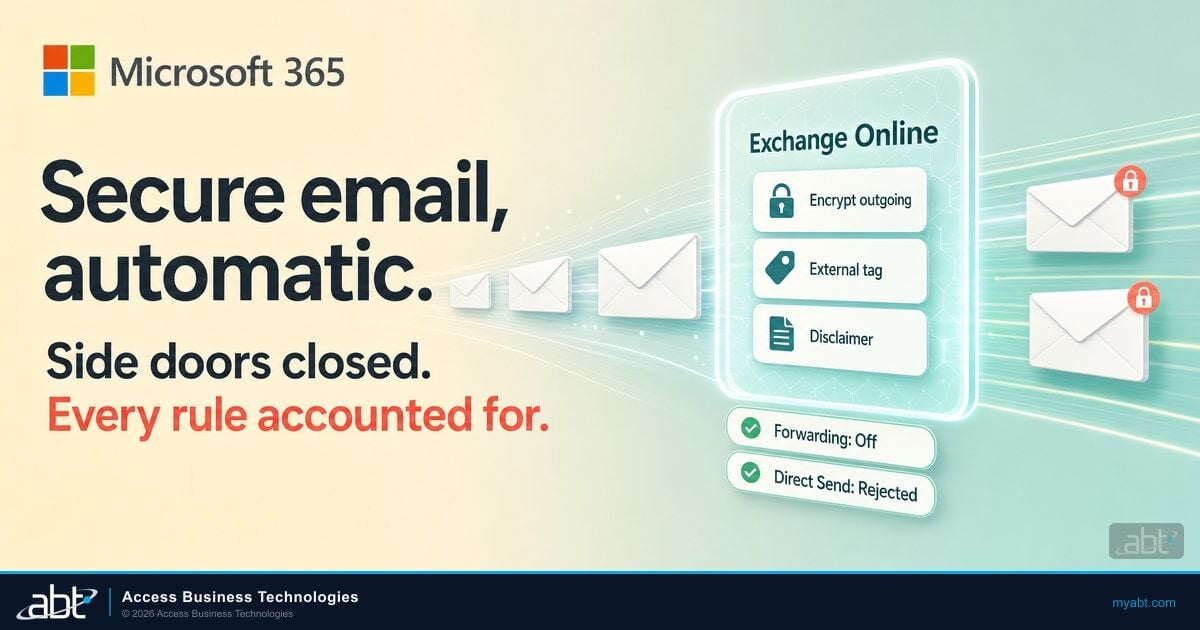
- Microsoft Purview Data Loss Prevention tuned to borrower NPI. Create policies that detect Social Security numbers, bank account details, loan application identifiers, and credit-report data in outbound emails. DLP rules alert the sender before sensitive borrower information leaves the organization through an unencrypted channel and can require Microsoft Purview Message Encryption automatically when a match is detected.
- Microsoft Purview Message Encryption. Outlook Message Encryption ensures loan documents and borrower correspondence stay confidential in transit. Recipients outside the organization open encrypted emails through a secure portal, which means a mistyped recipient address does not turn into a GLBA breach notification.
- SPF, DKIM, and DMARC enforcement. These email authentication protocols prevent attackers from spoofing the firm's domain. DMARC enforcement in
p=rejectmode tells receiving mail servers to drop emails that fail authentication checks, which closes the wire-fraud impersonation route attackers use to send fake closing instructions to title companies and borrowers. - Multi-Factor Authentication via Microsoft Authenticator or FIDO2. Deploy Microsoft Authenticator for push-based MFA at minimum. For high-risk accounts including administrators, finance personnel, and any user with access to wire-transfer systems, implement FIDO2 security keys that resist phishing proxy attacks. The FTC Safeguards Rule requires MFA for anyone accessing customer information including desktop access, not just web applications. The NYDFS Part 500 amendments require universal MFA for all system access with the MFA requirement effective November 1, 2025 and the first annual certification due April 15, 2026.
- Microsoft Intune device compliance and Conditional Access scoping. Every device that touches borrower data enrolls in Microsoft Intune with a mortgage-tuned compliance baseline. Microsoft Entra ID Conditional Access blocks access from non-compliant devices, from unmanaged personal devices, and from sign-in locations outside the firm's operating geography. This is the control that closes the BYOD gap that examiners ask about most often during an FFIEC Information Security Booklet review.
DLP, MFA, and Encryption: The Three Controls Examiners Look For
The FTC Safeguards Rule at 16 CFR Part 314.4(c) names the three controls every financial institution must implement: encryption of customer information in transit and at rest, multi-factor authentication for any individual accessing customer information, and access controls including the disposal of customer information when no longer needed. For a mortgage office, those three controls map directly onto three Microsoft products that ship in the Microsoft 365 Business Premium tier and above. Examiners do not ask whether the office bought the Microsoft license. They ask whether the controls are configured, enforced, and producing evidence on demand.
Encryption is the easiest of the three to document because Microsoft Purview Message Encryption can be triggered automatically by a Microsoft Purview Data Loss Prevention policy. The DLP rule scans outbound mail for borrower NPI patterns, loan application data formats, and wire-instruction language. When the rule fires, Microsoft Purview Message Encryption wraps the message in a Microsoft-hosted secure portal that the external recipient opens with a one-time passcode or a federated identity. The sender does not need to remember to encrypt the message. The system enforces the regulatory expectation in the background.
Multi-factor authentication is where the Microsoft Entra ID Conditional Access engine becomes the operating layer rather than a single setting. The Microsoft 365 admin can turn MFA on for every user with a single Conditional Access policy, but the regulatory question is not whether MFA is on. The regulatory question is whether MFA is required for every authentication path into systems that hold customer information, including desktop and mobile clients, third-party integrations to the loan origination system, and the wire-transfer terminal that sits behind a workstation in the closing department. Microsoft Entra ID Conditional Access policies scoped to the right user groups and the right application surfaces is what turns the FTC Safeguards Rule's three-word requirement into a real, enforced control.
For a mortgage office, the Microsoft baseline for compliant email runs across five Microsoft products. Microsoft Exchange Online handles the mailbox layer with tamper-evident retention through Microsoft Purview. Microsoft Defender for Office 365 handles anti-phishing, Safe Attachments, Safe Links, and impersonation protection tuned to wire-fraud patterns. Microsoft Purview Data Loss Prevention scans outbound mail for borrower NPI, loan application data, and wire-instruction language while Microsoft Purview Audit produces the time-stamped trail GLBA examiners ask for. Microsoft Entra ID enforces Conditional Access, multi-factor authentication, and sign-in risk policies under the FTC Safeguards Rule. Microsoft Intune enrolls every device that touches borrower data with a mortgage-tuned compliance baseline. ABT layers M365 Guardian, the firm's mortgage-tuned operating model for these Microsoft tools, on top of the deployment so the controls stay in compliance after configuration and produce examiner-ready evidence on demand.
The FTC Safeguards Rule does not ask whether the office bought a Microsoft license. It asks whether encryption, MFA, and access controls are configured, enforced, and producing evidence on demand.
From Configuration to Operating Model: Where M365 Guardian Fits
Configuration is a starting point. Drift is what happens next. A new branch office opens and the local IT contact sets up Microsoft 365 with default tenant settings, including default 90-day audit retention while the home office has been on 365-day retention since 2024. A loan officer transfers from processing to origination and keeps the processor-tier DLP exception that was never closed. A new device arrives in the field and never enrolls in Microsoft Intune. None of this is malicious. It is the natural drift of a multi-branch federated organization without an operating model sitting on top of the Microsoft baseline.
M365 Guardian is ABT's operating model on top of the Microsoft 365 configuration described in the sections above. The Microsoft baseline supplies the controls, including Microsoft Exchange Online, Microsoft Defender for Office 365, Microsoft Purview DLP, Microsoft Entra ID Conditional Access, and Microsoft Intune device compliance. M365 Guardian supplies the operating layer: a 24/7 security operations center watching the Microsoft Defender and Microsoft Sentinel signals every minute of the day, FFIEC-tuned policy templates calibrated against actual examiner findings rather than vendor SMB defaults, mortgage-specific DLP policies tested against borrower NPI patterns, loan application data types, and wire-instruction language, continuous drift detection that surfaces when a Conditional Access policy is modified locally or a retention rule is disabled at a branch, and examiner-ready evidence packs produced on demand for FTC Safeguards Rule annual reporting, GLBA examinations, and NYDFS Part 500 annual certifications.
The same multi-tenant control plane that broker-dealers use to standardize Microsoft 365 across affiliated entities applies to mortgage companies operating through multiple branches, wholesale channels, or correspondent relationships. The mortgage office's compliance officer does not need to log into Microsoft 365 admin centers across five branches every Monday to confirm that Defender for Office 365 anti-phishing policies are still in standard protection level. M365 Guardian does that confirmation continuously and surfaces only the exceptions.
- 24/7 SOC monitoring of Microsoft Defender for Office 365 + Microsoft Sentinel signals. Anti-phishing detections, Safe Attachments verdicts, impersonation alerts, and Defender for Cloud Apps signals all stream into a single operating console watched continuously, not reviewed on a part-time generalist's calendar.
- FFIEC-tuned policy templates calibrated against actual examination findings. Defender for Office 365 protection levels set to
standardorstrictbased on the role, Conditional Access scopes mapped to user groups that reflect the firm's real org chart, and Microsoft Purview retention policies set to 365 days for audit logs and longer for litigation hold. - Mortgage-specific Microsoft Purview DLP policies. Detection patterns tested against actual loan application data formats including Encompass, Calyx Point, and Empower exports, borrower NPI patterns covering SSN and credit-report identifiers, and wire-instruction language tuned to closing-table fraud patterns.
- Continuous drift detection across the tenant. When a Conditional Access policy is modified locally at a branch, when a retention rule is disabled, or when a new admin role is granted outside the firm's approved Privileged Identity Management workflow, M365 Guardian surfaces the change before it becomes the next examination finding.
- Examiner-ready evidence packs on demand. When the next FTC Safeguards Rule annual report comes due, when the next GLBA examination opens, when the next wire-fraud incident triggers an incident-response review under the firm's written information security program, the partner running the firm's Microsoft 365 tenant produces the evidence in hours, not weeks.
See where M365 Guardian fits on top of your Microsoft 365 baseline
ABT's mortgage email specialists map the current Microsoft 365 configuration in your tenant against the FTC Safeguards Rule, GLBA, FFIEC IT Handbook, and NYDFS Part 500 control lists. The conversation surfaces the drift between vendor defaults and mortgage-tuned settings and outlines what an ABT-managed M365 Guardian deployment would cover. No commitment and no quote required.
Key Takeaway
The Microsoft 365 baseline (Exchange Online, Defender for Office 365, Purview, Entra ID, Intune) supplies the controls that the FTC Safeguards Rule, GLBA, FFIEC IT Handbook, and NYDFS Part 500 require. M365 Guardian supplies the operating model that keeps those controls in compliance after configuration, surfaces drift before it becomes an examination finding, and produces examiner-ready evidence on demand. Configuration is the starting line. The operating model is what keeps the firm across the finish line examination after examination.
The ABT Tier-1 CSP Advantage for Mortgage Companies
Access Business Technologies is a Tier-1 Microsoft Cloud Solution Provider with a mortgage core in its customer book. ABT serves more than 750 financial institutions including banks, credit unions, mortgage companies, and securities firms. As a Direct-Bill CSP under the Microsoft New Commerce Experience, ABT operates as the partner of record for the customer's Microsoft 365 tenant under Granular Delegated Admin Privileges, which means the firm's compliance officer can answer the FTC Safeguards Rule third-party oversight question with documentation that names a single managed partner and a single vendor oversight agreement.
For mortgage workloads specifically, ABT layers M365 Guardian on top of the Microsoft baseline. Microsoft Entra ID Conditional Access is scoped to mortgage-specific user roles and the loan origination system surface. Microsoft Purview DLP policies are tuned to borrower NPI, loan-ticket data, and wire-instruction language with detection patterns ABT has tested against real mortgage email volumes. Microsoft Purview Communication Compliance is configured to surface wire-fraud impersonation patterns including the closing-table fraud schemes that California's Information Security Requirements call out specifically for mortgage lenders. Microsoft Purview Audit retention is set to 365 days or longer to satisfy GLBA examiner expectations for tamper-evident logs covering a 24-month examination lookback. Microsoft Sentinel ingests the Microsoft 365 audit stream alongside loan origination system logs to produce a single security operations view across the mortgage stack.
The CSP relationship operates under Granular Delegated Admin Privileges, a vendor oversight agreement that satisfies the FTC Safeguards Rule's third-party oversight requirement at 16 CFR Part 314.4(f), and an annual independent verification cycle that produces the documentation the firm hands to examiners during FFIEC Information Security Booklet reviews. ABT does not host Microsoft 365 in the traditional sense, because Microsoft owns the underlying infrastructure. ABT manages the firm's Microsoft 365 tenant as the delegated administrator, which is the precise role Microsoft documents in the Microsoft Partner Center and which auditors recognize as the correct line of accountability for a managed Microsoft 365 environment.
Frequently Asked Questions
The FTC Safeguards Rule at 16 CFR Part 314.4(c) requires mortgage lenders to encrypt customer information in transit and at rest, implement multi-factor authentication for anyone accessing customer data including desktop and server access, conduct regular penetration testing of applications that handle customer information, and maintain access controls that are periodically reviewed. Lenders must also deploy monitoring and logging to track user activity and detect unauthorized access to email systems containing borrower data. Microsoft Purview Message Encryption, Microsoft Entra ID Conditional Access with MFA, and Microsoft Purview Audit map directly onto these requirements inside Microsoft 365.
Microsoft Purview Data Loss Prevention scans outbound emails and attachments for patterns matching sensitive data types including Social Security numbers, bank account numbers, and credit card details. When a match is detected, the policy can block the email, require Microsoft Purview Message Encryption, or notify the sender with a warning before the message is sent. Mortgage offices configure custom DLP policies tuned to loan application data types and borrower NPI patterns to prevent accidental disclosure of borrower information to unauthorized recipients during the origination and servicing lifecycle.
SPF, DKIM, and DMARC are email authentication protocols that prevent attackers from spoofing the firm's domain in phishing emails. SPF verifies the sending server is authorized. DKIM adds a digital signature that confirms the email was not altered in transit. DMARC ties SPF and DKIM together with a policy that tells receiving servers to reject or quarantine emails that fail authentication. For mortgage companies, domain spoofing is a primary vector for wire fraud and business email compromise schemes that target closing instructions, title company communications, and borrower wire transfers.
Microsoft Purview Compliance Manager provides a compliance score for the organization and offers regulatory assessment templates for frameworks including the Gramm-Leach-Bliley Act, the FFIEC Information Security Booklet, and the FTC Safeguards Rule. It identifies gaps in the current configuration, recommends specific improvement actions, and tracks progress toward compliance targets. For mortgage companies, Compliance Manager maps Microsoft 365 settings directly to regulatory requirements and generates documentation useful during NCUA, FFIEC, state Department of Financial Services, and FTC examinations.
M365 Guardian is the operating model Access Business Technologies layers on top of a customer's Microsoft 365 tenant. A standard Microsoft 365 deployment supplies the controls including Microsoft Exchange Online, Microsoft Defender for Office 365, Microsoft Purview Data Loss Prevention, Microsoft Entra ID Conditional Access, and Microsoft Intune. M365 Guardian supplies the operating layer on top: a 24/7 security operations center watching the Microsoft Defender and Microsoft Sentinel signals, FFIEC-tuned policy templates calibrated against actual examiner findings, mortgage-specific DLP policies tested against borrower NPI patterns and wire-instruction language, continuous drift detection across the tenant, and examiner-ready evidence packs produced on demand for FTC Safeguards Rule annual reporting and GLBA examinations.
ABT operates M365 Guardian as the delegated Microsoft 365 administrator on the customer's behalf under Granular Delegated Admin Privileges. The mortgage office's compliance officer does not need to log into Microsoft 365 admin centers across multiple branches every Monday morning. ABT's security operations center watches the Microsoft Defender and Microsoft Sentinel signals continuously, surfaces drift in Conditional Access scopes or retention policies, tunes the Microsoft Purview Data Loss Prevention rules against new mortgage-specific patterns, and produces evidence packs for examinations on demand. The compliance officer receives a monthly executive report and an examination-ready evidence pack on request, and ABT handles the operating work behind the scenes.