

In This Article

Gartner analyst Dennis Xu spent 20 minutes on a single topic at the Sydney Security & Risk Management Summit this week: broken SharePoint permissions. Not ransomware. Not nation-state attacks. SharePoint permissions. Because when your organization turns on Microsoft 365 Copilot, every file that was quietly overshared for the past decade becomes instantly discoverable by AI.
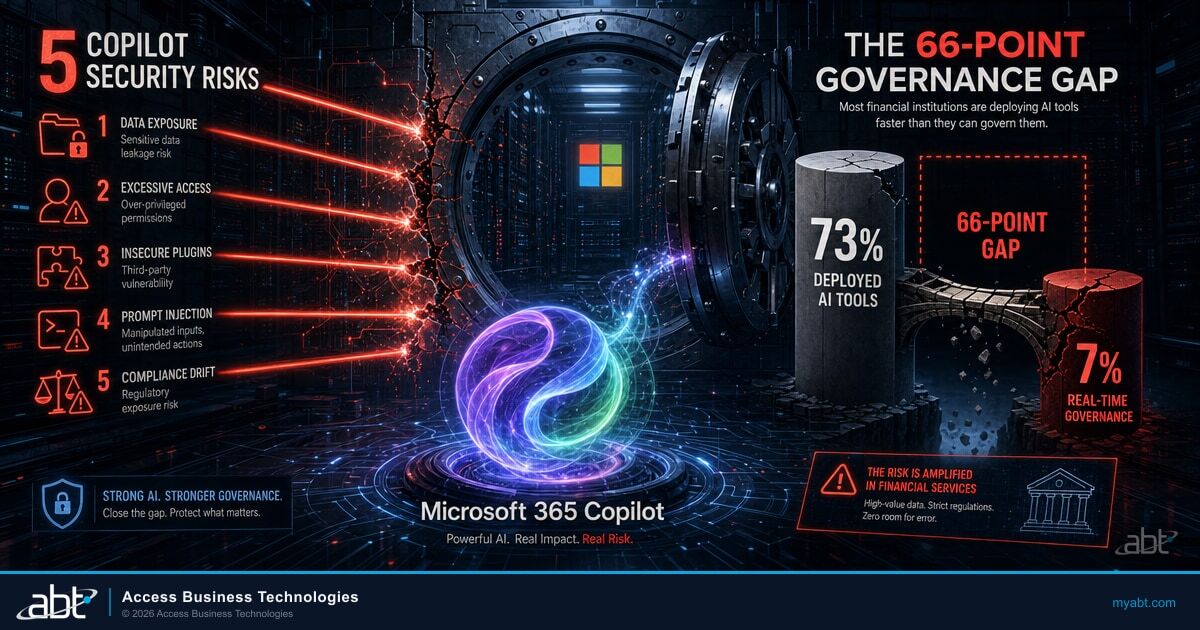
Xu identified five specific security risks that Copilot introduces or amplifies. Two of them already have active CVEs from the past seven days. And while 73% of organizations have deployed some form of AI tooling, only 7% have real-time governance in place to manage it. That is a 66-point gap between deployment and control, the same gap we detailed in our analysis of Treasury's 230-control AI risk framework.
For credit unions, community banks, and mortgage companies operating under NCUA, FDIC, and CFPB oversight, the gap carries regulatory weight. Here is what Gartner found, what it means for your institution, and what you can do about it before your next examiner visit.
Short on time? Gartner's 5 Copilot risks in under a minute.
Gartner named five Copilot security risks in its 2026 guidance. The Short runs through all five with the two live CVEs called out. The long walkthrough below maps each risk to the Purview, Entra ID, DLP, and sensitivity-label controls ABT deploys for banks that cannot afford to wait for the next patch cycle.
Watch the 60-second versionThe 66-Point Governance Gap
The number that should keep IT directors awake: 73% of organizations have deployed AI tools, but only 7% have governance systems that monitor those tools in real time. The remaining 66% are flying without instruments.
That gap has a price tag. Shadow AI breaches cost organizations $670,000 more per incident than breaches in governed environments. And the exposure surface is bigger than most teams realize. The average Microsoft 365 tenant has 802,000 files at risk from oversharing. These are files with broken inheritance, stale guest access, or permissions granted to "Everyone except external users" three years ago and never cleaned up.
Before Copilot, those files sat in quiet disorder. A user would need to know the file existed and navigate to it. Copilot changes that equation. It can surface any file you have permission to access in seconds. And "you have permission" now includes every overshared document in the tenant.
Why This Matters for Credit Unions and Community Banks
Financial institutions operate under data handling requirements that general enterprises do not. Member financial records, BSA/AML documentation, board minutes, and examiner correspondence all live in SharePoint and OneDrive. When Copilot can summarize any document a user has access to, a permissions audit is not optional. It is a prerequisite.

The Five Copilot Security Risks Gartner Identified
Dennis Xu laid out a clear taxonomy. Each risk is specific, each is already being exploited or tested, and each has a governance response.
Oversharing via Broken SharePoint Permissions
This is the risk Xu spent the most time on. When organizations migrated to SharePoint Online over the past decade, permission structures came along uncleaned. Files shared with "Everyone" groups, sites with broken inheritance, and guest access that was never revoked all create a surface that Copilot makes instantly searchable. A user in the accounting department asks Copilot for budget information and gets back the CEO's compensation review because someone shared a folder too broadly in 2019.
Oversharing Blueprint
Microsoft built this three-phase remediation framework for Copilot readiness. As a Tier 1 Cloud Solution Provider, ABT has deployed it for 750+ financial institutions, adapting each phase for NCUA, FDIC, and CFPB compliance requirements.
Export top 100 sites. Run SharePoint Advanced Management permission state report. Use Purview Content Explorer to find sensitive information types. Optionally enable Restricted SharePoint Search.
Discover oversharing risks with permission reports. Initiate Access Reviews. Apply Restricted Access Control on critical sites. Enforce DLP policies.
Automate permission reports. Proactively apply access controls at provisioning. Set up retention and deletion policies. Identify inactive sites.
Remote Code Execution via Malicious Prompts
Copilot processes natural language and translates it into actions: writing formulas, running macros, building Power Automate flows. Malicious prompts embedded in documents or emails can trick Copilot into executing code the user never intended. This is not theoretical. CVE-2026-26144, published March 10, demonstrates a zero-click exfiltration attack through Copilot Agent mode in Excel. The OWASP Top 10 for Agentic AI specifically catalogs this class of vulnerability.
The governance response: Conditional Access policies can restrict Copilot actions by risk level. Purview Data Loss Prevention monitors what Copilot reads and blocks sensitive file access based on sensitivity labels. Endpoint management through Intune ensures devices running Copilot meet security baselines.
Sensitive Data Access via Third-Party SaaS Plugins
Copilot's web plugin is enabled by default. That means third-party SaaS integrations can feed data into Copilot responses without the user explicitly requesting it. Xu warned that this creates a data leakage path where sensitive tenant information leaves the Microsoft 365 boundary through plugin APIs that most IT teams have not audited.
The governance response: Microsoft's Copilot Control System operates across three pillars - Security, Management, and Measurement. For this specific risk, the Management pillar applies: IT admins can disable web plugins at the tenant level, restrict which third-party connectors are approved, and audit plugin usage through the Copilot Dashboard. Agent 365, launching May 1, adds centralized agent governance with discovery, lifecycle management, and access controls. We covered the full E7 and Agent 365 licensing details in our analysis last week.
Prompt Injection Bypassing Guardrails
An attacker embeds instructions in a document or email that Copilot processes as legitimate prompts. The user asks Copilot to summarize their inbox, and a crafted email hijacks the response to exfiltrate data or change the output. CVE-2026-26133, published March 11, demonstrates this exact attack: cross-prompt injection in email summaries that turns Copilot into a phishing vector operating inside the trusted M365 interface.
The governance response: Purview Communication Compliance monitors Copilot interactions for anomalous patterns. Insider Risk Management can trigger dynamic security policies when a user's Copilot activity signals a potential compromise. Sensitivity labels inherited by Copilot responses prevent the AI from incorporating content above the user's clearance into its outputs.
Toxic Output Requiring Human Review
Copilot generates content based on what it finds in the tenant. If the training environment includes biased, outdated, or inaccurate documents, Copilot reproduces those problems. In a financial institution, this means a Copilot-drafted compliance response could reference a superseded regulation, or a customer communication could contain inaccurate rate information pulled from an old spreadsheet.
The governance response: Content lifecycle policies through Purview ensure outdated documents are either archived or labeled as superseded. Retention policies prevent stale content from accumulating. Regular content audits, combined with Copilot Dashboard analytics, identify which documents Copilot references most frequently so teams can prioritize accuracy reviews.
| Gartner Risk | Active Exploit | Microsoft Control | ABT Guardian Layer |
|---|---|---|---|
| 1. Oversharing | 802K files/tenant avg. | SharePoint Advanced Mgmt + Purview labels | SharePoint Advanced Management + Purview DSPM for AI (deployed and monitored by ABT) |
| 2. Remote Code Exec | CVE-2026-26144 | Conditional Access + Intune baselines | Security policy enforcement |
| 3. Third-Party SaaS | Default-on web plugins | Admin plugin controls + Agent 365 | Connector restriction + admin consent gating (ORG_AllowAppCreation + ORG_ApplicationConsent policies in Guardian baseline) |
| 4. Prompt Injection | CVE-2026-26133 | Purview Communication Compliance | Microsoft Defender XDR prompt injection signals (XPIADetected, JailbreakDetected) surfaced in Security Insights + Purview Communication Compliance Prompt Shield classifiers (configured by ABT) |
| 5. Toxic Output | Stale tenant content | Retention policies + lifecycle mgmt | Tenant-level AI governance hygiene (CA policies gating Copilot access + DLP-based content detection for sensitive Copilot output) |

The CVE Evidence Trail
Two of the five risks already have confirmed vulnerabilities from the past seven days.
Zero-click exfiltration vulnerability in Copilot Agent mode for Excel. An attacker crafts a spreadsheet that, when opened by a user with Copilot enabled, triggers autonomous data extraction without user interaction. The attack exploits Agent mode's ability to read, process, and act on spreadsheet contents independently.
The second vulnerability arrived one day later, targeting a different attack surface but exploiting the same underlying trust model: Copilot processes everything it can access, and users trust what Copilot returns.
Cross-prompt injection in Copilot email summaries. An attacker sends an email containing embedded instructions that Copilot processes when the recipient asks for an inbox summary. The result: phishing content delivered through Copilot's trusted interface, bypassing traditional email security filters that operate on message delivery rather than AI summarization.
These are not proof-of-concept demonstrations in a lab. These are published CVEs with MITRE identifiers, disclosed within a week of each other, targeting the AI layer that 73% of organizations adopted without governance.
Earlier this year, a DLP bypass bug allowed Copilot to summarize confidential emails in violation of existing Data Loss Prevention policies. And EchoLeak, scored at CVSS 9.3, demonstrated zero-click prompt injection for data exfiltration from Microsoft 365 tenants. The pattern is consistent: the AI layer introduces new attack surfaces that traditional security tools were not designed to monitor.
Not Sure Where Your SharePoint Permissions Stand?
ABT has audited tenant permissions for 750+ financial institutions. A short ABT Security Grade pass identifies the top security configuration gaps in your tenant - the same gaps that translate directly to Copilot risk once AI features are enabled.
Why Financial Institutions Face Amplified Risk
General enterprises face these five risks. Financial institutions face them with a regulatory amplifier.
Forty percent of organizations delayed Copilot rollout specifically because of oversharing concerns. Among regulated industries, the number is higher: 73% paused AI rollouts due to governance gaps, according to industry research. Financial institutions are overrepresented in that 73% because the consequences of a governance failure are not limited to breach costs. They include examiner findings, consent orders, and restrictions on business activities.
Copilot Without Governance
- 802,000 files instantly searchable by AI
- No visibility into what Copilot accesses
- Third-party plugins enabled by default
- No audit trail for AI-generated content
- Stale documents treated as current by AI
- Shadow AI spreading across departments
Copilot with ABT Governance
- Permission audit completed before deployment
- Guardian monitors every Copilot interaction
- Approved plugins only, audited quarterly
- Full Purview compliance trail for AI activity
- Retention policies clean stale content automatically
- Copilot is the governed AI, no shadow tools needed
The comparison is not theoretical. Every week, ABT sees the difference between governed and ungoverned tenants during onboarding audits. Here is what a real failure looks like.
A loan officer asks Copilot to summarize recent mortgage applications. SharePoint permissions were never cleaned after a 2021 department reorganization. Three folders containing denied application files are shared with "All Staff."
Copilot surfaces NPI from denied applications in the summary: applicant names, SSNs, income data, denial reasons. This creates a fair lending documentation risk, a potential ECOA violation, and an examiner finding that could have been prevented with a SharePoint permission audit before Copilot activation.
Scenarios like this are not edge cases. They are the predictable result of deploying AI on top of years of uncleaned permissions. The question is whether governance comes before or after the examiner finding. Microsoft's own data shows what happens when you get the sequence right.
As a Tier 1 Microsoft Cloud Solution Provider, ABT has access to internal Microsoft partner data that most MSPs never see. Here is what it shows: across Microsoft's own sales force of 24,000 sellers, Copilot users saw win rates jump 20% and per-seller revenue increase 9.4%. But those results came from a governed environment with clean data, proper permissions, and real-time monitoring. The 353% three-year ROI that Forrester independently documented requires the same governance foundation that ABT builds for financial institutions.
Two of Gartner's five Copilot risks have active CVEs. Patch cadence is now a compliance control.
The 80% of security leaders who cite data leakage as their primary generative AI concern are not wrong. But the answer is not to avoid Copilot. It is to govern it. Our Copilot deployment guide for financial institutions walks through the governance-first approach step by step. The risk is not in the technology. It is in the gap between deployment and governance.
The Governance Framework That Addresses All Five
Gartner's Dennis Xu called for Microsoft to build "a single de-risking layer." The components already exist. They just need to be configured, connected, and monitored. That is exactly what ABT does for credit unions, community banks, and mortgage companies.
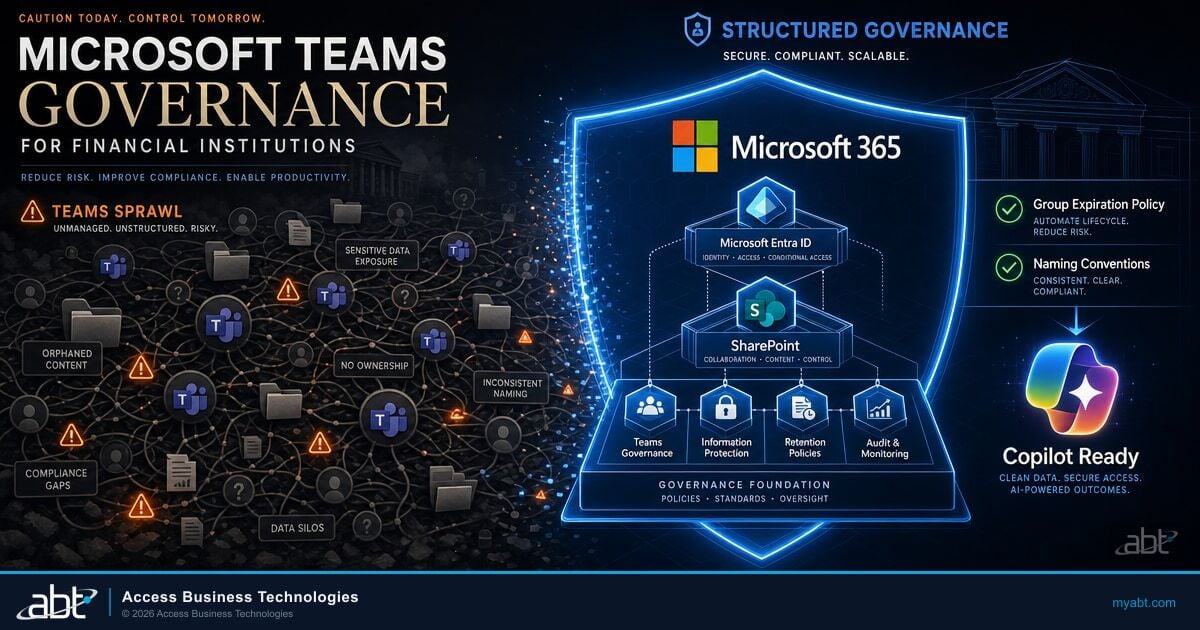
Identify and remediate overshared files, broken inheritance, and stale guest access before Copilot touches them
Classify financial data, member records, and examiner correspondence. Block Copilot from processing restricted content
Restrict Copilot actions based on device compliance, user risk level, and network location
Monitor Copilot interactions for anomalous prompts, data exfiltration attempts, and policy violations
Daily Guardian Security Insights reports surface security configuration drift, Microsoft Secure Score movement, and Copilot usage patterns across the tenant
Archive outdated documents, enforce regulatory retention periods, prevent Copilot from referencing superseded content
One detail that matters: Copilot inherits all existing Microsoft 365 security, privacy, identity, and compliance settings. Customer data is never used to train foundation LLMs. Copilot responses automatically inherit sensitivity labels from source documents. Data stays within your tenant and is processed inside the Microsoft Security Trust Boundary. The platform carries FedRAMP, ISO 42001, and GDPR compliance certifications.
Microsoft built the Copilot Control System around three pillars that map directly to Gartner's concerns:
| Control System Pillar | What It Covers | Gartner Risks Addressed |
|---|---|---|
| Security & Governance | Data security, AI security, compliance, privacy controls | Risks 1, 2, 4 (oversharing, code execution, prompt injection) |
| Management Controls | Licensing, configuration, third-party integrations, agent policies | Risk 3 (third-party SaaS plugin access) |
| Measurement & Reporting | Usage analytics, productivity impact, business value ROI, Copilot Dashboard | Risk 5 (toxic output: identify which documents Copilot references most) |
The security foundation is already there. The gap is in configuration and monitoring. That is exactly where ABT operates.
| Governance Capability | Business Premium | BP + Purview Add-On |
|---|---|---|
| SharePoint Advanced Management reports | Included | Included |
| DLP policies for Copilot in files and emails | Included | Included |
| Copilot responses inherit sensitivity labels | Included | Included |
| Targeted oversharing assessments | Add Purview | Included |
| Auto-apply protections to sensitive content | Add Purview | Included |
| Communications Compliance for prompt analysis | Add Purview | Included |
| Purview DSPM for AI data assessments | Add Purview | Included |
| Compliance and ethical violation alerts | Add Purview | Included |
Most credit unions and community banks under 300 users start with Business Premium and add the Purview suite to reach near-E5 governance without the E5 price tag. ABT right-sizes the SKU mix for each institution. You do not need the most expensive license to govern Copilot properly. You need the right add-ons configured correctly. ABT has built this governance stack for more than 750 financial institutions.
What to Do This Week
You do not need to wait for your next budget cycle to start addressing these risks. Three actions you can take this week:
Run a SharePoint Oversharing Report
SharePoint Advanced Management includes built-in oversharing detection. If you have Business Premium or E5, the tool is already in your tenant. Run it. The number will likely surprise you.
Microsoft published a step-by-step Oversharing Blueprint at aka.ms/Copilot/OversharingBlueprintLearn that walks through the full remediation.
Audit Your Copilot Plugin Settings
Go to the Microsoft 365 admin center and check which web plugins and third-party connectors are enabled. If the answer is "I don't know," that is the problem Gartner identified.
With Agent 365 launching May 1, agent governance policies will let you restrict oversharing at the agent level. But only if you have the controls configured before the agents arrive.
Ask Your MSP About Their Copilot Governance Plan
If they do not have one, that tells you something important. ABT follows Microsoft's five-step implementation framework and adds Guardian monitoring at every step.
Security first, productivity second. That sequence matters.
Those three steps are straightforward. None of them requires a budget approval or a vendor contract. They require someone to log into the admin center and check the settings. If your MSP has not already done this, ask them why.
Microsoft's own implementation framework follows five steps: enable Copilot Chat and prepare your workforce, define your Core Unit of Work, prioritize and scope agentic initiatives using a feasibility matrix, validate through a controlled pilot, then assess and scale with Copilot Analytics. Most institutions we work with skip straight to step 5. The ones who succeed start at step 1.
The organizations that get Copilot right are not the ones who move fastest. They are the ones who govern first and deploy second. That distinction is the difference between a productivity multiplier and an examiner finding.
How Many of Gartner's 5 Copilot Risks Apply to You?
Gartner named the risks; the work is knowing which ones live in your specific Microsoft 365 configuration and what to do first. An AI Readiness assessment turns that list into a prioritized plan for your institution.
Frequently Asked Questions
Gartner analyst Dennis Xu identified five risks at the March 2026 Sydney Security Summit: oversharing via broken SharePoint permissions, remote code execution via malicious prompts, sensitive data access through third-party SaaS plugins, prompt injection attacks that bypass guardrails, and toxic AI output from stale or inaccurate tenant content.
Yes. CVE-2026-26144, published March 10, is a zero-click exfiltration vulnerability in Copilot Agent mode for Excel. CVE-2026-26133, published March 11, enables cross-prompt injection in email summaries. Both are published vulnerabilities with MITRE identifiers.
No. The risks are governance gaps, not product flaws. Institutions that deploy Copilot with proper governance from day one see a 353% three-year ROI according to Forrester. The answer is not to avoid Copilot. It is to govern it with the right security framework before activation.
The AI Risk and Readiness Report 2026 found that 73% of organizations have deployed AI tools but only 7% have real-time governance monitoring those tools. That 66-point gap means most organizations are running AI without visibility into what it accesses, generates, or shares.
ABT configures Microsoft Purview, SharePoint Advanced Management, Conditional Access, and Guardian monitoring specifically for financial institutions. This includes permission audits before Copilot activation, sensitivity labeling for regulated data, DLP policies for AI interactions, and continuous monitoring through Guardian. ABT has deployed this governance framework for more than 750 credit unions, community banks, and mortgage companies.
Close the Governance Gap Before Your Next Exam
Every one of Gartner's five Copilot risks maps to a governance control that ABT configures for financial institutions. Find out where your tenant stands in five minutes.