

In This Article
- The Hidden Cost of Manual Data Re-Entry
- What Effortless Integration Actually Means
- Under the Hood: How the Bridge Works Day to Day
- Time Given Back to the People Who Earn It
- Security and Governance Built In, Not Bolted On
- Why This Matters for Every Credit Union
- What to Evaluate If You Are Considering Integration
- Frequently Asked Questions
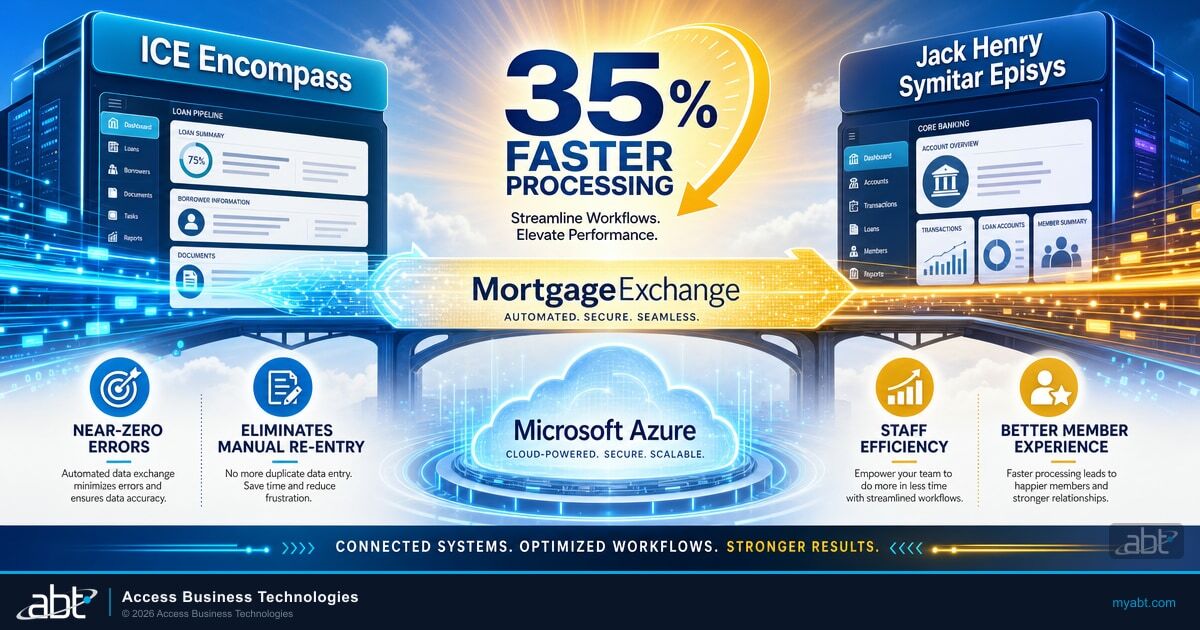
Industry research on mortgage operations consistently shows that automating the data handoff between a loan origination system and a core banking platform improves processing speed by roughly 35 percent with the same workforce. That improvement compounds over every closed loan, every month, every year. For Affinity Plus Federal Credit Union, eliminating manual re-entry between ICE Encompass and Jack Henry Symitar Episys did not just speed up loans. It changed what staff spent their time on, what auditors saw in records, and what the credit union could grow into without adding headcount.
This is the workflow-efficiency story behind the integration. If you are looking for the broader transformation narrative covering Affinity Plus, our companion case study From Manual to Seamless covers the institutional context. Here, we focus on the operational mechanics. What does effortless actually look like on a Tuesday morning when a loan needs to close?
Key Takeaway
Affinity Plus FCU connected ICE Encompass to Jack Henry Symitar Episys using ABT's MortgageExchange platform, eliminating the manual re-keying that previously consumed hours of staff time after every closing. The result: roughly 35 percent faster processing with the same workforce, near-zero transcription errors, audit-ready data by default, and loan officers redirected from clerical work to member-facing activities. Integration security inherits Microsoft Azure controls because MortgageExchange runs inside ABT's managed cloud environment.
The Hidden Cost of Manual Data Re-Entry
Most credit unions do not measure the time staff spend re-keying loan data because the work is invisible. It happens after closing, often after hours, while loan officers and operations staff transfer information from the loan origination system into the core banking platform field by field. Borrower name, address, loan amount, interest rate, escrow figures, payment schedule, insurance details, beneficiary information. Every closed mortgage represents 30 to 60 minutes of clerical entry that someone has to do before the loan can be serviced.
The cost is not just time. Manual transcription introduces errors at industry-standard rates of 1 to 5 percent per field. For a credit union closing dozens of mortgages per month, that translates to records with incorrect data flowing into servicing systems on a regular basis. A transposed interest rate becomes a payment discrepancy three months later. A mistyped escrow amount triggers a member complaint. A misspelled borrower name breaks identity matching downstream and creates a manual reconciliation cycle that consumes more staff time than the original entry did.
For Affinity Plus FCU, this dynamic played out daily. The credit union ran two best-of-breed platforms that did not natively talk to each other:
- ICE Encompass handled mortgage origination, application intake, underwriting, processing, and closing.
- Jack Henry Symitar Episys served as the core banking system for member accounts, loan servicing, regulatory reporting, and the rest of the operational backbone.
Both were capable systems individually. The gap between them was where the cost lived.
What Effortless Integration Actually Means
The word "effortless" in this case is not marketing language. It describes what staff at Affinity Plus experience now compared to before MortgageExchange was deployed. The integration removes the human from the data transfer entirely. Staff do not initiate the transfer. They do not validate it. They do not reconcile it. The transfer happens automatically as a consequence of work staff are already doing in Encompass.
When a loan officer completes a step in Encompass that updates a loan record, MortgageExchange detects the change, validates the data against business rules, transforms it into the format Symitar expects, and posts the clean record into the core banking system. The loan officer never sees this process. The Symitar operator never has to enter the data. The audit trail captures every field movement automatically.
This is what we mean by effortless. The integration produces the work product without producing the labor.
Why This Matters for Financial Institutions
The NCUA's annual cybersecurity report calls out third-party risk and integration controls as ongoing examination focus areas. Integration layers between an LOS and a core sit in exactly that gap. Even when both endpoint systems are hardened, the data flowing between them through manual processes is invisible to most security monitoring and audit tooling. Effortless integration is not just an efficiency win. It is a control win, because automated data movement is logged, validated, and reproducible in a way that manual transcription can never be.

Under the Hood: How the Bridge Works Day to Day
The mechanics of MortgageExchange are straightforward once you see them in operation. The platform sits as a managed service between ICE Encompass and Jack Henry Symitar Episys. ABT operates the integration on Microsoft Azure, monitors it continuously, and adjusts the data mapping whenever either vendor releases an update that affects field structure.
Day to day, a loan moves through the workflow like this at Affinity Plus:
- Origination in Encompass. A loan officer takes the application, processes the loan, and completes underwriting and closing steps within ICE Encompass. Nothing about this step changes from how the loan officer worked before.
- Event detection. MortgageExchange watches for the events that trigger data movement. When a loan reaches a defined milestone (closed, funded, or any other configured stage), the platform initiates the transfer.
- Validation against business rules. Before any data crosses to Symitar, MortgageExchange runs the record through a rules engine. Required fields must be present. Values must fall within expected ranges. Data types must match what Symitar expects. If anything fails validation, the record is flagged for human review rather than silently pushed forward.
- Transformation and routing. Valid data is reformatted to match Symitar's structure and transmitted over an encrypted channel. The Symitar endpoint authenticates the source before accepting the payload.
- Acknowledgment and audit logging. Symitar confirms receipt. MortgageExchange logs the entire transaction with timestamps, field-by-field values, and an immutable record of what moved when and from whom.
None of this requires a staff member to be present. The loan officer who closed the loan can be on a member call, at lunch, or working a different application. The data movement happens in the background, and the only signal staff receive is the same signal they would have received from the manual workflow: the loan now appears in Symitar.
Time Given Back to the People Who Earn It
The most visible change at Affinity Plus after MortgageExchange was deployed had nothing to do with software. It was the disappearance of the after-hours data entry shift that used to follow every closing day. Loan officers and operations staff who had been spending their evenings or early mornings keying loan fields into Symitar suddenly had that time back.
For a credit union the size of Affinity Plus, that time recovery is substantial. The benefits show up in several places at once:
- Loan officers focused on members again. Hours that used to go into post-closing data entry now go into pipeline management, application processing, and member consultations. The loan officer's job description always assumed this was the work they should be doing. Manual integration was just pulling them away from it.
- Operations staff redirected to exception handling. Instead of routine data transfer, operations staff now focus on the validation exceptions that MortgageExchange flags. This is more strategic, higher-skill work than typing the same fields into a second system. It also catches issues earlier in the cycle, when they are cheaper to fix.
- IT team freed from integration babysitting. Before MortgageExchange, every Encompass or Symitar update created the risk of integration breakage. The IT team had to monitor releases, test compatibility, and scramble when something broke. ABT now handles all of that. The credit union's IT team focuses on member-facing technology instead of vendor-compatibility chasing.
- Loan boarding accelerated from days to minutes. New mortgages appear in Symitar within minutes of closing in Encompass. Members see their loan reflected in online banking almost immediately. Welcome letters, payment schedules, and account access all start on time because the data is already there.
- Compliance preparation simplified. Pulling reports for an examiner used to mean reconciling records across two systems. Now both systems hold the same data because they receive it from the same validated source. Reports are pulled in minutes instead of days.
The cumulative effect is staff capacity. Affinity Plus did not need to hire additional loan officers or operations personnel to handle volume increases after MortgageExchange. The same workforce now processes more loans, with higher accuracy, in less time. Industry research suggests the productivity gain runs around 35 percent for institutions that automate this handoff. The math on staff cost alone makes integration platforms pay for themselves quickly. The accuracy and compliance gains are returns on top of that.
Effortless integration is not a feature claim. It is what happens when the integration produces the work product without producing the labor.
Security and Governance Built In, Not Bolted On
One of the questions financial institution leaders ask about integration platforms is whether the data movement creates a new security surface that needs separate monitoring, separate audit controls, and separate compliance documentation. For MortgageExchange, the answer is no. The integration inherits the security and governance posture of the broader Microsoft cloud environment that ABT manages.
MortgageExchange runs on Microsoft Azure inside ABT's managed cloud environment. As a Tier-1 Microsoft Cloud Solution Provider serving more than 750 financial institutions, ABT applies the same Microsoft Entra ID conditional access, Microsoft Defender for Cloud monitoring, and Microsoft Purview audit logging to the integration layer that it applies to the rest of the Microsoft 365 stack. The integration pipeline inherits the same identity, security, and compliance controls credit unions are already documenting for NCUA examiners, so it does not become a separate, weakly governed surface.
The specific controls that apply to MortgageExchange at Affinity Plus include:
- Encryption in transit and at rest. Data flowing through MortgageExchange uses TLS 1.2 or higher (TLS 1.3 supported). Stored data is encrypted at rest within the Azure environment. Both endpoints authenticate before data flows.
- Identity-based access controls. Service accounts used by MortgageExchange have dedicated credentials, separate from user accounts, monitored independently for anomalous access patterns. Microsoft Entra ID conditional access policies apply to privileged operations.
- Continuous monitoring. Microsoft Defender for Cloud monitors the Azure environment that hosts MortgageExchange for misconfigurations, suspicious activity, and threat indicators. Alerts feed into the same security operations workflow ABT uses across its managed customer base.
- Immutable audit logging. Microsoft Purview captures every data movement event with full attribution. Examiners can request the audit trail and receive a timestamped, field-level record of what data moved between systems, when, and on whose behalf.
- Vendor compatibility management. When ICE or Jack Henry releases an update that could affect the integration, ABT handles the compatibility work before it affects production. The credit union does not have to track vendor release notes for integration impact.
The governance result is that integration data is not less visible than data inside Encompass or Symitar. It is more visible, because every transfer is automatically captured by the audit infrastructure that surrounds the managed cloud environment. This is the inverse of how manual integration works, where the actual data movement happens inside someone's head and the audit trail is whatever the staff member happens to remember to log.
Why This Matters for Every Credit Union
Affinity Plus FCU's experience is not unusual. Most credit unions and community banks running mortgage operations face the same structural challenge: best-of-breed systems that solve specific problems brilliantly but do not natively share data with each other. The pattern repeats across vendor combinations, regional markets, and institution sizes.
The 2026 environment makes the cost of leaving this problem unsolved harder to ignore. Member expectations for immediate digital experience continue to rise. Examiners pay closer attention to operational risk and integration controls. Mortgage volumes fluctuate, which means institutions need workforce capacity that scales without hiring waves. And the labor market for skilled financial services staff remains tight, which makes it more expensive to lose loan officers and operations personnel to clerical work that automated systems should be doing.
Credit unions that solve the integration problem early gain a structural advantage. They process loans faster, maintain cleaner data, prepare for examinations with less effort, and absorb growth without adding back-office headcount. The institutions that delay keep paying the hidden tax on every closed loan. The tax is invisible because it shows up as staff hours, error rates, and reconciliation cycles rather than as a line item on the budget. But it is real, and it compounds.
For another perspective on the same pattern, see how Patelco Credit Union eliminated the same bottleneck between Empower LOS and Fiserv Spectrum, or read about 1st MidAmerica Credit Union's MortgageExchange deployment on a different LOS-and-core combination.
What to Evaluate If You Are Considering Integration
For credit union and bank leaders evaluating integration platforms, the questions to ask vendors are not primarily technical. They are operational and governance questions, because the technical capability tables for integration platforms all look similar. The differences show up in how the platform behaves in production over years.
- Pre-built connectors for your specific systems. Custom-built connectors are not just expensive to build. They are expensive to maintain when vendors release updates. Ask whether the platform supports your exact LOS and core out of the box. MortgageExchange supports 40+ mortgage technology systems, which means most credit union stacks are already covered.
- Mortgage-specific validation rules. Generic integration platforms move data between systems. They do not understand whether the data is correct. Mortgage-specific platforms validate against the business logic of lending, catching errors before they propagate. Ask what specific validation rules are applied and whether the rules engine can be customized for your institution.
- Managed service model versus product purchase. A managed service means the vendor handles updates, compatibility issues, and security monitoring on the integration layer continuously. A product purchase means your team handles all of that. Ask what the vendor takes responsibility for and what your team would need to absorb.
- Security posture and audit logging. Examiners increasingly ask about integration controls. Ask what cloud platform hosts the integration, what monitoring runs against it, what audit logs the platform produces, and how long those logs are retained.
- References from peer institutions. Talk to credit unions and banks similar to yours that are using the platform in production. Ask what surprised them. Ask what the platform does well. Ask what they wish they had known earlier.
The credit unions that have already deployed MortgageExchange report that the answers to all of these questions weighted in favor of a managed service from a partner who understands the financial services industry. The platform technology is necessary but not sufficient. The operational discipline that surrounds it is what makes integration effortless over the long run.
See where a managed integration pipeline fits in your stack
ABT's integration specialists map your current LOS-to-core data flow, identify where manual re-entry is costing you accuracy and audit time, and show you what a MortgageExchange deployment would look like for your specific systems.
Frequently Asked Questions
Effortless integration means the data transfer between ICE Encompass and Jack Henry Symitar Episys happens automatically as a consequence of work staff are already doing in Encompass. Staff do not initiate the transfer, validate it, or reconcile it. MortgageExchange detects loan record changes, validates them against business rules, and posts the clean data into Symitar without human intervention. The result is that staff get hours of clerical time back every week to focus on member-facing work.
Industry research on mortgage workflow automation consistently shows roughly 35 percent improvement in processing speed when the data handoff between origination and core systems is automated. For Affinity Plus FCU, the gain came from eliminating duplicate manual entry between ICE Encompass and Jack Henry Symitar Episys. Loan boarding accelerated from days to minutes, and the same workforce now processes more loans with higher accuracy than the manual workflow allowed.
No. MortgageExchange runs on Microsoft Azure inside ABT's managed cloud environment, so the integration inherits the same Microsoft Entra ID conditional access, Microsoft Defender for Cloud monitoring, and Microsoft Purview audit logging that applies to the rest of the Microsoft 365 stack. Integration data movement is logged, validated, and reproducible in a way that manual transcription cannot match. Examiners receive a timestamped, field-level audit trail rather than depending on staff to manually log what data moved when.
ABT handles vendor compatibility for MortgageExchange as part of the managed service. When ICE or Jack Henry releases an update that could affect the data flow, ABT adjusts the integration before it affects production. The credit union does not have to track vendor release notes, test compatibility, or scramble when something breaks. The IT team at Affinity Plus stays focused on member-facing technology instead of chasing vendor updates between two systems that do not coordinate releases.
The pattern repeats across vendor combinations and institution sizes. Most credit unions and community banks run best-of-breed systems that do not natively share data. MortgageExchange supports 40+ mortgage technology systems including ICE Encompass, Mortgage Cadence, Empower, Byte, and LoanSoft on the origination side, paired with Jack Henry Symitar Episys, Fiserv DNA, Fiserv Spectrum, Fiserv Premier, and Corelation KeyStone on the core side. The workflow efficiency gain Affinity Plus experienced applies wherever the same manual swivel-chair pattern exists.
The questions that separate integration platforms in production are operational rather than technical. Ask about pre-built connector coverage for your specific LOS and core. Ask about mortgage-specific validation rules versus generic data transformation. Ask whether the model is a managed service or a product purchase, since managed service means the vendor handles updates and compatibility continuously. Ask about security posture, audit logging, and log retention. And ask for references from peer institutions running the platform in production.
Continue Reading: Related Guides
- From Manual to Seamless: How Affinity Plus FCU Transformed Mortgage Operations
- Breaking the Mortgage Data Bottleneck: Patelco Credit Union's Integration Success
- Case Study for 1st MidAmerica Credit Union Using MortgageExchange
- AllSouth FCU Streamlined Mortgages With MortgageExchange Integration