

In This Article
Microsoft Entra ID is the front door to everything your team touches in Microsoft 365. Every email opened, every loan file pulled, every wire approval routed through Teams, every report a board member reviews in SharePoint runs through that identity layer first. When it holds, the whole stack just works and nobody thinks about it. On May 22, 2026, Microsoft disclosed that it had not been holding the way everyone assumed.
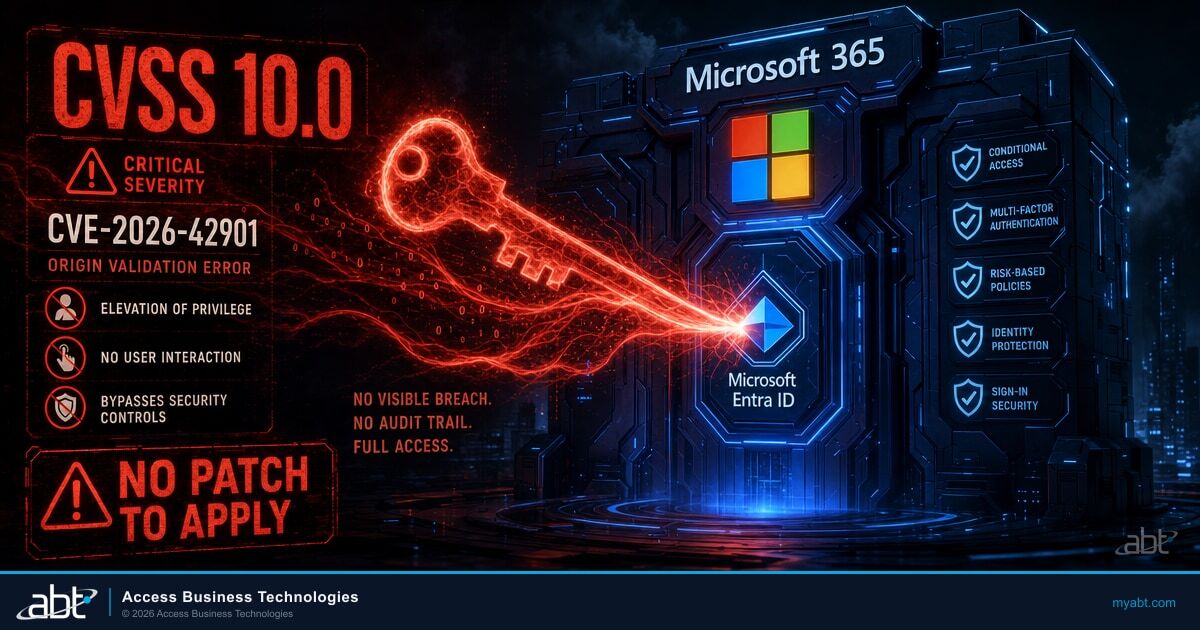
CVE-2026-42901 is a flaw in Microsoft's own Entra ID code, and it carries a CVSS score of 10.0. That is the maximum the scale allows. The detail that should stop a security leader cold is not the number. It is the vector: an attacker needed no stolen password, no phishing link, and no user to click anything at all.
That makes this vulnerability the opposite of nearly every identity threat banks, credit unions, and mortgage companies have read about this year. The last four identity stories were all about tricking a person. This one skipped the person entirely.
The Attack That Needed No One
Over the past month, the identity coverage aimed at financial institutions followed a familiar shape. Token theft through spoofed sign-in pages. Self-service password reset abuse. A Microsoft Authenticator information-disclosure flaw. Phishing-as-a-service kits that harvest credentials at scale. Every one of them starts the same way: a human being does something they should not have, or gets fooled into it.
That shape has dominated for good reason. Compromised credentials were the leading initial-access vector at 22 percent of breaches in the Verizon 2025 Data Breach Investigations Report, which is why so much defensive energy goes into protecting the user. But the same data shows the ground shifting: the Verizon 2026 report finds exploitation of software vulnerabilities now climbing past stolen passwords as the way attackers get in. The threat is no longer only the user, and CVE-2026-42901 is the textbook example of where it is heading.
The defenses follow the same shape too. You harden against phishing with phishing-resistant authentication. You train staff to spot the spoofed page. You shorten token lifetimes so a stolen session expires fast. These controls work because there is a user in the loop, and the user is the thing you are protecting.
CVE-2026-42901 has no user in the loop. The published exploitability profile says an unauthorized attacker, reaching the service over a network, can elevate privileges with no prior access and no interaction from anyone. There is no link to click because nobody needs to click. There is no credential to steal because the attacker never needed one. The weakness lives in how Entra ID itself validated the origin of a request, which is Microsoft's code, not your configuration and not your people.
An attacker sends a convincing email, a staff member enters credentials on a fake Microsoft sign-in page, and a session token is stolen. Your defense is phishing-resistant multifactor authentication, user training, and short token lifetimes. There is a person to protect and a behavior to change.
An attacker reaches the identity service over the network and elevates privileges with no credential, no phishing, and no user action at all. Training does not apply. Phishing-resistant sign-in does not apply. The flaw is in the platform code, so your only levers are how much standing privilege exists and how well you would see it being abused.
This is why the usual identity playbook does not answer the question this vulnerability asks. We covered phishing-resistant authentication in depth in our guide to phishing-resistant MFA for financial institutions, and that guidance still matters for the attacks aimed at your people. It just does not touch a server-side flaw in Microsoft's own code. Different problem, different answer.
What CVE-2026-42901 Actually Is
Strip away the framing and here is the technical reality. The National Vulnerability Database describes CVE-2026-42901 in one sentence: an origin validation error in Microsoft Entra ID allows an unauthorized attacker to elevate privileges over a network. The weakness class is CWE-346, origin validation error, and the source assigning the classification is Microsoft itself.
The CVSS 3.1 base score is 10.0, the top of the Critical band, with the vector string AV:N/AC:L/PR:N/UI:N/S:C/C:H/I:H/A:H. Tenable, Mondoo, and the GitHub Advisory database all corroborate the same score and the same metrics. None of that, by itself, tells a non-specialist why it earns a perfect 10. The vector does.
| Metric | Value | What It Means | Severity |
|---|---|---|---|
| Attack Vector (AV) | Network | Reachable remotely, not requiring local or physical access | Worst case |
| Attack Complexity (AC) | Low | No special conditions or timing windows required to succeed | Worst case |
| Privileges Required (PR) | None | The attacker is unauthorized before the attack begins | Worst case |
| User Interaction (UI) | None | No victim needs to click, open, or approve anything | Worst case |
| Scope (S) | Changed | Impact crosses a trust boundary into resources beyond the flawed component | Trust boundary breached |
| Confidentiality / Integrity / Availability | High / High / High | Full impact to data secrecy, data correctness, and service uptime | Worst case |
Read the right-hand column top to bottom. Every base metric sits at its worst possible value, and the scope is Changed, which means the damage does not stay contained inside the vulnerable component. That combination is exactly what it takes to reach a 10.0. Most vulnerabilities miss the ceiling on at least one metric. This one missed none.
What "Scope: Changed" Means in Plain Terms
In the CVSS standard, a Changed scope means an exploited weakness can affect resources beyond the security authority that governs the component where the flaw lives. In an identity platform, that is the worst direction for impact to travel: a privilege gained in one place can reach across into systems the original component was never supposed to control.
Why a Perfect 10.0 Is Different
It is worth being precise about what a 10.0 is and is not. Under the FIRST.org CVSS version 3.1 specification, base scores run from 0.0 to 10.0, and the Critical band spans 9.0 to 10.0. A perfect 10.0 is the very top of that band. It is not a marketing number and it is not assigned loosely. The math only reaches 10.0 when an attacker has every advantage at once and the impact breaches a trust boundary.
A CVSS 10.0 is not "very bad." It is the most severe rating the scale can produce, and it requires the worst value in every metric plus a breached trust boundary to get there.
For a board member or a non-technical executive, that is the translation worth keeping. This was not a routine patch-Tuesday item that happened to score high. It was the rare case where the scale ran out of room. And because the vulnerable component is the identity service that fronts the entire Microsoft 365 environment, the blast radius of a "Changed" scope is the whole tenant, not one mailbox or one app.

Decoded that way, the defensive problem comes into focus. There is no user mistake to prevent here and no password to protect, because the attacker needs neither. That is precisely the kind of platform flaw where the partner that manages your Microsoft 365 tenant earns its keep.
The National Vulnerability Database flags CVE-2026-42901 as an "Exclusively Hosted Service," which means Microsoft remediated it inside its own infrastructure. There is no update to download and no version to upgrade. As the partner that manages your Microsoft 365 tenant, that changes what we do for you on a flaw like this: there is no patch to apply, so the work shifts to confirming how little standing privilege exists in your tenant and how well anomalous privileged activity would be caught. Posture, not patching, is the deliverable.
When There Is Nothing to Patch
Here is the part that breaks the reflex. The first instinct on a CVSS 10.0 is to find the patch and deploy it fast. For CVE-2026-42901 there is no patch to deploy. Microsoft fixed it server-side as part of running the Entra ID service. Some vulnerability feeds still carry generic "apply the update" boilerplate, but the authoritative NVD record settles it: this is an Exclusively Hosted Service, remediated by the vendor, with no customer action of that kind available.
That is genuinely good news for the immediate exposure. It is also disorienting, because it removes the one task security teams are trained to reach for. If you cannot patch it, and you cannot train your way out of it, the honest question becomes: what does a maximum-severity identity flaw actually demand from a bank, a credit union, or a mortgage company?
The answer is a shift in where you put your attention. You stop asking "how do we close this specific hole" because Microsoft already did, and you start asking "if the identity platform itself can fail, how exposed are we when it does?" That question has nothing to do with this one CVE and everything to do with the standing posture of your tenant. It is the question worth answering whether the next platform flaw scores a 10.0 or a 6.
The Reflex to Resist
Treating a server-side-fixed cloud vulnerability as "nothing to do here" is the wrong read, and so is hunting for a patch that does not exist. The right response sits in between: confirm the vendor fix, then audit the privileged-access posture and detection coverage that determine how badly any identity flaw could hurt you. That work is yours to own, and examiners will ask whether you did it.
What You Actually Do Instead
For a managed Microsoft 365 tenant, the controls that matter for a privilege-escalation flaw are not phishing defenses. They are privileged-identity governance and identity-threat detection. The principle is straightforward: the less standing administrative access exists in your tenant, the smaller the prize any escalation flaw can reach, and the better your monitoring, the faster you would see a privilege boundary being crossed. Here is the concrete control surface inside Microsoft 365.
Make admin access just-in-time, time-bound, and approval-gated rather than standing. This limits how much permanent administrative access exists for any flaw to abuse, and it produces the downloadable audit history examiners expect.
Govern the conditions under which administrative roles can be used at all, evaluating identity, device, location, and risk before granting access. It controls who can use elevated roles and under what circumstances.
Surface risk detections such as anonymous IP usage, password spray, and leaked credentials, then feed those signals into Conditional Access or a security information and event management tool for investigation and correlation.
Detect identity-based attacks across on-premises, cloud, and hybrid environments, including the reconnaissance, privilege escalation, and lateral movement patterns an attacker would generate after gaining a foothold.
Review Entra ID sign-in and audit logs for anomalous privileged activity, exportable to Microsoft Sentinel for retention and correlation. This is the evidence trail that shows whether a flaw was ever exploited against you.
A precision note matters here, because the audience knows the difference. None of these controls patched CVE-2026-42901, and none of them prevent the next platform flaw. Privileged Identity Management reduces the standing-privilege blast radius and creates the audit trail. Conditional Access governs the conditions of admin access. Entra ID Protection and Defender for Identity detect and surface anomalous activity. They are governance and detection, not a fix. That distinction is exactly the point: when the vulnerability is in the platform, governance and detection are the levers you still hold.

This is the same logic we applied to self-service password reset abuse in our analysis of the Storm-2949 SSPR abuse campaign, and to token theft in our breakdown of the CVE-2026-40379 Entra ID token-service spoofing flaw. The common thread across all of them is that identity is the access foundation for the whole Microsoft 365 environment, and the institutions that govern privilege tightly and watch their logs closely are the ones that absorb these events without a crisis.
What Examiners Expect for a Cloud CVE
There is a common assumption that a vendor-fixed cloud vulnerability is invisible to examiners, since the institution never had to lift a finger. That assumption is wrong, and acting on it creates documentation risk. Financial institutions are expected to identify relevant vulnerabilities, assess whether they pose significant risk, and respond, even when the remediation happened inside the vendor's infrastructure.
The FFIEC IT Examination Handbook is explicit that moving systems to a third-party cloud provider does not lower the bar.
Outsourcing does not change the regulatory expectations for an effective information security program. Management should assess whether the institution has processes and procedures in place to identify and maintain a catalogue of relevant vulnerabilities, determine which pose a significant risk to the institution, and effectively mitigate and monitor the risks posed by those vulnerabilities.
The same booklet points institutions to the MITRE Common Vulnerabilities and Exposures dictionary as a standard tracking source, which is precisely where CVE-2026-42901 lives. The underlying statutory authority is the GLBA interagency information security standards, codified for credit unions at 12 CFR Part 748, Appendix A, and for national banks at 12 CFR Part 30, Appendix B. The expectation reaches every regulated institution that runs in the Microsoft cloud.
For a server-side-fixed CVE, satisfying that expectation is a short, documentable exercise. Record the vulnerability in your catalogue with the correct disposition. Document the privileged-access posture review you performed, the kind of structured identity audit we walk through in our guide to running an Entra ID security assessment for financial institutions. Show that you checked the relevant logs. And if you chose to accept any residual control gap rather than close it, document that decision and name the person accountable for it, exactly as the booklet requires.
The Documentable Response
Catalogue CVE-2026-42901 with the disposition "vendor-remediated server-side, no customer patch, identity-posture review performed." Record who holds standing admin access, whether just-in-time access is enforced, and whether admin sign-ins are gated by Conditional Access. Note that sign-in and audit logs were reviewed for anomalous privileged activity. That short paper trail is what turns a CVSS 10.0 headline into a clean examination answer.
How ABT Runs This for You
Access Business Technologies manages the Microsoft 365 tenants of more than 750 banks, credit unions, and mortgage companies through delegated administration. Microsoft hosts the infrastructure; ABT manages the tenant. On a flaw like CVE-2026-42901, that division of labor is the whole story. There is no patch for ABT to push, so the work is configuring and maintaining the privileged-identity controls inside your tenant: Privileged Identity Management for just-in-time admin access, Conditional Access policies for administrative roles, Entra ID Protection risk detections, and Microsoft Defender for Identity coverage.
Because the only durable defense against an unpatchable platform flaw is least standing privilege plus constant monitoring, the detection layer carries real weight. Guardian MxDR is the 24/7 managed detection and response service that watches Entra ID sign-in and audit signals, correlated through Microsoft Sentinel and Defender, for the anomalous privileged activity a scope-changed escalation flaw would produce. It is also the monitored evidence trail an examiner can point to when asking how the institution would know whether a vulnerability had been exploited.
The result is the answer to the question this CVE actually asks. When the vulnerability is in the platform, your defense is not the patch, because Microsoft already shipped it. It is how little standing privilege you carry, and how quickly you would see it if a privilege boundary were crossed. For an institution running Microsoft 365, that posture is something ABT builds, maintains, and documents. It is also what keeps loans closing, deposits clearing, and members served while a maximum-severity flaw is making headlines somewhere else. If you want to confirm where your own privileged-access posture stands, that review is exactly what we can run with you.
Find out how exposed your privileged identities really are.
ABT manages Microsoft 365 for more than 750 financial institutions and hardens Entra ID with Privileged Identity Management, admin Conditional Access, and Defender for Identity. Let us run your privileged-access posture review and show you what a maximum-severity identity flaw would actually reach.
Frequently Asked Questions
CVE-2026-42901 is an elevation-of-privilege flaw in Microsoft Entra ID caused by an origin validation error. It scores a CVSS 10.0, the maximum the scale allows, because it combines the worst value in every base metric (network attack, low complexity, no privileges, no user interaction, high impact) with a Changed scope that breaches a trust boundary.
No. The National Vulnerability Database lists CVE-2026-42901 as an Exclusively Hosted Service, meaning Microsoft remediated it server-side inside its own infrastructure. There is no update to download or version to upgrade. The institution's task shifts from patching to reviewing privileged-access posture and confirming that anomalous privileged activity would be detected.
Phishing, token theft, and MFA bypass all rely on tricking a user. CVE-2026-42901 requires no stolen credential, no phishing link, and no user interaction at all because the flaw is in Microsoft's own Entra ID code. Phishing-resistant authentication and user training, which defend against user-targeted attacks, do not address a server-side platform flaw.
Focus on privileged-identity governance and detection. Enforce just-in-time admin access with Microsoft Entra Privileged Identity Management, gate admin roles with Conditional Access, enable Entra ID Protection and Microsoft Defender for Identity, and review Entra ID sign-in and audit logs for anomalous privileged activity. These controls limit blast radius and surface exploitation.
Yes. The FFIEC IT Examination Handbook states that outsourcing to cloud providers does not change the expectation for an effective information security program. Institutions must catalogue relevant vulnerabilities, assess significant risk, and document their response, even for server-side-fixed flaws. The GLBA standards at 12 CFR Part 748, Appendix A apply to credit unions.
ABT manages the Microsoft 365 tenants of more than 750 financial institutions and hardens Entra ID with Privileged Identity Management, admin Conditional Access, and Defender for Identity. Because a server-side flaw cannot be patched by the customer, Guardian MxDR provides 24/7 monitoring of Entra ID signals through Microsoft Sentinel, plus the documented posture review examiners expect.