

In This Article
- Why Manual Document Processing Breaks at Scale
- How Real-Time Document Pipelines Work
- MortgageExchange and App Pilot: ABT's Document Automation Pipeline
- Microsoft 365 Copilot for Agentic Document Summarization
- AI-Powered Verification: Beyond Basic OCR
- Core System Integration: LOS, Core Banking, and the Document Pipeline
- Compliance Automation: BSA/AML, FFIEC, and TRID Together
- M365 Guardian: Keeping the Document Pipeline Audit-Ready
- ROI Framework for Document Automation
- Technical Reference
- Frequently Asked Questions
A loan file at a community bank, a member onboarding packet at a credit union, and a mortgage application all share one feature: they arrive as an unpredictable mix of PDFs, photos, and forms that someone has to read, classify, and route. For decades that someone was a human in a queue. In 2026, the document workflows that used to take days are dropping to hours, and the teams that depend on them are getting reorganized around the new speed.
The shift is not coming. It is here. Banks, credit unions, and mortgage companies are deploying intelligent document processing on top of Microsoft 365 to convert raw uploads into verified, fielded data ready for a core system, a loan origination system, or a compliance workflow. The technology now reads a Schedule C and computes qualifying income. It pulls names and dates from a beneficial-ownership form into a BSA/AML case file. It maps a regulator request letter to the documents the institution must produce.
This article walks through how these document pipelines actually work, where they pay off in banking and credit union operations as well as in mortgage lending, and what the ROI looks like once the workflow is running. It is written for IT directors, COOs, and operations leaders at financial institutions who already use Microsoft 365 and want to understand what document automation can do on top of it. We also cover how ABT pulls the pieces together with MortgageExchange, App Pilot, and Microsoft 365 Copilot Business inside the institution's own tenant.
Why Manual Document Processing Breaks at Scale
The volume of paper running through a financial institution has been climbing every year. Beneficial ownership rules under FinCEN, expanded Customer Due Diligence (CDD) requirements, and stricter mortgage and consumer-lending verification standards mean a 2026 file contains roughly double the documents of a comparable file from five years ago. That is true for a credit union opening a new business account, a community bank processing a commercial loan, and a mortgage company building a closing package.
Manual processing does not scale with that growth. Independent operations research at large banks has documented manual workflow defect rates between 10 and 15 percent for high-volume document handling, with the highest rates concentrated in income verification, address verification, and identity matching. Each defect triggers rework, audit findings, or, in the worst case, a regulatory inquiry that consumes far more staff hours than the original task.
The bottleneck is not the document. It is the human in the middle. Someone has to open the file, identify what it is, extract the relevant data, validate it against other sources, and route it to the right person. That workflow made sense when loan files were 50 pages and member onboarding packets were 6. At 300 to 500 pages for a complex commercial credit, or 40 to 60 pages for a fully documented mortgage, it is a staffing problem that hiring cannot solve.
Why This Matters for Banks, Credit Unions, and Mortgage Companies
The cost of manual document processing is no longer just headcount. Examiners under the FFIEC IT Examination Handbook now ask institutions to demonstrate that document handling, retention, and audit trails are repeatable, not dependent on individual staff. A workflow that lives in someone's email and a stack of network folders does not pass that test, regardless of how careful the staff are. AI document automation rebuilds the workflow as an auditable pipeline, which is the form examiners and external auditors expect to see.
How Real-Time Document Pipelines Work
Real-time document pipelines replace the manual intake-classify-extract-route cycle with a connected sequence of automated steps. A borrower uploads a pay stub from a phone, or a member uploads a beneficial-ownership form from a portal. Within seconds, the system identifies the document type, extracts the relevant fields, validates them against data already in the file, and writes the verified result into the system of record. Three layers do this work.
- Intelligent Document Processing (IDP): Classifies incoming documents by type, even when they arrive as multi-page PDFs with mixed content. Modern platforms handle 600 or more document types out of the box, covering loan files, KYC packets, BSA/AML reviews, audit responses, and vendor agreements in addition to mortgage-specific forms.
- AI-Powered Extraction: Multi-modal transformer models read the document and understand what the data means, not just what it says. They calculate qualifying income from a Schedule C, validate that bank statement transactions add up, cross-reference pay stub amounts against W-2 totals, and pull names, addresses, and tax IDs from beneficial-ownership forms into a CDD case file.
- Automated Validation: Flags missing documents, inconsistent data, and potential fraud in real time. The borrower or member sees specific, immediate requests rather than vague phone calls three days later.
The customer or member experience changes as much as the back-office one. Instead of uploading documents into a black box and waiting, they see instant confirmation that each file was received, processed, and accepted. Missing items generate clear, specific requests instead of an emailed checklist that arrives Monday and references a closing on Friday.
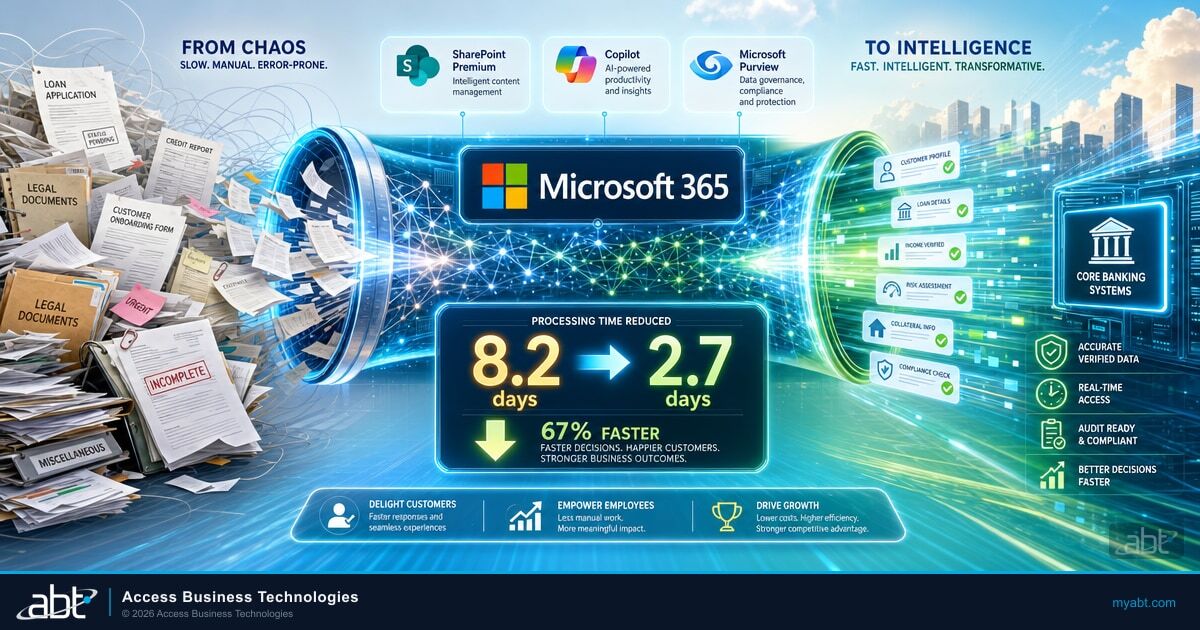
Microsoft 365 already includes the building blocks for this pipeline. SharePoint Premium (formerly Syntex) provides the AI-powered classification, extraction, and content understanding that turns unstructured uploads into structured fields, with governance and retention controls inherited from Microsoft 365. Microsoft 365 Copilot in Word, Excel, Outlook, and Teams, with agentic capabilities generally available since April 22, 2026, lets analysts run multi-step actions on extracted data, including variance analysis on pulled financial figures, anomaly detection in spreadsheet exports, and drafting board-ready narratives from the underlying numbers, while keeping previews and user control on each step. Microsoft Purview binds the audit trail, sensitivity labels, and retention policies to every document the pipeline touches.
MortgageExchange and App Pilot: ABT's Document Automation Pipeline
SharePoint Premium and Microsoft Purview supply the Microsoft side of the pipeline. The other half is the integration spine that carries verified fields out of the document layer and into the loan origination system, the core banking platform, and the downstream compliance workflow without anyone retyping a Schedule C figure into a second screen. That is where ABT MortgageExchange does the work that off-the-shelf middleware does not.
MortgageExchange is ABT's mortgage-aware integration platform. It carries verified borrower and document data from intake into ICE Encompass, MeridianLink Mortgage, Mortgage Cadence, Dark Matter Empower, or Calyx PointCentral, then onward into Fiserv Premier, Fiserv DNA, Symitar, Jack Henry SilverLake, or Corelation KeyStone on the core side. Income extracted from a pay stub lands in the 1003 fields. Beneficial ownership data extracted from a CDD packet lands in the member record. Closing disclosures extracted at TRID checkpoints land in the loan-level audit trail. The pipeline runs on Microsoft Azure, monitored by ABT, with audit evidence collected on every document boundary.
Where MortgageExchange handles the integration plane, App Pilot handles the application surfaces the staff actually click into. App Pilot is ABT's managed application service for the loan origination system, the document repository, the borrower-facing intake portal, and the downstream productivity surfaces the operations team uses. The team logs in to a stable, ABT-managed environment that already speaks to MortgageExchange. DocumentGuardian is the document-management surface that holds the source files with sensitivity labels and retention policies inherited from Microsoft Purview, so the extracted-field record and the original document live under the same governance contract. The combination gives a bank, credit union, or mortgage company a single accountable provider for the document pipeline, the integration spine, the application stack, and the Microsoft 365 tenant they all run inside.
Microsoft 365 Copilot for Agentic Document Summarization
The most visible day-to-day change for staff is what Microsoft 365 Copilot does inside Outlook, Teams, Word, and Excel after a document lands in the pipeline. With agentic capabilities generally available since April 22, 2026, Copilot reads the document where the analyst already works, summarizes the relevant fields, and drafts the next step the human needs to take. A loan officer opens a freshly extracted bank statement in Outlook and Copilot drafts the conditions request back to the borrower. A processor opens a Schedule E in Word and Copilot summarizes the rental income calculation, flags the inconsistencies, and proposes the underwriter narrative. A CDD analyst opens a beneficial-ownership packet in Teams and Copilot drafts the case-file note with the ownership chain already mapped.
Multi-step actions stay inside the institution's Microsoft 365 tenant. The data does not leave for a third-party AI service. Microsoft 365 Copilot Business at $21 per user per month, the standalone tier for community banks, credit unions, and mortgage lenders without an E5 footprint, is the version most ABT customers run on top of the document pipeline. Copilot inherits the tenant's Microsoft Entra ID identity controls, Microsoft Purview sensitivity labels, and Microsoft Defender protection so the analyst gets AI assistance on extracted document data without opening a new data-loss vector. The summarization layer is where productivity shows up first; the integration spine and the governance contract are what make the summarization safe to use at scale.
AI-Powered Verification: Beyond Basic OCR
Legacy OCR reads text on a page. AI document intelligence understands context. The difference is the gap between a scanner and an experienced processor, and it shows up in every document type a financial institution handles.
Consider a self-employed mortgage borrower with a 100-page tax return. Traditional OCR extracts text fields. AI document intelligence reads the Schedule C, calculates net business income using the correct GSE formula, flags inconsistencies between reported income and bank deposits, and generates the qualifying income figure an underwriter needs. The same model, applied to a small-business CDD packet at a credit union, reads a beneficial-ownership form, matches names against the institution's existing member database, and surfaces ownership chains that would take a human analyst hours to assemble manually.
Modern platforms achieve 95.4% extraction accuracy and 97.8% classification accuracy in production environments. Roughly four in ten complex mortgage files receive a "Refer" decision from automated underwriting and route to manual review. AI document intelligence does not replace the underwriter on those files. It prepares the analysis so the reviewer spends minutes per file instead of hours. The same pattern holds at a community bank reviewing commercial loan covenants, or a credit union ratifying a complex membership eligibility case.
The bottleneck is not the document. It is the human in the middle. Document intelligence does not replace the analyst on hard cases. It prepares the analysis so the analyst spends minutes per file instead of hours.
Core System Integration: LOS, Core Banking, and the Document Pipeline
Document automation only delivers ROI when extracted data flows into the system of record without manual re-entry. For mortgage companies, that means the loan origination system, with API integration writing verified income, asset, and identity data into 1003 fields automatically. For community banks and credit unions, it means the core banking platform, where verified beneficial-ownership data lands in a CDD case file, member identity data lands in the customer information file, and commercial loan covenant data lands in the loan administration record.
For Encompass users, the result is concrete. Income data from a verified pay stub populates 1003 fields. Asset verification data from a bank statement feeds the asset section. Conditions from automated underwriting map to specific document requirements that the system tracks and fulfills. The same architecture, applied to Fiserv DNA or Symitar at a credit union, lets a CDD case file populate from beneficial-ownership extraction without analyst keystrokes. Across institutions, ABT MortgageExchange and the wider connected Microsoft 365 workflow link these systems through Microsoft Power Automate, the Microsoft Graph, and pre-built MortgageExchange connectors.
The integration also runs in reverse. When an underwriter or analyst adds a condition, the system identifies which documents are needed, generates a specific request to the customer, and monitors for the upload. When the response arrives, the system verifies the document satisfies the condition and updates the file. ABBYY documented one global financial institution discovering 550,000 hours of rework buried in mortgage operations alone, much of it caused by missing or mis-routed documents that automation eliminates.
Compliance Automation: BSA/AML, FFIEC, and TRID Together
Every document in a financial institution file is a compliance checkpoint. Disclosures must be delivered within specific timelines under TRID for closed-end mortgage loans. CDD information must satisfy FinCEN beneficial ownership rules. Identity verification must satisfy KYC and AML obligations. Audit trails must meet the FFIEC IT Examination Handbook expectations on document retention and access logging. Manual tracking of these requirements at scale is exactly where compliance failures happen.
Document intelligence platforms embed compliance into the intake process rather than auditing it after the fact. They verify TRID disclosures were delivered within the required windows, flag expired or about-to-expire documents before they cause a closing or onboarding delay, and maintain audit trails that examiners and external auditors expect to see. Mapping these compliance controls to Microsoft 365 lets institutions point to a configurable platform record rather than a manual policy document when an examiner asks.
Why The Audit Trail Matters As Much As The Speed
Every document classification, every extraction, every validation decision is logged automatically. When an auditor asks why a specific income figure was used, or how a CDD review reached its conclusion, the system shows the source document, the extraction logic, and the validation checks it passed. Microsoft Purview retains those logs for the period set by the institution's retention policy, and Microsoft Defender for Cloud Apps surfaces unusual document access patterns. The combination is what turns "we follow our procedures" into "we can prove it."
M365 Guardian: Keeping the Document Pipeline Audit-Ready
A document pipeline that touches borrower NPI, member CDD packets, and TRID disclosures is high-value territory for an examiner and a high-value target for an attacker. ABT operates the security and governance layer over the pipeline through M365 Guardian, ABT's operating model layered on top of Microsoft 365 for financial institutions. Guardian configures Microsoft Purview DLP policies for borrower NPI and beneficial-ownership data, sets Microsoft Sentinel analytic rules tuned to document-pipeline signals like impossible-travel access to a deal room or mass downloads from DocumentGuardian, and monitors the integration plane through MortgageExchange logs.
The reader does not need to know where the Microsoft baseline ends and the ABT operating model begins. The institution experiences a single contract for the document pipeline, the integration spine, the AI assistance layer, and the security overlay, with one team holding every layer accountable. That is what Tier-1 Microsoft CSP status delivers to a community bank or a mortgage lender that cannot keep four different vendor relationships in sync on top of running the loan business.
See MortgageExchange and Microsoft 365 Copilot on Your Document Workflow
ABT helps banks, credit unions, and mortgage companies cut document processing time on top of Microsoft 365 they already own. A 30-minute conversation maps your current document workflow, identifies where MortgageExchange, App Pilot, and Microsoft 365 Copilot Business would pay off first, and outlines what an ABT-managed deployment with M365 Guardian governance would cover. No commitment, no quote, no obligation.
ROI Framework for Document Automation
Measure these metrics before and after implementing real-time document automation. The first three are operational; the last two are compliance and cost. All five should improve together, and improvement on cost without improvement on the others is a sign the automation has been bolted onto a broken process.
Manual baseline is typically 8 to 15 days for a mortgage file or a complex commercial loan packet. AI-powered systems bring this to 2 to 3 days, a reduction in the 67 to 70 percent range. KYC and CDD reviews see similar gains, often dropping from 5 days to under 24 hours.
Expect 100 to 130 percent more files processed per month with the same staff. The Landing AI mortgage case study showed 11,500 to 26,300 loans per month at the same headcount. Credit union member onboarding workflows show comparable gains.
Manual processing produces 10 to 15 percent defect rates on the highest-volume document types. Automation reduces these errors to below 2 to 3 percent. Over a year, the elimination of rework alone often justifies the investment.
Track audit exceptions per quarter or per examination. Automated systems with built-in compliance checks reduce findings by 50 to 78 percent. The reduction is largest in TRID timing, BSA/AML CDD completeness, and document retention.
Calculate total document handling cost (staff time, rework, buybacks, audit response) divided by file volume. Target a 60 to 70 percent reduction. ROI accelerates with volume because automated systems scale without adding headcount.
Most institutions recover their investment within months. The ROI accelerates as volume increases because automated pipelines scale without adding headcount, and because the audit-trail discipline they install pays compounding dividends in every subsequent examination cycle. ABT helps banks, credit unions, and mortgage companies phase the migration so the document pipeline goes live alongside the broader Microsoft 365 modernization, rather than as a one-off project. Loan officers, processors, and underwriters move onto the pipeline through role-specific Microsoft 365 Copilot Business workflows that mirror the daily steps the staff already run.
Technical Reference
IDP (Intelligent Document Processing)
AI-powered platform that automatically classifies, extracts, and validates data from structured and unstructured documents. In Microsoft 365, the entry point is SharePoint Premium.
OCR (Optical Character Recognition)
Technology that converts scanned images and PDFs into machine-readable text. Legacy OCR reads text only. Modern OCR-free models understand document structure and context together with the text.
Multi-modal Transformers
AI models that process visual layout and text content simultaneously, enabling document understanding without rigid templates. They are the model class behind modern IDP accuracy gains.
APA (Agentic Process Automation)
AI agents that orchestrate document workflows, make routing decisions, trigger downstream actions, and escalate exceptions across systems. Microsoft 365 Copilot agentic capabilities in Word, Excel, Outlook, and Teams, generally available April 2026, are an example.
CDD (Customer Due Diligence)
FinCEN-mandated process for identifying customers, identifying beneficial owners of legal entity customers, understanding the nature of the customer relationship, and conducting ongoing monitoring. Each component generates documents that fit a document automation pipeline.
TRID (TILA-RESPA Integrated Disclosures)
Federal regulations governing disclosure timing in mortgage lending. Document automation platforms track and enforce these timelines automatically and surface them in the audit trail.
Microsoft Purview
Microsoft 365 governance, risk, and compliance surface that holds the audit log, sensitivity labels, and retention policies for documents processed through the pipeline.
ABT MortgageExchange
Mortgage-aware integration platform that connects loan origination systems (ICE Encompass, MeridianLink Mortgage, Mortgage Cadence, Dark Matter Empower, Calyx PointCentral) and core banking platforms (Fiserv Premier, Fiserv DNA, Symitar, Jack Henry SilverLake, Corelation KeyStone). Carries verified document data between systems on top of Microsoft Azure.
ABT App Pilot
ABT's managed application service for the loan origination system, document repository, and borrower-facing intake portal. Pairs with DocumentGuardian and MortgageExchange to give institutions one accountable provider for the document pipeline.
M365 Guardian
ABT's operating model layered on top of Microsoft 365 for financial institutions. Configures Microsoft Purview DLP and retention, Microsoft Sentinel analytic rules, and Microsoft Defender protection around the document pipeline, the integration spine, and the Microsoft 365 Copilot Business deployment.
The Bottom Line
Real-time AI document automation is no longer a mortgage-only conversation, and it is no longer a future-state conversation. Banks, credit unions, and mortgage companies that ran the first pilots in 2024 and 2025 are running the second wave now, on top of Microsoft 365 surfaces that already sit inside the institution's tenant. ABT MortgageExchange, App Pilot, and Microsoft 365 Copilot Business under M365 Guardian governance pull the pipeline, the integration spine, and the AI assistance into one accountable contract. The institutions that wait will compete against peers who have already cut document handling time by two-thirds and audit findings by half, with the same staff.

Frequently Asked Questions
Traditional OCR reads text from scanned pages. AI document intelligence understands what the data means in context. It can calculate qualifying income from a Schedule C, cross-reference pay stub amounts against W-2 totals, validate that bank statement transactions add up, and pull names, addresses, and ownership chains from beneficial-ownership forms into a CDD case file. Modern systems achieve 97.8 percent classification accuracy across 700 or more document types covering loan files, KYC packets, BSA/AML reviews, and audit responses.
Production data shows processing time dropping from 8 to 15 days to 2 to 3 days, a reduction in the 67 to 70 percent range. File throughput per staff member increases by 100 to 130 percent. One Landing AI mortgage case study documented a jump from 11,500 to 26,300 loans processed per month after deploying AI document automation across 1.2 million pages. CDD and KYC reviews at credit unions and community banks see similar gains, often dropping from 5 days to under 24 hours.
ABT MortgageExchange is the mortgage-aware integration platform that carries verified document data from intake into the loan origination system and onward into the core banking platform. It carries Schedule C income into Encompass 1003 fields, beneficial-ownership data into Fiserv DNA or Symitar member records, and TRID disclosure checkpoints into the loan-level audit trail. The platform runs on Microsoft Azure, is monitored and supported by ABT, and is the most common spine for ABT customers connecting Microsoft 365 document automation to their LOS and core.
Microsoft 365 Copilot Business reads documents where the analyst already works, summarizes the relevant fields, and drafts the next step. A loan officer opens an extracted bank statement in Outlook and Copilot drafts the conditions request to the borrower. A processor opens a Schedule E in Word and Copilot summarizes the rental income calculation. A CDD analyst opens a beneficial-ownership packet in Teams and Copilot drafts the case-file note with the ownership chain already mapped. Multi-step actions stay inside the institution's Microsoft 365 tenant, inherit Microsoft Entra ID identity controls and Microsoft Purview sensitivity labels, and run at the $21 per user per month standalone tier most ABT customers buy.
API integration creates a pipeline where verified document data populates system-of-record fields automatically. Income from a pay stub goes into Encompass 1003 fields. Asset data from bank statements feeds the asset section. Underwriting conditions map to specific document requirements that the system tracks. The same architecture, applied to Fiserv DNA or Symitar at a credit union or to a community bank's core banking platform, lets a CDD case file populate from beneficial-ownership extraction without analyst keystrokes. ABT MortgageExchange is the spine most ABT customers use for that LOS-to-core integration, with pre-built connectors that cut the integration project from quarters to weeks.
Automated systems reduce compliance defect rates from 10 to 15 percent to below 2 to 3 percent. They enforce TRID disclosure timelines, satisfy FinCEN CDD beneficial-ownership requirements, flag expired documents before closing or onboarding, maintain complete audit trails for every classification and extraction decision, and meet the FFIEC IT Examination Handbook expectations for document retention and access logging. M365 Guardian configures the Microsoft Purview retention policies, Microsoft Sentinel analytic rules, and Microsoft Defender protections that hold the compliance posture together at examination time.
Most institutions see processing costs drop 60 to 70 percent, defect rates fall from double digits to below 3 percent, and file throughput double or more with the same staff. Compliance audit findings decrease 50 to 78 percent, with the largest reductions in TRID timing, BSA/AML CDD completeness, and document retention. One mortgage lender documented $100,000 in annual savings from automating a single document workflow. ROI accelerates with volume because the MortgageExchange spine and the Microsoft 365 Copilot Business workflow scale without adding headcount.
ABT manages Microsoft 365 tenants for more than 750 banks, credit unions, and mortgage companies as a Tier-1 Cloud Solution Provider primarily dedicated to financial services. ABT helps institutions design the document pipeline on top of SharePoint Premium and Microsoft 365 Copilot Business, connects the pipeline to Encompass, Fiserv, Symitar, Jack Henry, or other systems via ABT MortgageExchange, runs the application surfaces and document repository through ABT App Pilot and DocumentGuardian, and operates the security and governance overlay through M365 Guardian. The result is a single auditable document pipeline with one accountable provider, not a separate point solution stitched onto the tenant.