


Windows Server 2022 · Lifecycle
Windows Server 2022 does not go out of support on October 13. A different clock starts, and it runs out in 2028.
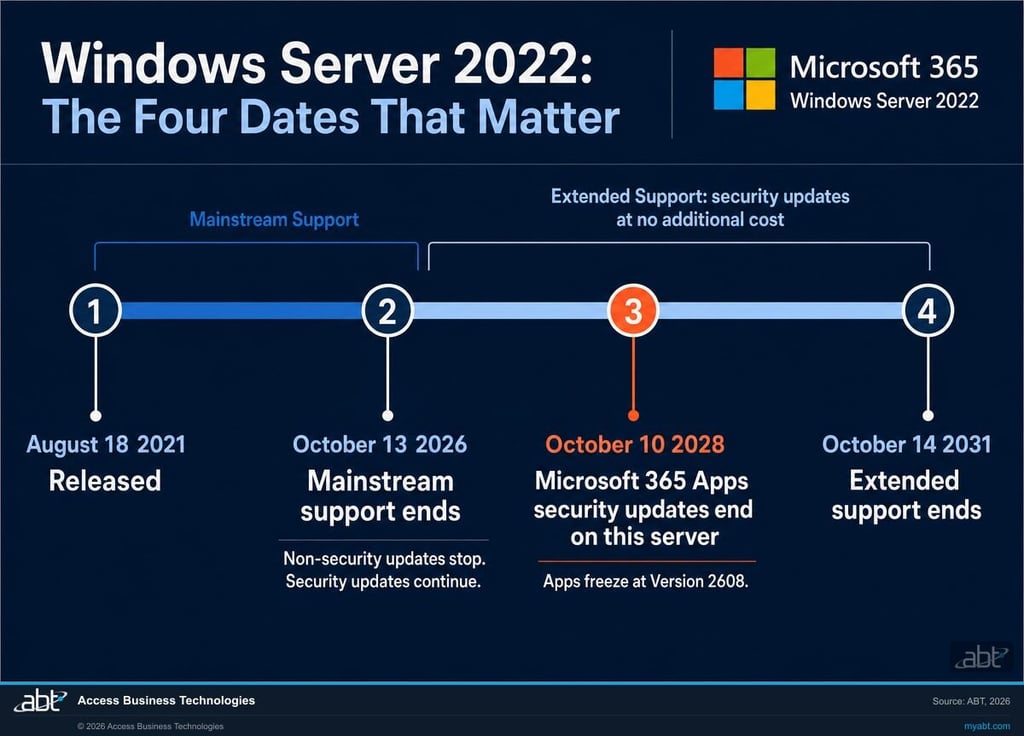
Mainstream support ends and the product moves into extended support, where Microsoft continues shipping monthly security updates at no additional cost through October 14, 2031. So the operating system stays supported. The deadline that bites is somewhere else: Microsoft ties Microsoft 365 Apps supportability on this server to mainstream support, which gives an Office estate on a session-host farm a real date of October 10, 2028.
- Microsoft: mainstream support ends October 13, 2026, and monthly security updates continue through October 14, 2031
- The October 2026 security update is the last mainstream update. Extended support then carries security updates at no additional cost
- Microsoft 365 Apps on this server freeze at Version 2608 and go security-only until October 10, 2028
Mainstream support ends
October 13, 2026
Security updates continue through October 14, 2031
Source: Microsoft, Windows message center, 30-day reminder published September 11, 2026.
The record
What does Microsoft actually publish about Windows Server 2022 support?
One row of dates, one policy name, and a timezone note. Everything else written about this date is interpretation.
Windows Server 2022 follows the Fixed Lifecycle Policy, which is Microsoft's oldest and most predictable support model: a defined timeline set at product launch, a minimum of five years of mainstream support, and an additional period of extended support. The lifecycle entry applies to the Datacenter, Datacenter: Azure Edition, Essentials, and Standard editions, and Microsoft notes that containers released with Windows Server 2022 follow the same dates.
| Listing | Start Date | Mainstream End Date | Extended End Date |
|---|---|---|---|
| Windows Server 2022 | 8/18/2021 8:00:00 AM | 10/14/2026 6:59:59 AM | 10/15/2031 6:59:59 AM |
Now the part that causes most of the confusion. Microsoft publishes these dates two different ways, and the two look a day apart. The lifecycle table stores each boundary as an end timestamp, and the page carries it as a UTC clock time. 10/14/2026 6:59:59 AM UTC is 11:59:59 PM Pacific on October 13, 2026, the last second of that day in Redmond, and the page's own script displays it in the reader's time zone, so readers in any US time zone see October 14. Microsoft's own announcements give the last supported day. The Windows message center reminder published on September 11, 2026 reads that on October 13, 2026 Windows Server 2022 will reach end of mainstream support, and that the October 2026 security update will be the last mainstream support update available for this version. Both describe the same moment. October 13 is the last day you are in mainstream support, and it ends when that day ends, Pacific time.
The same convention applies at the other end. The table lists an Extended End Date of 10/15/2031, and the message center says the product will continue to receive monthly security updates through October 14, 2031. If you are writing a date into a risk register or a questionnaire, use the announcement dates, October 13, 2026 and October 14, 2031, and cite the lifecycle page beside them. Anyone who checks will find both numbers and needs to know you knew that.
Is end of mainstream support the same as end of support?
No. Under the Fixed Lifecycle Policy these are two named phases with different contents, and only the second one ends support. A Windows Server 2022 machine on October 14, 2026 is a supported, patched, in-lifecycle operating system, and it stays that way for five years. An unsupported-operating-system entry against that machine describes its lifecycle status incorrectly, which tends to cost a review cycle spent explaining a remediation plan for something Microsoft is still patching.
Why does this get reported wrong so often?
Because the signal that reaches most people is a scanner result or a vendor questionnaire field, and both tend to carry a single boolean. The lifecycle phase is not a boolean. A scanner that flags "end of life approaching" is reading the same table correctly and saying something much weaker than the risk register entry it turns into three steps later. The gap opens between the tool and the write-up, which is exactly where nobody is looking.
The difference
What actually changes when mainstream support ends?
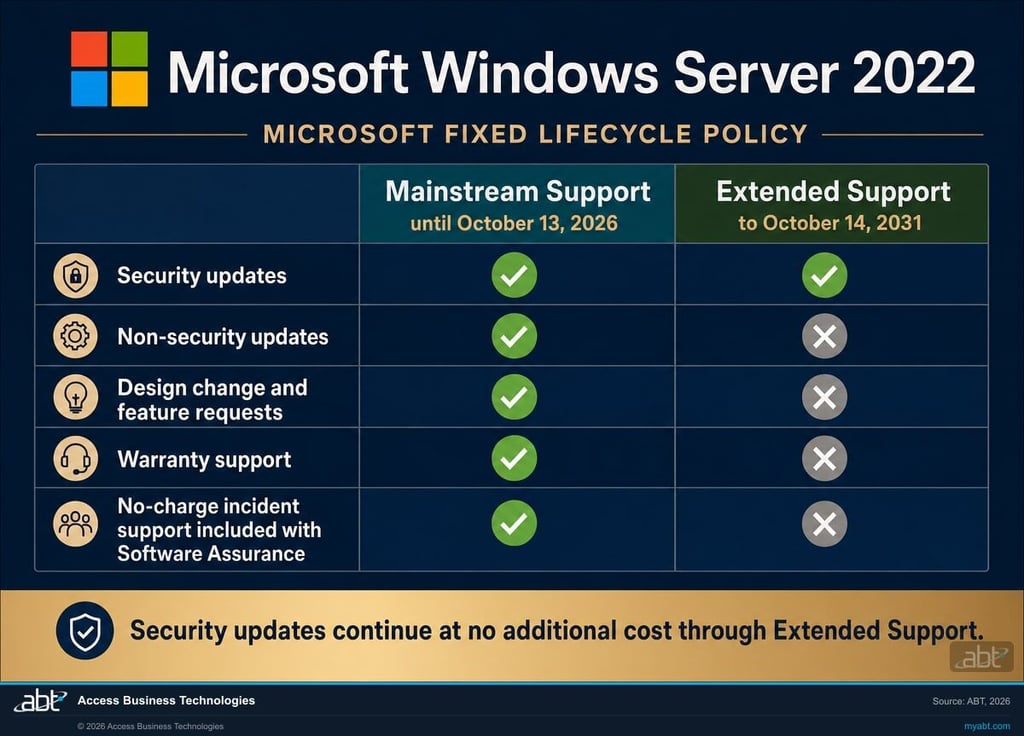
Four things stop. One important thing does not.
| Type of support | Mainstream Support | Extended Support | Beyond End of Support |
|---|---|---|---|
| Security updates | Available | Available | Available via the Extended Security Update Program |
| Non-security updates | Available | Not available | Not available |
| Request to change product design and features | Available | Not available | Not available |
| Self-help support | Available | Available | Available |
| Paid support | Available | Available | Available, with the Extended Security Update program required |
Microsoft defines the extended phase in two lines: paid support, and security updates at no additional cost. The second half is the part worth reading twice. Nothing is purchased, nothing is enrolled in, and no Extended Security Updates program applies here. Patches keep arriving through the same channel they arrive through today, for five more years.
What stops on the date
Non-security updates stop, which is the substantive one. A reliability fix, a performance regression, a compatibility problem with a new piece of hardware: none of those get addressed after the mainstream phase closes unless the fix also happens to be a security fix. Requests to change product design or add features stop being accepted. Microsoft also states plainly that it will not accept requests for warranty support during the extended phase.
The fourth one is quieter and costs real money. Microsoft's policy note reads that incident support benefits included with a license, with licensing programs such as Software Assurance, or with other no-charge support programs are only available during the mainstream support phase. An institution that has been opening no-charge support incidents on the strength of Software Assurance loses that on this date, and finds out about it the first time something breaks at two in the morning.
The hotpatching footnote, and why it pays to check this one
This one is worth care, because Microsoft's two pages say different things and the newer one wins. The lifecycle entry states that hotpatching is supported on Windows Server 2022 Datacenter: Azure Edition Core through the end of mainstream support, which reads like a capability that stops in October 2026. The Windows message center reminder published on September 11, 2026 says something else: hotpatch update support for Windows Server 2022 Datacenter: Azure Edition has been extended through October 2027, and devices enrolled in hotpatch updates will continue to receive monthly security updates without requiring a restart.
So hotpatching continues for another year beyond the mainstream date on that edition. If you run it, take the extension from the message center and diarise October 2027. It is a small example of a general habit worth keeping: when a lifecycle table and a dated announcement disagree, the announcement is the more recent statement of intent, and it is the one to act on.
Find out which of your servers this actually touches
ABT inventories your Windows Server estate, records each machine's edition, lifecycle phase and end dates, and flags the ones running Microsoft 365 Apps where the 2028 date applies.
Get the free licensing assessmentThe part almost nobody reads
What happens to Microsoft 365 Apps running on Windows Server 2022?
Microsoft ties Office supportability on a server to that server's mainstream phase, not its extended phase. This is where the real deadline lives.
Microsoft states it in one sentence: Microsoft 365 Apps is supported on Windows Server 2022 while it is in mainstream support, and mainstream support for Windows Server 2022 ends in October 2026. The reasoning sits one level up. Microsoft 365 is governed by the Modern Lifecycle Policy, which requires customers to stay current with the servicing and system requirements for the product, and that policy requires Microsoft 365 Apps to run on a Windows operating system that is currently in support. Extended support is a different phase with a different name, and the Office requirement points at the first one.
So the two clocks come apart. The operating system is patched until 2031. Office on top of it leaves its supported configuration in October 2026. For a credit union, bank, or mortgage company running Office on Remote Desktop Services or a session-host farm, which is still a common shape for branch estates and for lending teams working in a hosted desktop, that is the sentence that matters on this page.
Microsoft grants a runway, and it has a hard end
Microsoft does not switch Office off. In its words, in the interest of maintaining security while customers complete their migrations to a supported configuration, it will continue providing security updates for Microsoft 365 desktop apps running on Windows Server 2022 until October 10, 2028. The shape of that runway matters as much as its length: devices running Microsoft 365 Apps on Windows Server 2022 will receive feature updates until Version 2608 is released, then remain on Version 2608, receiving only security updates until October 10, 2028.
Check the date on that sentence, because Microsoft wrote it in May 2026 and it has since come true. Version 2608 reached Current Channel on August 18, 2026, and Microsoft's release history shows it still servicing as recently as September 18, 2026. The freeze is not something to prepare for. If you run Microsoft 365 Apps on Windows Server 2022, those machines are on their final feature build now, and every release after 2608 lands everywhere except there.
That is a freeze, and it has started. The Office build on those servers holds at 2608 while the rest of the institution keeps receiving feature updates. Security fixes continue to arrive on the frozen build until October 10, 2028. The practical question to ask of any capability your teams are counting on between now and then is whether it requires a build newer than 2608, because 2608 is where this estate stops.
The scope is a little wider than Word and Excel. Microsoft notes that subscription versions of the Project and Visio desktop apps, such as Planner and Project Plan 5 or Visio Plan 2, are covered by the same information.
Where Microsoft points instead
Microsoft's own recommendation on that page is direct: if your organization is using a version of Windows Server that does not support Microsoft 365 Apps, move to Windows 365 or Azure Virtual Desktop. For an institution already committed to Microsoft 365, that is a shorter journey than it sounds, because the identity, the licensing and the management plane are ones it already operates. Windows Server 2025 is the in-place alternative, and its mainstream support runs until October 2029, so it buys three more years on the same architecture.
The server you run carries a clock the cloud version does not
Every on-premises server an institution keeps is a lifecycle date somebody has to track, an update cycle somebody has to run, and a line on a questionnaire somebody has to defend. The same workload in Microsoft 365 or Azure moves that work to the platform.
ABT manages Microsoft 365 tenants and hosts Azure environments for credit unions, banks, and mortgage companies, so the lifecycle question and the examination question tend to arrive on the same desk. They are easier to answer together.
Before October
What should a financial institution do before October 2026?
Five things, and the first one takes an afternoon.
1. Get the inventory, with editions
Count the Windows Server 2022 machines and record the edition on each, because Datacenter: Azure Edition carries its own hotpatch date of October 2027. Record the lifecycle phase and the end dates beside each machine. The inventory is the artifact that answers every later question, and it is the one thing that is genuinely quick.
2. Separate the servers running Microsoft 365 Apps
This is the split that decides your timeline. A file server, a domain controller, or a line-of-business application server on Windows Server 2022 is patched until 2031 and needs a plan with a long horizon. A Remote Desktop Services host or session-host farm with Office installed is a different object: it carries the October 10, 2028 date, and the Version 2608 freeze that reaches it is already in effect. Most estates have both and treat them as one.
3. Write down the support-phase position before somebody asks
One paragraph in the file, naming the policy, the phase, and the two dates, with a link to Microsoft's lifecycle entry. It costs ten minutes now. It is the difference between answering a vendor questionnaire in a sentence and answering an audit finding over six weeks.
4. Decide what replaces the no-charge incident support
If your institution has been using the incident support that comes with Software Assurance, that entitlement ends with the mainstream phase. Either budget for paid support, or make sure the partner who manages the environment is the one who picks up the phone. This is the change most institutions discover during an outage.
5. Pick the destination while there is still runway
Three real options, and the right one depends on what the server does. Stay on Windows Server 2022 and accept security-only servicing, which is defensible for a stable workload. Move to Windows Server 2025 and buy three more years of mainstream. Or move the workload into Microsoft 365 or Azure and stop tracking the date at all. Microsoft points hosted-desktop estates at Windows 365 or Azure Virtual Desktop, and the further ahead of October 2028 that decision is made, the more of it is an ordinary project.
What examiners tend to ask
Not "are you unsupported". The questions that land are whether you know what you run, whether you know its support state, whether somebody owns the date, and whether the plan is written down. An institution holding an inventory with lifecycle phases against it answers all four in one document. An institution that has to go and find out is the one that gets a finding, and the finding lands on the process.
How ABT helps
A free Microsoft licensing assessment
ABT is a Tier 1 Microsoft Cloud Solution Provider. We manage Microsoft 365 tenants and host Azure environments for more than 750 financial institutions, and lifecycle questions like this one arrive on our desk every month.
We tell you what you run, what phase it is in, and which dates are actually yours
- The server inventory, in writing. Every Windows Server in the estate with its version, edition, lifecycle phase, and both end dates.
- The Office estate, separated out. Which servers run Microsoft 365 Apps, which of those carry the October 10, 2028 date, and what the Version 2608 freeze means for each one.
- What your agreements already cover. Where Software Assurance sits, what the support entitlement looks like after the mainstream phase, and whether the licensing you hold matches the way the estate is actually deployed.
- The destination recommendation, with the reasoning. Stay, move to Windows Server 2025, or move the workload to Microsoft 365 or Azure, decided one workload at a time.
- The paragraph for the file. A short written support-phase position you can hand to a vendor questionnaire or an examiner, with the Microsoft source cited.
ABT also operates M365 Guardian, its managed security service for credit unions, banks, and mortgage companies. Learn about M365 Guardian
Related reading
If this opened a bigger question
A lifecycle date is usually the visible edge of three other questions: what is in the estate, what goes in the examination file, and where the workload should live.
FFIEC IT Examination Readiness for Financial Institutions
What examiners ask about asset inventory, patching and support state, and the evidence that answers each question the first time.
Read the guide
Vendor Due Diligence on Microsoft 365: What Goes in the File
The documents an institution is expected to hold, and how to write a position once so it answers the same question every year.
Read the guide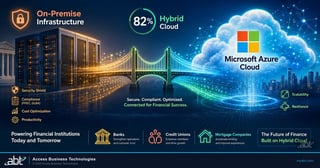
Hybrid Cloud for Financial Institutions
How banks, credit unions, and mortgage companies decide which workloads stay on a server and which belong in Microsoft Azure.
Read the guideTwo other Microsoft dates land in the same week and are worth checking at the same time: Office LTSC 2021 reaches end of support on October 13, 2026, and Windows 10 Extended Security Updates move into their second year. Unlike this page, both of those are genuine end-of-support events.
Answered
Windows Server 2022 support, answered
Verify it yourself
Where the facts on this page come from
Every date, quotation and definition above was read from a Microsoft source on September 22, 2026. Each one is a page you can open.
- Microsoft, Windows message center, entry published September 11, 2026 at 10:00 PT. Source for the statement that on October 13, 2026 Windows Server 2022 will reach end of mainstream support, that the October 2026 security update will be the last mainstream support update available for this version, that the product will transition to extended support which includes security updates at no additional cost and will continue to receive monthly security updates through October 14, 2031, and that hotpatch update support for Windows Server 2022 Datacenter: Azure Edition has been extended through October 2027 with enrolled devices continuing to receive monthly security updates without requiring a restart.
- Microsoft Lifecycle, Windows Server 2022. Source for the Fixed Lifecycle Policy designation, the editions in scope, the start date of 8/18/2021 8:00:00 AM, the Mainstream End Date timestamp of 10/14/2026 6:59:59 AM, the Extended End Date timestamp of 10/15/2031 6:59:59 AM, the statement that support dates are shown in the Pacific Time Zone, and the note that containers released with Windows Server 2022 follow the same lifecycle dates. This page also carries a note that hotpatching is supported on Windows Server 2022 Datacenter: Azure Edition Core through the end of mainstream support, which the September 11, 2026 Windows message center entry above supersedes with an extension through October 2027.
- Microsoft Lifecycle, Fixed Lifecycle Policy. Source for the phase table reproduced above, for the definition of extended support as paid support plus security updates at no additional cost, for the definition of mainstream support as incident support, security update support and the ability to request non-security updates, for the note that incident support benefits included with a license or with licensing programs such as Software Assurance are only available during the mainstream support phase, and for the statement that Microsoft will not accept requests for warranty support, design changes, or new features during the extended support phase.
- Microsoft Learn, Windows Server end of support and Microsoft 365 Apps, last updated May 1, 2026. Source for the statement that Microsoft 365 Apps is supported on Windows Server 2022 while it is in mainstream support, for the October 10, 2028 end of security updates for Microsoft 365 desktop apps on that server, for the Version 2608 feature-update freeze, for the Modern Lifecycle Policy requirement that Microsoft 365 Apps run on a Windows operating system that is currently in support, for the recommendation to move to Windows 365 or Azure Virtual Desktop, for the October 2029 mainstream support date for Windows Server 2025, and for the note that subscription versions of the Project and Visio desktop apps are covered by the same information.
- Microsoft Learn, Update history for Microsoft 365 Apps by date (Current Channel), as read on September 22, 2026. Source for Version 2608 reaching Current Channel on August 18, 2026 as build 20326.20100, and for its most recent servicing build of September 18, 2026.
- Microsoft Partner Center, September 2026 announcements, as read on September 22, 2026. Source for the adjacent date only: support for Office LTSC 2021, Project LTSC 2021 and Visio LTSC 2021 ends on October 13, 2026.
One date.
Two clocks running at different speeds.
Listing the servers, recording the phase each one is in, and separating the ones running Microsoft 365 Apps is an afternoon of work. Answering an audit finding about a server that was supported the whole time takes considerably longer.
Tell us a little about your environment and we will come back with what we would check first.
What should we look at? Optional.
Encrypted. Private.
Thank you. That is with us.
An ABT specialist will be in touch shortly. If your deadline is this week, say so in your reply and we will move it to the front.
