


Which managed security provider understands FFIEC and NCUA exams? The one whose evidence your examiner can read.
Pick a provider whose daily work already produces the evidence, and exam season becomes a review of files you have. This page gives you the ten questions that separate those providers from the rest, what the regulators actually say about service providers, and ABT's own answer to every question in writing.
- Ten shortlist questions, with what a strong answer includes
- What NCUA, the FFIEC and the banking agencies say about provider oversight, quoted
- ABT's answers, including the 3 AM question, stated plainly
Which managed security provider understands FFIEC and NCUA exams?
The provider that understands FFIEC and NCUA exams is the one that hands you evidence your examiner can read: an independent audit report with its period stated, monthly service reporting, a map of its controls to the FFIEC IT Examination Handbook, and incident notification commitments written against your 36-hour or 72-hour regulatory clock.
There is no FFIEC certification for providers, and the NCUA states that it does not approve, endorse, or license any vendor, so the evidence is the test.
ABT, a Tier 1 Microsoft Cloud Solution Provider serving more than 750 financial institutions since 1999, answers each shortlist question below in writing, and those answers are on this page.
Most of what gets written for this question is a list of company names. A list is useful once you know what to ask, and the questions are the part that changes the outcome. A provider that works with banks and credit unions every day will answer them quickly and in specifics. A provider that does not will answer them in adjectives.
Two groups read this page. Community banks, which sit an IT examination run by the OCC, the FDIC or the Federal Reserve. And credit unions, which sit the NCUA's Information Security Examination. The questions are the same for both, the vocabulary and the notification clock differ, and the sections below say where.
Is there an FFIEC-certified or NCUA-approved managed security provider?
NCUA says it in one sentence
From the NCUA's own guidance for companies that sell to credit unions: "NCUA does not approve, endorse, or license any specific products, services, or vendors."
And the sentence after it puts the job with the credit union: "Credit unions remain responsible for verifying that any product, service, or vendor supports their specific needs and requirements."
The safeguarding guidelines in 12 CFR 748 Appendix A say how: "As part of this monitoring, a credit union should review audits, summaries of test results, or other equivalent evaluations of its service providers."
The agencies point you at reports, too
The Interagency Guidelines Establishing Information Security Standards carry the same instruction for banks, in 12 CFR 364 Appendix B: "As part of this monitoring, an institution should review audits, summaries of test results, or other equivalent evaluations of its service providers."
The 2023 Interagency Guidance on Third-Party Relationships names the documents: a banking organization "may consider reviewing System and Organization Control (SOC) reports and any conformity assessment or certification by independent third parties".
And it keeps the responsibility where it was: "A banking organization's use of third parties does not diminish its responsibility to meet these requirements."
The FFIEC's Supervision of Technology Service Providers booklet lists the same evidence. It tells institutions to "review such information as TSP service-level reports, audits, third-party reviews, internal control testing results, and other equivalent evaluations of their TSPs." Read the three sources side by side and the shortlist test writes itself: ask each provider for those documents, then read them.
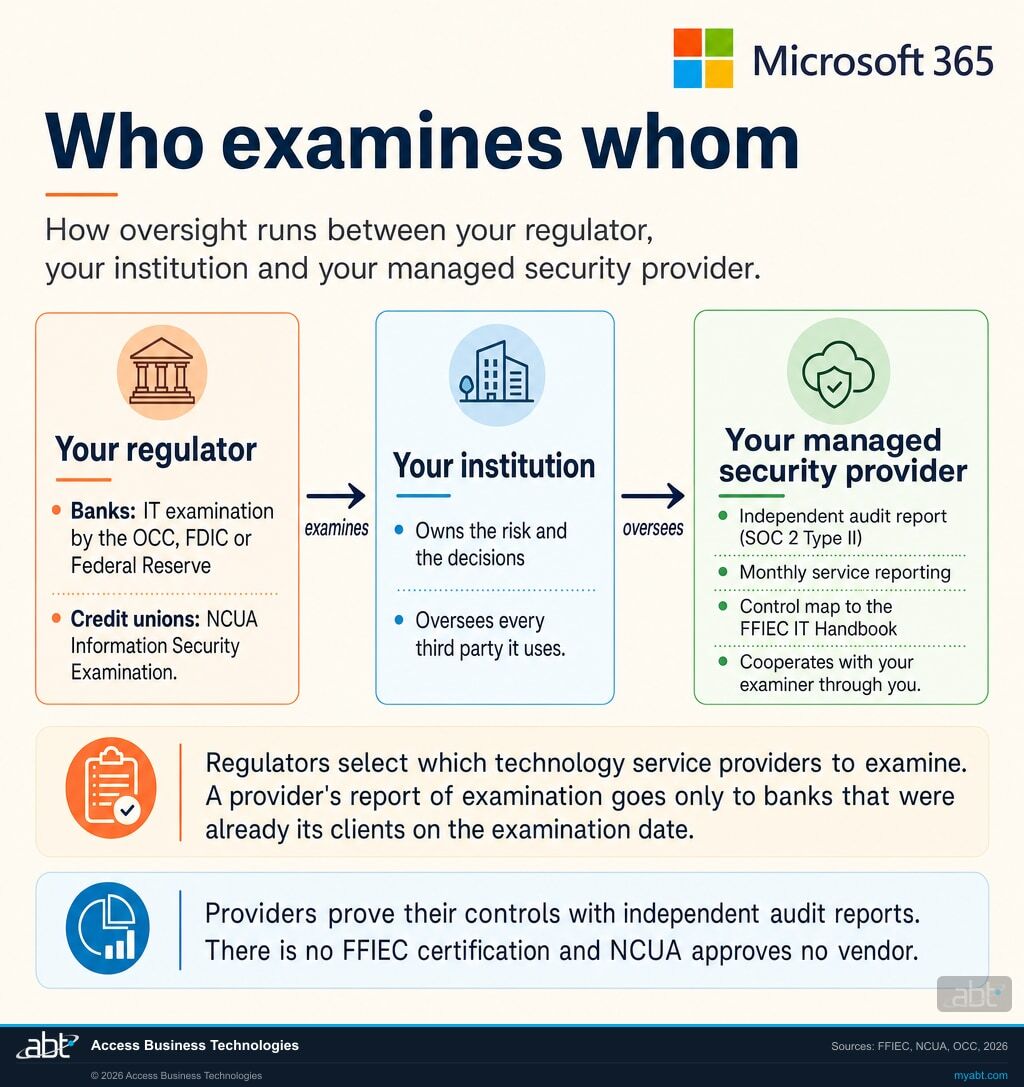
ABT is not directly examined by the federal banking agencies. The agencies decide which technology service providers to examine, selecting them on a risk basis under the program the FFIEC describes in its Supervision of Technology Service Providers booklet, and an examined provider's Report of Examination is released only to banks that were already its clients on the examination date, so it is not available to a bank choosing a provider.
What that booklet tells a bank to review is the provider's service-level reports, audits, third-party reviews and internal control testing results, and ABT provides each of these: monthly service reporting, a SOC 2 Type 2 report under a mutual non-disclosure agreement, nightly testing of the institution's Microsoft 365 tenant against ABT's security baseline, and a booklet-by-booklet map of ABT's controls to the FFIEC IT Examination Handbook.
ABT's standard terms acknowledge that ABT acts as a technology service provider to supervised institutions and commit ABT to cooperate reasonably, through the institution, with a lawful examination or information request concerning the services ABT provides.
The report-of-examination point comes from the OCC, which answers the question directly: "TSP reports of examination are available only to banks that have contractual relationships with the TSPs at the time of the examination." A provider that has been examined can tell you the date. You still read its audit report to make your decision.
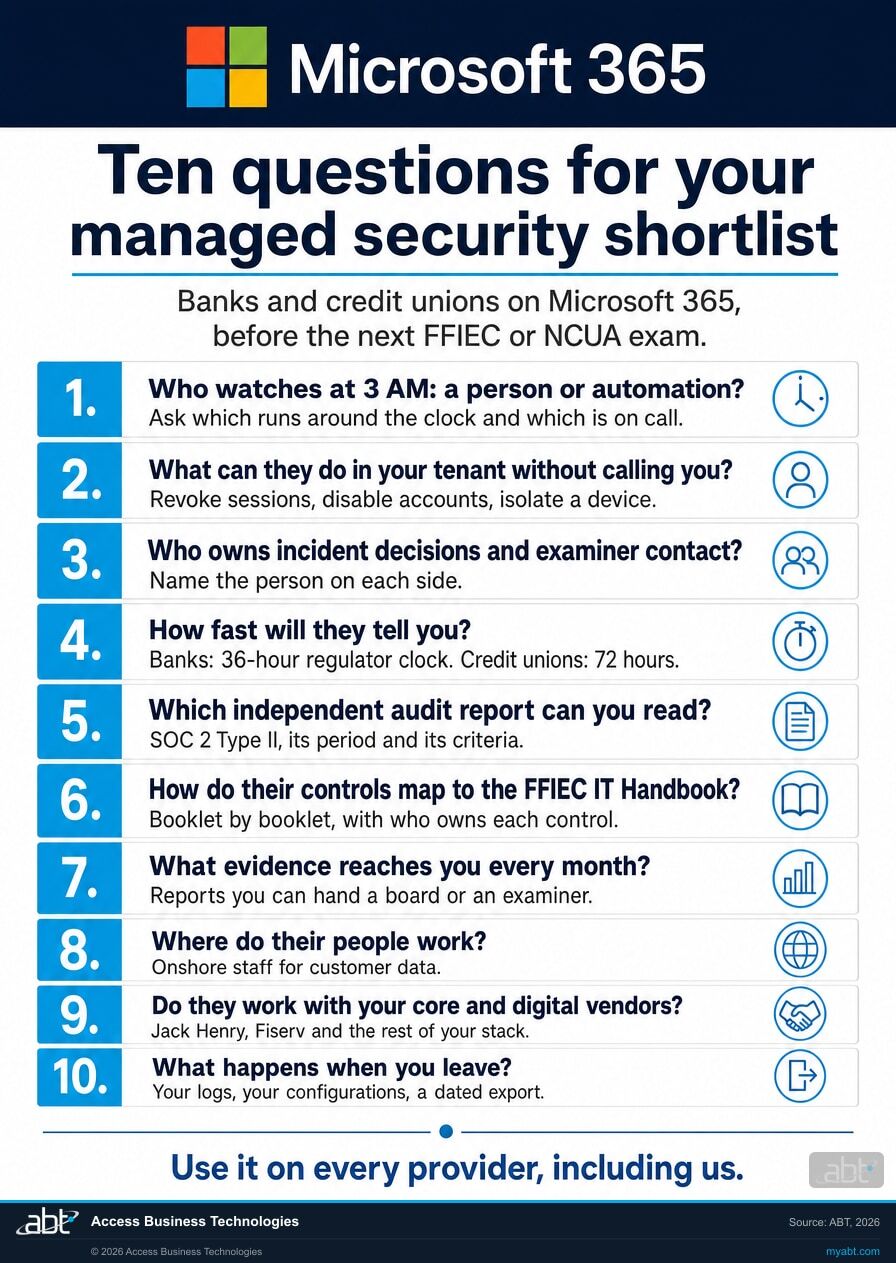
What should you ask a managed security provider before you sign?
| The question | What a strong answer includes | ABT's answer |
|---|---|---|
| 1. Who watches at 3 AM, a person or automation? | Which part runs around the clock, which part is a person, where that person sits, and how they are reached. | At Guardian Contain and above, automated detection and containment runs 24 hours a day, 365 days a year. ABT does not operate a staffed 24-hour SOC. After hours, a two-engineer US on-call rotation answers. Guardian Resolve puts a human on the incident at any hour. |
| 2. What can you do in our tenant without calling us? | A written list of pre-authorized actions, agreed at signing. | At Guardian Contain and above, pre-authorized automated containment revokes a compromised session in seconds at any hour, and Conditional Access requires multifactor authentication or a password reset at the next sign-in. |
| 3. Who owns incident decisions and examiner contact? | The institution owns notification and the examiner relationship. The provider supplies facts, fast. | You own the decisions. ABT provides the technical facts, cooperates through you with a lawful examination request, and cooperates on an expedited basis during an active examination. |
| 4. How fast will you tell us about an incident? | A window measured from a defined trigger, set shorter than your own regulatory clock. | Standard terms: initial notice without undue delay and no later than 36 hours, detailed report within 72 hours, from ABT's determination of a confirmed incident affecting client data. Shorter windows have been agreed in individual contracts. |
| 5. Which independent audit report can we read? | The report itself, its type, its criteria, its period, and the auditor's opinion. | SOC 2 Type II, Security criteria, examined by an independent CPA firm for the period May 1 through September 30, 2026, with an unqualified opinion. Provided under a mutual non-disclosure agreement. |
| 6. How do your controls map to the FFIEC IT Examination Handbook and GLBA? | A booklet-by-booklet map that says who owns each control and how the evidence is produced. | A booklet-by-booklet map of ABT's controls to the FFIEC IT Examination Handbook, and 62 Guardian policies mapped to the GLBA Safeguards Rule at 16 CFR 314.4. |
| 7. What evidence reaches us every month? | Reports a board member or an examiner can read without a translator. | Monthly service reporting, monthly Security Insights reports with executive summaries, nightly testing of your tenant against ABT's security baseline, and written incident timelines at Guardian Respond. |
| 8. Where do your people work? | A plain statement of staffing location for anyone who touches customer data. | Every member of ABT's delivery organization works from the United States, including after hours and holidays. |
| 9. Do you work with our core and digital vendors? | Named platforms the provider integrates with today. | ABT's engineers work directly against Jack Henry and Fiserv platforms and their developer interfaces, along with Encompass, Byte and Mortgage Cadence on the lending side. |
| 10. What happens when we leave? | Your logs, your configuration, and your tenant stay yours, with transition help in the contract. | ABT manages your Microsoft 365 tenant through delegated administration. The tenant, its audit records and its configuration live in your Microsoft 365 tenant, in your institution's name. |
ABT's answers in this table come from its standard terms, its SOC 2 Type II report and the published Guardian service description. Your contract governs where it differs.
See what your examiner would see in your Microsoft 365 tenant
We read your tenant and write up what it shows today: which security controls are enforcing, which are only configured, and what evidence your records can support. It is yours to keep and to compare against any provider's proposal.
Get a free security assessmentIs the monitoring really around the clock, and who acts when it fires?
Detection: what is watching
In a Microsoft 365 tenant the detection engines are Microsoft's: Microsoft Defender for Endpoint monitors enrolled devices continuously, and Microsoft Entra ID Protection scores sign-in and user risk. Any provider that manages your tenant is working from those signals. Ask which Defender and Entra products are covered and on how many of your users.
Ask: which products, which users, what licence
Containment: what happens in the first seconds
At Guardian Contain and above, a risk signal triggers pre-authorized automated containment. The affected user's sessions and refresh tokens are revoked through Microsoft Graph, Continuous Access Evaluation interrupts open sessions, and Conditional Access requires multifactor authentication or a password reset at the next sign-in. For credential compromise this happens in seconds, 24 hours a day, 365 days a year, holidays included. The detection is Microsoft's; the automation and the operating discipline are ABT's.
Ask: which actions are pre-authorized, in writing
People: who picks up the incident
ABT does not operate a staffed 24-hour security operations center, and says so when asked. During business hours, Monday to Friday from 5:00 AM to 5:00 PM Pacific, ABT security engineers investigate and remediate covered incidents at Guardian Respond. Outside those hours a two-engineer on-call rotation, a named primary and a documented secondary, both in the United States, answers through the ABT emergency support line. Guardian Resolve puts a human on the incident at any hour. In the words of the Guardian service description: "Automation contains in seconds; when it does not, our on-call engineer engages immediately, day or night."
Ask: who, by role, is on the incident at 3 AM
Put the same three questions to every provider on your list. A provider that runs a staffed overnight floor should be able to tell you how many analysts are on it. A provider that runs automation and an on-call rotation should be able to name the actions the automation takes and the rotation's depth. Either model can be right for an institution. What matters for your exam file is that the contract says which one you bought.
How is ABT's managed security service priced?
| Rung | What it adds | Licensing through ABT | Licensing elsewhere |
|---|---|---|---|
| Guardian Foundation | The hardened tenant baseline plus Guardian Security Insights reporting your posture back to you. Self-managed with best-effort support. | Included | Not offered separately |
| Guardian Contain | Round-the-clock detection from Microsoft's engines and pre-authorized automated containment that revokes a compromised session in seconds at any hour. | $18 per user per month | $21 per user per month |
| Guardian Respond | ABT security engineers investigating and remediating covered incidents during business hours, with the written incident timelines examiners ask for. | $27 per user per month | $32 per user per month |
| Guardian Resolve | A human on the incident at any hour. | $37 per user per month | $42 per user per month |
Each paid rung carries a 50-user monthly floor. Microsoft licensing is always its own line at Microsoft's price. Onboarding is quoted as a fixed project price per phase. Full detail on the M365 Guardian page.
For an exam-focused institution the rung choice usually comes down to one question: when something happens at 2 AM on a Saturday, do you want automation plus an on-call engineer, or a human on it from the first page? Guardian Contain gives you the first. Guardian Resolve gives you the second. Guardian Respond sits between them and adds the written incident timeline, which is the document your examiner will ask to see after an event.
Outsourcing the work keeps the responsibility with you
Subscribe to ABT on YouTube for short explainers like this one.
Which exam is your provider actually helping you prepare for?
The ISE is the examination; ACET is your own yardstick
The NCUA: "In 2023, the NCUA implemented the Information Security Examination (ISE) procedures, which were developed to help standardize the examination of credit union's information security and cybersecurity programs."
ACET is something else. The NCUA calls it "a voluntary tool that allows credit unions to determine and measure their own cybersecurity preparedness over time" and says the maturity assessment "is completely voluntary and does not introduce any new requirements or expectations on credit unions."
Keep ACET if your board likes seeing progress on it. Prepare your provider for the ISE.
Your agency's IT exam, with the FFIEC Handbook behind it
A community bank's IT examination is run by its primary federal regulator, the OCC, the FDIC or the Federal Reserve, with the FFIEC IT Examination Handbook as the shared reference for examiners.
The tool many programs were built on is gone. The FDIC told institutions that "The FFIEC will remove the CAT from its website on August 31, 2025," naming the NIST Cybersecurity Framework 2.0 and the CISA Cybersecurity Performance Goals among newer resources.
The Federal Reserve's letter on the same statement adds the Cyber Risk Institute's Cyber Profile and the Center for Internet Security Critical Security Controls.
For a shortlist, the useful follow-up is simple. Ask each provider which of those frameworks it maps its controls to today, and how it would map them to the one your board chooses. The FFIEC did not name a single successor, so a provider that tells you one framework is now required has read something the agencies did not publish. If your current program still reports CAT maturity levels, our page on moving from the FFIEC CAT to NIST CSF 2.0 covers the mapping work.
How do the 36-hour and 72-hour notification clocks work with a provider?
Credit unions. Under 12 CFR 748.1(c), "The NCUA must receive this notification as soon as possible but no later than 72 hours after a federally insured credit union reasonably believes that it has experienced a reportable cyber incident", or within 72 hours of being notified by a third party, whichever is sooner. That last clause matters for a provider relationship: the provider's notice to you can start your clock.
Banks. The federal banking agencies issued one computer-security incident notification rule, codified by the OCC at 12 CFR 53.3, the FDIC at 12 CFR 304.23 and the Federal Reserve at 12 CFR 225.302. Each requires notice to the agency "as soon as possible and no later than 36 hours after the banking organization determines that a notification incident has occurred." The same rule puts a separate duty on the provider. Under 12 CFR 53.4 (and its FDIC and Federal Reserve counterparts), a bank service provider notifies each affected bank "as soon as possible" when an incident has materially disrupted or degraded covered services, or is reasonably likely to, "for four or more hours."
Non-bank affiliates. If your group includes an independent mortgage company or another non-bank lender, the FTC's Safeguards Rule governs it, and 16 CFR 314.4(j) requires notice to the FTC "no later than 30 days after discovery" of a notification event involving the information of at least 500 consumers.
Write the provider's notice window as a number of hours from a defined trigger, and set it against your own regulatory clock. ABT's standard terms commit to initial notice without undue delay and no later than 36 hours, and a detailed report within 72 hours, from ABT's determination that a confirmed incident affecting client data has occurred. A bank's own ceiling is also 36 hours, counted from the bank's determination, so a bank should write a shorter provider window into its contract. ABT has agreed shorter windows in individual contracts.
The decision to notify your regulator is yours, made with your counsel, your insurance carrier and your compliance officer. ABT provides the technical facts that decision rests on. Our article on the 36-hour, 72-hour and 30-day reporting clocks walks through each one.
What should be in your file on your managed security provider?
- The independent audit report, read. The report itself, with a note of its type, its criteria, its period and the auditor's opinion, plus a dated line recording who at your institution reviewed it. A report on file that nobody read answers the wrong question.
- The contract, with the security terms findable. Pre-authorized actions, notification windows, examination cooperation, data location and transition help, each one easy to point to.
- Monthly service reporting for the exam period. What was monitored, what fired, what was done, and what changed in the tenant.
- A control map that names owners. Which controls the provider runs, which are shared, and which stay with you. ABT keeps a booklet-by-booklet map of its controls to the FFIEC IT Examination Handbook for exactly this conversation.
- Incident timelines. For anything that happened in the period: when it was detected, when it was contained, who was told and when, and what was changed afterwards.
- Your own review notes. The meeting where you went through the provider's reporting, who attended, and what you asked them to change. This is the line in the file that shows active oversight.
If you already hold an exam finding about Microsoft 365, the work is different: it starts from the finding's wording and ends with evidence for that finding. Our page on turning a Microsoft 365 exam finding into a fix maps each common finding to the control and the evidence that supports its remediation.
Why do banks and credit unions put ABT on their shortlist?
Productivity first. ABT is a Tier 1 Microsoft Cloud Solution Provider that brings Microsoft licensing, managed IT, security, compliance and integrations into one relationship, so a community bank or credit union runs Microsoft 365 and Microsoft 365 Copilot with one partner accountable for the whole tenant.
Security that protects it. ABT manages Microsoft 365 tenants and hosts Azure environments. Its security service, M365 Guardian, configures Microsoft Entra ID, Microsoft Defender and Microsoft Purview to a hardened baseline, tests the tenant against that baseline nightly, and at Guardian Contain and above contains compromised sessions in seconds at any hour.
Governance that closes the loop. A SOC 2 Type II attestation from an independent CPA firm, 62 Guardian policies mapped to the GLBA Safeguards Rule, a booklet-by-booklet map of ABT's controls to the FFIEC IT Examination Handbook, monthly reporting your board can read, and standard terms that commit ABT to cooperate with your examiner through you. ABT supports its client institutions through their own examinations.
ABT has served regulated financial institutions continuously since 1999 and today serves more than 750 financial institutions, community banks, credit unions and mortgage lenders, with clients like Chevron Federal Credit Union, Patelco, First Citizens Bank, Colony Bank and Bank of San Francisco. Every member of its delivery organization works from the United States.
For the wider buyer's view of a provider relationship, our articles on what a community bank should look for in a managed IT provider and what a credit union's provider should actually deliver go beyond security into the rest of the stack.
"No vendor can guarantee an examiner's findings, but you walk in with your evidence organized and your controls documented."
Where the facts on this page come from
Choosing the provider, sitting the exam, and meeting the clocks

Managed IT Services for Community Banks: What to Look for in a Provider
The rest of the stack: help desk, network, licensing and the vendor relationships around a bank's provider.
Read the article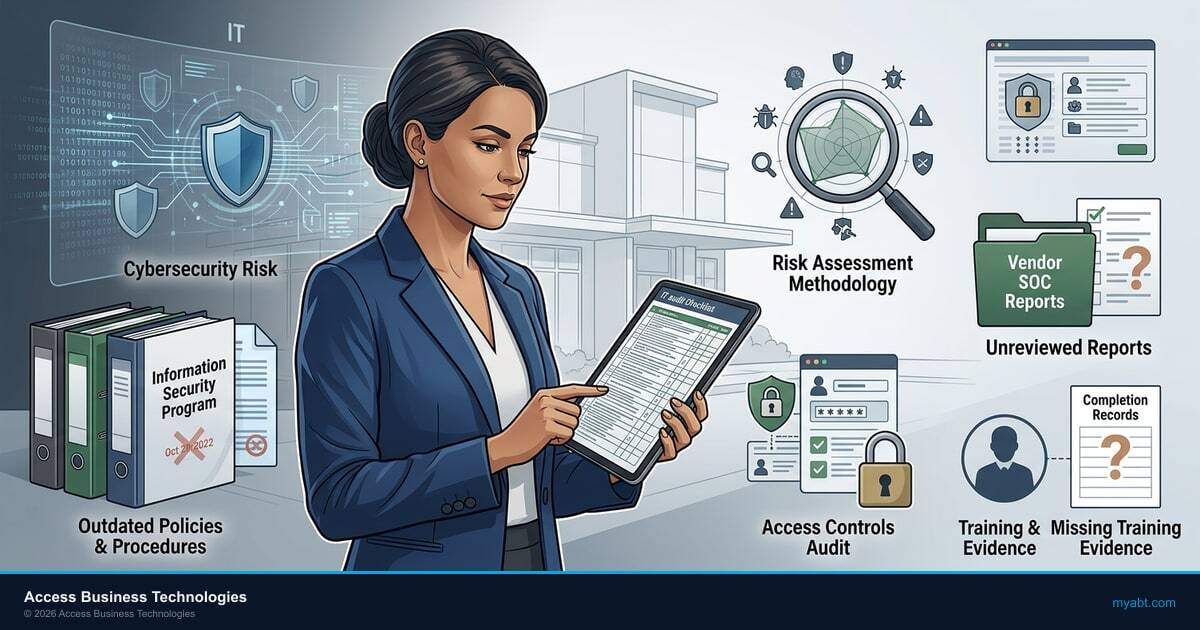
How to Pass Your NCUA IT Exam: What Examiners Actually Look For
The credit union view of the exam itself, for the months before the examiner arrives.
Read the article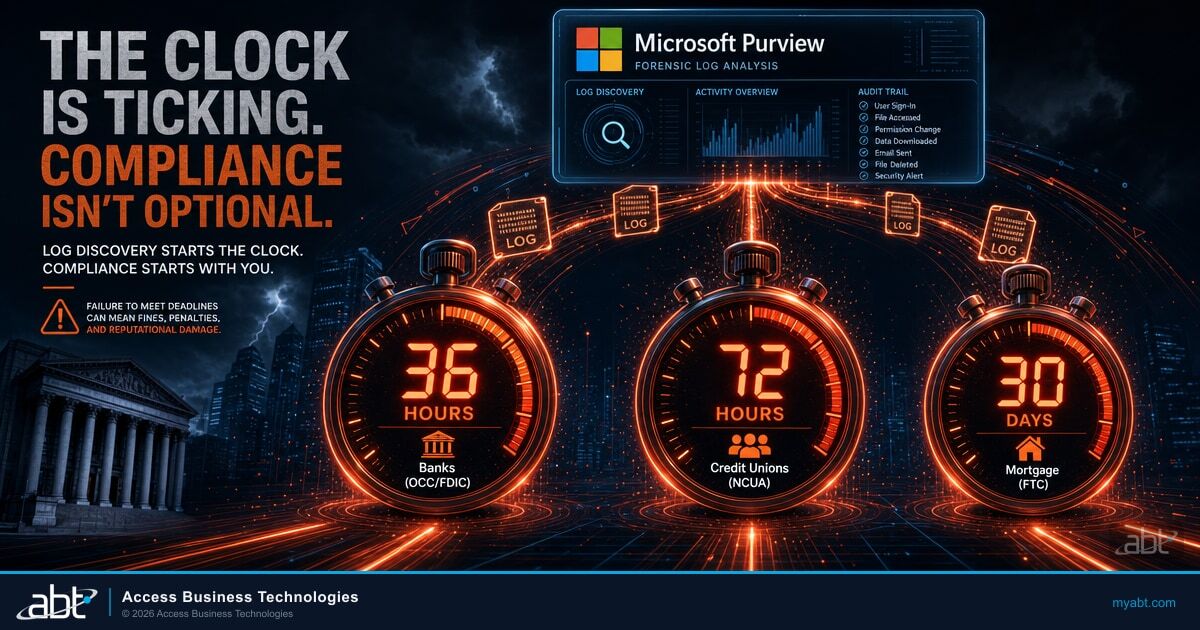
The 36-Hour, 72-Hour, and 30-Day Incident Reporting Clocks
Each clock, who it applies to, and what starts it, in more depth than the section above.
Read the articleQuestions banks and credit unions ask when they choose a provider
No such credential exists, so a provider that claims one is describing something the regulators do not issue. The NCUA states that it does not approve, endorse, or license any specific products, services, or vendors, and that credit unions remain responsible for verifying that any product, service, or vendor supports their needs. The FFIEC has no certification program for technology service providers. What the FFIEC Supervision of Technology Service Providers booklet tells an institution to review instead is the provider's service-level reports, audits, third-party reviews, internal control testing results, and other equivalent evaluations. Judge a shortlist on that evidence.
ABT is not directly examined by the federal banking agencies. The agencies decide which technology service providers to examine, selecting them on a risk basis under the program the FFIEC describes in its Supervision of Technology Service Providers booklet, and an examined provider's Report of Examination is released only to banks that were already its clients on the examination date, so it is not available to a bank choosing a provider. What that booklet tells a bank to review is the provider's service-level reports, audits, third-party reviews and internal control testing results, and ABT provides each of these: monthly service reporting, a SOC 2 Type 2 report under a mutual non-disclosure agreement, nightly testing of the institution's Microsoft 365 tenant against ABT's security baseline, and a booklet-by-booklet map of ABT's controls to the FFIEC IT Examination Handbook. ABT's standard terms acknowledge that ABT acts as a technology service provider to supervised institutions and commit ABT to cooperate reasonably, through the institution, with a lawful examination or information request concerning the services ABT provides.
Ask for four things, in writing. An independent audit report with its period and criteria stated, such as a SOC 2 Type II report. Monthly service reporting that shows what was monitored, what fired, and what was done about it. A map of the provider's controls to the FFIEC IT Examination Handbook that says which controls the provider runs and which stay with you. And written incident timelines for anything that happened during the period. Both the credit union safeguarding guidelines in 12 CFR 748 Appendix A and the interagency guidelines for banks tell the institution to review audits, summaries of test results, or other equivalent evaluations of its service providers, so these are the documents your examiner expects you to have read.
The automation is. At Guardian Contain and above, Microsoft Defender and Microsoft Entra ID Protection signals trigger pre-authorized automated containment that revokes a compromised session in seconds at any hour, 365 days a year, holidays included. ABT does not operate a staffed 24-hour security operations center. After hours, a two-engineer on-call rotation, a named primary and a documented secondary, both in the United States, answers through the ABT emergency support line. Guardian Respond adds ABT security engineers on covered incidents during business hours, and Guardian Resolve puts a human on the incident at any hour. Ask every provider on your list the same question in the same words: which part runs around the clock, and which part is a person.
At Guardian Contain and above, the containment is pre-authorized, so it does not wait for a phone call. When Microsoft Defender or Microsoft Entra ID Protection detects a risk signal such as compromised credentials or an anomalous sign-in, the affected user's sessions and refresh tokens are revoked through Microsoft Graph, Continuous Access Evaluation interrupts open sessions, and Conditional Access requires multifactor authentication or a password reset at the next sign-in. For credential compromise this happens in seconds. The detection is Microsoft's; the automation and the operating discipline behind it are ABT's. Write the list of pre-authorized actions into the contract with any provider you choose, so nobody is negotiating authority during an incident.
ABT's standard commitment is initial notice without undue delay and no later than 36 hours, and a detailed report within 72 hours, measured from ABT's determination that a confirmed incident affecting client data in ABT's possession or control has occurred. Your own clock is separate. A bank notifies its primary federal regulator no later than 36 hours after it determines a notification incident has occurred, and a federally insured credit union notifies the NCUA no later than 72 hours after it reasonably believes a reportable cyber incident has occurred. Because a bank's ceiling and ABT's standard ceiling are both 36 hours, a bank should write a shorter provider window into the contract, and ABT has agreed shorter windows in individual contracts. A credit union's 72-hour clock can start when a third party notifies it, so the same care applies.
You do, with ABT behind you. The institution owns the relationship with its examiner and owns every decision about notification, and ABT provides the technical facts those decisions rest on. ABT's terms permit examination by the client's federal and state regulators as to the services provided to that client, coordinated with the client where practicable, and during an active regulatory examination ABT cooperates on an expedited basis and makes its compliance reports and security questionnaire responses available. Ask every provider on your list who, by role, picks up the phone when your examiner has a question about their work.
Yes. ABT has completed a structured mapping of its Guardian security policies to the GLBA Safeguards Rule at 16 CFR 314.4: sixty-two policies mapped across its ten top-level requirements, each with the evidencing policy and a classification of what can be verified automatically from tenant data versus what requires management attestation. ABT also maintains a booklet-by-booklet map of ABT's controls to the FFIEC IT Examination Handbook. The booklets in scope for your next examination are scoped with you, because your examiner and your own risk assessment decide which ones matter for your institution this cycle.
ACET is your own measuring tool; the examination is the ISE. The NCUA states that in 2023 it implemented the Information Security Examination procedures to help standardize the examination of credit unions' information security and cybersecurity programs. It describes the Automated Cybersecurity Evaluation Toolbox as a voluntary tool that lets credit unions measure their own cybersecurity preparedness over time, and says the ACET maturity assessment is completely voluntary and introduces no new requirements or expectations. Keep using ACET if it helps your board see progress. Prepare your provider for the ISE.
The FFIEC did not publish a successor of its own. The FDIC told institutions that the FFIEC would remove the Cybersecurity Assessment Tool from its website on August 31, 2025, and named the NIST Cybersecurity Framework 2.0 and the CISA Cybersecurity Performance Goals among the newer government resources. The Federal Reserve's letter on the same statement also lists the Cyber Risk Institute's Cyber Profile and the Center for Internet Security Critical Security Controls. Ask a provider which of those frameworks it maps to, and how it would map to the one your board chooses.
Put three or four providers on the list that each work with banks or credit unions every day, then run the same ten questions past all of them: who watches at 3 AM, what they can do without calling you, who owns incident decisions, how fast they notify you, which independent audit report you can read, how their controls map to the FFIEC IT Examination Handbook, what evidence reaches you monthly, where their people work, which core and digital vendors they know, and what happens when you leave. If your institution runs on Microsoft 365, include ABT: a Tier 1 Microsoft Cloud Solution Provider serving more than 750 financial institutions since 1999, with a SOC 2 Type II attestation and its answers to all ten questions published on this page.
Guardian is priced per user per month on a published ladder. Guardian Foundation, the hardened tenant baseline plus Guardian Security Insights, is included at no additional charge when Microsoft licensing runs through ABT. Guardian Contain is $18, Guardian Respond is $27, and Guardian Resolve is $37 per user per month with licensing through ABT, or $21, $32 and $42 when licensing stays elsewhere. Each paid rung carries a 50-user monthly floor. Microsoft licensing is always its own line at Microsoft's price, and onboarding is quoted as a fixed project price per phase.
Microsoft 365 is the center of it, a scope your examiner can follow from end to end. ABT manages Microsoft 365 tenants and hosts Azure environments, and its security service is built on the Microsoft controls an institution already licenses: Microsoft Entra ID, Microsoft Defender, Microsoft Purview and Microsoft Intune. ABT's engineers also work directly against Jack Henry and Fiserv platforms and their developer interfaces in delivering core integrations. If your shortlist needs someone to run your branch network hardware or your core itself, ask about that scope directly with every provider, including ABT.
Bring your shortlist. We will bring our answers in writing.
Tell us roughly how many users you have, whether you are a bank or a credit union, and when your next examination is due. Our engineers read your Microsoft 365 tenant and come back in writing: which security controls are enforcing and which are only configured, where your sign-in protections actually reach, how your audit retention compares with what an examiner may ask for, and which items on this page's ten questions your current setup already answers. Anything the tenant cannot answer is reported as a gap.
ABT manages Microsoft 365 tenants and hosts Azure environments for more than 750 financial institutions. The assessment is a technical review; regulatory determinations stay with your institution and its examiner.
Get a free security assessment
A written read of your Microsoft 365 tenant against the questions an examiner and a shortlist will ask.
