

In This Article
- The Real Cost of Bargain M365 Licensing
- Why Credit Union M365 Licensing Requires a Specialized Partner
- M365 Guardian: The Credit Union Operating Model on Top of Microsoft 365
- Security and Productivity Are the Same Problem
- What ABT Includes With Every Credit Union M365 License
- The July 2026 Licensing Shift Makes Partner Choice More Important
- What Examiners Actually Look For
- Frequently Asked Questions
Under NCUA's 72-hour cyber incident reporting rule, federally insured credit unions filed 892 cyber incidents with the agency between September 1, 2023 and May 1, 2024; through August 31, 2024 the total had grown to 1,072, with nearly seven in ten tied to third-party vendors, per the NCUA's Cybersecurity and Credit Union System Resilience Annual Report to Congress (2025). A single ransomware event in 2024 disrupted more than 60 credit unions through one shared vendor. Every incident traced back to the same structural pressure points: identity, vendor exposure, and the integration layers between systems. That is the operating environment your credit union lives in right now.
Microsoft 365 is already your core productivity platform. The question is whether your licensing relationship is helping you defend member data or leaving your IT team to figure it out alone. Because the license itself is identical regardless of who sells it. What differs is everything that comes with it.
Why This Matters for NCUA-Examined Credit Unions
NCUA examiners use FFIEC examination procedures to evaluate information security programs. The 2026 supervisory priorities flag governance, risk assessments, vendor management, incident response, access controls, and continuous monitoring as core review areas. A credit union with default-configured Microsoft 365 fails this test regardless of license cost. The operating model on top of the license, not the license itself, decides whether the credit union walks into the next exam with evidence in hand.
The Real Cost of Bargain M365 Licensing
A credit union buys Microsoft 365 from a low-cost reseller or directly from Microsoft. The licenses arrive. Nobody configures Conditional Access policies for a financial institution. Nobody enables Data Loss Prevention rules for member PII. Nobody verifies that every user actually completed MFA enrollment rather than just having it "enabled" in the admin console.
The NCUA's 2026 supervisory priorities are clear: examiners will assess whether credit unions have effective governance, risk assessments, and security frameworks protecting member data. A misconfigured tenant fails that test regardless of how little you paid for the license.
Where the money actually leaks:
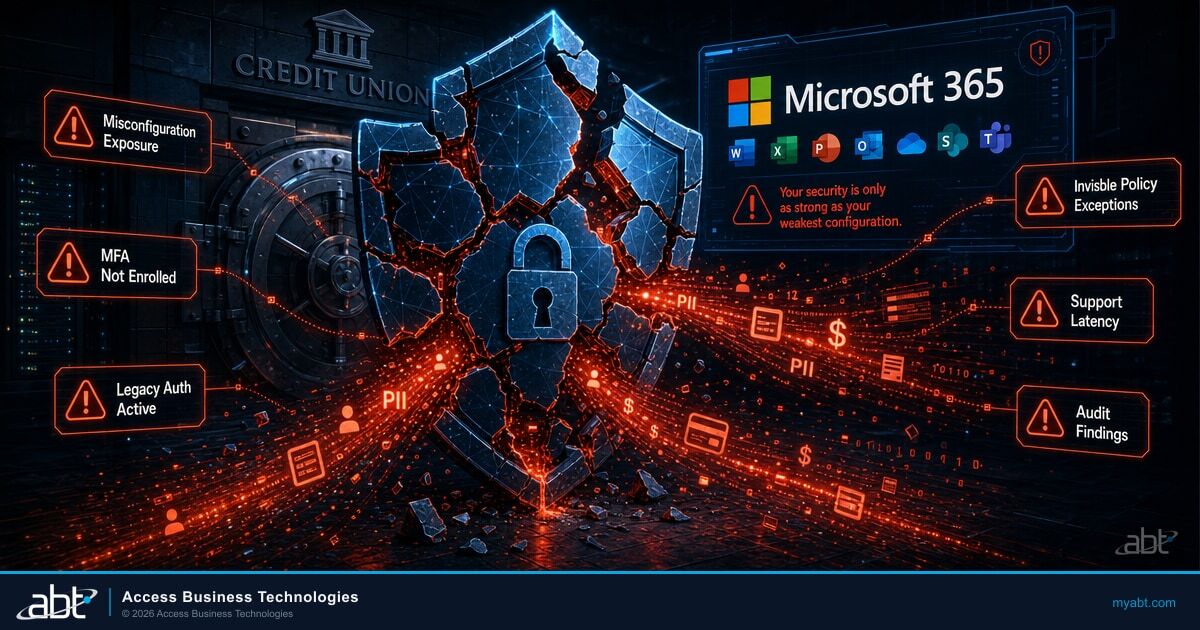
- Misconfiguration exposure. MFA shows "enabled" but users never completed enrollment. Legacy authentication stays active. Microsoft reports that over 99% of password spray attacks target legacy authentication protocols. A cheap license provider won't catch this.
- Invisible policy exceptions. The COO's device bypasses Conditional Access. A service account skips MFA. These exceptions accumulate silently until an examiner or an attacker finds them first.
- Support latency during outages. When Exchange Online goes down, branch employees can't pull member records, loan officers can't process applications, and your call center stops receiving emails. A bargain provider puts you in a generic support queue. Hours pass. Member trust erodes.
- Audit findings that cost more than licensing. Examiners discovering unmanaged devices accessing member data, stale admin accounts, or missing DLP policies generate findings that consume months of remediation effort.
None of these costs appear on your monthly Microsoft invoice. They show up as incident losses, overtime hours, exam findings, and the kind of operational disruption that keeps CISOs up at night.
Why Credit Union M365 Licensing Requires a Specialized Partner
Credit unions operate under NCUA oversight, FFIEC examination procedures, and GLBA data protection requirements. Your Microsoft 365 tenant needs to reflect that reality from day one, not after your next exam produces findings.
Configuration is not optional. The FFIEC has cautioned that management "should not assume that effective security controls exist simply because systems are in a cloud environment." Moving to Microsoft 365 doesn't make you secure. Configuring it for your regulatory environment does.
A Tier-1 Microsoft Cloud Solution Provider like ABT starts from your credit union's regulatory obligations and works backward into tenant configuration:
- Conditional Access policies tailored to branch, remote, and BYOD scenarios
- MFA enforcement verified at the user level, not just the policy level
- Data Loss Prevention rules protecting member PII across email, SharePoint, and Teams
- Device compliance baselines through Intune for both managed and personal devices
- Legacy authentication blocking across the entire tenant
- Email authentication (SPF, DKIM, DMARC) configured to prevent spoofing
This is not a one-time setup. Microsoft releases updates, new threats emerge, staff roles change, and settings drift. A credit union needs ongoing tenant management, not a one-time configuration project.
M365 Guardian: The Credit Union Operating Model on Top of Microsoft 365
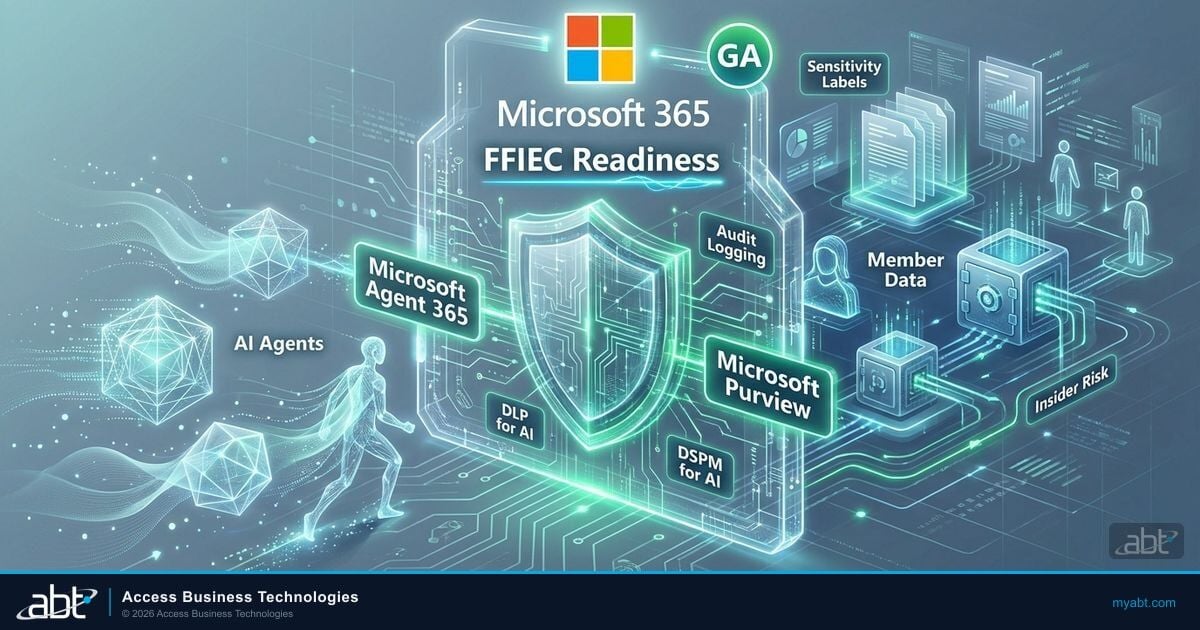
The Microsoft baseline for a credit union is Microsoft 365 plus Microsoft Defender, Microsoft Purview, and Microsoft Entra ID. Those products are the surface where the controls live. The license puts them in your tenant. What it does not do is decide which Conditional Access policies fit a credit union, which DLP templates catch member PII versus generic SMB patterns, which Sentinel analytic rules surface credit-union-specific attack patterns versus default e-commerce noise, or who watches the alerts at 3 AM when an examiner-relevant signal fires.
That layer has a name. ABT calls it M365 Guardian, and for a credit union it is the operating model on top of the Microsoft baseline. The credit union keeps its Microsoft 365 licensing and retains tenant ownership. The Guardian layer is added through the partner relationship under Granular Delegated Administrative Privileges (GDAP) with least-privilege role grants. For a federally insured credit union, the Guardian layer covers four things the Microsoft baseline does not decide for you:
The Microsoft baseline for a credit union: Microsoft 365 for productivity, Microsoft Defender for email and endpoint threat detection, Microsoft Purview for audit logs and DLP, and Microsoft Entra ID for identity and Conditional Access. The M365 Guardian layer on top of that baseline covers NCUA-tuned Conditional Access policies, member-PII DLP profiles aligned to GLBA Safeguards, Microsoft Sentinel analytic rules tuned to credit-union attack patterns rather than generic SMB defaults, and the 24/7 security operations center that watches every Sentinel and Defender signal. The credit union keeps its tenant. The operating model is added through the partner relationship.
- NCUA-tuned Conditional Access policies. Branch geography, remote-work patterns, BYOD device posture, examiner-mode read-only access, and step-up authentication for high-risk sign-ins, mapped to FFIEC examination expectations rather than vendor SMB defaults.
- Member-PII DLP profiles aligned to GLBA Safeguards. Microsoft Purview DLP rules tuned to credit-union member data: account numbers, share account identifiers, loan files, BSA/AML notes, and the SharePoint and Teams locations where they live. Generic SMB templates miss the credit-union-specific patterns.
- Credit-union-specific Microsoft Sentinel analytic rules. Rules tuned to credit-union attack patterns, including member-account takeover signals, branch-targeted phishing, vendor-supply-chain anomalies that fed the 2024 multi-credit-union ransomware incident, and the impossible-travel patterns that recur in NCUA exam findings.
- 24/7 SOC watching every Microsoft signal. When Microsoft Defender generates a high-severity alert at 3 AM, ABT's security operations team responds within minutes. The credit union's IT staff does not have to be the first responder, and the NCUA 72-hour incident-reporting clock is not eaten by detection lag.
The Microsoft license puts the controls in your tenant. The Guardian operating model decides how they are configured, monitored, and documented for the credit union's regulatory perimeter.
Security and Productivity Are the Same Problem
Credit unions often treat security and usability as opposing forces. Tighten controls and employees complain. Loosen them and you're exposed. The real problem is poor implementation, not security itself.
Smart BYOD policy. Board members, committee volunteers, and field staff use personal devices. Locking down personal phones entirely causes pushback and shadow IT. Instead, deploy Mobile Application Management (MAM) first. Work apps and data live inside a secure container. The credit union can wipe the container if a phone is lost. Personal photos, apps, and browsing stay private. No "IT is spying on my phone" pushback. Expand to full Mobile Device Management (MDM) only for high-risk roles that need device-level controls.
Passwordless authentication. Instead of text-message codes your staff constantly types in (which attackers can phish), implement Microsoft Authenticator with number matching and biometrics. More secure than SMS codes. Faster for users. A teller logs in with a quick phone approval and starts serving members immediately.
Conditional Access that fits your workflows. A loan officer visiting a member's business doesn't get blocked from accessing the loan file. Low-risk actions are allowed from verified devices. High-risk activities require a compliant device or VPN. The policy matches how your team actually works instead of fighting against it.
When security is implemented correctly, productivity goes up. Users stop creating workarounds. The help desk stops fielding lockout calls. IT stops fighting fires. That's the outcome of managed licensing rather than DIY licensing. Credit unions that have lived through this transition tell the same story; see how Bay Federal Credit Union streamlined post-closing operations after putting an operating model on top of their Microsoft footprint.
What ABT Includes With Every Credit Union M365 License
When you license Microsoft 365 through ABT, you pay the same as Microsoft direct pricing. The difference is what comes with it.
Guardian Security Insights
A weekly, executive-ready report covering 12 critical security checks across your Microsoft 365 tenant. Written in plain English for non-technical leadership. No digging through admin portals.
Guardian surfaces the issues that matter to credit unions:
- Users with MFA "enabled" but never enrolled
- Admin accounts bypassing Conditional Access policies
- Stale devices, legacy authentication usage, non-compliant endpoints
- Policy exceptions that should have been temporary
Your CEO can forward it to the board with one sentence: "Here's where we stand on cybersecurity this week." Your IT team uses it as a Monday morning checklist. Your NCUA examiner sees documented, continuous oversight rather than annual audit scrambles.
Managed Extended Detection and Response
Guardian Insights catches misconfigurations. ABT's security operations team catches active threats. When Microsoft Defender generates a high-severity alert at 3 AM (impossible travel sign-in, token theft attempt, malware detection), ABT's team responds within minutes rather than waiting for your IT staff to check email the next morning.
Speed matters. The IBM Cost of a Data Breach Report shows breaches contained in under 200 days cost an average of $3.9M. Breaches that take longer cost $5M or more. For credit unions, fast response isn't just a dollar figure. Members expect reliable access to their accounts. Prolonged incidents destroy trust.
Tier-1 CSP Direct Escalation
ABT holds Tier-1 Cloud Solution Provider status with Microsoft. That means direct access to Microsoft engineering for critical issues. When Exchange Online goes down or a security incident needs Microsoft involvement, ABT escalates directly. No generic support queue. No hour-long hold times during an outage that's affecting every branch.
Most credit union MSPs don't have this relationship. They file the same support ticket you would and wait in the same line. For a deeper look at the partner-side multi-tenant control plane that sits underneath this, see our companion article on how Microsoft 365 Lighthouse standardizes compliance across multiple tenants; the same control-plane pattern applies to a credit union that runs separate tenants for the credit union, a CUSO, or an affiliated insurance agency.
Continuous Tenant Management
Security configurations drift. Microsoft adds new features that change default settings. Staff turnover creates orphaned accounts. ABT actively maintains your tenant week over week:
- Policy validation after Microsoft updates
- Account lifecycle management (provisioning, deprovisioning, role changes)
- License optimization to reduce waste on unused seats
- Configuration alignment with evolving NCUA and FFIEC guidance
The July 2026 Licensing Shift Makes Partner Choice More Important
Microsoft's July 2026 pricing update raises M365 subscription costs by 5-33% depending on plan tier. Volume licensing discounts have been eliminated. For credit unions managing hundreds or thousands of seats, the cost impact is significant.
This makes license optimization more critical than ever. ABT tracks license utilization across your tenant and identifies waste: unused licenses, over-provisioned plans, and opportunities to right-size your subscription. Credit unions working with a Tier-1 CSP have access to licensing guidance that bargain resellers don't provide. For a structured walk-through of which plans to downgrade and which to keep, see our M365 license downgrade guide for financial institutions.
The price increase also bundles new security and AI capabilities into existing plans. A credit union without expert configuration support will pay more and get less from those new features.
What Examiners Actually Look For
NCUA examiners use FFIEC examination procedures to evaluate your information security program. They are looking at:
- Governance and board oversight of cybersecurity as a top-level responsibility
- Risk assessments that include your cloud environment
- Vendor management for your technology providers (including your CSP)
- Incident response capability and the 72-hour reporting requirement
- Access controls including MFA enforcement, least privilege, and device compliance
- Continuous monitoring rather than point-in-time assessments
A credit union using ABT for Microsoft 365 licensing has documented evidence for every one of these areas. Guardian reports provide weekly proof of continuous monitoring. Tier-1 CSP status demonstrates responsible vendor selection. Managed detection and response covers incident readiness. Configuration documentation shows deliberate access control decisions.
Credit unions working with bargain license providers have to produce this evidence themselves. Most can't.
Key Takeaway
The Microsoft license is identical regardless of who sells it. What differs is whether anyone configures it for a federally insured credit union. The Microsoft baseline (Microsoft 365, Defender, Purview, Entra ID) lives in every tenant. The M365 Guardian operating model on top of that baseline, NCUA-tuned policies, member-PII DLP, credit-union-specific Sentinel rules, and a 24/7 SOC, decides whether the credit union walks into the next exam with evidence already in hand or with a spreadsheet that takes three weeks to assemble.
Get a Credit Union M365 Configuration Review
ABT manages Microsoft 365 tenants for federally insured credit unions across the country under the M365 Guardian operating model described in this article. A 30-minute conversation maps your current tenant configuration, surfaces the gaps your next NCUA examiner is most likely to find, and outlines what an ABT-managed deployment would cover. No commitment, no quote, no obligation.
Frequently Asked Questions
Credit unions operate under NCUA oversight, FFIEC examination procedures, and GLBA data protection requirements. Microsoft 365 tenants must be configured to meet these specific regulatory obligations including Conditional Access policies, MFA enforcement verification, Data Loss Prevention for member PII, and device compliance baselines. Bargain license providers deliver a product key without this regulatory configuration expertise.
No. ABT's Microsoft 365 licensing matches Microsoft direct pricing. The additional value including Guardian Security Insights, managed detection and response, Tier-1 CSP direct escalation, and continuous tenant management is included with your licensing agreement. Credit unions pay the same for the license and receive significantly more support, security configuration, and compliance documentation.
A Tier-1 Cloud Solution Provider has a direct billing and support relationship with Microsoft, unlike indirect resellers who go through distributors. For credit unions, Tier-1 status means faster escalation during outages, direct access to Microsoft engineering for critical security incidents, and the ability to manage licensing changes without intermediaries. ABT is the largest Tier-1 CSP primarily dedicated to financial services.
Guardian produces weekly executive-level reports covering 12 critical security checks across your Microsoft 365 tenant. These reports document continuous monitoring of MFA enforcement, Conditional Access policy exceptions, device compliance, and legacy authentication status. NCUA examiners evaluating your information security program see evidence of ongoing oversight rather than annual point-in-time assessments, directly supporting examination readiness.
Microsoft's July 2026 pricing update raises M365 subscription costs by 5-33% depending on plan tier, and volume licensing discounts have been eliminated. Credit unions working with a Tier-1 CSP like ABT benefit from license optimization analysis that identifies unused seats, over-provisioned plans, and right-sizing opportunities. This guidance helps offset cost increases that bargain resellers cannot help you manage.