

In This Article
Generic Microsoft 365 Copilot is a productivity unlock for everyone in your shop. Loan officers, processors, underwriters, closers, ops staff, the CFO, the marketing team. It reads emails. It drafts letters. It summarizes Teams meetings. It builds Excel models. It does all of this by reasoning over your institution's own tenant content through Microsoft Graph, which is why the productivity case lands so cleanly at most community banks, credit unions, and mortgage lenders.
But the moment a loan officer asks Copilot a question only the current Fannie Mae Selling Guide can answer, generic Copilot's answer gets thin. With web search enabled, generic Copilot will pull together a Fannie-flavored summary from Bing-indexed public web results plus your tenant content. What it will not do is cite the specific Selling Guide section back to the underwriter (B3-3.5-01 paragraph two, not just B3-3.5 in general), distinguish the Selling Guide rule from a Lender Letter that superseded it last week, or refresh on the cadence the guideline corpus actually changes. It will not tell you whether a self-employed borrower with two years of K-1s and a recent S-corp election qualifies under the current Selling Guide rules with the section reference your QC team will look for. It will not tell you whether a partial claim on a VA file has cured. It will not tell you which Mortgagee Letter superseded the FHA borrower-eligibility rule the underwriter used last quarter. Generic Copilot reasons over your tenant content plus what Bing indexed from the public web; neither is the current authoritative GSE and agency guideline corpus that mortgage lending actually runs on.
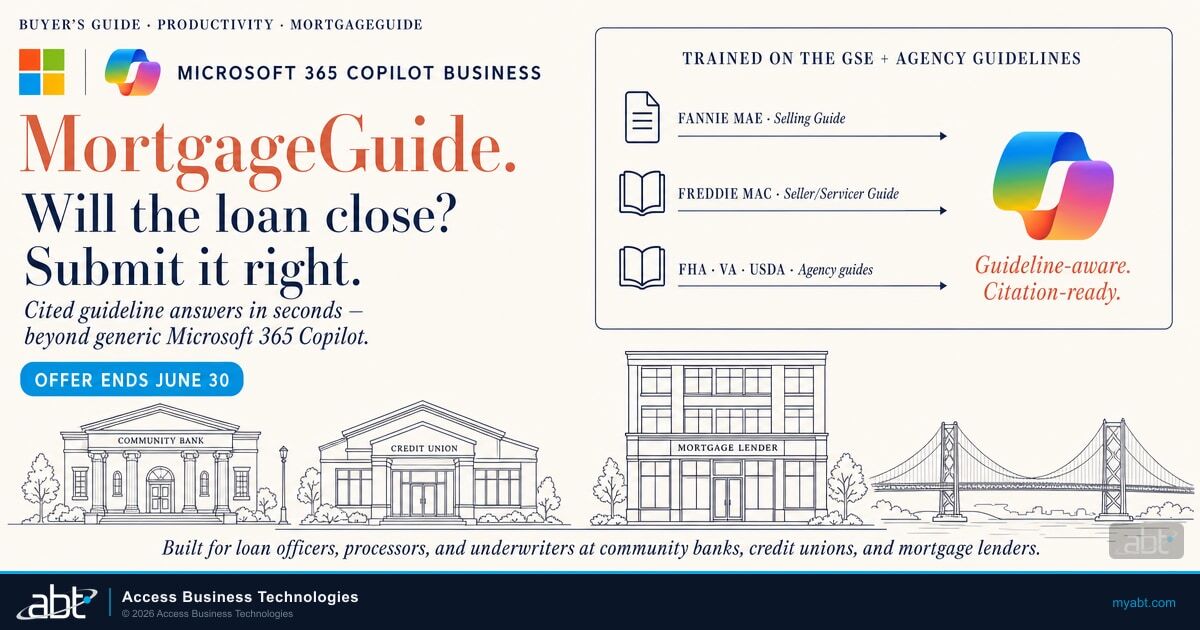
ABT MortgageGuide Copilot is the agent built for that second question. It is currently in beta, available exclusively to ABT customers, and built on Microsoft Azure AI Foundry. MortgageGuide is designed as a productivity assistant for the loan officer, the processor, the underwriter, and the compliance officer, not a replacement for them. The human reviews, validates, and signs every output. The promise is simple: cited guideline answers in seconds, beyond what generic Microsoft 365 Copilot can do, with the underwriter's judgment kept where it belongs. This article walks through what that means for a real mortgage workday, where the data sits, why citing the specific guideline section is the difference between a clean repurchase-defense file and a defect on a Fannie Mae QC review, and how ABT customers get on the beta list.
AI is showing up in every mortgage tool. Every loan origination system, pricing engine, borrower-experience platform, mortgage-insurance lookup, and data-warehouse vendor is adding AI capabilities inside their own product surface, and those capabilities keep getting better with every release. That is genuinely useful for the work that happens inside each of those tools. The complement to all of that, and the layer ABT focuses on, is the cross-tool productivity work that fills the rest of a mortgage professional's day.
That cross-tool work lives in Microsoft 365. The loan officer drafts borrower outreach in Outlook and pre-qual letters in Word. The processor drafts stip-clearance emails, builds Excel pipeline trackers, and translates Desktop Underwriter and Loan Product Advisor reports into plain English. The underwriter drafts credit memos and adverse-action narratives. The compliance officer reviews adverse-action language across declines. Microsoft 365 Copilot Business is the AI layer for that work, and it sits inside the tenant ABT manages. MortgageGuide adds the mortgage-domain knowledge layer (GSE and agency guidelines). ABT Mortgage Exchange brings loan-origination-system data into the same Microsoft Azure tenant through Mortgage BI, our mortgage data warehouse. The layers compound: the more your tenant content, LOS data, and guideline corpus sit in the same reasoning surface, the more useful the AI becomes on the workflow you actually run. Everything stays inside the tenant ABT manages, with one audit log, one set of sensitivity labels, one Data Loss Prevention policy, and one examiner-defensible governance configuration. The vendor AI inside each tool keeps doing what it's specialized for; the Microsoft 365 + MortgageGuide + Mortgage Exchange layer handles the cross-tool work that connects them.
Our Microsoft 365 Copilot Business Buyer's Guide for Financial Institutions walks the broader Copilot buying decision across community banks, credit unions, and mortgage lenders. Our companion guide on how mortgage roles actually use Microsoft 365 Copilot Business shows what loan officers, processors, and underwriters do with generic Copilot on a Tuesday afternoon. Our Copilot Business pricing guide for community banks and credit unions walks the $10 incremental bundle (now a permanent Microsoft price), the $18 standalone rate available through December 31, 2026, and the $21 standard standalone list it reverts to afterward. This article is the mortgage-specialized agent that runs on top of all of that.

How MortgageGuide Saves a Loan Officer's Morning
A loan officer at a community lender opens her laptop at 8:15 a.m. Three loans on her desk. The first is the easy one: a W-2 borrower with two years on the job, 740 FICO, 20 percent down, conventional conforming. She submits without thinking about it. The other two are the question marks. One is a self-employed borrower whose tax returns just got produced last night, with a recent S-corp election that changes the income calculation. The other is a VA cash-out where the appraisal came in lower than expected and the borrower wants to know whether the file still works at the new value. Both of these are questions only the GSE or agency guideline can definitively answer, and both of them have to be answered before 9:30 a.m. because the borrower is going to call.
In a generic Microsoft 365 Copilot workflow, the loan officer pivots to a browser tab, opens the Fannie Mae Selling Guide at selling-guide.fanniemae.com, searches for self-employment, scans through five subsections under Part B3-3.5 (calculation of self-employed income), opens a second tab for the relevant Lender Letter or Selling Guide Announcement that may supersede or qualify the rule, opens a third tab to check whether her institution's overlays apply, and starts piecing together an answer. The S-corp election changes which Form K-1 entries the underwriter pulls and how the qualifying income is averaged. Twenty minutes after the first tab opens, she still has not landed on a defensible answer; she calls a senior underwriter to confirm. That is forty-five minutes the loan officer is not on the phone with the next borrower, and the question still has to be re-asked by the underwriter when the file gets submitted.
MortgageGuide's productivity outcome is the time spent between the question and a defensible answer. The agent is a chat experience the loan officer can use directly in her Microsoft 365 surface; she asks a question in the same place she asks generic Copilot a question. The agent is currently in beta and available exclusively to ABT customers. The platform supports citation behavior through Microsoft Azure AI Foundry's managed knowledge layer, so answers surface alongside the underlying guideline source rather than as freestanding paragraphs the loan officer has to verify by hand. The loan officer never leaves the Microsoft 365 surface to read a separate website; the senior underwriter is reserved for the genuinely ambiguous files; the borrower gets a same-morning answer.
Specific behaviors of the beta agent (response format, exact citation style, refresh cadence on the guideline corpus, integration with the institution's loan origination system) are part of the work currently under engineering review and will be communicated to ABT customers as the beta progresses. ABT customers participating in the beta get update notes through their account team and through the engagement's weekly office hours.
The same morning workflow plays out for processors gathering conditions, for underwriters writing decisions, and for closers confirming the file is ready for funding. Each role asks different questions; each role spends less time in browser tabs and more time in the institution's loan origination system. A processor asks the agent about the documentation required to clear an income condition. An underwriter asks the agent to summarize the qualifying-income calculation for the credit memo. A closer asks the agent about the seasoning requirement on a VA cash-out. The questions are not the same; the productivity dynamic (cited answers in the same surface where the work already lives) is. For the role-by-role view of how the broader Copilot Business surface helps these mortgage roles, see our companion guide: How Mortgage Roles Actually Use Microsoft 365 Copilot Business. This article focuses on what the mortgage-specialized MortgageGuide agent adds on top.
What generic Copilot does vs what MortgageGuide adds
Generic Microsoft 365 Copilot reads your tenant (emails, documents, meetings, Microsoft Teams chats, Microsoft SharePoint files) and, when web search is enabled, supplements with Bing-indexed public web content. It is a productivity unlock for everyone in your shop, regardless of industry. MortgageGuide is a specialist on top: a mortgage-tuned Copilot agent built on Microsoft Azure AI Foundry, trained on GSE and agency guidelines, currently in beta, available exclusively to ABT customers. You run generic Copilot for the general workflow (borrower email drafts, meeting recaps, Excel modeling, document summarization). You run MortgageGuide when the question requires guideline-aware reasoning grounded against the current Selling Guide with specific section citations, which a tenant-plus-public-web summary cannot reliably deliver. The two work together inside the same Microsoft 365 surface.
| What the loan officer asks | Generic Microsoft 365 Copilot | ABT MortgageGuide Copilot (beta) |
|---|---|---|
| "Draft a status email to the borrower about the appraisal." | Yes. Reads the institution's prior emails on the file, drafts a borrower-appropriate update. | Same. Generic Copilot's productivity surface covers this cleanly. |
| "Summarize what conditions we still owe Fannie on the LO Cuevas file." | Yes if conditions live in the institution's tenant. Reads the institution's SharePoint and Teams content. | Same. Tenant-content reasoning is generic Copilot's home. |
| "Does this self-employed borrower's K-1 income qualify under the current Selling Guide?" | No native guideline corpus. Cannot answer from training data alone in any defensible way. | Designed for this. The platform supports cited, guideline-grounded answers via Microsoft Azure AI Foundry's Foundry IQ. Specific MortgageGuide behavior is in beta and under engineering review. |
| "Which Mortgagee Letter replaced the prior FHA borrower-eligibility rule?" | No native FHA Handbook 4000.1 corpus. Generic answer at best. | Designed for this. Agency-guideline reasoning is the specialist case. |
| "What VA seasoning requirement applies to a cash-out refinance at 90 days?" | No native VA Lenders Handbook M26-7 corpus. Vague answer. | Designed for this. VA-program reasoning is in scope. |
The two-column comparison above is the underlying logic of why ABT built MortgageGuide on top of Microsoft 365 Copilot rather than as an alternative to it. The everyday productivity workflow that runs on tenant content stays on generic Copilot, where it belongs. The mortgage-guideline workflow that requires reasoning against a corpus the tenant does not contain runs on MortgageGuide, which is what the agent is built to do.
One more thing about the morning workflow that matters at scale: across a 25-loan-officer mortgage lender, the cumulative cost of the guideline-question tax (the morning browser-tab marathon described above) compounds quickly. Conservative arithmetic: if every loan officer averages even one hard guideline question per day that costs 30 minutes of cross-referencing plus a 5-minute senior-underwriter call, that is 14.6 hours of mortgage-team time per day across the shop, or roughly 3,650 hours per year. That number is a back-of-envelope arithmetic example to illustrate the shape of the cost, not a benchmark or a savings guarantee. The actual productivity outcome at any given institution depends on the loan mix, the staffing model, the institution's own overlays, and how the team integrates the agent into the workflow. The point of the arithmetic is the scale: a meaningful share of a mortgage shop's daily time goes to guideline reasoning, and any reduction in the friction of that reasoning lands as immediate top-of-the-day productivity recovery.
The Azure AI Foundry Platform Underneath
Microsoft Azure AI Foundry is Microsoft's enterprise platform-as-a-service offering for building, deploying, and governing AI agents and applications. It is a code-first platform (C# and Python software development kits) that runs inside the customer's Azure subscription, with unified role-based access control, networking, and policy under a single Microsoft resource-provider namespace. The unified resource provider means an institution's IT team sees Foundry agents in the same Azure portal where they see virtual networks, storage accounts, key vaults, and Azure Monitor. There is no separate management plane; there is no separate identity store. The identity that authenticates a loan officer to her Microsoft 365 mailbox is the same Microsoft Entra ID identity that authenticates her to any Foundry agent the institution has licensed.
Foundry is distinct from Microsoft Copilot Studio, which is the low-code and no-code SaaS experience for building flows inside Microsoft 365 and Microsoft Power Platform. Copilot Studio is where most institutions build their first conversational experiences: an internal HR-policy chat, an IT helpdesk triage bot, a customer-service flow that answers branch-hours questions. Foundry is built for the harder cases. It supports three documented customization paths: Supervised Fine-Tuning (training the model on a labeled dataset specific to the institution's domain), Direct Preference Optimization (training against preferences), and Reinforcement Fine-Tuning (training against a reward signal). It supports Retrieval-Augmented Generation (RAG) "when you need answers grounded in private or frequently changing data," per Microsoft's published Azure AI Foundry RAG concepts documentation. Mortgage-guideline reasoning is the canonical RAG use case: the corpus changes monthly with each Selling Guide update, with each Freddie Mac Bulletin, with each Mortgagee Letter, and the agent must reason against the current state of the corpus rather than against frozen training data.
Foundry IQ, the managed knowledge layer inside Azure AI Foundry, provides citation-backed answers that ground agent responses in enterprise or web content. The retrieval pipeline decomposes complex questions into sub-questions, executes parallel subqueries against the indexed corpus, semantically reranks the candidate passages, and returns unified responses with source attribution back to the underlying documents. The pipeline is agentic in the sense that the agent reasons about which subqueries to issue and how to combine the results rather than performing a single static retrieval. This is the public Microsoft capability ABT uses to enable MortgageGuide's guideline-aware behavior. Specific tuning of MortgageGuide on top of Foundry IQ (which guideline corpora are indexed, what the refresh cadence is for each, how citations are rendered to the loan officer, which subquery patterns are used for mortgage-specific reasoning) is part of the beta work currently under review and will be communicated to ABT customers as the beta progresses.
The enterprise controls that come with the Foundry platform are the same controls financial-services examiners expect to see on any production workload that touches customer non-public information. Authentication for Model Context Protocol (MCP) and Agent-to-Agent (A2A) communication, Azure Policy integration that lets the institution enforce specific compliance baselines on the agent's runtime, Microsoft Entra ID role-based access control for who can invoke the agent and what they can ask, Azure Key Vault integration for secret management, private endpoints that keep agent traffic off the public internet, and Azure Monitor observability for audit and incident response. These are not MortgageGuide-specific features; they are platform features the agent inherits by virtue of running on Foundry. An institution's IT lead can map them directly to the FFIEC IT Examination Handbook control families the examiners already know how to interpret.
Why Azure AI Foundry, not Copilot Studio
Copilot Studio is the right tool when the institution wants a no-code conversational flow built on top of Microsoft 365 content. It is what most banks and credit unions use to build a customer-service bot or an internal HR-policy chat. Azure AI Foundry is the right platform when the agent needs deeper customization (custom retrieval, fine-tuning, agentic patterns), full Azure governance (private endpoints, Key Vault, Azure Monitor, Microsoft Entra ID role-based access control), and the option to run dedicated infrastructure for sensitive workloads. MortgageGuide is built on Foundry because mortgage-guideline reasoning is the deeper-customization case, not the no-code-flow case. The two platforms are complementary, not competing; an institution can run a Copilot Studio HR bot and a Foundry-based mortgage agent inside the same Microsoft 365 surface.
For the institution's IT lead, the practical answer is that MortgageGuide sits on a Microsoft-published enterprise platform with the same Microsoft Entra ID identity, the same Azure tenant boundary, and the same governance controls as the rest of the institution's Azure footprint. ABT operates this stack end-to-end as your Tier-1 Microsoft CSP: your Microsoft 365 tenant and the Azure subscription that runs MortgageGuide both sit under our partner-of-record relationship. Your IT lead has one team to call for any of it.
For the auditor, the practical answer is that MortgageGuide is not a black-box vendor SaaS. It is an application running on a Microsoft enterprise platform with the same control surfaces (Entra ID Conditional Access, Microsoft Purview Audit, Azure Monitor, Defender for Cloud) the institution already documents in its IT examination response. The examiner conversation about MortgageGuide is not a brand-new conversation; it is the same conversation about any Azure-hosted workload.
The public sources the GSE and agency guideline corpus is built from
These are the published sources that define the GSE and agency guideline corpus mortgage lenders run on every day. The corpus changes constantly, which is why mortgage-guideline reasoning is a true Retrieval-Augmented Generation use case rather than a frozen-training-data use case. ABT MortgageGuide Copilot is built to ground answers against this corpus; specifics of which sources are indexed and at what cadence are part of the beta work currently under engineering review.
At selling-guide.fanniemae.com with policy archives at singlefamily.fanniemae.com. Organized into Parts: A (Lender Relationships), B (Origination Through Closing, subdivided B1 Loan Application, B2 Eligibility, B3 Underwriting Borrowers, B4 Underwriting Property, B5-B7 specialized topics), C (Selling, Securitizing, and Delivering Loans), D (Ensuring Quality Control), E (Quick Reference Materials). Servicing-side requirements live in the separate Fannie Mae Servicing Guide. The Selling Guide is updated typically the first Wednesday of each month, with numbered Selling Guide Announcements (for example SEL-2025-08 through SEL-2025-10 across late 2025). Lender Letters supplement between Selling Guide cycles.
At guide.freddiemac.com with bulletins and tooling at sf.freddiemac.com. Structured as a unified Seller/Servicer Guide combining Selling chapters (4000-series ARMs and eligibility, 5000-series documentation, income, and assets, 6000-series cash window) and Servicing chapters (8000-series insurance and loss-mitigation). Updates issue as numbered Guide Bulletins (typically 10 to 20 per year).
On hud.gov. Five-section structure: I (Doing Business with FHA), II (Origination Through Post-Closing/Endorsement), III (Servicing and Loss Mitigation), IV (Claims), V (Quality Control). Updates flow through FHA INFO emails and numbered Mortgagee Letters.
At benefits.va.gov/HOMELOANS. Chapter-organized (Ch. 5 Loss Mitigation Waterfall, Ch. 7 Eligibility, Ch. 22 Partial Claim, among others). Revisions issue as chapter-specific drafts.
At rd.usda.gov. Chapter structure paired with regulatory text at 7 CFR section 3555.
The reason this corpus matters for an AI agent specifically (rather than for a search tool or a static reference) is that the questions a loan officer asks are rarely single-source. A self-employment qualifying-income question may touch the Fannie Mae Selling Guide section, a recent Selling Guide Announcement that updated the calculation, an FHA Handbook 4000.1 section if the file is FHA, the institution's own overlay policy stored in SharePoint, and the underwriter's prior notes on similar files. The job of the agent is to combine those sources, ground each piece of the answer in its specific citation, and surface the combined reasoning to the loan officer in the productivity surface where the work already lives. The agentic-retrieval pipeline inside Foundry IQ is built for exactly this kind of multi-source decomposition. The mortgage tuning on top of it is what ABT brings to the engagement.
Mortgage-guideline reasoning is a true Retrieval-Augmented Generation use case. The corpus changes monthly; the agent must reason against the current state of the corpus, not against frozen training data.
Where MortgageGuide's Tenant Data Lives
The data question is the second thing a mortgage CTO asks after the productivity question. Where does MortgageGuide put my borrower's tax returns when the loan officer asks a question about self-employed income? Where do the prompts go? Where do the answers go? Who reads any of it? What happens to a borrower's information if an examiner later asks the institution to reconstruct the AI-assisted reasoning on a specific file?
The platform answer is straightforward because Azure AI Foundry runs inside the customer's Azure subscription. Tenant data the agent reasons over stays within the customer's Microsoft tenant boundary. Prompts and answers are subject to the institution's Microsoft Purview Audit configuration and Microsoft Entra ID Conditional Access policies, the same way generic Microsoft 365 Copilot prompts are. The audit log captures who asked what, when they asked it, and what the agent returned. The Conditional Access policy can require multi-factor authentication, a managed device, a particular network posture, or any other condition the institution applies to other Microsoft 365 workloads, and the agent respects those conditions on every invocation. Microsoft does not train foundation models on Microsoft 365 Copilot or Azure AI Foundry customer tenant data, per the Microsoft Product Terms and the published commitments at Microsoft Learn. Those are platform-level guarantees that apply to any agent built on the Azure AI Foundry platform, including MortgageGuide.
The mortgage-specific tuning happens inside the same boundary. When a loan officer asks MortgageGuide whether the self-employed borrower's K-1 income qualifies, the agent grounds its reasoning against GSE and agency guidelines (the high-level corpus is confirmed; specifics of which guidelines, which versions, and which refresh cadence are currently under engineering review and will be communicated to ABT customers as the beta progresses). The borrower's tax returns never leave the institution's tenant. The guideline corpus is the agent's knowledge layer; the institution's tenant content is the agent's context layer. The two stay in their lanes.
For the institution's data-protection officer, the implication is that the same data-protection regime the institution already runs against Microsoft 365 covers the agent. Microsoft Purview Information Protection sensitivity labels follow content into the agent's reasoning surface. Microsoft Purview Data Loss Prevention policies that block customer non-public-information patterns from leaving the tenant apply to the agent's output the same way they apply to email. Microsoft Defender for Cloud Apps shadow-AI discovery covers the agent traffic as a known sanctioned application, which is the opposite of the shadow-AI risk profile.
The shadow AI alternative is much worse
The realistic comparison is not "MortgageGuide vs generic Copilot." The realistic comparison is "MortgageGuide vs the loan officer pasting borrower tax returns into a personal ChatGPT Plus account at 8:30 a.m. on Friday." That second workflow is happening at financial institutions right now (recent research from sources like Harmonic and Cyberhaven finds a meaningful share of sensitive AI usage at financial-services firms is coming from personal consumer accounts, not enterprise platforms). The shadow-AI workflow puts customer non-public information outside the institution's tenant boundary, outside any audit log, outside any examiner-defensible governance, and outside the institution's contractual data-protection regime with Microsoft. MortgageGuide and generic Copilot both keep the data inside the boundary. The point of running MortgageGuide for the mortgage workflow is that the loan officer never feels the need to pivot to a personal browser tab for the guideline question. The productivity unlock and the security posture are paired.
For the broader examiner-response configuration story (the five Microsoft 365 control surfaces, the April 17, 2026 OCC/Federal Reserve/FDIC joint guidance, NIST CSF 2.0, and the state regulatory layer), see the companion examiner-ready controls article. MortgageGuide inherits that posture; the agent is one more surface inside the same governed perimeter.
Why Citing the Fannie or Freddie Section Matters at Audit
An underwriter writes a decline narrative on a self-employed borrower's file. Two versions of that narrative exist. Version one reads: "Borrower's income is insufficient based on tax return analysis." Version two reads: "Borrower's two-year average self-employment income calculated per Selling Guide section B3-3.5-01 results in qualifying monthly income of $X, which produces a debt-to-income ratio of Y percent, exceeding the program threshold of Z percent." The first narrative is a sentence. The second narrative is an examiner-defensible explanation of the underwriting decision with the specific Selling Guide section cited. Three years later, when Fannie Mae's QC review pulls the file, the second narrative passes and the first narrative is a finding.
Fannie Mae publishes its Loan Defect Taxonomy as a standalone reference at singlefamily.fanniemae.com/loan-defect-taxonomies, organizing critical defects into 8 top-level categories. The Selling Guide itself runs Parts A through E: Part A (Lender Relationships), Parts B1-B7 (Origination Through Closing), Part C (Selling, Securitizing, and Delivering Loans), Part D (Ensuring Quality Control), and Part E (Quick Reference Materials). Servicing-side requirements live in the separate Fannie Mae Servicing Guide. The ACES Quality Management Mortgage QC Industry Report Q3 2025 places the current critical defect rate on GSE loans at 1.79% (recent quarterly range 1.3-1.8% across 2025), with Income/Employment contributing roughly 22.99% of critical defects in ACES Q1 2025. The mathematics is still unforgiving: at a 1.8 percent critical defect rate on, say, 600 loans funded in a year, roughly eleven loans land in the critical category. Defects in the rep-and-warranty window can drive repurchase demands from the GSEs, which means full principal-plus-interest exposure on the institution's balance sheet for every loan that fails the QC review. A single repurchase on a $400,000 conforming loan is a six-figure hit to the income statement. Repurchases also drive insurance and counterparty consequences that compound the underlying loss.
The Consumer Financial Protection Bureau and federal prudential regulators have separately emphasized explainability, auditability, and Fair Lending compliance for any AI used in credit decisions, which makes citation-backed answers an industry baseline rather than a nice-to-have. The April 17, 2026 joint guidance from the OCC, Federal Reserve, and FDIC (issued as OCC Bulletin 2026-13 and Federal Reserve SR Letter 26-2, rescinding the 2011 SR 11-7 framework) explicitly excludes generative and agentic AI from the formal Model Risk Management scope and requires enterprise risk governance over those tools instead. MortgageGuide is designed for exactly that posture: a productivity assistant that helps the underwriter draft faster and cite better, not a tool that makes the decision. The underwriter reviews every output, the audit trail shows the review happened, and the exception-handling workflow is documented. With that human-in-the-loop discipline in place, examiners do not expect MortgageGuide to be governed as a regression-style credit model under MRM; they expect documentation of how the tool fits into the institution's broader risk and lending operations. Without that discipline, the tool functions as the decision-maker and the carve-out does not hold. Citation-grounded answers make the documentation natural because the answer itself is a self-documenting reference back to the source-of-truth guideline.
The narrative the underwriter writes is what survives a Fannie Mae QC review three years later. The cited section is what makes the narrative defensible.
The agent platform supports citation behavior through Foundry IQ's agentic-retrieval design. That is the public Azure AI Foundry capability that grounds responses with source attribution back to the indexed corpus. How MortgageGuide renders citations to the loan officer or underwriter, which guideline sections appear in the response, how the citation depth is calibrated for different question types, and how the response format ties back to the institution's loan origination system are part of the beta work currently under engineering and product review. ABT customers participating in the beta receive updates as the agent matures.
One more boundary worth naming clearly: the Equal Credit Opportunity Act (12 CFR section 1002.9) requires creditors to provide specific principal reasons for adverse-action decisions within 30 days of an application, subject to fair-lending review. Copilot (generic or specialized) cannot be the final author of an ECOA decline narrative. The underwriter retains authorship and accountability. MortgageGuide is a first-draft assistant for the underwriter, the same way generic Copilot is a first-draft assistant for the loan officer's borrower email. The role of the human stays the role of the human. Examiners ask specifically about this division of labor in the lending exam workflow, and the institution's documented response should make clear that AI assistance is a productivity layer, not a decision-making layer, on every adverse-action file.
The defect taxonomy itself rewards specificity. A QC reviewer reading an underwriter narrative that cites Selling Guide section B3-3.5-01 for self-employed income calculation has a fast path to validate the underwriting decision: open the cited section, verify the calculation, sign off. A QC reviewer reading "borrower's income was analyzed and qualifying income was determined" has to do the entire calculation from scratch, second-guess the underwriter's logic, and decide whether to escalate. The first path takes minutes and produces a clean file; the second path takes hours and risks a downgraded loan finding. The citation is the speed gear for the QC team, not just the defensibility gear for the institution.
Get on the MortgageGuide beta list
ABT customers running the 30-day Copilot adoption sprint can request MortgageGuide beta access as part of the engagement. New customers qualify by adding 11 or more new Copilot seats through ABT (no tenant migration required, multi-CSP additive).
How ABT Customers Get MortgageGuide Beta Access
MortgageGuide is currently in beta and available exclusively to ABT customers. Two practical paths exist for institutions evaluating it, and both paths run through the broader Copilot adoption engagement rather than as a standalone agent procurement.
Existing ABT Microsoft 365 customers can request beta access through their account team as part of an active or planned Copilot training engagement. ABT runs Copilot adoption as a productized 30-day sprint with five components: a kickoff workshop with the institution's leadership and IT lead on Day 1, champion enablement for two to four internal champions per role on Days 2 through 5, a role-based scenario library adapted to the institution's actual templates on Days 6 through 10, weekly office hours running Days 11 through 25 to fix adoption blockers in real time, and a Day 30 executive ROI readout. MortgageGuide beta access folds into the sprint where the institution's roles benefit from guideline-aware grounding, primarily loan officers and underwriters at mortgage lenders and at the mortgage divisions of community banks and credit unions. The beta is not separately licensed; it travels with the Copilot adoption engagement for institutions that fit the mortgage-specialization use case.
New customers can start with Microsoft's free 30-day Microsoft 365 Copilot trial, which is available now to SMB organizations of up to 300 users and which ABT helps run and govern. The qualifier for the broader ABT engagement is adding 11 or more new Copilot seats through ABT. Microsoft allows multiple Cloud Solution Provider partners to coexist on the same tenant, so ABT becomes an additional CSP alongside any existing CSP. There is no license transfer, no tenant migration, no Microsoft fees, and no break in the institution's existing relationship with its current CSP. ABT activates the new Copilot Business licenses against the new seats for the pilot cohort. The institution gets the AI Readiness Assessment, the 30-day adoption sprint, and MortgageGuide beta access for mortgage roles, all bundled into the engagement. The multi-CSP-additive model is one of the most important pieces of the procurement story: the buyer does not have to choose between switching providers and getting access to ABT's mortgage-specialist work, because the buyer does not have to switch providers at all.
For the three-tier pricing strategy (the $10 incremental ABT bundle, the $18 standalone rate through December 31, 2026, and the $21 standard standalone list), the shadow-AI cost-recovery story, and the five Microsoft 365 controls that make the deployment defensible, see our pricing guide: Microsoft 365 Copilot Business Pricing for Community Banks and Credit Unions. The $18 standalone rate runs through December 31, 2026, after which the standalone reverts to its $21 standard list price; the $32 Business Premium with Copilot bundle is a permanent Microsoft price with no reversion. The one dated pricing item, the standalone rate through December 31, 2026, is independent of MortgageGuide; the agent is currently in beta and available exclusively to ABT customers regardless of which Microsoft 365 Copilot tier the institution is licensed for. Contact ABT for current beta availability based on your institution's plan.
If you run mortgage operations, the realistic ask is to compare what your loan officers and underwriters do today (the morning workflow described at the top of this article) against what they could do if the guideline question and the productivity workflow lived in the same Microsoft 365 surface, with cited answers grounded in the GSE and agency guideline corpus. The path from today to that future state runs through generic Microsoft 365 Copilot Business for the everyday productivity unlock (the borrower email drafts, the meeting recaps, the Excel modeling, the document summarization that every shop benefits from) plus ABT MortgageGuide Copilot beta for the mortgage-guideline lift on top. Our Microsoft 365 Copilot Business Buyer's Guide for Financial Institutions ties the two together for the buying decision and walks through the broader buyer journey from productivity to security to governance for community banks, credit unions, and mortgage lenders alike.
The mortgage-specific story is on top of that foundation. Generic Copilot gets you the productivity floor. MortgageGuide is the ceiling lift for the mortgage workflow specifically. The institution that pairs the two has the cleanest path through the next examination cycle, the next QC review cycle, and the next year of borrower-facing turn-time competition. The path is open today for ABT customers; the door is the AI Readiness Assessment that comes with ABT's Copilot Business adoption engagement. For a step-back view of how the free Copilot trial fits into the broader productivity / security / governance buyer journey at community banks, credit unions, and mortgage lenders, our Microsoft 365 Copilot Business Buyer's Guide for Financial Institutions walks through all of it.
| Role at a mortgage shop | Generic Microsoft 365 Copilot daily value | What MortgageGuide adds (beta) |
|---|---|---|
| Loan officer | Borrower email drafts, application-status updates, meeting recaps with referral sources, Excel calculations for borrower-affordability scenarios. | Same-morning answers on threshold guideline questions: self-employed income, gift funds, subordinate financing, non-traditional credit, recent job changes, agency-program eligibility. |
| Processor | Condition tracker summaries, document-status emails, internal Teams chat coordination with LOs and UWs, file-status reports. | Guideline-aware answers on documentation requirements: which forms, which seasoning, which compensating factors satisfy which conditions per the current Selling Guide or Handbook. |
| Underwriter | Credit-memo first drafts from the file content, AUS findings summarization, exception narratives for the credit committee. | Cited reasoning for qualifying-income calculations, debt-to-income analysis, eligibility determinations. First-draft assistance only on ECOA adverse-action narratives; the underwriter remains the final author per 12 CFR section 1002.9. |
| Closer | Closing-package checklists, lender-instructions emails, post-closing document tracking, settlement-statement reconciliation. | Final-pass guideline checks on funding-ready files: VA seasoning, FHA endorsement, GSE delivery requirements per the current bulletins. |
| Compliance and QC | Regulatory summaries from the institution's policy library, exam-prep file pulls, OCC/FFIEC/CFPB-finding triage from internal docs. | Cross-referenced QC reviews: validate the underwriter's cited Selling Guide section, flag files where the narrative does not match the agency rule the file claims to satisfy. |
The table above is the practical answer to "which roles benefit from MortgageGuide." The shortest version: every mortgage-shop role benefits from generic Microsoft 365 Copilot Business for the day-to-day productivity workflow, and the loan officer, underwriter, and QC roles benefit from MortgageGuide on top for the moments when the question depends on the GSE or agency guideline. The closer and the processor benefit from MortgageGuide on the smaller share of their workflow that touches agency rules directly; the larger share of their work runs cleanly on generic Copilot.
How MortgageGuide is priced during the beta depends on your Microsoft licensing relationship with ABT.
| Path | When it applies | What you pay for MortgageGuide |
|---|---|---|
| Bundled | ABT is your primary Microsoft Cloud Solution Provider (the partner holding your Microsoft 365 licensing) | No incremental cost. Included in the Copilot adoption engagement. |
| Metered | You keep your existing CSP, and ABT runs alongside as a secondary CSP on the same tenant | Usage-based charge during the beta. ABT shares current pricing on request. |
How institutions move between paths. Microsoft permits multiple CSPs on the same tenant, so the metered path is fully supported and many institutions stay there indefinitely. Institutions that consolidate to the bundled path do so when their existing CSP agreements come up for renewal. The technical lift is zero because the tenant is already shared; the change is a billing decision on the institution's own contract boundary, not a Microsoft-side migration.
The arithmetic for the bundled path. The institution pays Copilot Business per seat per month at the standard published rate (the $10 incremental bundle, now a permanent Microsoft price; the $18 standalone rate through December 31, 2026; and the $21 standard standalone list it reverts to afterward, depending on path). MortgageGuide beta access is included.
The forward look. MortgageGuide is expected to mature toward standalone product status as the beta progresses. For now, the bundled path with ABT as primary CSP is the simplest economics for the full Microsoft 365 + MortgageGuide + Mortgage Exchange + Mortgage BI stack inside one tenant.
The clean version of "what does it take to get started"
Open a conversation with your ABT account team. The 30-day Copilot Business adoption sprint is the engagement vehicle; MortgageGuide beta access folds in for mortgage roles. The AI Readiness Assessment is included for existing ABT customers as part of the Tier-1 Microsoft Cloud Solution Provider relationship during 2026.
Microsoft's free 30-day Microsoft 365 Copilot trial, which ABT helps run and govern, is the path. The qualifier for the ABT engagement is adding 11 or more new Copilot seats through ABT. Microsoft allows multiple Cloud Solution Provider partners on the same tenant, so ABT becomes an additional CSP without any tenant migration. The AI Readiness Assessment, the 30-day adoption sprint, and MortgageGuide beta access for mortgage roles are all bundled into the pilot.
The two product-differentiator questions to ask: does the other CSP run Copilot adoption as a productized 30-day sprint with documented components, and does the other CSP offer a mortgage-specialized Copilot agent? As of May 2026, ABT runs the sprint and ABT runs MortgageGuide beta; no other Microsoft Cloud Solution Provider publicly markets an equivalent GSE-guideline citation agent today.
The control surfaces are the same surfaces you already document for Microsoft 365: Microsoft Entra ID Conditional Access, Microsoft Purview Audit, Microsoft Purview Information Protection sensitivity labels, Microsoft Purview Data Loss Prevention, Microsoft Defender for Cloud Apps, Microsoft Defender for Office 365, Microsoft Azure Monitor. The AI Readiness Assessment maps your current configuration against the FFIEC framework and produces an examiner-ready gap report. There is no separate AI-specific compliance regime to learn for MortgageGuide because the agent is governed under the institution's existing Microsoft 365 and Azure controls.
The four-square framing above is the practical "what's next" for a mortgage lender, mortgage-division leader at a community bank or credit union, or technology executive who has read this far. Each scenario maps to the same engagement vehicle (the 30-day Copilot Business adoption sprint) and the same starting point (Microsoft's free 30-day Microsoft 365 Copilot trial, which ABT helps run and govern). The MortgageGuide beta access folds in for mortgage roles inside the engagement; it does not require a separate procurement, a separate contract, or a separate sale.
One closing observation about the broader competitive picture for buyers reading this in mid-2026. The mortgage-technology vendor landscape is rich with AI capabilities at the platform level: document classification, automated indexing, intelligent stacking-order routing, automated underwriting findings interpretation, fraud-signal detection across loan-level data. Those capabilities serve real workflows and they are not duplicated by what MortgageGuide does. MortgageGuide does not classify documents, does not stack files, does not produce AUS findings. It answers the loan officer's question about whether the guideline applies and cites the section the answer comes from. The role is narrow on purpose. The agent does one thing well rather than ten things vaguely. For a mortgage shop, that means MortgageGuide does not replace the loan origination system, the AUS engine, the document classification platform, the fraud detection vendor, or the QC software. It is a specialist assistant alongside those systems, accessed inside the Microsoft 365 surface where the team already works.
The deployment risk profile reflects that narrowness. Because MortgageGuide is a productivity assistant operating inside the Microsoft 365 surface (rather than a system of record in the loan workflow), the institution's downside if the agent produces an unhelpful answer on any given query is small: the loan officer or underwriter checks the cited guideline section themselves, makes the call, moves on. There is no automated decisioning behind it. There is no submission of the loan to a GSE based on the agent's output without a human in the loop. There is no funding decision rendered by the agent. The agent reduces friction; the human retains decision-making authority on every file. That is the right deployment shape for an AI assistant in a regulated lending context, and it is the shape Microsoft, the federal prudential regulators, and the GSE-counterparty risk teams have all separately landed on through their 2025 and 2026 published guidance.
If you are a CFO reading this, the cost picture is also worth naming clearly. Generic Microsoft 365 Copilot Business is a per-seat-per-month license, billed monthly with no separate AI consumption charge for the agent layer. MortgageGuide beta access is a service component of the ABT engagement and does not introduce a separate per-query, per-seat, or per-agent license at the institution level for participating customers during the beta. The pricing details after the beta exits and the agent enters general availability will be communicated to ABT customers when those details are finalized; the beta itself is structured to be a low-cost entry into the productivity gain rather than a separate procurement cycle. The institution's full Microsoft AI spend through this engagement equals the Microsoft 365 Copilot Business seat license cost, period.
| Examiner question | The institution's clean answer (with MortgageGuide in scope) |
|---|---|
| What AI tools are deployed in your lending operations, and what governance do you have over them? | The institution runs Microsoft 365 Copilot Business across the lending team for general productivity, and ABT MortgageGuide Copilot beta for mortgage-guideline reasoning. Both are governed under the institution's existing Microsoft 365 and Azure controls: Microsoft Entra ID Conditional Access requires MFA and managed devices, Microsoft Purview Audit logs prompts and outputs with the institution's documented retention, Microsoft Purview Information Protection sensitivity labels travel with content into the agent's reasoning surface, Microsoft Purview Data Loss Prevention blocks NPI-pattern egress, Microsoft Defender for Cloud Apps surfaces shadow-AI alternatives, and Microsoft Azure Monitor captures the agent's runtime telemetry. |
| Where is the borrower data going when your loan officers use these tools? | Tenant data stays within the institution's Microsoft tenant boundary. Microsoft does not train foundation models on the institution's tenant data, per the Microsoft Product Terms and the published Microsoft Learn commitments. MortgageGuide is built on Microsoft Azure AI Foundry, which runs inside the customer's Azure subscription with private endpoints and Azure-network isolation as configured. There is no third-party SaaS exfiltration path in this deployment. |
| How do you document that the AI's reasoning is reviewed before it affects a credit decision? | Per the OCC/Federal Reserve/FDIC April 17, 2026 joint guidance, generative and agentic AI are excluded from the formal Model Risk Management scope but require enterprise risk governance. The institution treats AI assistance as a productivity layer, not a decision-making layer. The underwriter retains authorship and accountability on every adverse-action narrative per 12 CFR section 1002.9. The cited Selling Guide or Handbook section in the underwriter's narrative is the audit trail back to the source-of-truth guideline. |
| What controls prevent the AI from being used to surface non-public information beyond the user's role-based access? | Microsoft 365 Copilot (generic and specialized) honors the user's existing Microsoft 365 permissions. The agent cannot reason over content the user is not already permissioned to access. Sensitivity labels with encryption travel with documents outside the access boundary. Conditional Access enforces device and identity posture on every invocation. Defender for Cloud Apps surfaces anomalous usage patterns for investigation. |
| How does the institution stay current on guideline changes that affect the AI's outputs? | The corpus the agent grounds against is the published Fannie Mae Selling Guide, Freddie Mac Single-Family Seller/Servicer Guide, FHA Handbook 4000.1, VA Lenders Handbook M26-7, and USDA HB-1-3555. The institution's normal subscription to Selling Guide Announcements, Lender Letters, Freddie Mac Bulletins, FHA Mortgagee Letters, VA chapter revisions, and USDA program updates is the source-of-truth feed. Specific MortgageGuide refresh-cadence details are part of the beta work currently under engineering review and will be communicated to ABT customers as the beta progresses. |
The five examiner questions above are the realistic content of a 2026 IT or compliance examination at a community bank, credit union, or mortgage lender deploying AI assistance in the lending workflow. The clean answer in each row is what the institution's documented response looks like once the Microsoft 365 control surface is configured and the agent is governed under that surface. Nothing in the answer set is MortgageGuide-specific in a way that creates a new exam category; the answers are extensions of the institution's existing Microsoft 365 governance posture.
The same logic applies to the institution's third-party risk management documentation. The institution's existing vendor file on Microsoft (covering the SOC 2 Type II reports, the data-processing addendum, the customer copyright commitment, the published Microsoft Learn data-handling commitments) covers Microsoft Azure AI Foundry the same way it covers Microsoft 365. ABT, as the Tier-1 Microsoft Cloud Solution Provider operating the institution's tenant and hosting the Azure subscription where MortgageGuide runs, is documented under the institution's existing CSP relationship. There is no new vendor onboarding cycle required to add MortgageGuide to the institution's third-party inventory; the agent is already covered by the existing Microsoft and ABT relationships the institution has on file. That is one of the practical advantages of building MortgageGuide on the same Microsoft enterprise stack the institution is already running rather than as a separate vendor SaaS that would require a fresh procurement and a fresh vendor risk review.
For the institution's compliance officer who reads compliance bulletins as a hobby, the regulatory through-line is this: federal prudential regulators have been pushing for explainability, auditability, and Fair Lending compliance on AI used in credit decisions throughout 2024, 2025, and into 2026. The April 17, 2026 OCC/Federal Reserve/FDIC joint guidance is the cleanest articulation: generative and agentic AI sit outside formal Model Risk Management scope but require enterprise risk governance. The CFPB has separately circulated guidance on adverse-action notice obligations under ECOA and on UDAAP risk in AI-driven credit operations. State-level AI laws (Colorado's stayed enforcement, Texas TRAIGA's state-law affirmative defense to Texas AG enforcement under Tex. Bus. & Com. Code Ch. 552, New York DFS's MFA and deepfake-resistant authentication requirements) form the secondary regulatory layer. An institution that runs MortgageGuide as a productivity assistant inside the Microsoft 365 surface, governed by the documented Microsoft 365 control set, with human authorship retained on every adverse-action narrative per 12 CFR section 1002.9, lands in a defensible spot against all of these regulatory frames. The agent does not change the institution's regulatory posture; the institution's governance configuration does that work. The agent operates inside that posture.
One specific point worth naming for credit-union compliance officers: NCUA examiners have begun asking about AI governance in lending operations as part of the standard examination program. The questions in the examiner table above are not hypothetical; they are the realistic content of a 2026 IT or compliance exam at a federally insured credit union, particularly those operating an active mortgage program. The same questions show up in OCC and FDIC examinations of national banks and state-chartered banks. The institution's documented response set is the asset; the agent is the productivity layer the response set covers.
For the institution's chief lending officer, the through-line back to the morning workflow at the top of this article is the cleanest part of the story. The loan officer who opens her laptop at 8:15 a.m. with three loans on her desk does not care about Microsoft Azure AI Foundry architecture, defect taxonomies, or examiner question patterns. She cares about whether the file in front of her is going to close, what she has to tell the borrower, and how to get to the next call. MortgageGuide is built for that loan officer. Everything else in this article (the platform, the security, the governance, the regulatory posture) is the scaffolding that makes the loan officer's experience defensible at the institution level. The scaffolding matters because the loan officer's workflow has to survive a QC review and an examiner conversation; the loan officer's daily experience is the point.
The bridge from where the institution is today to where it could be tomorrow runs through the AI Readiness Assessment that comes with ABT's Copilot adoption engagement, the 30-day Copilot Business adoption sprint that operationalizes the productivity gain, and MortgageGuide beta access for the mortgage-guideline lift. All three travel together inside the same engagement. All three are designed to land inside the same Microsoft 365 surface the institution's teams already work in every day. None of them require the institution to switch CSPs, migrate tenants, change vendors, or rework its existing Microsoft relationships. The path is additive. Institutions can start now with Microsoft's free 30-day Microsoft 365 Copilot trial, which ABT helps run and govern; the standalone Copilot Business rate stays at its promotional level through December 31, 2026 before it moves to the standard list. The agent itself, MortgageGuide, sits ready inside the engagement as it matures through beta toward general availability.
Frequently Asked Questions
Generic Microsoft 365 Copilot reasons over the institution's tenant content (emails, documents, meeting transcripts, Microsoft Teams chats, Microsoft SharePoint files). It is a horizontal productivity unlock for everyone in the shop regardless of industry. ABT MortgageGuide Copilot is a mortgage-specialized Copilot agent built on Microsoft Azure AI Foundry, trained on GSE and agency guidelines, currently in beta and available exclusively to ABT customers. The two work together: institutions run generic Copilot for the general workflow (drafting borrower emails, summarizing meetings, building Excel models) and run MortgageGuide for questions that require mortgage-guideline-aware reasoning. Specific behaviors of the MortgageGuide beta (response format, citation style, refresh cadence, exact corpora indexed) are part of the work currently under engineering and product review and will be communicated to ABT customers as the beta progresses.
MortgageGuide is trained on the GSE and agency guideline corpus that mortgage lenders rely on across the conventional, FHA, VA, and USDA programs. The public sources that define this corpus include the Fannie Mae Selling Guide (selling-guide.fanniemae.com, updated typically the first Wednesday of each month with numbered Selling Guide Announcements), the Freddie Mac Single-Family Seller/Servicer Guide (guide.freddiemac.com, updated through numbered Guide Bulletins), the FHA Handbook 4000.1 (hud.gov, updated through Mortgagee Letters), the VA Lenders Handbook M26-7 (benefits.va.gov), and the USDA Single-Family Housing Guaranteed Loan Program Handbook HB-1-3555 (rd.usda.gov). Specific MortgageGuide ingestion details (exact corpora versions, refresh cadence, and how Lender Letters and announcements are handled) are part of the beta work under engineering review and will be communicated to ABT customers as the beta progresses.
Loan officers spend a meaningful portion of every morning answering the threshold question: does the file even fit the program. For straightforward W-2 borrowers the answer is fast. For self-employed borrowers, non-traditional credit, recent job changes, gift funds, subordinate financing, and the long tail of edge cases the guidelines actually cover, the answer involves cross-referencing the Selling Guide or Seller/Servicer Guide section, checking any Lender Letters or Bulletins that supersede or qualify the rule, applying the institution's own overlays, and confirming with a senior underwriter when uncertainty remains. The productivity outcome MortgageGuide targets is the time spent between the question and a defensible answer the loan officer can act on. The agent operates inside Microsoft 365 Copilot's surface, so the loan officer asks the question in the same place she asks any other Copilot question. Specific accuracy and response-time characteristics of the MortgageGuide beta are part of the engineering review currently under way and will be communicated to ABT customers as the beta progresses.
The Microsoft Azure AI Foundry platform that MortgageGuide is built on supports citation behavior through Foundry IQ, the platform's managed knowledge layer. Foundry IQ provides citation-backed answers via an agentic-retrieval pipeline that decomposes complex questions, executes parallel subqueries, semantically reranks results, and returns unified responses with source attribution. That is the public Microsoft capability that enables guideline-aware citation in agents built on the platform. The specific way MortgageGuide renders citations to the loan officer or underwriter (citation format, depth of section reference, integration with the loan origination system) is part of the beta work currently under engineering review. ABT customers participating in the beta receive updates as the agent matures.
MortgageGuide is currently in beta and is available exclusively to ABT customers as part of the Copilot training and adoption engagement, regardless of which Microsoft 365 Copilot tier the institution is licensed for. Microsoft has not separately published which Copilot tier scope applies to Azure AI Foundry agents, and tier-specific availability for ABT MortgageGuide is part of the engineering work currently under review. Contact ABT for current availability based on your institution's Microsoft 365 plan.