

In This Article
- Why Customers, Regulators, and Partners Care About Your Security
- Three Ways Strong Security Creates Business Advantage
- The Defender + Sentinel Security Baseline Community Banks Can Match
- Turning Security Data Into a Sales Tool
- What Financial Institutions Do With Guardian Security Insights
- The ABT 24/7 SOC Running This Stack for 750+ Financial Institutions
- The Pure Microsoft Stack Advantage
- Frequently Asked Questions
A 2025 Deep Instinct survey found that 45 percent of financial services organizations faced AI-powered cyberattacks in the prior 12 months, significantly higher than the 38 percent rate across other industries. The KPMG 2025 Banking Technology Survey confirmed what CISOs already know: 89 percent of senior bank executives named security and fraud prevention a top investment priority. In this environment, the financial institutions that can prove their security posture to customers, examiners, and business partners gain a measurable edge over institutions that simply claim to take security seriously.
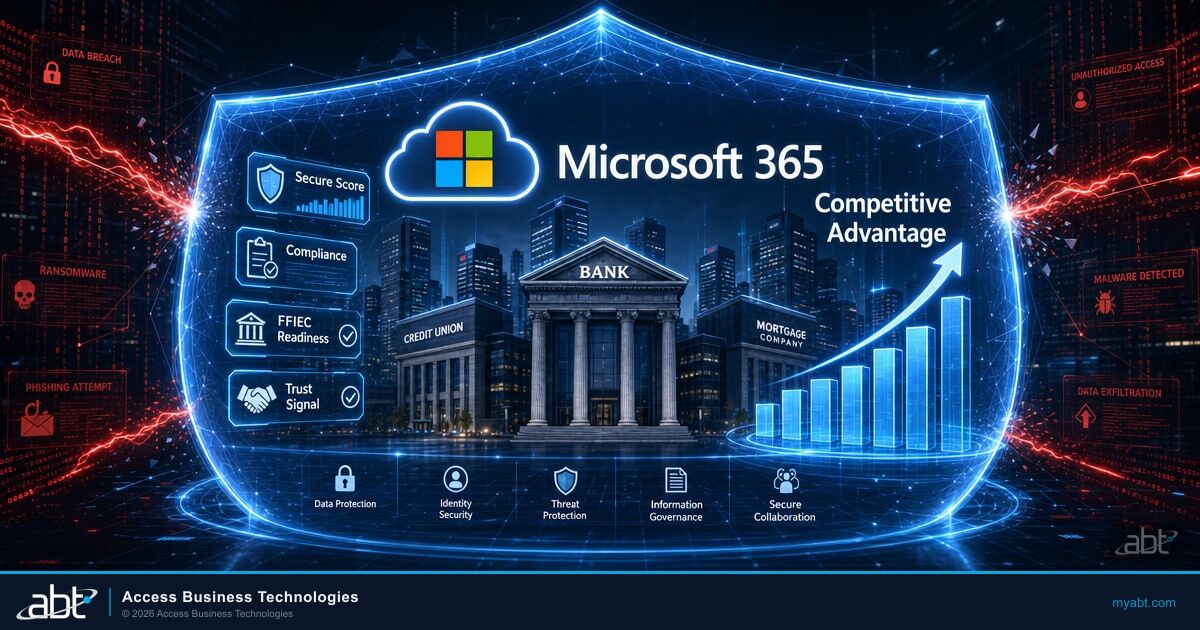
Cybersecurity is not a cost center. It is a trust signal. And trust wins deposits, commercial relationships, and examination outcomes.
Every financial institution says it takes security seriously. The ones that differentiate themselves are the ones that prove it with documented scores, continuous monitoring evidence, and compliance verification that examiners and partners can see. This article covers how banks, credit unions, and mortgage companies turn their security investment from an IT expense into a business development tool.
Why Customers, Regulators, and Partners Care About Your Security
Every banking and mortgage transaction involves account numbers, Social Security numbers, tax identification data, and financial records. Customers trust their institution with their entire financial identity. They want to know it is protected.
But customers are not the only audience. Commercial depositors evaluate your security posture before concentrating funds. Correspondent banks review your controls before establishing relationships. Business partners who refer clients choose institutions they trust with sensitive data. Regulators publish enforcement actions publicly. A compliance failure is not just a fine. It is a searchable public record that affects your institution's reputation with every stakeholder who runs a search.
FFIEC examiners evaluate your information security program as a core component of every safety and soundness examination. Institutions that can demonstrate continuous monitoring, documented compliance scores, and proactive threat response earn cleaner examination outcomes. Those that rely on annual self-assessments and point-in-time audits face longer examinations, more findings, and board-level management actions. If your institution is already investing in Microsoft 365 security tools, the question is whether you are documenting their effectiveness in a way examiners and partners can evaluate.
Three Ways Strong Security Creates Business Advantage
1. Cleaner Examination Outcomes
FFIEC examiners review your information security program against documented standards. Institutions that provide continuous monitoring evidence, MFA enforcement documentation, incident response plans, and compliance trend data on day one of the examination move through the process faster than institutions scrambling to assemble evidence from multiple systems. A financial institution that demonstrates a documented 90-plus percent Secure Score with 12 months of trend data gives the examiner exactly what they need to close the IT section with minimal findings.
2. Stronger Commercial and Correspondent Relationships
Commercial depositors concentrating significant funds evaluate your institution's operational resilience. Correspondent banks require evidence of your cybersecurity program before establishing interbank relationships. Business referral partners protect their own reputations by directing clients to institutions they trust. When you can demonstrate a documented security posture, complete with compliance scores and trend data, you differentiate your institution from competitors who say "we take security seriously" but cannot prove it.
3. Lower Cyber Insurance Premiums
Cyber insurance underwriters set premiums based on documented security controls. Financial institutions that can show continuous MFA enforcement, managed endpoints, and automated compliance monitoring receive more favorable terms. The documentation itself, generated automatically by tools like Guardian Security Insights, becomes a financial asset that directly reduces operating costs.
Why Documentation Matters More Than Tools
Having security tools is not the same as proving they work. An institution with Defender, MFA, and DLP deployed but no continuous monitoring evidence will struggle more in an FFIEC examination than an institution with those same tools plus 12 months of documented trend data, compliance scores, and incident response activity. Guardian Security Insights bridges that gap by turning raw Microsoft 365 telemetry into the evidence trail that examiners, insurers, and business partners evaluate.

The Defender + Sentinel Security Baseline Community Banks Can Match
The security stack that wins examinations and commercial relationships at the largest banks is not exotic. It is the Microsoft Defender suite paired with Microsoft Sentinel as the SIEM of record. Microsoft Defender for Office 365 blocks the phishing, business email compromise, and impersonation attacks that account for the majority of financial-services breach entry points. Microsoft Defender for Endpoint watches every laptop, workstation, and server for behavioral indicators of attack and ransomware staging. Microsoft Defender for Identity detects lateral movement, privilege escalation, and credential theft inside Microsoft Entra ID. Microsoft Defender for Cloud Apps brings shadow-IT discovery and cloud session controls under one console. Microsoft Sentinel aggregates the signals from all of them, plus Entra ID, Purview, and Intune, into a single incident timeline tuned to the institution's actual risk profile. Together, that stack is the enterprise-grade security baseline that examiners expect to see at a large national bank, and it is exactly what a community bank or credit union can run inside its existing Microsoft 365 footprint.
Turning Security Data Into a Sales Tool
Most financial institutions hide their security program. It sits in an IT folder nobody outside the department ever sees. That is a missed opportunity.
Guardian Security Insights produces reports designed for multiple audiences. IT teams get technical details. Executives get board-ready summaries. But a third use case is external-facing. Compliance readiness scores, trend data, and framework alignment documentation can be shared with examiners, commercial deposit prospects, and correspondent banking partners.
Consider what this looks like in practice:
- During an FFIEC examination. You send a Guardian compliance summary showing MFA coverage, device management, and data protection metrics. The examiner sees continuous monitoring evidence going back 12 months. The IT section of your examination closes with zero findings.
- During a commercial deposit pitch. You show the CFO of a regional business that your institution actively monitors for threats, maintains a 90-plus percent Secure Score, and undergoes continuous compliance verification. No competitor in the room can match that transparency.
- During a correspondent banking review. You share a one-page security posture summary. The reviewing institution sees documented controls that meet or exceed the standards they enforce internally.
Every financial institution claims to take security seriously. The ones that win commercial relationships are the ones that prove it with documented scores, trend data, and continuous compliance verification.
What Financial Institutions Do With Guardian Security Insights
BNY's 2025 Voice of Community Banks survey found that banks prioritizing cybersecurity measures, including continuous monitoring, regular auditing, and documented compliance, were more than 50 percent more likely to grow their small business clientele than peers who did not. Security concerns drove over half of client losses at institutions that could not demonstrate their posture.
Guardian Security Insights gives institutions the documentation to make that case. The platform produces compliance readiness scores, Secure Score trend data, MFA enforcement rates, and framework alignment reports that can be shared directly with examiners during FFIEC or NCUA examinations, with commercial deposit prospects evaluating operational resilience, and with correspondent banking partners requiring evidence of cybersecurity controls. Instead of assembling evidence the week before an examination, the institution presents 12 months of continuous monitoring data, the difference between a quick IT section and findings that require board-level response.
The 2025 CSBS Annual Survey found that 96 percent of community bankers now rate cybersecurity as extremely or very important. The institutions that convert that priority into documented, shareable evidence are the ones that win the commercial relationship, close the examination faster, and catch the anomaly before it becomes an incident.
The ABT 24/7 SOC Running This Stack for 750+ Financial Institutions
Deploying the Defender and Sentinel stack is the first step. Running it 24 hours a day, seven days a week, with eyes on the signals at 2:00 a.m. on a holiday weekend, is what separates institutions that catch incidents in minutes from institutions that learn about them from the FBI. That round-the-clock signal watching is Guardian MxDR, ABT's managed extended detection and response service. Guardian MxDR runs the Microsoft Defender suite plus Microsoft Sentinel for the financial institution, surfaces the signals into a 24/7 security operations center staffed by analysts who know what a community bank or credit union breach pattern looks like, and produces the incident timeline that satisfies amended SEC Regulation S-P notification analysis and FFIEC incident response evidence requirements. Layered on top is M365 Guardian, ABT's operating model for the broader Microsoft 365 control surface, including Microsoft Entra ID Conditional Access, Microsoft Purview retention and DLP, and Microsoft Intune device compliance, all tuned to financial-institution exam expectations rather than vendor SMB defaults. ABT manages the Microsoft 365 tenants for more than 750 banks, credit unions, mortgage companies, and securities firms under that operating model, which means the SOC analysts watching the institution's tenant tonight have seen the same attack patterns play out across hundreds of peer FIs. That pattern recognition is something a smaller MSP or in-house team building it from scratch cannot match.
The Pure Microsoft Stack Advantage
ABT runs a pure Microsoft technology stack. No ConnectWise. No Kaseya. No SolarWinds. When the ConnectWise ScreenConnect vulnerability hit in February 2024, or the Kaseya VSA breach disrupted thousands of MSP clients in 2021, ABT's clients had zero exposure.

This is not a theoretical benefit. It is a concrete differentiator your institution can evaluate. While competitors depend on third-party MSP platforms with documented breach histories, ABT's infrastructure operates entirely within the Microsoft security perimeter. For institutions that also consolidate their own security stack, the result is fewer integration gaps, a smaller attack surface, and simpler compliance documentation.
Guardian Security Insights monitors that perimeter continuously. Every finding comes from native Microsoft APIs. No middleman. No additional attack surface. The same security posture that protects your customers is the posture that wins your next commercial relationship and your next clean examination.
ABT serves more than 750 financial institutions as the largest Tier-1 Microsoft Cloud Solution Provider dedicated to the financial services industry. Whether your institution is preparing for an FFIEC examination, pursuing commercial deposit growth, or evaluating Microsoft Copilot deployment, the security foundation determines the outcome.
Make Security Your Competitive Advantage
Guardian Security Insights gives you the evidence to back up your security claims with documented scores, trend data, and continuous compliance verification. M365 Guardian and Guardian MxDR layer ABT's 24/7 security operations center on top, running Microsoft Defender and Microsoft Sentinel for your institution every minute of every day.
Frequently Asked Questions
Financial institutions gain competitive advantage from cybersecurity by sharing documented security posture evidence with examiners, commercial depositors, correspondent banks, and business partners. Continuous monitoring data, compliance readiness scores, and MFA enforcement metrics demonstrate commitment to data protection beyond verbal assurances. Institutions that provide this documentation during examinations, business development meetings, and partner reviews achieve cleaner outcomes and stronger relationships.
M365 Guardian is ABT's operating model for the broader Microsoft 365 control surface for financial institutions, covering Microsoft Entra ID Conditional Access policies, Microsoft Purview retention and data loss prevention, Microsoft Intune device compliance, and the configuration of Microsoft Defender across Office 365, Endpoint, Identity, and Cloud Apps. Guardian MxDR is the 24-hour managed detection and response service that runs the Defender suite plus Microsoft Sentinel from a security operations center staffed around the clock. The two services work together. M365 Guardian sets the configuration and policy baseline. Guardian MxDR watches the signals every minute of every day and responds to incidents.
Cyber insurance underwriters evaluate security controls documentation when setting premiums for financial institutions. Evidence of continuous MFA enforcement, managed endpoints, incident response plans, and automated compliance monitoring typically results in more favorable premium rates. Institutions that cannot document their security controls may face higher premiums, coverage exclusions, or claim denials after an incident.
The combination of Microsoft Defender for Office 365, Defender for Endpoint, Defender for Identity, and Defender for Cloud Apps, with Microsoft Sentinel as the SIEM aggregating their signals, is the same enterprise-grade security baseline that large national banks deploy. Community banks and credit unions on Microsoft 365 already have the licensing surface for most of those components, which means a smaller institution can run the same detection and response stack as a peer 100 times its size, without rebuilding the infrastructure or hiring a 20-person security team to operate it.
ABT operates entirely on Microsoft technologies with no third-party MSP platforms such as ConnectWise, Kaseya, or SolarWinds. When those platforms experience security breaches, ABT's clients have zero exposure because the vulnerable software is not part of their environment. Guardian Security Insights pulls data directly through native Microsoft APIs, keeping the monitoring stack within the same security perimeter as the institution's Microsoft 365 tenant.
Guardian Security Insights produces continuous monitoring evidence, compliance trend data, and security posture documentation that maps directly to FFIEC examination standards. Instead of assembling evidence from multiple systems during examination preparation, institutions provide Guardian reports showing 12 months of MFA enforcement rates, Secure Score trends, device management compliance, and incident response activity. This level of documentation typically results in faster examinations and fewer IT findings.