


Your team can be running Copilot inside 30 days. Microsoft turns one of the two ways in on by default.
There are two different free 30-day Microsoft 365 Copilot trials running right now, and Microsoft scopes them differently: the self-service one to tenants of up to 300 seats, and the partner-arranged one to organizations with fewer than 300 employees. One you set up deliberately with your Microsoft partner. The other is enabled by default, and your people start it themselves from Copilot Chat without entering a payment method.
- Real work, in real documents, for 30 days at no cost
- The content policies you already set in your tenant keep applying during both
- You can switch the self-service one off, but per product, and new products default to allowed
- Copilot Business has no month-to-month plan, so day 31 is an annual decision
Is there a free trial of Microsoft 365 Copilot?
Yes. As of August 2026 there are two, they are 30 days each, and they are not two names for the same thing. Microsoft even scopes them differently, one by seats and one by employees, so check both predicates against your own numbers rather than assuming a single cutoff.
The self-service trial
Microsoft calls it the Low Friction Trial. An eligible user opens Copilot Chat, starts a 30-day Microsoft 365 Copilot trial, and is working inside it a minute later.
- No payment method required to start it
- Enabled by default in eligible tenants of up to 300 seats
- Includes Copilot Chat grounded in your Microsoft 365 content, plus the Researcher and Analyst agents
- Every start raises a license request in the Microsoft 365 admin center
Copilot in 30
Microsoft describes this one as partner-led. A Cloud Solution Provider sets up a 25-user, 30-day Microsoft 365 Copilot Business trial and the month comes with a structure attached.
- 25 users for 30 days, sized for an evaluation rather than one curious person
- Built for organizations with fewer than 300 employees
- Comes with guidance for picking priority users and use cases before the clock starts
- Available in CSP New Commerce through December 31, 2026
Here is the honest way to choose between them. If you want to know whether Copilot is worth money to your organization, the self-service route is the weaker instrument. Anyone eligible can start one, so what you end up with is a scatter of individual impressions, started on different days, aimed at whatever each person happened to try. A 25-seat evaluation run across a lending team, an accounting team and a branch operations team answers a different and more useful question, because you can compare what happened in three places that do genuinely different work over the same 30 days.
And if you want to know whether your people are already forming that opinion without you, that is a different question, and it is the one most organizations have not asked yet.
The trial nobody has to approve
Microsoft published this in a Message Center post in June 2026 and revised the timeline in July. It is not hidden. It is just easy to miss in a feed that also carries mailbox quota changes and Teams icon updates.
"Trials are enabled by default for eligible tenants."
Microsoft 365 Message Center post MC1338815, "Microsoft 365 Copilot: Self-service 30-day trial for eligible small and medium businesses", last updated July 23, 2026Read that alongside the rest of the same post and the shape becomes clear. Eligible users "without a paid Microsoft 365 Copilot (Premium) license can start a 30-day trial from Copilot Chat." No payment information is required. Trial users get "full access to Microsoft 365 Copilot, including Copilot Chat grounded in Microsoft 365 content," and they also get "access to agents such as Researcher and Analyst."
Grounded in Microsoft 365 content is the phrase that matters to a compliance officer. This is not a chatbot answering general questions. It is reading the SharePoint sites, the mailboxes and the files that the person who started it already has permission to open.
Which is also why the reflex response to this is usually wrong. The instinct is to treat it as a data leak. It is not. Microsoft's design point is that Copilot answers from content the signed-in person is already permitted to open, so the trial is not meant to widen anyone's access. What it does is surface results faster and in one place, so over-permissioning that has been quietly tolerated for years can become visible in a week. That is uncomfortable, and it is not the same thing as a breach. It is also worth confirming rather than assuming, because the answer depends on how your sharing, labeling and connector settings are configured, which is one of the things an assessment looks at.
Microsoft also says the program is "offered on an experimental basis" and that if it is discontinued, "active trials will continue through their trial period" with no new trials issued. So this is a window rather than a permanent feature, which cuts both ways: it may not be there when you get round to planning for it.
The rollout is in progress, not finished
The rollout schedule published in MC1338815 reads, verbatim: small and medium business "begin rolling out in early July 2026 and expect to complete by early July 2026," then "General Availability (Worldwide): We begin rolling out late July 2026 and expect to complete by mid-September 2026." That post carries its own revision note dated July 23, 2026 saying the timeline was updated, so earlier summaries of it circulating elsewhere may still show the pre-revision wording. Whether this is live in your tenant today is a question to answer by looking, not by assuming.
Find out whether it is already on in your tenant
ABT will look, read-only, and tell you whether self-service Copilot trials are enabled, who has already started one, and which of your Microsoft 365 plans qualifies for Copilot Business. No cost and no obligation.
What actually differs between the two trials
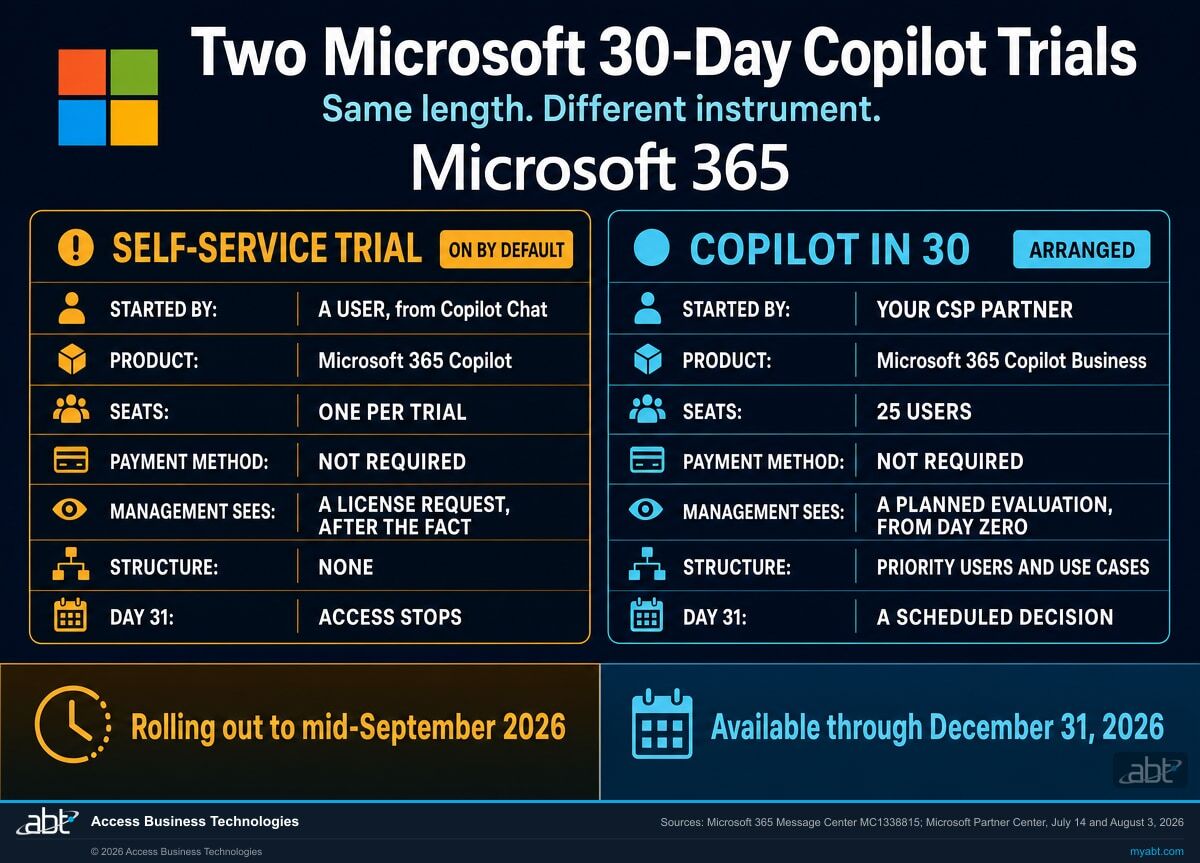
Same length, same product family, genuinely different instruments. The rows below are the ones that change a decision.
| Self-service trial | Copilot in 30 | |
|---|---|---|
| Who starts it | An eligible user, from inside Copilot Chat | A Cloud Solution Provider, in CSP New Commerce |
| Product | Microsoft 365 Copilot, described by Microsoft as Premium | Microsoft 365 Copilot Business |
| How many people | One user per trial, started individually | 25 users |
| Enabled by default | Yes, in eligible tenants | No, it is arranged deliberately |
| Payment method | Not required | Not required of the customer |
| What management sees | A license request in the Microsoft 365 admin center, once someone has already started | A planned evaluation with named participants from day zero |
| Structure around the 30 days | None. The user decides what to try | Guidance on priority users and use cases, plus an industry-tailored evaluation tool Microsoft announced for mid-August 2026 |
| How long it lasts | No published end date. Microsoft calls the program experimental and says that if it is discontinued, active trials finish their 30 days and no new ones are issued | The program is available through December 31, 2026 |
| What happens on day 31 | Access stops unless an administrator assigns a paid license | A buy or walk away decision you scheduled in advance |
Sources: Microsoft 365 Message Center post MC1338815 (self-service trial), and the Microsoft Partner Center announcements of July 14, 2026 and August 3, 2026 (Copilot in 30). Microsoft's wording for Copilot in 30 is "partner-led" and it is transacted in CSP New Commerce; Microsoft does not publish a customer-side prohibition, so treat this row as who normally sets it up rather than who is permitted to.
Does a Copilot trial change your data protection?
Not the part usually worried about, and yes to one part that rarely gets read. Both halves are worth having in front of you before somebody asks in a board meeting.
Your tenant policies still apply
Microsoft states that Copilot Business "follows the same data policies that your organization sets for your Microsoft 365 for business tenants." Starting a trial is not a change to those policies. Whatever Microsoft Purview, Microsoft Entra ID and your sharing settings were doing on day zero, they are still doing on day one.
Permissions become visible
Copilot answers from what the person can already reach. A trial does not grant access, it exposes access. A trial will often surface a site or a shared mailbox that a wider group could open than anyone intended, and finding that during an evaluation is considerably cheaper than finding it during an examination.
One boundary does get crossed
Allowing self-service lets Microsoft's Commerce service process directory data "outside the boundaries of the Microsoft 365 tenant," specifically a Microsoft Entra ID access token carrying name, email address, IP address and identifiers. That is licensing metadata, not your documents and not customer records. It is still a question an examiner is entitled to ask.
That third card deserves a sentence of plain English, because it is the kind of finding that gets over-read. Microsoft is not describing your loan files leaving the tenant. It is describing the commerce plumbing that has to know who a licence belongs to and where to send the confirmation email. Name, email address, IP address, tenant and user identifiers, used to issue the licence and email the person about it.
The reason it belongs on this page anyway is that credit unions, banks, and mortgage companies get asked about data boundaries in writing, and "we read the documentation and here is exactly what crosses and why" is a much better answer than a shrug. It is also the sort of thing that is far easier to write down before a trial starts than after an examiner asks.
Four moves, labeled honestly for what each one actually does
Two of these control something. One of them only tells you something. One is a decision, not a control at all. Anybody who presents all four as equivalent safeguards is selling.
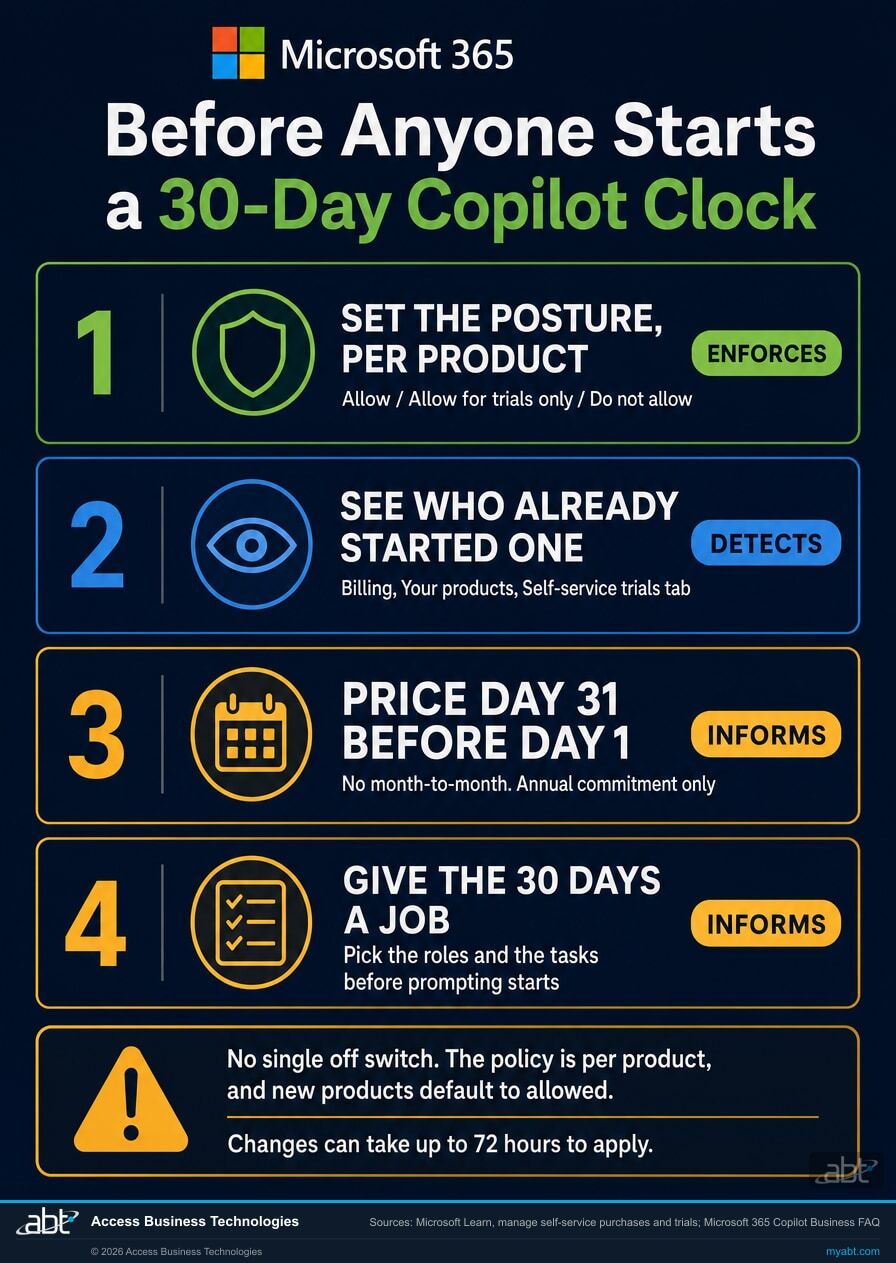
Decide the posture, per product
Microsoft gives three settings, not two: Allow, Allow for trials only, or Do not allow. That middle setting is easy to miss, and it is often the right answer. Staff can try Copilot. Staff cannot commit your organization to a purchase.
Microsoft 365 admin center › Settings › Org settings › Services › Self-service trials and purchasesLook at who has already started one
This takes about two minutes and it is easy to leave undone. The Microsoft 365 admin center lists self-service subscriptions with the product, the purchaser, the expiration date and the assigned users, and it will export the user list.
Microsoft 365 admin center › Billing › Your products › Self-service trials tabPrice day 31 before day 1
Microsoft 365 Copilot Business is sold "as an annual commitment with either monthly or annual billing," and Microsoft is explicit that "there's no month-to-month purchasing agreement for the Copilot Business plans." There is no small version of this decision. The 30 days is the only look you get before a twelve-month term.
Two further locks are worth knowing while the trial is still running, because both of them are much cheaper to plan around than to discover. An existing Copilot customer "must wait until your annual purchase commitment ends to change plans." And you cannot move from Business Standard or Business Premium with Copilot Business up to an Enterprise plan mid-term; that also waits for the commitment end date.
Give the 30 days a job
A trial with no measurement produces a feeling, and a feeling does not survive a budget meeting. Pick the roles first, pick two or three tasks each of them does every week, and write down what "better" would look like before anyone starts prompting.
This is the half Copilot in 30 exists to supply. Microsoft's own framing for it is that it helps customers "identify priority users, explore relevant use cases, and evaluate potential value before broader deployment," and Microsoft announced an industry-tailored evaluation tool for mid-August 2026 that hands customers prompts and scenarios matched to their industry rather than generic ones.
Which Microsoft 365 plans qualify for Copilot Business?
Check this against your own tenant rather than against a document, and here is why that sentence is doing real work.
The Microsoft 365 Copilot Business FAQ says that if you hold "a Microsoft 365 Business Basic, Business Standard, or Business Premium plan, you can buy Microsoft 365 Copilot Business as an add-on," and defines the segment the same way: organizations of 300 or fewer users on one of those three plans.
Microsoft's licensing options page, which carries a more recent revision date, lists four plans under the Copilot Business heading. The same three, plus Microsoft 365 Apps for business.
Both pages are current, both are Microsoft, and they do not say the same thing. We are not going to tell you which one is right, because the useful answer is not in either document. It is in your tenant, on your subscription, on the day you try to assign the licence. If your organization sits on Microsoft 365 Apps for business and this is the deciding factor in your plan, confirm it before you build a budget on it.
One more piece of the same picture, and it is reassuring rather than otherwise. Microsoft states that the Copilot Business add-on "delivers the same capabilities as the Microsoft 365 Copilot offering." The trial is not a cut-down preview of the real thing. It is the real thing, priced for smaller organizations. Our breakdown of Copilot Business for community banks, credit unions and mortgage lenders goes deeper on how the plan choice interacts with what you already own.
The one thing a trial cannot tell you
Whether Copilot is a good idea for your organization is a question about your data, not about the product. If your SharePoint permissions are loose and your retention labels are aspirational, a Copilot trial will go well and the deployment will go badly, because the trial ran with 25 careful volunteers and the deployment runs with everybody. That gap is exactly what a readiness assessment is for, and it is the reason ABT looks at the tenant before recommending a licence.
A free Copilot readiness assessment, scoped to this exact question
We read your tenant and tell you where you actually stand before anyone starts a 30-day clock.
- Whether self-service trials and purchases are currently enabled in your tenant, and for which products
- Who has already started a Copilot trial, and whether any licence requests are sitting unread
- Which of your current Microsoft 365 plans qualifies for Copilot Business, confirmed against your subscription rather than a documentation page
- The sharing and permission findings a Copilot rollout would surface, so you fix them before 200 people do the finding for you
- What day 31 costs at your seat count and on your plan, with the annual commitment stated plainly
- A written summary you can hand to an examiner, an auditor or a board committee without translating it first
ABT manages your Microsoft 365 tenant as a Tier 1 Microsoft Cloud Solution Provider, and hosts the Azure environments that sit alongside it. The assessment is read-only and carries no cost or obligation. Note that not every control described on this page is available in every Microsoft 365 plan or add-on, and eligibility for either trial is Microsoft's to define rather than ours. Telling you which of these apply to your current licensing, before you buy anything, is part of what the assessment is for.
ABT also operates M365 Guardian, its managed security service for credit unions, banks, and mortgage companies.
Why this lands differently in a regulated institution
ABT is a Tier 1 Microsoft Cloud Solution Provider serving more than 750 financial institutions. Credit unions, banks, and mortgage companies carry supervision duties that assume somebody decided, on the record, what tooling touches member and borrower data. A trial that switched itself on is a weak answer to that question, and it is an entirely fixable one. We work this problem inside regulated tenants every week, which is why the limits above are printed on the page rather than raised after the project starts. More on what a Tier 1 CSP actually does, and if you are weighing whether your current provider is the one to run this, our guide to changing Microsoft 365 partner covers how the move works.
Every claim on this page, and where it comes from
Each item below is the Microsoft document a statement on this page rests on, with its title, identifier and revision date, checked on August 18, 2026. If you are writing this up for an examiner or a board committee, these are the citations.
| Microsoft source | What it supports here |
|---|---|
| Microsoft 365 Message Center post MC1338815, "Microsoft 365 Copilot: Self-service 30-day trial for eligible small and medium businesses". Published June 3, 2026, last updated July 23, 2026. | The Low Friction Trial: 30 days, no payment method, started from Copilot Chat, enabled by default for eligible tenants, up to 300 seats, Copilot Chat grounded in Microsoft 365 content, Researcher and Analyst agents, a license request per start, the admin control path, the rollout schedule, and the experimental status. Message Center posts are visible to administrators inside your own tenant rather than on the public web, so check it against your own admin center. |
| Manage self-service purchases and trials (for admins), Microsoft Learn. Revised May 6, 2026. | The per-product off switch and why no single command does it tenant-wide, new products defaulting to allowed, the three settings, the 72-hour propagation window, what an administrator can and cannot do with a user-started subscription, where to view self-service trials, and the directory data processed by Microsoft Commerce. |
| Partner Center announcements, July 2026, "Introducing Copilot in 30". Dated July 14, 2026. | Copilot in 30 as a Cloud Solution Provider partner-led trial, 25 users, 30 days, and organizations with fewer than 300 employees. |
| Partner Center announcements, August 2026, "Copilot in 30 now generally available". Dated August 3, 2026. | General availability, availability in CSP New Commerce through December 31, 2026, transactability from August 1, 2026, and the industry-tailored customer evaluation tool announced for mid-August 2026. |
| Microsoft 365 Copilot Business FAQ, Microsoft Learn. Revised May 6, 2026. | Annual commitment with no month-to-month agreement, the mid-term plan-change and Enterprise-upgrade restrictions, the 300-seat ceiling, capability parity with Microsoft 365 Copilot, the tenant data policy, and the three qualifying Business plans. |
| License options for Microsoft 365 Copilot, Microsoft Learn. Revised June 18, 2026. | The four-plan eligibility list for Copilot Business, which is where Microsoft 365 Apps for business appears and the FAQ above does not. |
Microsoft revises these pages, and two of them already disagree with each other on plan eligibility. Treat any date, price or eligibility rule here as correct on the date it was checked and worth re-checking against your own tenant before you commit to it.
Related reading
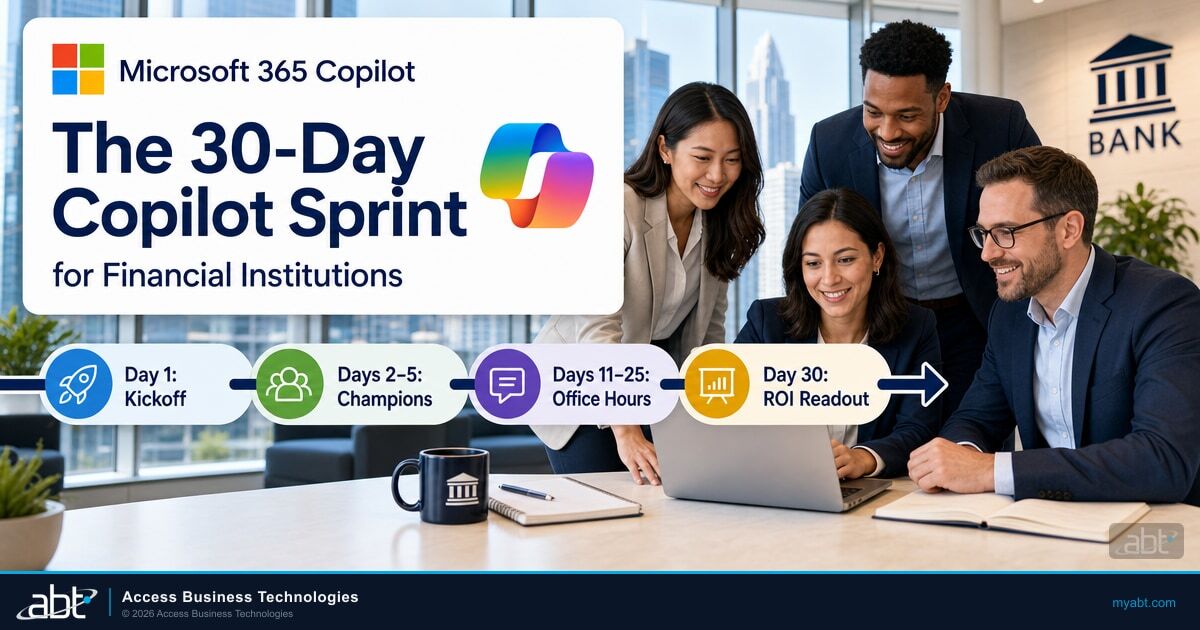
The 30-Day Copilot Sprint for Financial Institutions
What to actually do with the thirty days, from kickoff and champions through to a measured readout on day 30.

Microsoft 365 Copilot Business for Community Banks, Credit Unions and Mortgage Lenders
How the plan choice interacts with what you already own, and where the seat count starts to change the answer.
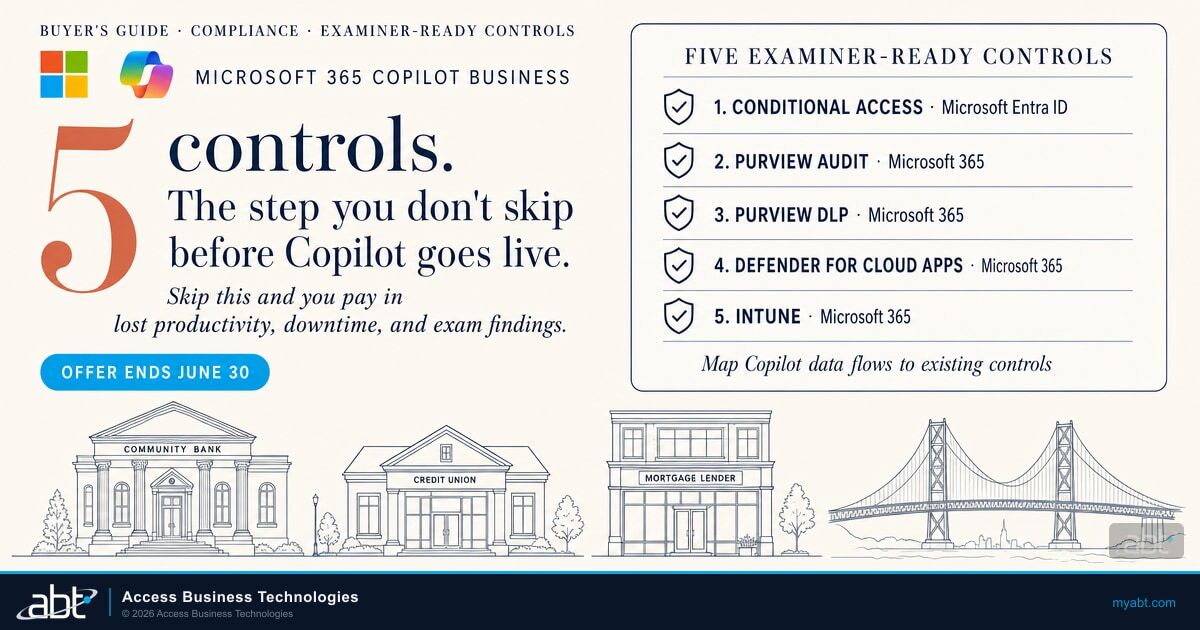
Five Microsoft 365 Controls Examiners Will Ask About Before You Roll Out Copilot
The controls that come up in an examination, and how to have the evidence ready before you are asked for it.
Two more that sit next to this one: the difference between a work and a personal Copilot account, which is the other way Copilot arrives in an organization nobody planned for, and how loan officers, processors and underwriters actually use Copilot Business, which is a good place to pick the roles for a 25-seat evaluation.
The Microsoft 365 Copilot trial, answered
Is a Copilot trial
already running?
Tell us about your tenant and ABT's team will run a free readiness assessment: whether self-service trials are enabled, who has already started one, which of your plans qualifies for Copilot Business, and what day 31 costs.
