

In This Article
- Section 1033 Is Paused, Not Cancelled
- Where the API Traffic Is Coming From Today
- The Five Threats Hiding in Consumer-Permissioned Access
- Microsoft 365 and Azure: The Identity and API Foundation
- A Community Bank Sized API Security Posture
- What the Reconsideration Likely Changes (and What It Won't)
- The 9-Question Self-Assessment for Community Bank CIOs
- Frequently Asked Questions
For community banks watching the Section 1033 saga, the easy read is "we got a reprieve." A federal court in Kentucky stayed the compliance deadlines in late October 2025. The Consumer Financial Protection Bureau then told that same court its own 2024 rule went too far, opened a reconsideration docket, and started writing a new version. By every reasonable measure, the legal compliance deadline is paused. For banks under the small depository asset threshold of about $850 million, that already-permanent exemption now sits inside an enforcement stay.
And yet the API traffic continues. Right now, your customers are connecting their checking accounts to budgeting apps, accounting platforms, gig-economy payment tools, and small-business lending services. They are doing it through Plaid, MX, Yodlee, and Akoya. They are doing it whether your community bank has a documented Section 1033 program or not. The legal deadline paused. The operational reality did not.
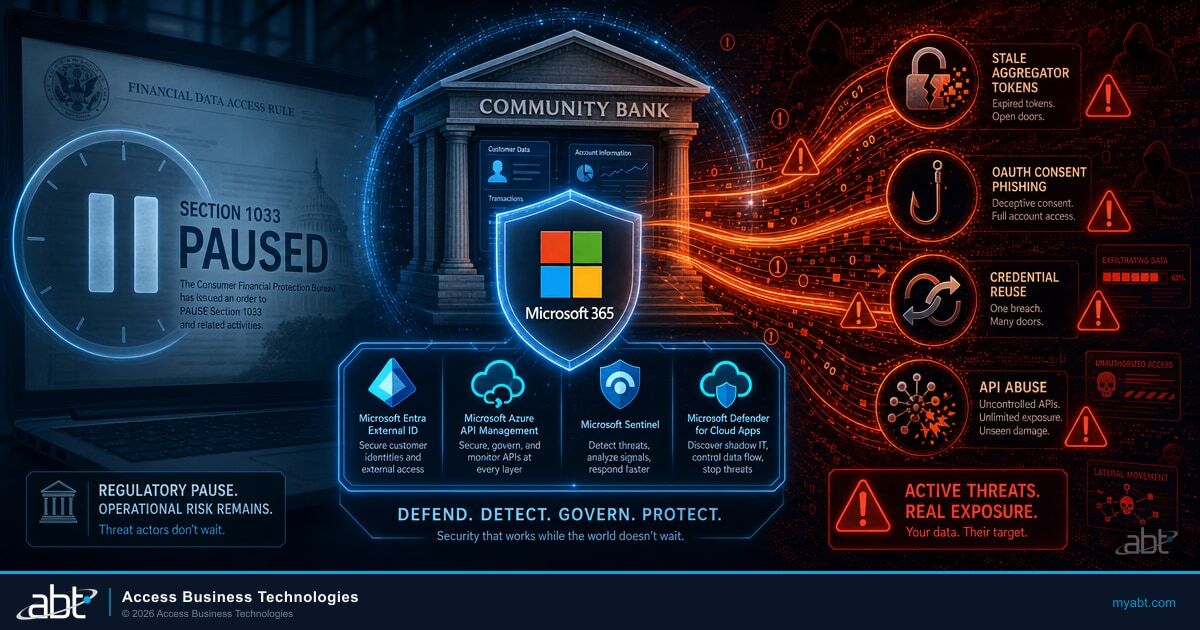
This guide is for IT directors, CISOs, and CIOs at community banks, credit unions, and mortgage companies who want to look past the regulatory headlines and ask the better question: regardless of when (or whether) a final Section 1033 rule lands, what API security posture should we be running on the Microsoft 365 and Microsoft Azure platforms we already have? The good news is that the answer is largely buildable today, using Microsoft Entra External ID, Microsoft Azure API Management, Microsoft Sentinel, and Microsoft Defender for Cloud Apps. The harder news is that most community-sized institutions have not turned those controls on.
Section 1033 Is Paused, Not Cancelled
The CFPB issued the final Personal Financial Data Rights Rule in October 2024. It was published in the Federal Register on November 18, 2024. The rule set up a phased compliance schedule that ran from April 1, 2026 for the largest data providers through April 1, 2030 for the smallest covered institutions, with a permanent exemption for depository institutions below the Small Business Administration's small depository asset threshold. That threshold is approximately $850 million in total assets. Most community banks, virtually all credit unions in the smaller cooperative tiers, and most independent mortgage companies fall under that line.
On October 29, 2025, the United States District Court for the Eastern District of Kentucky issued an injunction in Forcht Bank v. CFPB. The court prohibited the Bureau from enforcing the rule and stayed all compliance deadlines until the CFPB completes a reconsideration rulemaking. Acting CFPB Director Russ Vought told the same court that the Bureau itself believed the 2024 rule exceeded the agency's statutory authority. In August 2025, the CFPB opened an Advance Notice of Proposed Rulemaking that re-examines core elements including third-party access, fee prohibitions, and data security expectations.
What This Means for Your Community Bank Today
The text of 12 CFR Part 1033 is still in the books. The April 2026 through April 2030 phased dates are still printed in the rule. The under-$850 million exemption is still on the page. None of it is enforceable while the injunction holds and the reconsideration rulemaking proceeds. Your community bank cannot be fined, examined, or required to stand up FDX-conformant Open Banking APIs based on the 2024 rule as written. What you can absolutely still be hit with is a customer-aggregator breach that flows back to your tenant, your reputation, and your fraud reserves.
Where the API Traffic Is Coming From Today
The Section 1033 saga distracted a lot of community banks from the operational picture. While Washington argued about what data providers must do, customers kept connecting accounts. Tens of millions of US consumers use aggregator-based services to share their bank data with budgeting apps, savings platforms, robo-advisors, expense management tools, small-business accounting software, and payment initiation services. The CFPB's own 2024 final rule preamble documented the prevalence of this traffic. It described the practice of screen-scraping, where aggregators log in as the customer using credentials the customer shared, and pull data from web pages. It described the parallel growth of OAuth-based connections, where the aggregator gets a delegated token instead of the customer's password.
Both flows hit your community bank. Both flows depend on identity and API controls that most community banks have never explicitly designed. Most institutions in the $200 million to $5 billion asset range entered the aggregator era passively, by allowing their core banking provider, their digital banking vendor, or their open data partner to expose data on their behalf. The result is an API surface that no one inside the bank has formally mapped, an OAuth consent flow that no one inside the bank has policy-reviewed, and a screen-scraping pathway that no one inside the bank has actively decommissioned.
The legal deadline paused. The operational reality did not. Your customers are connecting their accounts to fintech aggregators right now, through an API surface most community banks have never formally mapped.
Four aggregator names dominate the US market: Plaid, MX, Yodlee (now part of Envestnet), and Akoya (jointly owned by FMR, eight banks, and several core banking providers). The Financial Data Exchange (FDX), recognized by the CFPB in January 2025 as the first official Section 1033 standard-setting body, sets the technical norms most aggregators have agreed to follow. Those norms are built on OAuth 2.0, OpenID Connect, and the OpenID Foundation's Financial-grade API security profile. They are not legally mandated by Section 1033 or by the 2024 rule, but they are the de facto pathway US banks and aggregators have aligned around.
The Five Threats Hiding in Consumer-Permissioned Access
Walking the API security posture from a CISO's chair, the threats that matter for community banks group into five categories. Each one is independently exploitable. Several of them have already produced incidents at FIs of every size band.
| Threat | How It Manifests | Severity |
|---|---|---|
| OAuth consent phishing | A malicious app uses your real OAuth login screen to harvest a customer access token. The customer thinks they are connecting a budgeting app. They are actually granting persistent read access to an attacker. | High |
| Stale aggregator tokens | A customer connected an aggregator three years ago, uninstalled the app two years ago, and never revoked the token. The aggregator still has live access to the account. The bank has no inventory of which tokens are still live and which are abandoned. | High |
| Screen-scraping credential reuse | A customer used the same password at the bank, at the aggregator, and at a breached service. An aggregator credential database breach now exposes the bank login, and lockout rate limits at the bank are tuned for human typing speed, not bot fan-out. | High |
| API abuse and scraping at the edge | An aggregator (or a bad actor pretending to be one) pulls data at rates that exceed legitimate use. Your origin gets slow. Your fraud detection signals get noisy. Your hosting bill quietly grows. | Medium |
| Authorization-code injection and PKCE bypass | An attacker exploits OAuth flows that do not require PKCE (Proof Key for Code Exchange) or that accept improperly bound authorization codes. The attacker swaps in their own code and steals the access token mid-flow. | Medium |
None of these threats requires a Section 1033 compliance deadline to materialize. Three of the five are independent of OAuth entirely; they exploit screen-scraping or credential reuse pathways most banks did not realize they were running. The other two assume OAuth is in place but configured at the OAuth 2.0 baseline rather than at the FAPI security profile baseline.
The Bottom Line on Threats
Five threat categories. Three of them work today without any Section 1033 rule. Two of them require OAuth flows but exploit weak OAuth configurations rather than the absence of OAuth. The community bank that says "we will get to this when the compliance deadline lands" is choosing to absorb the loss exposure while it waits.
Microsoft 365 and Azure: The Identity and API Foundation
For community banks that already run Microsoft 365 and have an Azure subscription as the partner of record (which describes the majority of ABT's 750 plus financial institution customers), the building blocks for an Open Banking API security posture are mostly already paid for. They just need to be turned on, configured correctly, and operated.
There is no shortcut to FAPI certification. Microsoft does not market Azure API Management or Microsoft Entra External ID as Financial-grade API certified products. The capabilities are present; the certification is not. What ABT has seen work is treating the Microsoft stack as a configurable foundation rather than a pre-baked compliance solution.
Microsoft Entra External ID for Consumer-Facing OAuth
Microsoft Entra External ID is the successor product to Azure AD B2C. It handles the OAuth 2.0 authorization code flow with Proof Key for Code Exchange, OpenID Connect identity tokens, and consent screen presentation to your customers when an aggregator asks for permission. Entra External ID can be configured to require PKCE on every flow, validate redirect URIs strictly, scope access tokens narrowly, and log every consent event to Microsoft Entra audit logs and Microsoft Sentinel. It is not formally FAPI certified, but it implements the underlying mechanics FAPI requires.
Microsoft Azure API Management for the Front Door
Microsoft Azure API Management sits in front of your bank's account data APIs and your screen-scraping replacement endpoints. It enforces JWT validation through the validate-jwt policy, rate-limits aggregator traffic per client, requires mutual TLS where contracts demand it, transforms responses to strip data the aggregator was not authorized to see, and emits per-request telemetry that flows into Sentinel. It is the policy enforcement point that turns a bare API into a governed API. ABT hosts your Azure environment as the Microsoft partner of record, which means the API Management instance you stand up sits inside infrastructure ABT operates on your behalf.
Microsoft Defender for Cloud Apps for OAuth Telemetry
Microsoft Defender for Cloud Apps includes an OAuth-aware app governance layer that watches every third-party application your users grant consent to. Its risky OAuth investigation tool surfaces apps with suspicious behavior patterns, including newly registered apps with broad delegated permissions, apps requesting access scopes that exceed what a budgeting tool would reasonably need, and apps tied to known abusive consent campaigns. For an FI, the value is binary: either every aggregator consent is visible and policy-graded, or some of them are not. Defender for Cloud Apps tips the answer to the visible side.
Microsoft Sentinel for Detection and Hunting
Microsoft Sentinel ingests Microsoft Entra sign-in logs, Microsoft Entra audit logs, Microsoft Defender for Cloud Apps signals, and Microsoft Azure API Management diagnostic data through native data connectors. That gives a community bank security team a single pane to detect impossible-travel sign-ins that precede an OAuth consent, spikes in token refresh traffic from a single aggregator, anomalous API call patterns at the edge, and consent grants to applications that have never been seen in the tenant before. Sentinel analytics rules and hunting queries can be tuned to community-bank-sized signal volumes without overwhelming a small security operations team.
Defender for Cloud Apps app governance monitors every OAuth-enabled application a user consents to. Suspicious app behavior, broad permission scopes, and unusual access patterns surface in the risky OAuth investigation view. Microsoft Sentinel ingests Microsoft Entra sign-in and audit logs through the Entra data connector and correlates them against API gateway telemetry. For community banks where every aggregator consent matters, this stack converts a previously invisible flow into a queryable, alert-ready signal.
A Community Bank Sized API Security Posture: What ABT Builds
One of the failure modes ABT sees when community banks talk to enterprise security firms about Open Banking is scope creep. The enterprise firm proposes an FAPI 2.0 certification project with a six-figure professional services bill and a three-quarter timeline. For a bank with 12 branches and a four-person IT team, that is not a real plan. It is a plan to do nothing.
The community bank sized posture has five rollout phases. Each one is independently valuable. Each one is achievable within an existing Microsoft 365 and Azure footprint. The full program lands in roughly 90 days for an institution that already has Microsoft Entra ID Premium P1, Microsoft Defender for Office 365 Plan 2, and Microsoft Sentinel licensing in place. Plans without those licenses get a license-true-up phase at the front.
Inventory every aggregator that currently touches the tenant. Catalog active OAuth tokens, screen-scraping IP ranges, and customer consent records. Most banks find more aggregator tokens than they expected.
Stand up Microsoft Azure API Management as the policy enforcement point. Migrate the busiest screen-scraping flow to a delegated-OAuth replacement. Apply PKCE, JWT validation, and per-client rate limiting on day one.
Turn on Microsoft Defender for Cloud Apps app governance. Set OAuth consent policies that block broad-scope apps and require admin review for any aggregator the tenant has not seen before. Surface stale tokens.
Configure Microsoft Sentinel analytics rules for OAuth consent anomalies, token refresh spikes, and API abuse signatures. Build a community-bank-sized incident response playbook for aggregator-related alerts.
Produce examiner-ready evidence: aggregator inventory, OAuth consent policy, incident response runbook, and a quarterly review cadence. This is what FFIEC examiners look for, regardless of Section 1033 status.
The five-phase rollout is not a 12-month consulting engagement. It is a 90-day reset for community banks already operating Microsoft 365 and an Azure subscription. The phases are independently valuable, which means an institution that stalls at Phase 3 (Govern) for budget reasons still walks away with better OAuth consent governance than 95% of the community bank market.
A note on FDX conformance
If the CFPB reconsideration rulemaking lands with a Section 1033 rule that retains FDX as the recognized standard-setting body (which is the most likely path), the five-phase posture above maps cleanly into FDX-aligned API publication when the deadline arrives. The discovery, gating, governance, detection, and documentation work does not need to be redone. The Microsoft Entra External ID and Microsoft Azure API Management foundation is already where consumer-permissioned access lives.
Where Does Your Community Bank Sit on the Five-Phase Open Banking Posture?
ABT's Microsoft 365 Guardian and Guardian MxDR teams run the discovery, gating, governance, and detection program for community banks, credit unions, and mortgage companies on the Microsoft 365 and Microsoft Azure platforms they already operate. We start with a Security Grade scan that surfaces the OAuth and aggregator visibility gaps in your tenant.
What the Reconsideration Likely Changes (and What It Won't)
The August 2025 Advance Notice of Proposed Rulemaking signaled which areas the CFPB intends to reopen. Reading the ANPR, three things are clear. First, the Bureau is interested in fee structures. The 2024 rule prohibited data providers from charging third parties for access; the ANPR asks whether that prohibition should be modified, qualified, or removed. Second, the Bureau is interested in third-party accreditation. The 2024 rule placed the data security obligations on aggregators through consumer authorization mechanics; the ANPR asks whether more direct accreditation requirements would be appropriate. Third, the Bureau is interested in data security expectations, including whether to formalize protocol-level requirements that the 2024 rule deliberately left flexible.
What the reconsideration is unlikely to change is the underlying technical pattern. FDX recognition is established. OAuth 2.0 and OpenID Connect are the consensus identity layer for US consumer-permissioned data sharing. FAPI is the consensus security profile when high-assurance flows are required. The aggregator ecosystem (Plaid, MX, Yodlee, Akoya, and the smaller participants) is mature enough that any new rule will be writing into an existing market, not creating one. The new rule may extend deadlines, refine accreditation, and allow some fees. It is very unlikely to break the technical architecture community banks build around today.
Your community bank waits for the final reconsideration rule before doing anything. Aggregator traffic continues. OAuth consent grants accumulate. A stale token tied to an abandoned aggregator app is harvested in an aggregator breach. The fraud event hits your customer, your reserves, and your reputation. Examiners ask why your aggregator inventory and OAuth consent policy were not in place when the customer impact landed.
Your community bank runs the five-phase posture (discover, gate, govern, detect, document) over 90 days on the Microsoft 365 and Microsoft Azure footprint you already have. When the reconsideration rule lands, the discovery, gating, governance, detection, and documentation work maps directly into compliance evidence. The investment was never wasted; it just preceded the deadline.
The 9-Question Self-Assessment for Community Bank CIOs
Before you call any vendor (including ABT), answer these nine questions for your community bank, credit union, or mortgage company. The answers tell you which phase of the five-phase posture you should start with.
- Aggregator inventory. Can you name every aggregator that currently has live OAuth tokens or active screen-scraping IP ranges hitting your accounts?
- OAuth consent policy. Is there a written policy describing which aggregator apps can be granted consent, by which user types, with which permission scopes?
- Stale token review. Has any team conducted a stale-token review in the last 12 months? Do you know how many OAuth tokens granted before 2025 are still live and unused?
- PKCE enforcement. Are all OAuth authorization code flows configured to require Proof Key for Code Exchange?
- Rate limiting at the API edge. Are aggregator-fronting APIs rate-limited per client identity, or only globally?
- JWT validation. Is JSON Web Token signature and audience validation enforced at the API gateway, not just at the application?
- Microsoft Entra audit ingestion. Are Microsoft Entra sign-in and audit logs flowing into Microsoft Sentinel with at least 90-day retention?
- OAuth detection rules. Are there Microsoft Sentinel analytics rules tuned for OAuth consent anomalies, refresh token spikes, and API abuse signatures?
- Examiner-ready documentation. If your next FFIEC examiner asked you to walk through aggregator and API security oversight, do you have evidence (inventory, policy, incident response runbook, quarterly review cadence) you could hand them?
Fewer than four yes answers usually means starting at the discover phase. Four to six yes answers means starting at gate or govern. Seven plus yes answers means the foundation is in place; the work is detection and documentation refinement.
The point is not that every community bank, credit union, and mortgage company needs to run a six-figure Open Banking program. The point is that the right-sized posture is buildable with the Microsoft 365 licensing most institutions already have, and the cost of not building it falls on customer trust long before any examiner deadline arrives. ABT's job, as a Tier 1 Microsoft Cloud Solution Provider managing your Microsoft 365 tenant and hosting your Azure environment, is to make that right-sizing the default rather than the exception.
For deeper reading on adjacent controls, see our companion article on API Gateway Security for Financial Institutions: Protecting Every Integration Point in 2026, which covers the generic API surface across vendor, internal, and partner integrations. For the broader identity foundation, see our coverage of 5 Conditional Access Rules Every Financial Institution Needs. For the examiner-readiness lens, the FFIEC IT Examination Readiness guide explains how aggregator and API oversight fits into the broader FFIEC IT Examination Handbook framework. And for the licensing question that comes up immediately after this posture is scoped, our breakdown of Microsoft 365 E3 vs E5 vs Business Premium for financial institutions walks through which security features your community bank already pays for.
Frequently Asked Questions
No. As of May 2026, the phased compliance deadlines in the CFPB's 2024 Personal Financial Data Rights Rule are stayed by an October 29, 2025 injunction from the United States District Court for the Eastern District of Kentucky in Forcht Bank v. CFPB. The CFPB has opened a reconsideration rulemaking and is preparing a revised rule. Depository institutions below the Small Business Administration small depository asset threshold (approximately $850 million in total assets) were already permanently exempt from the 2024 rule. The threshold and the underlying technical reality, that aggregators are pulling customer data from your accounts every day, are independent of the compliance schedule.
FDX is a non-profit standards body that publishes a unified API specification for consumer-permissioned financial data sharing. Its specification is built on OAuth 2.0, OpenID Connect, and the OpenID Foundation's Financial-grade API security profile. In January 2025 the CFPB recognized FDX as the first official standard-setting body under the 2024 Section 1033 rule. FDX adoption is the de facto pathway US banks and aggregators have aligned around, but it is not legally mandated by Section 1033 or by the 2024 rule. Most community banks interact with FDX standards through their aggregator partners and through Microsoft Azure API Management and Microsoft Entra External ID configurations that match FDX-recommended patterns.
Microsoft Azure API Management supports OAuth 2.0 and OpenID Connect-secured APIs natively through policies including validate-jwt, which validates signed JSON Web Tokens issued by an OpenID Connect identity provider. The mechanics that FAPI 1.0 and FAPI 2.0 require (PKCE, JWT validation, mTLS, sender-constrained access tokens) are configurable in Azure API Management. Microsoft does not currently market Azure API Management as a FAPI-certified product out of the box, and there is no explicit FAPI toggle in the portal. For a community bank that needs FAPI-style assurance, the path is configuration rather than certification: assemble the policies, document the configuration, and treat it as an FAPI-aligned implementation that may need formal certification later.
Microsoft Defender for Cloud Apps includes app governance, which monitors every OAuth-enabled application that users in your tenant grant consent to. The risky OAuth investigation view surfaces applications with broad delegated permissions, newly registered publishers, or behavioral signals associated with abusive consent campaigns. Microsoft Sentinel ingests Microsoft Entra sign-in and audit logs (which include consent events) through the Entra data connector. Together they let a community bank security team see every aggregator consent, alert on anomalies, and build hunting queries that correlate consent events against sign-in patterns. The Microsoft Learn "Investigate risky OAuth apps" documentation is the canonical reference for how to operate the workflow.
OAuth-based access uses delegated tokens. The customer logs into the bank, grants the aggregator a scoped permission, and the aggregator receives an access token. The bank knows who the aggregator is, controls what data is exposed, and can revoke the token. Screen-scraping is older. The customer gives the aggregator their bank username and password. The aggregator logs in as the customer, fetches the same web pages a human would see, and parses them. The bank does not natively distinguish that traffic from a customer typing in their living room. Screen-scraping is faster to start, slower to govern, and the credential-reuse risk is real. Most modern aggregators (Plaid, MX, Yodlee, Akoya) prefer OAuth where the bank supports it. A community bank's posture should aim to migrate every screen-scraping pathway to a delegated-OAuth replacement managed through Microsoft Entra External ID and Microsoft Azure API Management.
ABT manages your Microsoft 365 tenant as a Tier 1 Microsoft Cloud Solution Provider with delegated administration permissions. Microsoft owns and operates the Microsoft 365 infrastructure itself; ABT manages the tenant configuration, identity, security, and governance for our 750 plus financial institution customers. For Azure, ABT is the partner of record and hosts your Azure environment, which means the Microsoft Azure API Management instance, the Microsoft Entra External ID configuration, and the Microsoft Sentinel workspace that operates the Open Banking posture all sit inside Azure subscriptions ABT operates on your behalf. The split (manage Microsoft 365, host Azure) is how Microsoft Learn describes CSP responsibilities and how ABT delivers them for community banks, credit unions, and mortgage companies.
Ready to See Where Your Tenant Sits Today?
ABT's Microsoft 365 Guardian and Guardian MxDR teams run the five-phase Open Banking posture (discover, gate, govern, detect, document) for community banks, credit unions, and mortgage companies on the Microsoft 365 and Microsoft Azure footprint you already have. Start with a Security Grade scan or talk directly with an ABT expert.