

In This Article
- What Loan Stacking Is and Why Detection Keeps Failing
- The Quiet Period Problem Between Application and Closing
- Six Detection Strategies Your Systems Need
- How Undisclosed Debt Monitoring Closes the Gap
- AI-Powered Fraud Detection for Financial Institutions
- Building Anti-Stacking Rules Into Your Workflow
- The Microsoft Defender Stack Beneath Your Fraud Detection
- Microsoft Sentinel and the M365 Guardian Operating Model
- Frequently Asked Questions
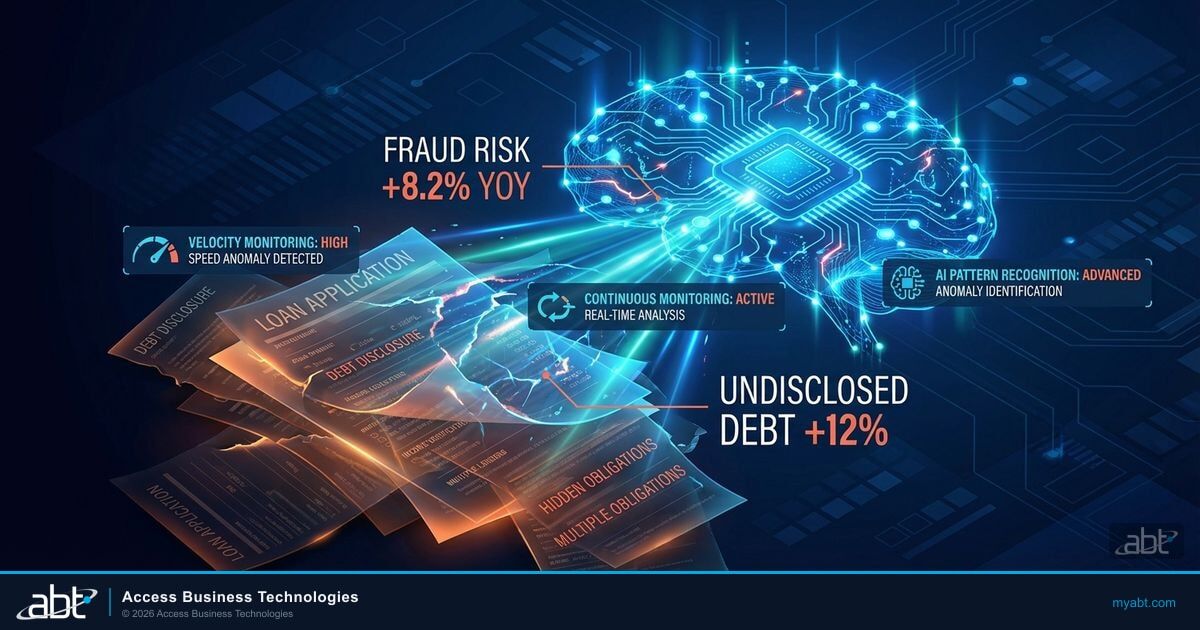
Financial fraud risk rose 8.2% year-over-year in Q3 2025, with 1 in 118 applications showing fraud indicators according to Cotality's quarterly report. Undisclosed real estate debt fraud led the surge at 12% growth. Identity fraud indicators climbed for the second consecutive year. And regulatory enforcement postures shifted across multiple agencies, with some scaling back oversight while fraud continued to accelerate.
That combination of rising fraud and shifting enforcement creates a specific problem for credit unions, banks, and mortgage companies: fraud detection now falls more heavily on your internal systems. When a borrower takes out multiple loans from multiple lenders in the same week, each institution sees only its own file. The borrower qualifies individually for each one. By the time credit bureaus update, the damage is done.
Detection systems that handle loan stacking and application fraud need to do more than run a credit check at intake. They need velocity monitoring, continuous debt surveillance, cross-platform data sharing, and AI pattern recognition working together throughout the origination lifecycle. They also need a hardened Microsoft 365 environment underneath, because every modern fraud-detection workflow runs through Microsoft Outlook, Teams, SharePoint, OneDrive, and the loan origination systems that integrate with them. Here is how stacking detection has evolved, what your technology stack needs to catch what manual review cannot, and how M365 Guardian from Access Business Technologies operates the underlying Microsoft Defender and Microsoft Sentinel layer for 750+ financial institutions.
Rising Fraud + Reduced Oversight = Your Problem
Undisclosed real estate debt fraud is up 12% year-over-year. Identity fraud is climbing for the second consecutive year. Regulatory enforcement has shifted across multiple agencies. If your fraud detection systems still rely on point-in-time credit snapshots and your Microsoft 365 tenant lacks Defender and Sentinel coverage tuned to financial-institution patterns, you are carrying risk that compounds with every application you process.
What Loan Stacking Is and Why Detection Keeps Failing
Loan stacking happens when a borrower takes out multiple loans in rapid succession, often from different lenders, without disclosing existing obligations. Each lender sees only its own file. The borrower qualifies individually for each loan because no single institution has the full picture. By the time credit bureau data updates, the borrower is overextended and defaults start cascading.
Three structural shifts have made stacking harder to catch across credit unions, banks, and mortgage companies.
Faster digital disbursals. Approval-to-funding timelines collapsed from weeks to hours. That speed creates windows where a borrower can apply across multiple platforms before any single institution's approval appears in bureau data.
Fragmented data across lenders. Even with credit bureau integration, real-time liability visibility is imperfect. Reporting cycles and update delays create the gaps that sophisticated borrowers and fraud rings target.
Non-traditional product growth. Cotality identified non-traditional loan products as a growing fraud vector, noting that fraud detection programs may lag in these segments. Products involving non-traditional income documentation make it harder to verify a borrower's complete financial picture.
Is Your Microsoft 365 Environment Protecting the Data Your Fraud Systems Depend On?
Fraud detection systems are only as reliable as the Microsoft 365 environment they run in. If your tenant is not hardened with Microsoft Defender for Office 365, Microsoft Defender for Endpoint, and Microsoft Entra ID Conditional Access tuned to financial-institution attack patterns, your fraud detection runs on a compromised foundation. ABT operates that hardened layer for 750+ financial institutions through M365 Guardian.
The Quiet Period Problem Between Application and Closing
The quiet period between initial credit pull and loan closing is where most stacking damage occurs. Nearly 14% of all borrowers apply for at least one new trade line during this window, according to Equifax data. Even a 3% increase in debt-to-income ratio during this period can change a risk profile or trigger costly repurchase demands.
Traditional underwriting treats the credit report as a snapshot. It shows what the borrower owed at the time of the pull. A borrower who opens new credit lines between application and closing changes the risk profile without triggering any flag in the original file.
A borrower applies for a mortgage at your institution on Monday. On Tuesday, they apply at two other lenders. On Wednesday, they open a personal line of credit at a fintech. Your credit pull from Monday shows none of this.
By closing, the borrower's actual DTI is 8% higher than your underwriting decision assumed. The loan defaults within 12 months. Your institution absorbs the loss because the original credit data was accurate at pull time.
DU Version 12.0 introduced enforcement relief for representations and warranties related to undisclosed non-mortgage debt. The platform recognized that catching undisclosed debt before closing is a technology problem, not a discipline problem. Institutions that adopt continuous monitoring tools get relief. Those that rely on point-in-time snapshots absorb the repurchase risk.
Six Detection Strategies Your Systems Need
No single check catches every stacking attempt. Your systems need all six strategies working together.
Track how fast a borrower is seeking credit. Multiple bureau pulls within 7-14 days, rapid applications across platforms, and amounts clustering near thresholds are stacking signals.
Refresh bureau data at disbursal, not just at approval. Monitor for newly opened trade lines between approval and funding.
Borrowers stacking loans show specific cashflow signatures: multiple small inbound disbursals, immediate withdrawals, and repayment obligations across overlapping cycles.
Consortium-based detection tools score risk based on patterns learned across participating lenders. High-risk files get flagged at intake.
Test for concentrations of approvals near threshold values, clusters of similar amounts, and correlations between borderline approvals and early delinquency.
Individual applications may pass every check. Portfolio patterns reveal what individual reviews miss. Early delinquency rates by geography or origination campaign signal stacking clusters.
How Undisclosed Debt Monitoring Closes the Gap
Undisclosed Debt Monitoring (UDM) provides continuous surveillance of borrower credit files between application and closing. Instead of a single credit snapshot, UDM sends daily alerts when new inquiries or trade lines appear, when significant balance changes occur, or when a borrower's DTI ratio shifts materially.
What Is Undisclosed Debt Monitoring?
UDM is a continuous surveillance service that monitors borrower credit files throughout the origination process. Products like Equifax's UDM, integrated into platforms such as First American's FraudGUARD, provide proactive notifications of new credit activity between application and closing. Risk scores update dynamically rather than relying on a single point-in-time pull.
DU Version 12.0 created a direct incentive to adopt UDM-style tools. Applications that receive an Approve/Eligible recommendation now qualify for enforcement relief on undisclosed non-mortgage debt. If a borrower takes on a car loan or credit card debt between application and closing, the lender gets representation and warranty protection. Mortgage-related undisclosed debt (HELOCs, second liens) is excluded from this protection.
This signals that continuous monitoring should be standard practice. Institutions that invest in real-time surveillance get regulatory protection. Those that rely on point-in-time checks absorb the repurchase risk.
AI-Powered Fraud Detection for Financial Institutions
The Fannie Mae and Palantir partnership announced in May 2025 represents the biggest escalation in financial fraud detection in years. The AI-powered Crime Detection Unit scans millions of datasets to detect patterns, anomalies, and fraud rings that rule-based systems miss.
Traditional Rules-Based Detection
- Flags static indicators like mismatched addresses
- Requires manual updates for new fraud schemes
- Each institution sees only its own data
- Single-point evaluation at application time
AI-Powered Detection
- Identifies fraud rings across multiple lenders and time periods
- Learns from new data continuously without manual rule updates
- Analyzes behavior, timing, and cross-institution patterns
- Continuous monitoring throughout the origination lifecycle
The practical question is not whether to adopt AI fraud detection. It is how to integrate it into existing workflows. The Mortgage Bankers Association reports AI reduced fraud cases by 20% in 2025. Companies like Ocrolus, which processes over 95% of Better Mortgage's documents, combine AI extraction with human validation to boost accuracy while catching indicators that manual review misses.
AI identifies fraud rings operating across multiple lenders, geographies, and time periods. A single fraudulent application might pass every rule-based check. A pattern of 20 similar applications from related entities triggers an AI alert.
Building Anti-Stacking Rules Into Your Workflow
Detection technology works only when it is embedded in your origination workflow, not bolted on as a QC afterthought. Here is how credit unions, banks, and mortgage companies should integrate detection at each stage.
- At application intake: Run velocity checks and consortium-based screening. Flag applicants with multiple recent credit inquiries. Score risk at the front door.
- At underwriting: Pull refreshed credit data, not just the initial report. Cross-reference declared liabilities against bureau data and bank statement analytics. Challenge borderline DTI ratios with additional documentation.
- Between approval and closing: Activate continuous UDM monitoring. Set alert thresholds for new trade lines, balance changes, and inquiries. Build a clear triage workflow for alerts that must be resolved before funding.
- Post-closing: Monitor early payment default rates by segment. Feed findings back into front-end scoring models. Look for stacking patterns in portfolio data that individual file reviews miss.
Point-in-time credit checks are no longer sufficient for any financial institution processing lending applications. Continuous monitoring, AI-powered pattern detection, and cross-platform data sharing are the minimum viable fraud detection stack in 2026, and they only work when the Microsoft 365 tenant running them is hardened against the identity and email attack vectors that fraud rings use to compromise lender environments in the first place.
The Microsoft Defender Stack Beneath Your Fraud Detection
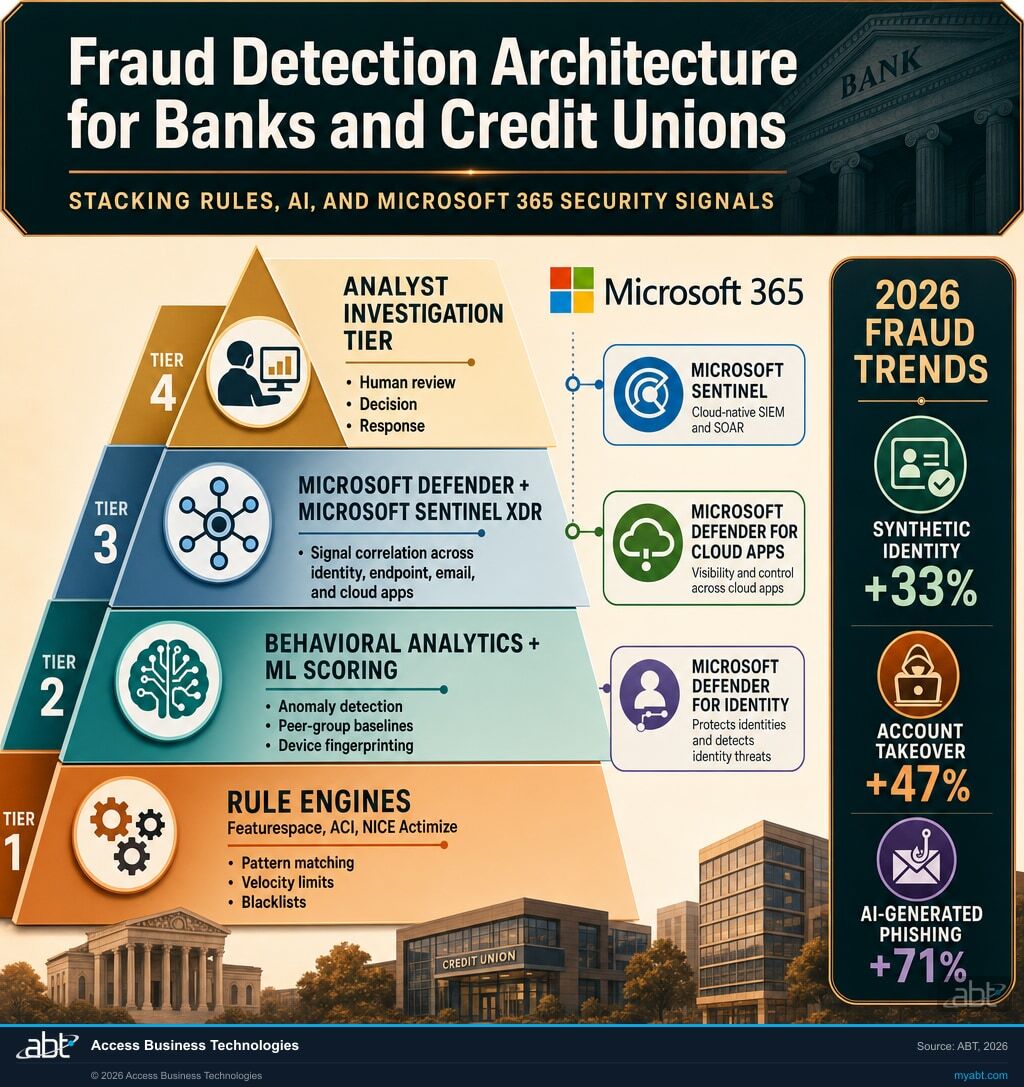
Loan-stacking rings do not start by submitting fake applications. They start by compromising a loan officer's mailbox, a processor's workstation, or a registered representative's identity. From there, they manipulate documentation, redirect wire instructions, and steer applications through whatever fraud-detection workflow you have built. That is why fraud detection at credit unions, banks, and mortgage companies cannot live above a thin layer of email and endpoint defenses. The Microsoft Defender family supplies the layered protection that fraud-detection workflows assume but rarely audit. Microsoft Defender for Office 365 protects the email channel that handles most borrower correspondence, with anti-phishing, anti-impersonation, Safe Attachments, and Safe Links policies tuned to the business-email-compromise patterns that target lender operations. Microsoft Defender for Endpoint covers the loan officer laptops, branch workstations, and underwriter desktops where origination decisions are made, with attack surface reduction rules, EDR, and automated investigation that contain a compromise before it touches the loan pipeline. Microsoft Defender for Identity watches the Microsoft Entra ID and on-premises Active Directory signals for the credential-theft and lateral-movement patterns that precede document tampering and unauthorized application submission. Together, these three Defender surfaces are the layer that keeps a fraud-detection workflow from running on a tenant already in the hands of the people you are trying to catch.
The Microsoft 365 baseline that fraud detection assumes is Microsoft Defender for Office 365 at the email layer, Microsoft Defender for Endpoint on every device that touches loan files, Microsoft Defender for Identity on the directory, and Microsoft Entra ID Conditional Access enforcing MFA and device compliance on every sign-in. Most lenders have these licenses already through Microsoft 365 Business Premium, E5, or the E5 Security add-on. The gap is configuration, not licensing. M365 Guardian is ABT's operating model on top of those Microsoft tools, tuned to the specific email-compromise, identity-takeover, and document-tampering patterns that target credit unions, banks, and mortgage companies during the origination cycle.
Microsoft Sentinel and the M365 Guardian Operating Model
Individual Defender alerts on their own do not catch coordinated fraud. A single suspicious sign-in is noise. A single suspicious email is noise. A single new trade line during the quiet period is noise. The fraud-ring pattern only surfaces when you correlate Defender for Office 365 mail-flow events with Defender for Endpoint device telemetry with Defender for Identity directory signals with Microsoft Entra ID sign-in logs with loan-origination-system audit logs over a 30-day or 90-day window. Microsoft Sentinel is the SIEM and SOAR surface inside Microsoft 365 that does that correlation. Sentinel ingests the full Defender XDR signal set, the Entra ID sign-in and audit logs, and custom log streams from the loan origination system, the core banking platform, and the consortium fraud-detection feeds. Analytic rules tuned to lender attack patterns (registered-representative impersonation, branch-targeted phishing, customer-account takeover signals, document-tampering on shared folders) produce a single incident timeline a fraud analyst can act on instead of a dashboard of alerts a tier-1 SOC dismisses one by one.
Sentinel only matters if someone is watching it every minute of the day. That is the operating-model gap that M365 Guardian closes. ABT's Guardian operating model includes a 24/7 security operations center that watches the Sentinel and Defender signals continuously, with analytic rules tuned to financial-institution fraud patterns rather than vendor SMB defaults, and incident-response runbooks calibrated to the specific evidence a regulator would expect from a credit union, a community bank, or an independent mortgage banker. The institution keeps its Microsoft 365 licensing and tenant ownership. Guardian is added through the partner relationship, with the underlying Microsoft Defender and Microsoft Sentinel deployment configured, monitored, and run by ABT as a Tier-1 Microsoft Cloud Solution Provider that manages Microsoft 365 tenants for 750+ financial institutions. Fraud-detection workflows sit on top of that hardened, monitored Microsoft 365 layer, not next to it.
For the conditional-access policies that close the identity blind spot beneath your fraud detection, see our guide on 5 Conditional Access rules every financial institution needs. For the multi-tenant management plane that standardizes the Defender, Sentinel, Entra ID, and Intune configuration across affiliated entities, branches, and OSJs, see our guide on deploying Microsoft Lighthouse for compliance standardization. For the device-management pillar that closes the unmanaged-endpoint exposure the same rings exploit during the quiet period, see Zero Trust's blind spot: the unmanaged endpoints undermining your security.
Harden the Microsoft 365 Layer Your Fraud Detection Runs On
ABT manages Microsoft 365 tenants for 750+ financial institutions. A 30-minute conversation maps your current Microsoft Defender for Office 365, Defender for Endpoint, Defender for Identity, and Microsoft Sentinel posture, surfaces the email and identity gaps that loan-stacking rings exploit before they ever submit a fraudulent application, and outlines what an ABT-managed M365 Guardian deployment would cover for credit unions, banks, and mortgage companies. No commitment, no quote, no obligation.
Key Takeaway
Stacking rings, identity fraud, and undisclosed-debt schemes are accelerating while regulatory enforcement has shifted, which puts more of the detection load on your internal systems. Velocity monitoring, undisclosed debt monitoring, AI pattern recognition, and consortium-based data sharing are the minimum-viable fraud-detection stack for credit unions, banks, and mortgage companies in 2026. Those workflows only hold up when the Microsoft 365 tenant underneath them is hardened with Microsoft Defender for Office 365, Microsoft Defender for Endpoint, Microsoft Defender for Identity, Microsoft Entra ID Conditional Access, and Microsoft Sentinel correlation tuned to financial-institution attack patterns. M365 Guardian is ABT's operating model that configures and runs that Microsoft layer with a 24/7 SOC, so the fraud-detection workflow your underwriting team sees is sitting on a Microsoft 365 environment that is not already compromised.
Frequently Asked Questions
Loan stacking occurs when a borrower obtains multiple loans from different lenders in rapid succession without disclosing existing obligations. It is increasing because digital disbursals shortened approval timelines, credit bureau reporting cycles create visibility gaps between lenders, and growing non-traditional loan volumes involve less standardized fraud detection. Cotality's 2025 data found undisclosed real estate debt fraud rose 12% year-over-year.
Undisclosed Debt Monitoring provides continuous surveillance of borrower credit files between application and closing. It sends daily alerts when new trade lines, credit inquiries, or balance changes appear during this period. Nearly 14% of borrowers apply for new credit during this window. UDM catches these changes before closing, letting institutions address DTI shifts that point-in-time credit reports miss.
AI-powered fraud detection identifies stacking patterns that rule-based systems miss. It analyzes behavior across multiple lenders, geographies, and time periods to detect fraud rings and coordinated applications. Fannie Mae partnered with Palantir in May 2025 to launch an AI Crime Detection Unit scanning millions of datasets. AI systems adapt to new fraud tactics continuously without requiring manual rule updates.
The quiet period is the gap between initial credit pull and loan closing, typically spanning several weeks. During this window, borrowers can take on new debt not reflected in the original decision. Traditional credit reports capture a single snapshot, so new obligations go undetected. Even a 3% DTI increase during this period can change the risk profile of a loan approved based on stale data.
Financial institutions need velocity monitoring to track how fast borrowers seek credit, real-time liability checks that refresh data at disbursal, bank statement analytics that identify stacking cashflow patterns, cross-platform data sharing through consortium-based detection networks, underwriting threshold testing for approval concentrations near limits, and portfolio-level pattern monitoring to catch stacking clusters that individual file reviews miss.
Microsoft Defender for Office 365 protects the email channel that handles borrower correspondence and document exchanges, with anti-phishing, anti-impersonation, Safe Attachments, and Safe Links policies that block the business-email-compromise patterns targeting lender operations. Microsoft Defender for Endpoint covers loan officer laptops, branch workstations, and underwriter desktops with attack surface reduction, EDR, and automated investigation. Microsoft Defender for Identity watches the Microsoft Entra ID and Active Directory signals for credential-theft and lateral-movement patterns. Together, those three layers keep fraud-detection workflows from running on a tenant already compromised by the same rings the workflows are trying to catch.
Microsoft Sentinel is the Microsoft 365 SIEM and SOAR surface that correlates signals across Microsoft Defender for Office 365, Microsoft Defender for Endpoint, Microsoft Defender for Identity, Microsoft Entra ID sign-in logs, and custom log streams from the loan origination system and core banking platform. Individual Defender alerts on their own do not catch coordinated fraud rings. The cross-product correlation that Sentinel produces is what surfaces registered-representative impersonation, branch-targeted phishing, customer-account takeover signals, and document-tampering patterns over the 30 to 90 day windows fraud rings operate across. Sentinel only delivers that value when analytic rules are tuned to financial-institution attack patterns and a 24/7 SOC is watching the output.
M365 Guardian is ABT's operating model on top of the Microsoft 365 security stack. For fraud detection specifically, Guardian configures and runs Microsoft Defender for Office 365 anti-impersonation policies tuned to lender business-email-compromise patterns, Microsoft Defender for Endpoint deployments on origination and underwriting workstations, Microsoft Defender for Identity coverage of Microsoft Entra ID and Active Directory, Microsoft Sentinel analytic rules calibrated to financial-institution attack patterns rather than vendor SMB defaults, and a 24/7 security operations center watching the resulting incident timeline every minute of the day. Access Business Technologies is a Tier-1 Microsoft Cloud Solution Provider that manages Microsoft 365 tenants for 750+ financial institutions. The institution keeps its Microsoft 365 licensing and tenant ownership. The Guardian operating model is added through the partner relationship.