


Every Examiner Will Ask About Your AI. Have the Answer Ready.
FFIEC, NCUA, CFPB, and GSE examiners are adding AI governance to their examination playbooks. The questions are straightforward: What AI tools operate in your environment? What data do they access? How do you monitor them? Show me the audit trail. Guardian Audit Assurance ensures you have documented, verifiable answers for every one of those questions, continuously, not just at exam time.
Stop Failing Audits.
Start Passing Them.
Your MSP can't audit their own work—GSEs require independent validation. Guardian™ hardens your Microsoft 365 environment to Zero Trust standards, then coordinates an independent third-party firm to certify it. That's the separation regulators expect.
Zero Trust hardening of your Microsoft 365 environment aligned to NIST/FFIEC standards. We fix issues BEFORE auditors arrive.
We coordinate independent penetration testing through our partner network. Better we find vulnerabilities than attackers or auditors.
Independent third-party assessment from a qualified firm with no stake in the outcome. That's what GSEs require and what protects you.
If the audit surfaces findings, we fix them. We don't just point at problems—we solve them and document the resolution.
The Guardian Audit Lifecycle
Why Continuous Compliance Beats Point-in-Time Audit Preparation
Most financial institutions treat audit preparation as a project: a burst of documentation, evidence gathering, and policy review in the weeks before an examiner arrives. As we wrote in Living Compliance, annual audits are dead in the AI era. This approach worked when the technology stack changed slowly. It fails completely when AI tools are being adopted monthly, new agents are being deployed weekly, and employees are experimenting with AI capabilities that did not exist at the last examination.
Guardian Audit Assurance replaces the point-in-time model with a four-phase continuous lifecycle: Prepare (baseline your security configuration and begin automated evidence collection), Test (run simulated examination scenarios and identify gaps before examiners do), Certify (support the live examination with organized, verifiable evidence), and Remediate (close gaps immediately with ongoing monitoring to prevent recurrence).
The AI governance dimension makes this even more critical. The shift from FFIEC CAT to NIST CSF 2.0 means your examiner expects a completely different framework. When your institution deploys Copilot Business, examiners will ask about data access controls. When you build Copilot Studio agents, they will ask about agent governance. When employees use Copilot Cowork for multi-step tasks, they will ask about audit trails for AI-initiated actions. Guardian's continuous monitoring captures all of this evidence automatically. The same controls that protect your environment also document your compliance.
The four sovereignty domains feed directly into audit readiness: Infrastructure sovereignty (hardened tenant) provides the security configuration evidence. Connectivity sovereignty (governed integrations) provides the data flow documentation. Intelligence sovereignty (observability) provides the monitoring evidence. Governance sovereignty (AI controls) provides the agent audit trails. Together, they create a compliance posture that does not degrade between examinations.
A failed GSE cybersecurity audit can cost an institution its seller/servicer status, $250,000 or more in remediation, increased oversight requirements, and lasting reputational damage. Continuous compliance through Guardian costs a fraction of a single failed audit. The interactive demonstration above shows exactly how the four-phase lifecycle works, from baseline preparation through ongoing monitoring, for a financial institution of your size.
Frequently Asked Questions
Most institutions fail because they treat audit preparation as a point-in-time event. Common failures: outdated security configurations, incomplete evidence, access control gaps, and inability to demonstrate ongoing monitoring. With AI tools now in the environment, examiners are adding AI governance questions that point-in-time preparation cannot answer.
Guardian Audit Assurance is ABT's four-phase continuous lifecycle: Prepare (baseline configuration + automated evidence collection), Test (simulated examination scenarios + gap analysis), Certify (audit execution support + organized evidence), and Remediate (immediate gap closure + continuous monitoring). Evidence is generated automatically from the same controls that protect your environment.
FFIEC, NCUA, and OCC guidance increasingly references model risk management for AI. Examiners will ask: What AI tools operate in your environment? What data do they access? How do you monitor them? Show the audit trail. Guardian's continuous monitoring and Agent 365's agent audit trails provide documented, verifiable answers for each question.
Guardian supports GSE cybersecurity requirements (Fannie Mae, Freddie Mac, Ginnie Mae), FFIEC examinations, NCUA/FDIC requirements, SOC 1 Type II, GLBA/FTC Safeguards Rule, CFPB oversight, SOX compliance, and the emerging AI governance expectations referenced in OCC Bulletin 2023-17.
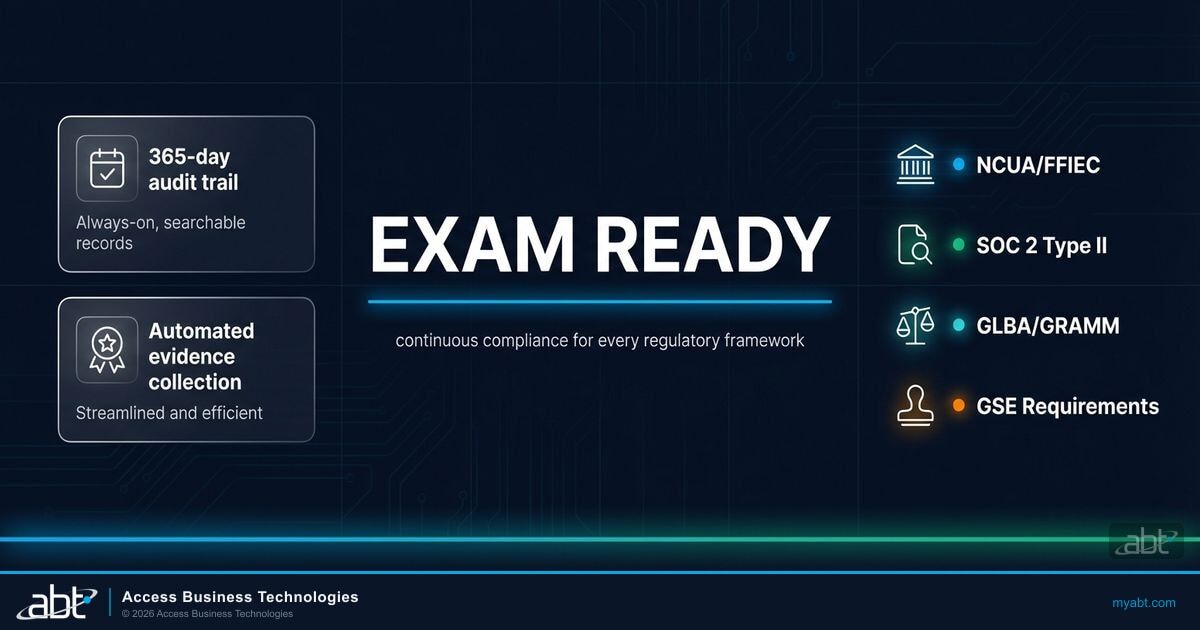
Audit preparation is a burst of work before an examiner arrives. Continuous compliance means the evidence is always current because it comes from the controls that are always running. Guardian monitors 160+ security settings, logs every access event, and tracks every AI agent action, 24/7. When an examiner asks a question, the answer is already documented. A failed audit costs $250,000+. Continuous compliance costs a fraction.
Where Does Your Institution Stand?
Most financial institutions we assess score 30-40% on Microsoft Secure Score. Pick the assessment that matches your priority.
Request a security baseline hardening evaluation.
Quantify ROI from integrations and automation.
Identify oversharing risk before deploying Copilot.
Prepare for FFIEC, NCUA, GSE, SOC, and cyber insurance audits.
An ABT specialist will reach out within one business day to discuss your assessment.
