

Why Credit Unions Can't Afford Cheap Microsoft 365 Licenses
In the first year after NCUA's 72-hour cyber incident reporting rule took effect, credit unions reported 1,072 incidents. A single ransomware event...
5 min read

Justin Kirsch : Updated on February 27, 2026
A CIO at a financial institution doesn't pick a Microsoft 365 licensing partner the way someone picks a phone plan. The license SKU is identical from any provider. Business Premium from ABT is the same Business Premium from Microsoft direct or from a $5/month reseller.
The difference is what happens after the purchase. Configuration. Monitoring. Incident response. Regulatory alignment. The 99% of the work that determines whether Microsoft 365 protects your organization or exposes it.
More CIOs at banks, credit unions, and mortgage companies are consolidating their Microsoft licensing, managed IT, and security under one relationship. Here's why that shift is happening and what it means for organizations still buying licenses from one vendor and security from another.
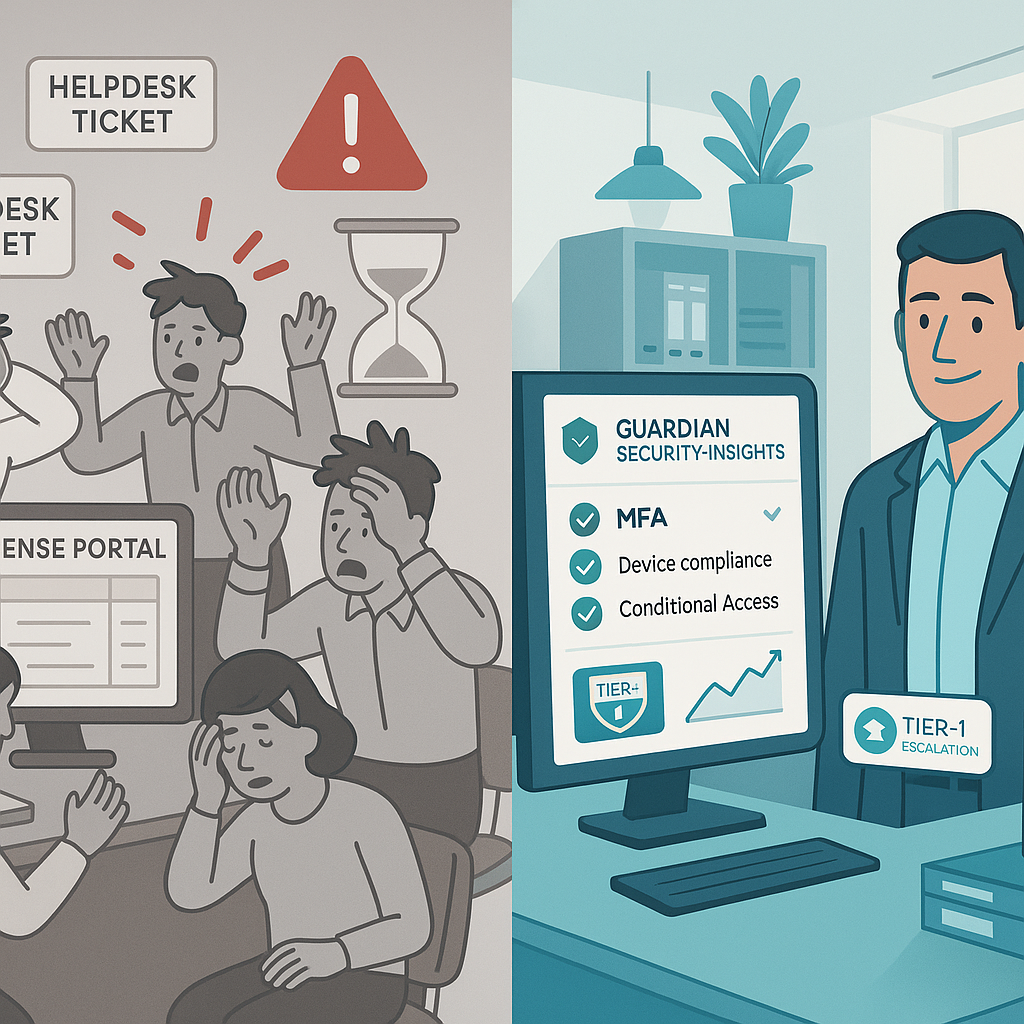
Most Microsoft 365 licensing relationships end at the invoice. You get a product key, maybe a welcome email, and access to the same generic support queue as everyone else. What you don't get:
For a technology company or a marketing agency, that might be acceptable. For a financial institution under regulatory examination, it's a liability. Microsoft reports that over 99% of password spray attacks target legacy authentication protocols. If your license provider isn't blocking legacy auth in your tenant, your employees are exposed to the most common attack vector in cloud environments.
CIOs at financial institutions have learned this through experience: the cheapest license is rarely the least expensive outcome.
When you license Microsoft 365 through ABT, you pay the same as Microsoft direct pricing. The license cost is identical. The value is in what wraps around it.
A weekly executive-level report covering 12 critical security and compliance checks across your Microsoft 365 tenant. Not a raw data dump from the admin portal. Plain English, designed for a CIO to forward to the board.
Guardian catches the issues that slip past security dashboards:
Every finding is an actionable item. IT teams treat it as their Monday morning checklist. By the time leadership sees the report, issues are already being resolved. That cadence turns security from an annual audit scramble into a continuous operating discipline.
Guardian Insights handles the preventive side: is your tenant configured securely? ABT's security operations team handles the reactive side: if something bad happens, will you catch it and stop it?
When Microsoft Defender, Entra ID Protection, or Sentinel generates a high-severity alert (impossible travel sign-in, token theft, malware detection), ABT's team responds within minutes. Many financial institutions have alerts going to an inbox nobody monitors, or firing at 3 AM when IT staff are offline.
The IBM Cost of a Data Breach Report puts the cost difference plainly: breaches contained in under 200 days average $3.9M. Breaches that take longer average $5M+. Fast response capability isn't a feature. It's a financial risk control.
ABT holds Tier-1 Cloud Solution Provider status with Microsoft. That means a direct billing and support relationship, not an indirect channel through a distributor. When your email goes down during a critical business day, ABT contacts Microsoft engineering directly. No generic support ticket. No hold time.
ABT is the largest Tier-1 CSP primarily dedicated to financial services. That specialization matters because your escalation comes with context. ABT's team doesn't need to explain to Microsoft that a mortgage company with rate locks expiring needs faster resolution than a standard ticket SLA.
Setting up a Microsoft 365 tenant correctly for a financial institution is not a default wizard. It requires deliberate decisions about Conditional Access policies, Intune device compliance baselines, DLP rules for sensitive financial data, email authentication (SPF, DKIM, DMARC), and privilege management.
ABT has configured tenants for 750+ financial institutions across banking, credit unions, mortgage companies, and regulated industries. That experience translates into configuration patterns that balance security requirements with operational reality. Controls that are too strict get circumvented. Controls that are too loose fail exams. The goal is the configuration that actually gets used and passes regulatory scrutiny.
Most financial institutions currently buy Microsoft licensing from one vendor, managed IT support from another, cybersecurity monitoring from a third, and compliance consulting from a fourth. Each vendor has its own contract, support process, escalation path, and blind spots about what the other vendors are doing.
ABT collapses that into one relationship. Licensing, configuration, security monitoring, incident response, compliance documentation, and direct Microsoft escalation all flow through the same team. When there's an incident, there's no finger-pointing between vendors about whose responsibility it is. One call, one team, one resolution path.
For a CIO managing vendor relationships, that consolidation reduces coordination overhead. For a CISO managing risk, it eliminates the gaps that exist between separate vendors. For a CFO reviewing IT spend, it turns four invoices into one with measurably better outcomes.
Microsoft's July 2026 pricing update raises subscription costs by 5-33% depending on plan tier. Volume licensing discounts have been eliminated. For financial institutions managing hundreds or thousands of seats, the annual impact runs into six or seven figures.
This makes license optimization a board-level conversation. ABT's license utilization tracking identifies unused seats, over-provisioned plans, and right-sizing opportunities across your tenant. Financial institutions working with a Tier-1 CSP have access to licensing intelligence that transactional resellers don't provide.
The pricing update also bundles new security and AI capabilities (including Security Copilot compute units in E5) into existing plans. Without expert configuration support, your organization pays more and gets less from those new features.
Whether it's an NCUA examination, FFIEC review, SOC 2 audit, or cyber insurance renewal, the evidence trail matters. A CIO using ABT for Microsoft 365 licensing can point to:
That evidence doesn't exist when you buy from a transactional reseller. Your IT team produces it manually, if it gets produced at all. Most financial institutions discover this gap when the examiner arrives, not before.
Get a free Microsoft 365 Security Assessment to see where your tenant stands. Or talk to an ABT specialist about consolidating your Microsoft licensing, security, and managed IT under one relationship.
CIOs are consolidating Microsoft licensing, managed IT, and security under one relationship to eliminate gaps between separate vendors. A transactional license provider delivers a product key without security configuration, continuous monitoring, incident response, or regulatory alignment. Financial institutions under examination need all of those capabilities tied to their licensing agreement, not purchased separately.
Guardian Security Insights covers 12 critical security and compliance checks across your Microsoft 365 tenant. It surfaces MFA enforcement gaps where users show enabled but never enrolled, Conditional Access policy exceptions, non-compliant devices, legacy authentication usage, stale admin accounts, and policy changes that weaken posture. Reports are written in plain English for executive and board-level consumption.
No. ABT's Microsoft 365 licensing matches Microsoft direct pricing. Guardian Security Insights, managed detection and response, Tier-1 CSP direct escalation, expert configuration, and continuous tenant management are included with the licensing agreement. Financial institutions pay the same license cost and receive security, monitoring, and compliance documentation that would otherwise require separate vendor contracts.
Microsoft's July 2026 pricing update raises M365 subscription costs by 5-33% depending on plan tier. Volume licensing discounts have been eliminated. Financial institutions managing hundreds or thousands of seats face significant annual cost increases. A Tier-1 CSP provides license optimization analysis identifying unused seats, over-provisioned plans, and right-sizing opportunities that transactional resellers cannot offer.
A Tier-1 Cloud Solution Provider has a direct billing and support relationship with Microsoft, bypassing distributors and intermediaries. For financial institutions, Tier-1 status means faster escalation during outages, direct access to Microsoft engineering for critical security incidents, and licensing management without middlemen. ABT is the largest Tier-1 CSP primarily dedicated to financial services.
In the first year after NCUA's 72-hour cyber incident reporting rule took effect, credit unions reported 1,072 incidents. A single ransomware event...

Your Microsoft Secure Score reads 87%. MFA is deployed. Conditional Access policies are configured. The compliance dashboard shows green across the...
Quick Answer: Not all Microsoft 365 licenses are equal in practice. Buying from a bargain reseller often just gets you a product key and a long...